Archive for the English Manga Category


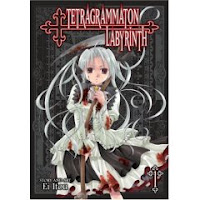
Yuri Manga: Tetragrammaton Labyrinth, Volume 1

August 28th, 2007

When people first fall in love, one of the the inevitable feelings they encounter is that if their lover should, for even a second, stop needing them to exist, they might well cease to exist.

Imagine for a second if that were *really* true.

You would be tethered to that person forever. And they would be enslaved to you, or otherwise you could no longer be.

Somehow, it doesn’t sound so much like fun, does it?

In Tetragrammaton Labyrinth Volume 1, Angela is no longer alive, but neither is she dead. As long as her partner, a nun named Meg, needs her, she can remain in existence. If Meg should stop needing Angela, she would cease to exist utterly. But Angela has a need of her own – she wants to die as a human. To that end, she and Meg fight demons who infect and infest humankind in a battle to protect not only all humanity, but Angela’s chance at the death she craves.

The story takes place in Victorian England, but Angela is drawn as a Goth-Loli, and Meg is given rights and responsibilities not usually given to nuns. I particularly love the manga trope of nuns who hear confession, for instance. I’m not a Christian (although I have played Saint George in a mystery play, does that count?) but I know that only priests can hear confessions. And I am also fairly sure that Meg’s sexy nun outfits were bought, not from the convent, but from the local Halloween supply store. ;-) But I digress.

Aside from the religious dissonance, there’s temporal dissonance as well. This is a Victorian England in which occult magick and Big-Ass Guns(TM) coexist. If demons and their ilk didn’t *actually* walk the streets of Victorian London, I’m inured to their proposed existence from the oh-so-many series that include them. ^_^

Because of the existences of the aforementioned demons, B-A Guns and magick, it’s not too much of a surprise that Tetragrammaton Labyrinth is also full of violence and blood. This is your quintessential Victorian Goth-Loli horror manga, baby.

The book, like most of the adaptations by Seven Seas (and thanks once again to Jason and the folks at 7S for providing me with a copy to review!) is done well. The translation feels seamless, and in general, the reproduction is high quality. The fact that the source material is thoroughly and firmly “meh” is not their fault at all.

And therein lies the problem. Tetragrammaton Labyrinth just isn’t a very good story. Sure, there’s lots of action, and violence and some of what passes for plot, but at it’s heart, it’s basically a violent, bloody, string of servicey scenes that barely hold together.

Which brings me to the “Yuri.” I called this a “Yuri” manga in the title of the review, because it is an incontrovertible truth that Meg and Angela are inextricably bound to one another. Especially towards the end, they appear to even show affection for one another. The codependency of their relationship alone is grounds enough to call this relationship “lesbian.” ^_^ But with one being a nun and the other an undead pre-pubescent child, that sort of makes the relationship thing moot. So, really, the Yuri here is an implied fetish, no more. There’s no way to know if they are “in love” with one another and I’m fairly certain that the author is more interested in drawing Angela without underwear than answering that question, so don’t expect the Yuri to be more than two females draped over one another. If that’s enough for you, well then, enjoy! ^_^

Ratings:

Art – 6
Characters – 6
Story – 7
Yuri – 2
Service – 4

Overall – 5

Considering that I had read this manga years ago in the original Japanese and basically dismissed it as tripe, I was surprised that I didn’t hate it in English. Is it high art? Nope. (Quick, name three manga that are. Exactly.) But since Scape-God never went past one volume, this ought to fill yours (and my) random fake-Yuri with scads of violence and blood needs for a while. ;-)





Yuri Manga: Kedamono Damono, Volume 2 (English)

August 15th, 2007

Thank you, everyone who emailed or commented to wish Okazu a happy birthday! Special thanks to Brigid of Mangablog, who stuck the news at the top of her wonderful blog with very kind words attached. ^_^ (If you don’t already, you should absolutely read Mangablog. It’s awesome-ness personified. She works much, much harder on her blog than I do here.)

Today’s review has been sponsored by Eric P – thank you sir for your kindness. Sponsorship of materials for review makes a *tremendous* difference to me, really. Some of the companies will send me books or give me anime, but most do not. I buy all of the Japanese materials I review, and your support in the form of a book or video from my Wish List is just so important and helpful. Thanks to everyone who has ever sponsored a review! When I say that I couldn’t do it without you, I really mean it! ^_^

Kedamono Damono, Volume 2 is exactly like Volume 1, only more annoying. Mainly it is more annoying because it is *exactly* like Volume 1. Not a single thing has changed, except for the expected love rival for Konatsu’s affection. In effect, we’re watching the same story all over again, with no development, no progress, nothing.

I admit – I expected this to be the case. I was discussing this with Sean Gaffney last weekend, and he mentioned that this quality of prolonged repetition is something that he has come to expect from Tokyopop manga. As soon as he said that, I was in full agreement. It’s a manga quality – repeating the same situation over and over, changing only one characteristic from episode to episode. This works okay in action/fantasy stories, where the Monster or Enemy du jour can be taken at face value…but in stories about relationships that are predicated on one thing being out of balance so the relationship can’t just *be* a relationship, it’s downright exhausting.

Haruki still changes gender, he’s still rude and awkward about it as a boy and perfectly fine with getting Konatsu as a girl. Konatsu is still passive-aggressive about it all. Haruki’s family also still changes gender and he is still over the top upset by it all. I’m a pragmatist. Like, dude, get over it already. It is what it is. You’re what? 17? That means you’ve, at minimum, thrown 6205 hissy fits about something you can’t change. Aren’t your arms tired from being flailed uselessly all the time?

In the final chapter, there’s a pretty decent scene – when Haruki stops changing gender every time s/he sneezes and he proclaims that he’s back to being a normal guy. Konatsu sweetly comments that he’s never been normal and that’s why she likes him. For one second, I almost liked them both. Then she goes and ruins it by kissing him as she calls him a beast. This is important. Because the next story is a vile little character piece about a girl who loves a boy who treats her like dirt in public. And it really gets my goat to see this portrayed as a “love” story.

Dear shoujo manga readers – boys treating you badly is NOT a sign of love.

I get angry every time I see a dysfunctional, non-communicative troll being portrayed as a love interest. Not to mention bored.

So, as a gender-bending, Yuri, shoujo, romance manga goes, Kedamono is a mediocre specimen. I would definitely not give it to any young person questioning his or her sexuality or gender. But I think if the reader is the kind of person that enjoys gender-bending with a straight romance at the core, like Hana-Kimi and Ouran, this will probably be the light-hearted romp it’s meant to be enjoyed as.

Ratings:

Art – 7
Characters – 6
Story – 6
Yuri – 6
Service – 5

Overall – 6

Ishkabible. I really didn’t get as worked up about this manga as it sounds. It’s pretty much just more of the same.


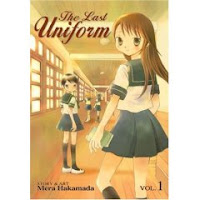
Yuri Manga: The Last Uniform, Volume 1 (English)

August 13th, 2007

My sincere thanks to the folks at Seven Seas for providing me a copy of The Last Uniform for today’s review. Your generosity is sincerely and greatly appreciated!

As you may know, if you have been reading my reviews of the Yuri Hime magazines for the past few months, I do not like Hakamada Mera’s art. And the recent entries by Hakamada in those magazines have outright repulsed me. Nonetheless, I am going to say that The Last Uniform is, in every other way other than the art, an enjoyable manga. (My original review of Saigo no Seifuku says pretty much the same thing – if the art was better and the characters looked their age, I most likely would love this manga. But they don’t. So I don’t.)

The manga takes place at the ubiquitous girl’s school in one of the dorms, where the rule is that everyone must share a room. There can be no single-person rooms. So, when a new student transfers in, she is placed with roommates Ai and Fuuko. Ai is exceptionally upset about this – more than she can even deal with. By the time she realizes why, so has her new roommate, who goes out of her way to stay out of their way and even encourages Ai.

In addition to Ai and Fuuko, an older pair of students, Tsumugi and Beniko, are also involved in a gavotte around their feelings for one another. Their relationship is complicated by an upperclassman who openly courts Beniko, but to no avail.

These two relationships are the main focus of the manga, with some side stories and a key flashback.

The plot, such as it is, revolves around normal school life, with the trials and tribulations twisted only slightly to reflect the student’s feelings for one another. There are some kisses, but no outright confessions in this volume. By the end of Volume 1 the couples are neither together, nor are they apart. It’s a story of beginning more than endings though, so the reader can remain hopeful that things might progress.

As with all of the Seven Seas books I’ve reviewed so far, the translation and adaptation are nearly seamless, which makes for a pleasant and smooth read. If only the art wasn’t so darn unappealing…oh well. (And remember that this is *my* opinion. You might not be bothered by it as much as I am. I am bothered by it a great deal. I don’t like the oversize, misshapen heads and the little-girl bodies.)

Of all of the so-far released books in 7S’s Yuri imprint, remembering that Kashimashi is NOT part of their Strawberry line, Last Uniform is pretty much the only one with actual Yuri. The others have “Yuri-service,” where the two female protagonists are shown in a variety of posed positions in still art or screencaps as if they are potentially lovers, but there’s no actual emotional connection. Like the Newtype effect, many people cannot discern the difference between two women in love with one another or two women who are merely posed to look as if they desire one another. (Thinking about it, this explains the popularity of lesbian porn for men – the viewers can’t differentiate/don’t care about the fact that they are just two women being paid to have sex on one another. But I digress.)

In any case, the strength of this book is the characters’ feelings for one another, which reads pretty convincingly and not at all unpleasantly.

Ratings:

Art – 3
Story – 5 (nothing new or earth-shaking, but nothing taxing or horrible)
Characters – 8
Yuri – 8
Service – 1 (but only on the basis that someone, somewhere will always get off on something, as the author clearly does on school uniforms.)

Overall – 6

As the only manga with actual Yuri in the Strawberry imprint, I think it does a fair job. I’ll never sing paeans of praise to this series, but you could do worse….


Yuri Manga: Kashimashi ~ Girl Meets Girl, Volume 3 (English)

August 8th, 2007

I have two gentlemen to thank for today’s review. First and foremost, Daniel P. who sponsored today’s review by hitting up my Wish List. Thank you very much Daniel! And secondly, Mike H. who just yesterday wrote me a wheedling email wanting to know when I would review this manga already. Mike – I’m reviewing it, ‘kay? Stop whining. ^_^

The plot of Kashimashi Girl Meets Girl, Volume 3 is no different from my review of the Japanese edition in 2006. For a basic outline (with the usual mild spoilers) of the plot in Volume 3, please go ahead and read that review. This time I’m going to focus on the adaptation to English.

First of all, I continue to be both impressed and pleased by the translation and adaptation of this manga. Not only is Seven Seas attempting to capture the feel and sense of the original, but leaving honorifics and cultural relics untranslated, but in this issue I noticed a sincere effort to capture the *voice* of each character. This simply puts this adaptation orders above every other translated manga company out there, except for ALC. Because we also work hard to keep the character’s voices intact through our translations and adaptations.

If you know anything about me as a writer or editor, have ever attended a writing workshop with me, or even just read my Fanfic Writer’s Workshop, you’ll know that lack of “voice” in writing, much less translation, is my bete noir. I cannot stand it when all the characters in a book, manga, anime, whatever, sound the same. Rarely do they, in the original, but American translators, by virtue of being one person translating several chapters/volumes, often smooth out the voices to the point that all the differences in speech disappear. Maintaining them in any translation is difficult. And kudos to 7S for obviously working at it.

But.

(You just *knew* there had to be a “but,” right?)

Unless Tomari has all of a sudden become an old Jewish guy, I’m just not convinced that “putz” is the right word as a translation for “baka.” *I* don’t even use putz – and I’m an old Jewish woman. My Dad…*he* uses putz. “Idiot” “Moron” “Stupid” – all are perfectly good insults that don’t make Tomari sound like my father. ^_^

One other thing I wanted to point out on the good side: I noticed immediately that all the characters, save Sora-sensei (who is alien and a freak above that) now call Hazumu “she” or “her.” Well done. Thank you.

The Stupid Plot Complication Disorder (SPCD) this volume is far more exhausting than Yasuna’s merely not being able to see men, and I can swear to you that the conflicts, such as they are, will drag out for most of the next two volumes. But I’ll also council you to stick with the story, because IMHO, the end isn’t at all bad. Check back here for an upcoming review of the final volume, which came out this summer in Japan.

Ratings:

Art – 8
Characters – 7
Story – 7
Yuri – 9
Service – 4

Overall – 8

Asuta and his fantasies…total snooze. What a paucity of imagination that boy has.


Yuri Manga: High School Girls, Volume 8 (English)

June 30th, 2007

Once again, it is my great pleasure to welcome Guest reviewer Sean Gaffney!

Dr Master has just put out Volume 8 of High School Girls, and it’s pretty much more of the same wackiness. If, like me, you read this to look at Towa Oshima’s wonderful facial expressions, you won’t be disappointed. Eriko, in particular, gets to express disgust, dismay, and embarrassment in a variety of amusingly drawn ways.

This volume continues the class trip to Okinawa, and Chapter 1 involves Eriko and Kouda attempting to bond with the Takarazuka pair, Nao and Sayaka, and failing miserably. Kouda is just too much of a giant freak all the time, and every time that Eriko tries to be friendly, Kouda interrupts with a new horror.

This continues throughout the book, and eventually they do get to know a little more about the pair. In fact, Nao and Sayaka have the only thing remotely approaching plot development here, as we discover that Sayaka has a secret that she’s hiding from her classmates. Once again, Towa’s expansion of the cast works well, as we get to know people beyond just the main six.

The manga has about the final third devoted to three short stories. The first has Momoko once again trying to give the girls beauty tips, with the usual results. In the second, Ayano discovers that her sister is dating Kouda’s brother, much to her horror. And in the last (and best), Eriko and her brother try to find various ways to beat the heat, and Eriko remains completely oblivious to the fact that her brother’s hit puberty by now so she shouldn’t be bathing with him anymore.

The main reason to get this, of course, is for the comedy. There is Yuri, yes, but it’s Yuri played for laughs. Nao and Sayaka sleep in the same bed, and Nao even scrubs Sayaka’s body with her hands in the bath (her skin is very sensitive, you see). Nao and Sayaka keep saying ‘please don’t misunderstand’, just to keep it vague enough for Japanese editors, but as Yuma notes, ‘It’s pretty clear what they’ve got going on there.’

We also get Kouda once again getting Eriko in compromising positions, and Yuma and Ayano acting far too close for comfort. Provided you don’t demand, you know, actual follow through in your Yuri, there’s plenty here for you.

There’s also tons of comedy, ranging from the usual embarrassment of periods and tampons to metatextual humor that breaks the fourth wall. At one point the gang are on an island trying to hunt wild animals, and Eriko tries to draw it for them. She can’t draw, so it’s basically a kid’s scribble. Lo and behold, they immediately catch a creature that looks, literally, exactly like the scribble. As Eriko notes, “This is turning into a different kind of manga…”

As for how Dr. Master did things… well, it’s still sort of schizophrenic. On the plus side, the cover is well done, the color pages are fantastic, and the reproduction is miles ahead of the earlier volumes. As for the adaptation…geh. When they don’t have to try to do Japanese culture, it’s a sturdy, well-written adaptation. When they do, either they translate it straight and don’t bother to note the joke, or they change it to an English variant that tends to jar horribly (Diff’rent Strokes references? In 2007? COME ON.) On the bright side, there’s fewer Japanese culture refs as the manga goes on, so things do improve.

Ratings:

Art: 8. Towa’s expressions get better and better, and even her SD-shorthand poses are funny.
Story: 5. There’s really no plot here at all, with the exception of finding out
Sayaka has a mysterious secret.
Characters: 7. Himeji and Ogawa are almost totally absent this volume-again – but the rest are fun and entertaining.
Yuri: 6. It’s quite a high rating for something where it’s all tease, but the tease is *so* blatant I moved it up a notch.
Service: 6. Again, I suspect any perverts who try to read this will be put off by the constant mentions of tampons, periods, and various other ‘female problems’. That said, this is fanservice-y as heck.

Overall: 7.

This is a fairly light and fluffy volume, but again, you aren’t reading this manga for the deep meaning or tragic backstory. If you like Japanese high school girls being weird, strange, and bizarre, and don’t mind a healthy dollop of service, then you’ll enjoy this.

Thanks so much Sean – my copy’s on its way and I’m looking forward to it even more. ^_^

And while I’m thinking about it – if you, dear reader, have ever wanted to try your hand at reviewing a Yuri Anime or Manga, especially one I won’t/can’t/haven’t covered, feel free to contact me and we can talk. There’s only so much time in the day and I appreciate a break once in a while. Consider your email your audition – it has to be well-written, grammatically correct, good spelling and it helps if you’re funny, too. lol

Here’s an idea. I have no intention of covering Hitohira, because I think that it’s stoopid. Send me a review of Hitohira and the best one gets posted. ^_^ Use the format I use in my reviews, with ratings at the bottom. I look forward to seeing what comes in! ^_^