Archive for the English Manga Category


Kiss the Scars of the Girls, Volume 1 Guest Review by Christian LeBlanc

October 25th, 2023

Two girls in dark old-fashioned Japanese school uniforms, look at us. One, with long, dark hair embraces a younger student with light brown hair. This image is an Amazon affiliate link.Vampires crossed with Class S!
And set in the future, no less.
With a setup so fun
You would think volume 1
Should be more fun than paint drying, not less.

For a story that’s set “in the far, distant future,” Aya Haruhana’s Kiss the Scars of the Girls  from Yen Press languishes in Yuri tropes of old. Emille Florence is our bright, cheerful, young and blonde protagonist, who falls for her assigned cool and distant big sister Eve Winter (whose first name rhymes with “Leave,” the very first thing she says to Emille upon meeting her). Maybe it’s the tea parties with cookies and cake, maybe it’s the secret rose garden (“vampires love the scent of roses”) or maybe it’s the school uniforms that the cast of Maria Watches Over Us would think were too old-fashioned, but I’m just not feeling this ‘future’ vibe. (Or this ‘vampire’ vibe, but we’ll get to that.)

Set at an all-girls’ school where students are assigned a “big sister” on their 14th birthday, Emille spends a great deal of time trying to win over Eve, who, as luck would have it, appears to have hidden, secret reasons for not wanting to get close to anyone. Emille’s friend Yucca Lotus seems to have an unspoken crush on Emille, while Violetta Emme (whose name I keep reading as Violent Femmes) also likes Emille, but not as much as she likes bullying her classmates and obligatory big sister.

Since this is a manga where everyone at the school is a vampire, you’d be forgiven for thinking that this was going to be a book that portrays vampiric content without vampiric identity. Unseen vampire hunters do factor into things, however, attacking the students with swords and shotguns whenever they visit the local town to hypnotize the local ladies enough to feed on them. Vampires are persecuted for their appetites (with no gore, but much blood), but never in a fun, ultra-violent way (which is a missed opportunity in my opinion).

 The vampires in Scars work a little differently than the vampires you’re probably used to, in fact: when a vampire turns 14, they start requiring human blood to live, losing interest in the food they used to love eating. The implication here is that vampires are living (as opposed to undead) creatures, seemingly born this way. These vampires also have no trouble with sunlight, fall easily to any type of weapon, and lack the immortality (and mystique, if we’re being honest) of your stereotypical bloodsucker.

 Overall, Kiss the Scars of the Girls feels like a missed opportunity. The vampire angle doesn’t do anything to make this Class S story stand apart from other Class S stories, except to give a narrative excuse to have the occasional student die violently. If you’re Ride or Die for Class S stories, then by all means give this book a try, but if you like your Yuri vampires to be comedic, or violent, or even inappropriate, you’ll probably feel like you have no stake in this.

Ratings:

Characters – 4 (Shiki Amakuni, we barely knew ye)
Story – 4 (does very little with either Class S or Vampires)
Service – 1 (scale this a little higher if you’re into shoulders)
Yuri – 5

Overall – 6

Erica here: Thank you Christian for this look at what I found to be a surprising license.

I am reminded by Amazon that I have to tell you that the book is linked to an affiliate link, in case you may have forgotten.


She Loves To Cook, She Loves To Eat, Volume 3

October 23rd, 2023

Last winter I reviewed Yuzaki Sakaomi’s Volume 3 of Tsukuritai Onna to Tabetai Onna (作りたい女と食べたい女), expressing my delight over the entire volume – even squeeing throughout. Today I was able to revisit those moments of joy with the release of She Loves To Cook, She Loves To Eat, Volume 3 out now from Yen Press.

In Volume 1 we met Nomoto Yuki and her neighbor Kasuga, two women who bond over their use food as a form of escape from stress and entertainment. In Volume 2, Nomoto realizes that her feelings for Kasuga are more than friendship.  Here in Volume 3, Nomoto finds another friend and confidant with her online pal Yako, a woman who loves food, but doesn’t care about cooking.  And Kasuga befriends the neighbor who lives in between then, Nagumo, a young woman with a very fraught relationship with food. The four women build a family together, a space in which every one of them is accepted for who they are and their needs are accommodated. This volume is moving and funny and adorable in equal measure.

Yako gives Nomoto a primer in sexual diversity, freeing Nomoto up to stop comparing herself to other people and find her own story. Yako’s light-heartd acceptance and casual speech really blasts barriers away, so it’s an especial delight to have Caleb Cook’s outstanding translation here. In this volume we also get to see the core issue between Kasuga and her family, which is, simply, lack of respect. This is echoed by Nagumo, so they become close over the shared experiences of dealing with family that blames them for not being compliant. I don’t think I have to tell Okazu readers how powerful a message that is. When Kasuga comes to understand how she feels about Nomoto, there are layers and layers being addressed.

In this month, where we have I’m In Love With The Villainess in anime, with heartfelt discussion of queer experience, this manga is the perfect pairing for even more discussions of diversity within sexual and gender minorities. ILTV is a great ice-breaker for folks unused to these conversations in their entertainment, but She Loves To Cook, She Loves To Eat, Volume 3 is rooted in real experiences and reflects the kind of community that we as queer fans create for ourselves.

An outstanding volume of one of the best LGBTQ manga of the last few years.

Ratings:

Art – 9 Yako and Nagumo give Yuzaki-sensei a chance to ramp up expressions to 11
Story – 10
Characters – 9 (only to give them room to be even more wonderful)
Service – 0  Unless, like Nomoto, you consider watching Kasuga eat “service.”
LGBTQ+ – 10

Overall – 10

I was also pleased that letterer Phil Christie get to retouch S/Fx, at least on some pages, where it wouldn’t affect the art. More of that, please!

There is one more volume available right now in Japanese, but since Chapter 40 of the manga, the series has been on hiatus due to the manga artist’s health. Were’ all wishing Sakaomi-sensei a safe recovery.


If My Favorite Pop Idol Made It to the Budokan I Would Die, Volume 2 Guest Review by Christian LeBlanc

October 11th, 2023

Seven-member pop idol group makes their signature gestures at us, wearing cute outfits of white blouses and blue accents and skirts.Like finding a big ol’ slice of salmon in the special parfait you ordered at the maid cafe*, volume 2 of If My Favorite Pop Idol Made It to the Budokan I Would Die is an ugly volume of a very sweet and poignant series. 

Admittedly, I know very little of idol culture outside of what Erica’s written about it in her reviews of the Japanese volumes of this series. Maybe Auri Hirao is satirizing and/or critiquing some of the darker parts of idolatry, which would mean the negative impression I get is not a bug, but a feature. Regardless, I can only react to what’s on the page, with the background that I bring to it. 

So, what is my background? Well, as an awkward fan, I feel like I have a lot in common with Eripiyo, “the number one stan for Maina, a sidelined member of the underground idol group Cham Jam.” The desire to show support, coupled with a clumsy, almost debilitating awkwardness around those I admire, makes me feel comradery when I see fellow trash like Eripiyo, Kumasa and Motoi being too fan to function around their faves.

On the other hand, I have trouble understanding why fans and performers, especially on this small, local-group scale, can’t just be friends if they want to be. I think that’s why I liked the chapter where Eripiyo and Kumasa run into Aya moonlighting at a maid cafe: it just feels like how things *should* be, imho. An idol and a few fans just casually shooting the breeze and messing around, unbeholden to the forced interactions imposed on them by management. They’re all just people, free to interact with each other. As if they were humans.

I especially can’t relate to the idea that idols aren’t allowed to have a personal life outside of fan interactions. When a member of Cham Jam is rumored – not spotted, but rumored – to have been seen with a man, her popularity within the group drops, she loses fans, and even some of her fellow idols are disappointed in her. 

And I’m not even going to get started on how Maina is able to ignore Eripiyo’s signs of suffering to ask her why she isn’t buying many CDs. I don’t think it’s just because Eripiyo says things like “I eat salmon while thinking of you, Maina!”

This all being said, there’s still a lot to recommend this volume. Eripiyo manages to clearly communicate to Maina why she likes her, a feat rarely seen in volume 2 of anything I’ve read. Cham Jam holds a track and field event for some reason, with references to brutal violence happening when they tried this the year before. We spend some time with Yumeri and Maki, who are always a delight to see together. Eripiyo is shown eating a guardrail, and – I said this before, but it bears repeating – is able to tell the girl she likes that she eats salmon while thinking of her. I realize that most Yuri manga would close up shop at that point, but luckily for us, the third book comes out in print…today!

Ratings:

Art – 7
Characters – 6
Story – 5 Rather disjointed volume, in spite of the thread of a popularity contest tying things together.
Service – 1
Yuri – 6

Overall – 7

*Yes, this happens, and yes, Eripiyo is absolutely here for it.


Assorted Entanglements Volume 2, Guest Review by Matt Marcus

September 20th, 2023

A school girl wearing a sweat jacket with uniquely braided hair, straddles another girl in a blazer uniform, with pony tails, looking mischievously up at her.Matt Marcus is a cohost of various projects on the Pitch Drop Podcast Network, as well as the writer for the blog Oh My God, They Were Bandmates analyzing the manga series How Do We Relationship.

In Assorted Entanglements volume 1, OL dirtbag Iori drunkenly hooks up with a delinquent with a heart of gold, Minami, and the two begin dating thereafter. Also in the mix is Iori’s yandere siscon younger sister Shiori and Minami’s old juvvie friend Shizuku, both of whom are problematic in their own ways which means they make prime secondary ’ship material, I guess.

Before I dive into Assorted Entanglements, volume 2, I do want to go on a Brief Rant about the series generally. I feel that the series has a very conflicting, and dare I say irresponsible, approach to the topic of violence. This is a series where two of the main characters have suffered through traumatic childhood abuse, who both end up in pairings with partners who physically abuse them–but this time, it’s for comedy! I can understand what Mikanuji is going for, which is the role reversal of these two Bad Girls™ who end up dominated by two “normie” ones, but the tonal whiplash leaves an awful taste in my mouth. When Minami’s coworkers see her bruised face and say “you should leave your partner”, I go yeah, actually. What’s worse is that the most common cause of Iori’s violence are times when Minami is expressing how little she values herself, which is a result of the abuse she suffered from her parents. The whole conceit becomes very difficult to stomach the second you put any thought into it.

What’s probably best about this volume is that a good chunk of it is not dedicated to Minami and Iori. A new couple is introduced: the mangaka Heke-sensei and her editor, Shinohara. Professionally, they’re in constant friction, but they get along swimmingly when they play online games together while hiding behind their gaming handles. It’s a tad contrived, sure, but it’s a nice panacea to the grimey undertones that haunt our previously established couplings (also props for making this scenario not a coincidence). The way Mikanuji ties their story into the broader picture is one of the most hilariously paper-thin excuses, which is that Iori and Shinohara are old college friends. Of course, neither admit to each other that their love lives involve other women. So it goes.

What we do see of Minami and Iori is still the mixed bag of good sexual chemistry, some warm tenderness, and the occasional smack across the jaw. We get a glimpse into what led to Minami landing in the detention center and hoo boy, is it a doozy (thankfully it is only described, not shown). Meanwhile, Shiori and Shizuku’s relationship continues to develop. They are both so terrible, they deserve each other.

Mikanuji’s art is attractive to look at but it does suffer from the worst case of Same Face Syndrome that I have ever seen. The delinquent characters have an aesthetic that I dig–lots of piercings and tattoos, funky hairstyles–but I find it really difficult to tell apart any of Minami’s or Shinohara’s coworkers. Another odd habit of the art is how Mikanuji often completely skips bouts of action between panels which often leads to a disjointed flow when reading. The most egregious example is when Shiori breaks into Shizuku’s apartment by smashing a window: in one panel, we see Shizuku’s face with a small crash sound effect hiding in the corner, and in the next panel Shiori is standing in the room holding a rock with glass on the floor. Mikanuji is not incapable of drawing action–see Shizuku’s punch in volume 1–but they have a habit of not drawing it when the action is meant to drive a joke, such as the countless times Iori has punched Minami in the face between panels (no I will not let this go, it happens a lot).

The thing that keeps bringing me back to this series is that when a joke lands, it lands well. The way Minami texts with Shizuku? The weird phone charm that Shiori is interested in? The argument between Iori and Minami on who should top? All good gags. I would credit translator Eleanor Ruth Summers with keeping the dialogue snappy. When the characters are bouncing off of each other with things other than their fists, it’s a pretty good time.

Art – 7 I like it, but the craft of it could use some improvement
Story – 7 Better than volume 1 but the violence issue still persists
Characters – 7 Every character has their moments of likability. Yes, even Shizuku
Service – 4 Iori and Minami still go at it from time to time
Yuri – 8 / LGBTQ – 6 This is the first time I’ve seen “pillow princess” used in a manga, so that’s neat

Overall – 7 I’m still willing to play a round or two

Don’t involve your children in your crimes, but if you must, at least make it a fun crime


The Moon on a Rainy Night, Volume 1

September 4th, 2023

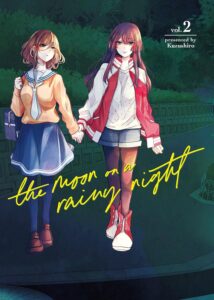
Two girls sharing an umbrella look back over their shoulders at us, as rain pours down around them. They both wear a dark school uniform skirt with white stripes at the hem. One, with collar length red-brown hair, wears a beige sweater, over which you can see her "sailor" style collar. The other, with long black hair, wear a red sweat jacket with  thick white stripe down the arms. Both carry book bags.I cannot begin to tell you how happy I am that you get to read The Moon on a Rainy Night, Volume 1! This masterwork by Kuzushiro hits English language shelves tomorrow and I implore you to get it if you haven’t already.

Amayo no Tsuki (雨夜の月) has been one of my favorite series since it launched last year – Volume 5 was reviewed here just last week, in fact. I’ve been a fan of Kuzushiro-sensei’s work for ages and was able to bring Kimi no Tame Nara Shineru (姫のためなら死ねる) out in English in partnership with JManga.  So this is technically not the first time Kuzushiro-sensei’s work had been published in English, but it is the first time in print and so well-positioned for success.

The Moon on a Rainy Night follows the lives of Saki, a typical student in high school, and her classmate Kanon, who is hard-of-hearing. Kanon has isolated herself from her classmates after a painful misunderstanding in middle school so, when Saki is asked to be her friend, Kanon asks her to just not.

Saki and Kanon are thrown together by random circumstances, but their friendship radically changes both their lives in ways that they could not have possibly predicted.

Disability manga is not entirely uncommon. For instance, we’ve been talking about Kabi Nagata‘s mental and physical health since 2016. But there is a reasonable pushback from disability advocates on “inspirational” portrayals of disabled and chronically ill folks gaining unreasonable success “despite” their limitations. No one needs that shit. What we get in Moon on a Rainy Night is the coming together of two people who help one another to become their best selves. Saki reaches out to understand Kanon – she begins to learns sign language to make it easier to communicate and brings Kanon into situations in which she can thrive, instead of hiding from stress. Kanon learns to become part of the larger community – without compromising her own needs. It is a fantastic tale of what “accommodation” ought to look like in a perfect world. Saki and one of the teachers  makes space for Kanon to participate in student life in ways that allow her to feel included on her own terms.

This doesn’t mean life is perfect for Saki or Kanon, which means that there is room for them both to grow – together and separately. As I said in my review of this volume in Japanese, “I’m glad it neither fetishizes nor romanticizes deafness. Instead, it is a bit of an explainer manga, which gives Kanon a chance to speak for herself and to correct Saki’s mistakes and misunderstandings.”

Kuzushiro’s art has really matured over the last few years. There’s amazing reaction shots and this will continue to develop as the story goes on. The storytelling is a little rough in the very beginning, but soon finds it’s own pacing. It’ll pick up speed as the story progresses.

Kodansha has done a fine job of bringing this volume over to us. Kevin Steinbach’s translation feels as natural as it can be, given that in this volume, the characters are still being developed by the creator. Above everything, it feels like young people talking, which I very much appreciate. Jamil Stewart’s lettering is solid, with the Kodansha house style of doing matching captions to the Japanese. The English reads smoothly, great job on editor Andres Oliver.  And the cover design by Phil Balsman captures the feel and colors of the Japanese edition.

Ratings:

Art – 8
Story – 7 This will go up as the narrative matures
Characters – 9
Service – Let’s say 1 on principle but not really
Yuri – Also mostly on principle right now, but that, too, will change

Overall – 8

I am so, so glad this manga is here! It is at the top of my list for possible best of the year.  The Moon on a Rainy Night is a Yuri series that can and should be read by everyone.