
Archive for the English Manga Category


Yuri is My Job!, Volume 11, Guest Review by Christian LeBlanc

July 26th, 2023

Two girls in old-fashioned Japanese school uniforms in a shady garden. On a bench sits a blonde wearing glasses, one arm up on the back of the bench, turned to talk to a silver-haired girl standing behind her. They smile at each other in an easy and friendly way.To fully appreciate the wretched hive of scum and villainy Miman puts on display in  Yuri is My Job!, Volume 11, I strongly recommend going back and re-reading volume 9 and volume 10, which begin this arc. If earlier volumes could be said to be a parody of Class S, then these volumes are a scathing attack on the concept.

Miman is putting on a masterclass of layers and blurred lines in this volume, and so, with my literary degree in one hand, a copy of Erica’s By Your Side: The First 100 Years of Yuri Anime and Manga in the other, and a Blu-ray of Maria Watches Over Us playing in the background, I want to go a little bit in depth on what’s going on in these volumes.

This necessitates spoilers, of course, so let me briefly describe what happens in this book: 

Sumika (the gyaru) and Kanoko (the walking anxiety attack) are going out, but Sumika is ok with the two of them taking their time, not wanting to push Kanoko into anything she’s not ready for (I’d say Sumika is good at reading non-verbal communication, but Kanoko’s body language only knows the phrases ‘flinch’ and ‘look like someone just shot her dog’ whenever Sumika gets too close). 

Nene (the cook) and Sumika used to be schwestern at Café Liebe, but grew apart after a falling out which we are shown in full detail, along with the two of them confronting their past in a particularly raw, honest chapter. 

Meanwhile, we see to what extent former employee Yoko (who LARPs Class S outside of café hours playing, as she accurately says in Volume 10, the role of “Instigator”) is involved in all of the above. 

All the while, rehearsals continue for the play that the characters of Liebe will be performing. That’s right: the characters in Yuri is My Job! are playing the roles of Liebe Academy students at the café, and those characters in turn are rehearsing for a play that they’ll perform for café patrons. The play itself is adapted from A Maiden’s Heart, which is what the Liebe Academy characters are based on, so I believe that performing the play will actually summon a giant Yuri ouroboros (Yuriboros for short) that will alchemically transform the world of Yuri is My Job! into our reality.

Actual queerness is touched on, we get to see Sumika’s fluffy and bubbly side as she’s excited to be Kanoko’s girlfriend, we get a lot of drama and even some resolution, and as an added bonus for some of you, Hime is only in this for 16 pages including splash illustrations and Afterwords. There is something extremely not right about Sumika’s and Kanoko’s relationship, however, and I imagine this will come to a head in the next volume. 

Ratings:

Art – 9Story – 9 Diana Taylor (translation) deserves a commendation for handling all the nuances of the multi-layered conversations and exchanges.Characters – 9Service – 4 A tiny bit of nudity with much implied, nothing shownYuri – 10

Overall – 9

Still here? Ok, grab your einnerung nachtisch with buchwelt, dig in, and remember, we’ll be spoiling plot points the way Yoko spoils joy. Let’s dish!


To put it simply, this whole story arc is about the negative repercussions that happen when you apply Class S tropes to real-life relationships. 

We learn in Volume 10 that Yoko was already familiar with A Maiden’s Heart, the in-universe novel series on which Café Liebe is based. “I’ve always wanted to live in those sorts of settings,” she says, even choosing to base her character off of Therese, “who uses her wiles to rile other people up. Should be fun, right?”

True to her word, she soon starts dating Nene, “even if it’s just for fun.” Yoko never takes it very seriously, and in the spirit of Class S, ends things as soon as she ‘graduates’ from the pretend school (ie, quits Liebe after her “main employer found out that she was moonlighting”), leaving Nene feeling betrayed, and Nene’s relationship with Sumika quite damaged. (Yoko suggested going out with Nene in the first place to make Sumika jealous so she would realize her true feelings for Nene, but everything backfired spectacularly because that’s not how any of this works).  

Nene and Sumika do eventually patch things up, but it’s significant that Nene is a cook at this point, no longer playing among the Class S sisterly roles of schwestern. Also significant is how this discussion takes place at the café with no customers or anyone else around; Sumika and Nene are both in plainclothes, not performing, outside of the ‘false’ world of Liebe.

As for the influence of Class S on Sumika and Kanoko’s relationship: 

As Sumika slowly realizes that she’s caught feelings for Kanoko, she remains largely in denial about what her affections mean, telling herself “I do love Kanoko-chan . . . but that’s a sisterly love. I just want to protect my little sister.” She’s partially in denial because she’s always thought of herself as straight, and partially because she’s always viewed any kind of romance as a destructive force: “that stupid thing called romance that’s the real villain.” Sumika even describes the concept of schwestern to new hire Haruko as “if you took the romance out of a romantic relationship.” She’s confusing Class S concepts with real life; fittingly, she’s depicted practicing for the play-within-a-play while alone, taking that Class S lifestyle home with her. (Hime and Yano, for their part, are only ever shown rehearsing in-character and during work hours, suggesting they’ve learned to compartmentalize these concepts).

Sumika also rehearses the play with Kanoko at her place, which again reflects how Class S informs the way each of them views their relationship. Sumika is ok with dating Kanoko even knowing that Hime will always be Kanoko’s number one (which horrifies Nene when she finds out), similar to how Kanoko is ok with always being with Hime, even knowing that Hime will never have romantic feelings for her (which horrifies Sumika in turn). Both of these are ‘false,’ or at least ‘unmutual’ relationships based on the type of unrequited yearning that Class S would glamourize, but are, in reality, quite unhealthy and unfulfilling.

For her part, Kanoko only views her relationship with Sumika as yet another performance, just like her job at Liebe; she only went out with her at the suggestion of Yoko, who practically feeds her a script of what to do: go out with Sumika so she can have someone to talk to about Hime again (Sumika had cut her off at one point, you see). Kanoko even goes so far as to ask Nene how you’re supposed to behave in a relationship, but as Nene says, “no matter how ‘romantic’ an act seems . . . if your intent doesn’t align with theirs, then it’s not ‘romantic.’” Nene’s assurance that everything will work out as long as she and her girlfriend both love each other isn’t what Kanoko wants to hear, since she doesn’t actually love Sumika and is only looking for ways to help sell her performance. 

In summary, the underlying message seems to be that Class S stories are well and good for entertainment, but the “S” may as well stand for “Septic” when applied to real life, especially when someone wants more than a Platonic love. The way this message is conveyed is entertaining, complex, and well thought out – Miman is employing a play-within-a-play-within-a-manga on a metatextual level that would make Hamlet’s head spin! I am very much looking forward to Volume 12 coming out in December to see if any of my theories about what happens next hold any water (including the summoning of the Yuriboros).




Otherside Picnic Manga, Volume 5

July 18th, 2023

A woman with long blond hair and a baseball cap stands, holding a rifle, her gloved left hand on the shoulder of a woman with medium-length brown hair, one blue eye, one brown eye, who is holding a semi-automatic weapon. They are posed in front of an oversized military vehicle. Otherside Picnic, Volume 5 is significant turning point in the narrative. It is in this volume (equivalent to the beginning of Volume 2 of the Light Novel series), in which Sorawo and Toriko begin to take control of their experiences in the Otherside.

This is even more significant for Sorawo. When we first encounter her, she is passive, almost unable to act without Toriko for a little while. Now she and Toriko are acting as a partnership. They are learning how, well, how it seems that the Otherside works, even if the underlying logic isn’t understandable. In this volume they resolve to return to Kisaragi Station and save the American Marines…and then they do that.

For Sorawo, who has been an anthropological observer of her own life up until now, recognizing that she  has the knowledge to act, and  granting herself the ability to act will change her life significantly. And walking next to Toriko, as opposed to following her, will begin to change their relationship as well.

I enjoy the novels for this series, but for once, I really think I have to award the best media to this manga. Eita Mizuno’s art is outstanding. It’s understandable enough to be uncomfortable and inexplicable enough to give the frisson of  horror that Toriko and Sorawo are dealing with. Taylor Engle capture everyone’s voice perfectly in the translation, Nicole Roderick’s lettering is clean and readable. Great work by the Square Enix team, and honestly, if you’re looking for Yuri that’s not schoolgirl stuff and can stand a few chills down your spine, I really do recommend this manga.

Ratings:

Story: 9
Character: 9
Service:0
Yuri: 1

Overall: 8

As the beginning of the next phase of this series, this is an incredibly strong volume.


Run Away With Me Girl Volume 2

June 14th, 2023

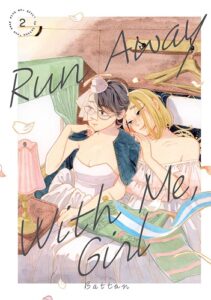
Two adult woman sit up in bed, half dressed, gently touching.by Matt Rolf, Guest Reviewer

What happens when a woman gets to question the path she’s on in a supportive environment away from negative people and the weight of societal expectations? Battan gives their protagonist the space to do just that in Run Away With Me Girl, Volume 2, and the result is a book far more enjoyable to read than Volume 1.

Makimura still holds a torch for Midori, who is still pregnant and engaged to a man. At the beginning of the book the women are not speaking. But, as Midori contemplates the weight of her impending life changes, she breaks down and lets Maki back into her life. Maki takes the opportunity to invite Midori on a trip to see Maki’s friend Komari, a school girl with whom she chats online. Midori, wanting to escape her own life, takes Maki up on the offer, and the women immediately leave for Shōdoshima Island where Komari lives. 

The bulk of the book takes place on Shōdoshima, keeping the reality of Maki and Midori’s real world at bay. It is here that all three women connect with each other and take stock of their lives. The adults find awe in Komari’s fearlessness and honesty as she grapples with the challenges she faces in trying to live her identity. All three observe and encourage each other and use the information to consider what it is they really want from their lives and relationships.

I strongly support the plot choices made in this book. At least some of the characters in this volume are working toward healthier choices than Volume 1, and that’s to Battan’s credit. As with all vacations, there is a bill to be paid upon Midori and Maki’s return.  The bill does not come due in this volume, allowing the characters to bask in the possibilities of a hopeful future.

The artwork is improved in this volume. The dreamy quality of the series overall is accentuated on the island. The backgrounds are more interesting and help set the scene better than Volume 1. Battan wields frame-breaking character features with skill, and uses them more effectively here than Volume 1. My biggest critique is that at times Komari is drawn in a very elfin manner. This accentuates her youth and the un-reality of the island vacation, but at times she just looks weird.

While yuri, this book still exists in a space where the relationships and commitments of the characters are left unstated at important places. A group bath scene with excellent artwork is the service highlight. The scene is tasteful and well-done, and anything more explicit is just not what this series is. The real relationship payoffs are emotional. Midori is moving toward making definitive statements about the sort of relationships she wants, and Volume 3 will give her an opportunity to make good on those movements.

Final Verdict: Leave your troubles behind and get yourself sorted in a steam bath with other women.

Published by Kodansha Comics, with translation by Kevin Steinbach and lettering by Jennifer Skarupa.

Ratings

Art – 8
Story 8 – Not as harsh as volume one, and that’s most welcome.
Characters – 7 We’re getting there.
Service – 5 We don’t have to take our clothes off to have a good time.
Yuri – 8
Overall – 8


My Future Starts Today ~Miku&Kyoko~, Volume 1

June 12th, 2023

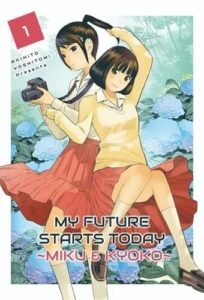
On a background of blue hydrangeas, are two girls in tan sweater and red skirt school uniforms are back to back. Standing, one holds a camera. The other reaches back above her head to hold the other's ponytail and reaches behind her to hold the other girl's wrist.Do you remember Blue Drop? It began as a manga, then had a couple of Drama CDs. Some years later it was given an anime that was both very interesting and kind of forgettable at the same time.  Funimation licensed it, releasing a complete collection in 2010. That’s practically a human lifespan ago and I wouldn’t be at all surprised if you didn’t remember it. But the point is, that the creator, Yoshitomi Akihito has gone on to make a number of stories and few series, most of which center on sexualizing schoolgirls. None of them have made it over here. I was very surprised to learn that My Future Starts Today ~Miku&Kyoko~, Volume 1 has been localized and released as a digital volume.

Kyoko and Miku have been friends since childhood, but Kyoko doesn’t really understand Miku. So when Miku tells Kyoko she’s in love with her, Kyoko has no idea how to feel about it. It doesn’t help at all, that Miku offers Kyoko her body to do whatever she wants with.

Miku sets about trying to appeal to Kyoko, to seduce her, but Kyoko…while not opposed, per se, really doesn’t know what Miku is thinking. Miku ramps up the seduction with every chapter until Kyoko pushes her away, causing a separate misunderstanding. As this volumes ends, Kyuko hears rumors in school that Miku is hanging with the predatory lesbian Nana-sempai! 

The major down side to this story is Miku’s behavior. She’s written and drawn like every pervy middle-aged dude who thinks high school girls are seductive, thinks girls are like. It’s frankly exhausting. But this has always been Yoshitomi’s oeuvre, so I can’t say I was surprised. That said, both girls stay mostly full dressed (Miku does undress a little) and while they do kiss, when Miku tries to touch Kyoko is when she is pushed away.

This series is complete at Volume 2 if you’d like to see what becomes of Kyoko and Miku. I think I can guess. ^_^

Ratings:

Art – 7 Very clean and understandable, lots of “sexy” poses
Story – 5 Miku wants Kyoko, there’s not that much subtlely
Characters  – 7 Other than the immediate circumstances, we don’t learn much about the as people
Service – 7
Yuri – 7

Overall – 7

I’ve encountered the publisher MediBang and Media Do Co., Ltd.once or twice, but I finally looked them up. MediBang seems to be a publishing and art platform, while Media Do describes themselves as “one of the largest eBook distribution companies in the world ” – and they own Netgalley, for those reviewers out there. On the translation side they seem to be doing a fine job, but this manga hardly had complicated ideas to communicate, either. They don’t credit humans for the production and I have a nagging feeling that some or all of this is automated. I hope I am wrong.


If I Could Reach You, Guest Review by Luce

June 7th, 2023

A woman stands looking out onto a purple night sky, holding a sitting girl's hand.Welcome once again to Guest Review Wednesday! We have a whole bunch of guest for the next few weeks, so let’s this part started! Today we once again welcome back Luce, who will be taking a look at a completed series. Take it away, Luce!

I’m Luce, collector of books and sometimes I even read them. I come bearing a review of a series that’s been out for a while and is complete, If I Could Reach You by tMnR. Enjoy!

The very first pages of the manga, tinged with blue, show us the exact moment Uta realised that she’d fallen in love – the exact moment her sister-in-law became her crush. A year later, Uta is in high school and is living with Reiichi, her older brother, and Kaoru, the aforementioned sister-in-law. No matter how she tries, she cannot get over this love, her ‘too late’ love. If I Could Reach You is the examination of this binary star system of Uta and Kaoru, and how they keep circling each other, never quite able to clear that distance, nor leave.
 
A tragedy, to me, is a story in which fate cannot be fought. It marches on, tramples over all in its path, and death seems the only escape from it. Is this a tragedy? No, not really. But I think it shares some similarities. It is circular, somehow, an invetability to the telling of it. Uta loves Kaoru. Uta knows it’s hopeless, but cannot give it up. She knows that Kaoru sees her as a sister only, which only makes it worse – Kaoru wanting to be closer in a familial way speaks to what Uta wants, but not for the reasons she wants it. The manga is seven volumes, so it’s not so prone to the endless circling that some romance manga seem to get into, but it’s certainly not decisive in its action. It moves quite slowly, building up layers of paint onto the canvas, until you finally get the whole picture – or is it? Some things are left untold even by the end, left to our imagination.
 
The drama felt pretty realistic and down to earth. It’s fairly obvious that Kaoru and Reiichi’s relationship isn’t quite working even at the start – the blurb of the first volume tells you that – but the actual reason is kept right until the end of the manga, as the issue comes together. The fall out is realistic. It’s not so much a soap opera of a shoujo manga, but a more melancholic tide of no one quite being happy, but none are able to address it, nor particularly face it, so it continues.
 
Having said that, I don’t see this as a depressing manga. It doesn’t feel hopeless, to me. It feels like a snapshot of lives not my own, just watching them play out, unable to impact them in any way. There are plenty of moments of levity, and characters that change the tone, not interested in dwelling in pity. Kuro, and her relationship with Miyabi, is an interesting aside, and Konatsu, although she has her own regrets, has her own unique way of dealing with things too. I think this manga is about uneven relationships, really, where feelings don’t quite match each other, and the strain that can put on them – and whether they can survive it. I’m not so keen on the portrayal of love as some unending emotion, unable to be shaken or swayed, but I can forgive that, as I do with many manga.
 
The art is fairly simple, but gives itself space to breathe – the emotions come through clearly. There was a panel in the first volume, where Uta has a dream in class about Kaoru kissing her – the panel of her jolting awake is the thing I remember most. The despair, the horror, perhaps the relief that it hadn’t actually happened, or the disappointment. It was this panel that really caught me, and made me carry on with it. There are lots of big panels and expressions which made me stop – if I had one complaint, it would be that everyone is a little stretched, with long limbs. It’s not unusual for manga, but does make me wonder about everyone’s heights, sometimes.
 
Although I enjoy this series, I’m having trouble with who to advise might like it. It has a little of the realism of How Do We Relationship? But isn’t so swift in its story-telling. It doesn’t really have the clear narrative of many shoujo, and it’s neither a wholly happy story nor a big drama. Perhaps if you like stories with something of an open end, this might appeal. If I had to compare the mood of it, it would be to Solanin by Inio Asano, in its relatively mundane, melancholic realism in depicting messy and imperfect relationships.
 
Story: 6
Art: 6
Yuri: 5
Service: 3 (the odd bath scene, not done salaciously as far as I recall)

Overall: 6

E here: Fantastic review, Luce. “…this manga is about uneven relationships” really puts it all into perspective for me. Terrific. Thanks so much!