Archive for the English Manga Category


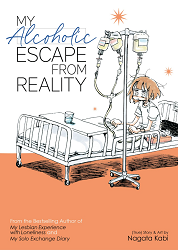
My Alcoholic Escape from Reality by Nagata Kabi

May 14th, 2021

Right now the first Virtual Toronto Comic Arts Festival is underway on Youtube and this week we had the pleasure of watching Deb Aoki doing a pre-recorded interview with Nagata Kabi, the creator of comic essay My Lesbian Experience With Loneliness, and its sequels. This interview will be available online until May 21, so definitely watch it while its available – its not often we North Americans get a chance to see our favorite manga artists.

This month also saw the release of Nagata-sensei’s newest work in English, My Alcoholic Escape From Reality, detailing her bout with alcohol-induced pancreatitis. As with her previous works, this book covers a number of personal details, physical and emotional. She made it very clear in the interview that she has regrets about the way she talked about her family in previous books and she addresses that in the book, as well.

In my review of this book in Japanese, I said, “We’ve watched Nagata-sensei struggle with food, with alcohol, with depression, and now with her pancreas. It’s all very heavy going, but as a reader I don’t feel like I have the luxury of wallowing since, for any bleak feelings I might have, I have to believe that it’s harder for her. To some extent, the only thing we can do is be distant, abstract cheerleaders on the sidelines of the parts of her life she chooses to share with us. We have to know were not getting the whole story – and we have to be okay with that. So we mentally pull for her and send good thoughts.”

And, indeed, we do mentally pull for her and send her good thoughts and she could see that in the interview chat, if she was interested. Especially now that we’ve put a face to the name, I imagine fans will care about her even more. Which makes this book harder to read, not easier, honestly! But there are two things I want to note – one, the second half of the book is less about her struggle with her physical body and more about the creative struggle…which I interpret as a very positive thing. The creative struggle, while no less real, is also much more abstract and requires the ability to think about something other than the pain in one’s abdomen. I’m sure we can all identify with how difficult it is to work when we don’t feel good. It’s a testament to her strength of will that she could work in such circumstances.

The second thing I noted in my review of the Japanese volume was that she’s back with East Press for this book. They aren’t the biggest publisher she’s worked with, but I’m kind of happy that she’s with them again. They are a very pro LGBTQ content company. Her newest book series is with Futabasha, another company that has been really positive for queer manga creators and content, so I’m very much looking forward to seeing what they do together!

Following this all up, Seven Seas announced the license of her next book, Meisou Senshi・Nagata Kabi(迷走戦士・永田カビ) as My Wandering Warrior Existence. You can read this online in Japanese on Web Action. This has a projected release date in English of March 2022. But wait, Nagata-sensei is working on *another* series now, Meisou Senshi・Nagata Kabi Gourmet De GO!  (迷走戦士・永田カビ グルメでGO!) the first chapter is also available on Web Action in Japanese. This is the story she alludes to in this volume – a food manga. I am really looking forward to this, as it’s an audacious and amazing concept having a food manga written by a woman with eating disorder and a contentious relationship with food. It should be fascinating.

Ratings:

Art – 8 Her style has really grown and visibly become more confident
Story – 8, by which I mean it can be gut-wrenching
Character – 9 ^_^;
Service – ? There’s some details in there.
LGBTQ – N/A, but wait. The next book is about her gender and sexuality

Overall – 8

Watch her TCAF interview and then take a look at this book translated ably by Jocelyn Allen. I also want to nod in the direction of the lettering and retouch folks, Karis Page and Gwen Silver, since Nagata’s pretty heavy on the in-art sound effects here. Thanks to the entire Seven Seas Team for their work on this book, and to TCAF staff, Jocelyne Allen for her delightful translation and interpretation and Deb Aoki for another great interview.
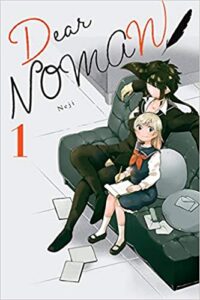

Dear Noman, Volume 1 – Guest Review by Luce

May 12th, 2021

Welcome to another Guest Review Wednesday here on Okazu! Today we have a new Guest Reviewer, Luce, who is going to take us through a series I haven’t even had a chance to look at, so yay, I’m totally ready to learn something new. ^_^ Please give Luce you attention and consideration!

I’m Luce, long-time follower of this blog, and I own too many Yuri manga. Not that that’s much of a bad thing, though… I can be found as silverliningslurk on Tumblr, and farfetched #1235 on discord. Anyway, on with the review!

Mashiro is ostensibly a normal school girl—except she can see ghosts and spirits. After a terrifying encounter with one, she meets Bazu, a crow Noman (the name this series gives to anything not living) and Nelly, who both work for the Border Preservation Society. Due to an accidental bond (read: kiss) with the vitriolic Bazu, Mashiro ends up deciding to work with them to bring Nomans to peace and prevent them eating souls.

There are likely a good many series that deal with a supernaturally gifted human teaming up with a supernatural being to fight monsters, and I doubt this series will do anything new, per se. We have the initial monster, the one the new girl manages to talk around from violence, and the more obviously sentient one. I haven’t read too many of these, so it’s not a tired trope for me. It’s interesting enough, even if the grading system the Society uses for these monsters confuses me somewhat. I hope future volumes will shed some light on it.

What is probably slightly more novel is a canon lesbian. Well, at least one. It’s not the happiest of stories though, as she is a Noman… But it is possible it could take a turn for the better. Another character states that her death happened at least a few years ago, and says that things have ‘changed for the better’. Not that that helps her much, at the moment. This volume leaves that story on something of a cliffhanger, albeit a low stakes one, so we’ll have to find out in the next volume. As for being yuri between the main characters, it has potential. The only problem is the visual age gap. I say visual because Bazu, being a crow Noman, doesn’t have a stated age, and clearly didn’t age by human standards whilst alive, so it’s hard to tell. Her body is most definitely adult, while Mashiro says she is fourteen, and looks younger partly because she’s small, and partly because she’s drawn to look young. Age is a funny thing in manga anyway.

Quite a lot happens here, although the pacing didn’t feel rushed to me. I’m curious to see what happens with the lesbian noman, and with what I imagine to be foreshadowing, in that Mashiro frequently writes letters to her deceased older sister. I also want to see Bazu and Mashiro evolve and grow, regardless of whatever it will turn into a relationship or not. Bazu is pretty harsh and aggressive initially, although we see later than she has a good reason for her hatred. Mashiro is a little naive, and perhaps blunt, but she does genuinely care about Bazu, and wants to learn more about her. I’m intrigued to see the effect they have on each other.

All in all, for a series that looks like it could be quite light, it gets surprisingly dark, but it balances these quite well. I like it, and I’m looking forward to the second volume, slated to come out in English from Yen Press in June.

Art – 6
Story – 7
Characters – 7
Service – Bazu has, to borrow another character’s comment from a different series, ‘some mad cleavage’. It is, thankfully, not used in a servicey way, and there aren’t many lingering close ups. I’d say 3.
Yuri – there are kisses between women. They don’t mean a great lot emotionally… Until they do? We shall see. Canon lesbian puts it up to 5.

Overall – 7

Erica here: Sounds like it could be worth a read. Thank you very much for the fab review! This series reminds me a bit of Ghost Talker’s Daydream, with it’s tragic lesbians. ^_^;

You can find Dear Noman, Volume 1 on Amazon, Comixology/Kindle, RightStuf, Global Bookwalker and manga stores near you!


Strawberry Fields Once Again, Volume 2

April 23rd, 2021

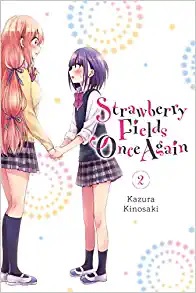
As the pages of Kazura Kinosaki’s Strawberry Fields Once Again, Volume 2 opens, I am primed to find spanners in the works and, indeed, that is what happens, in several ways at once.

To begin where we left off, Akira has kissed Pure and in time-honored fiction fashion, Pure has passed out/overheated. Having kissed Pure, Akira pulls away, inexplicably telling herself that the woman who professes her love like 5 times a day, would have been put off by a kiss. (This is how you know Akira really is a lesbian. ^_^;) So that’s one spanner in the works.

Then we find that Pure has pushed Akira to go visit her father who, it turns out is alive and well and has a new family. Which she does and and has a lot of complicated feelings about it, quite naturally. Akira’s distancing from the world is making more sense now. Spanner number two. When Ruri, her brother confronts Pure with a question that seems out of the blue, then we might be forgiven for wondering if we’ve missed something critical because that seems a really big spanner. In a sense yes, we have, but it hasn’t happened yet, so we can be forgiven for forgetting that this is not just a school life Yuri drama. It will however have to remain a mystery as to what it is, until Volume 3. Unless you read my review of the Japanese volume, or remember the advice from my review of Volume 1. Then you know what it is and why the spanners are flying from every direction.

The art gets both tighter and more detailed and sketchier and less detailed in places. Akira’s face undergoes a massive change from the affectless face of Volume 1, as she runs through a gamut of expressions right until the end of this volume, where the biggest spanner of them all throws everything we think about this story into question.

When I originally read Volume 1 in Japanese I had little idea where the story was going, so put off reading Volume 2 for a while. By the time I got through Volume 2, I knew I had to read Volume 3, but was a little intimidated by it, for reasons that will become clear. Nonetheless as I finished the series, it was pretty well put together, with the kind of non-linear storytelling that keep me engaged.

Ratings:

Art – 7
Story – 7
Character – 7
Service – 2
Yuri – 6

Overall – 7

Thank you very much to Yen Press for the review copy, I really appreciate it and am looking forward to Volume 3 – which will be released in June of this year- very much. Thanks to everyone at Yen for bringing this story to an English reading audience.


Our Teachers Are Dating!, Volume 3

April 20th, 2021

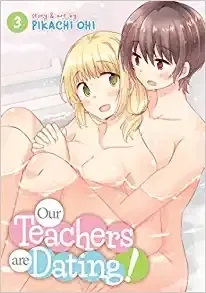
Hayama Asuka and Terano Saki are teachers who have found love together. The students, administration and their colleagues think they are ridiculously adorable about it. They can’t help but tease them, but the pure cuteness of their responses is excruciating. So of course they keep teasing. In Volume 3 of Our Teachers Are Dating! by Pikachi Ohi, it’s one adorable moment after another in this series, interspersed by moments of tender intimacy. 

In between being squeed at by students and their friends on the faculty complaining how teeth-rottingly cute they are, Hayama-sensei and Terano-sensei find themselves at a couple of relationship crossroads. Firstly and, possibly most important, in what passed for their real world, Hayama-sensei meets another adult woman in a relationship with another woman. I cannot overstate the power of having someone to speak with as a peer – so this chapter was important to me. Yes, they have been accepted by the people around them, but having someone in a similar boat is really powerful.

And they celebrate their one year anniversary together, which ends up with them deciding to move in together. Of course they have a bunch of adventures together which all sound silly when you type them out, and all end up with them sleeping together, so we’ll skip those, but let us wave to those Yuri ghosts as they float by.

This is a delightfully fluffy story that simply and openly celebrates adult love between two women. Because Asuka and Saki love each other so much, we get to just…enjoy their joy in one another. The world is a complex place. There is room for dark tales and tales of childhood romance and action and magic and there is room for something ridiculously adorable and fluffy. This is exactly the ridiculously adorable and fluffy Yuri manga we need.

Ratings:

Art – 9
Characters – 10
Story – 9
Service – 5 There is nudity and sex. They are in the bath on the cover, so…
Yuri – 10

Overall – 10

Our Teachers Are Dating, Volume 3 is available in print and digital now from Seven Seas. No date as of yet for Volume 4 in English, but I’d guess at an autumn release, as Volume 4 just hit Japanese bookstores.


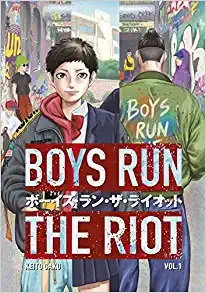
Boys Run the Riot

April 18th, 2021

Ryo has a secret and it is becoming increasingly difficult to keep it under wraps. Ryo is a boy, and yet, here he is forced to wear the girl’s school uniform and suffer from both the indignities of being perceived as a girl and having a female body. Ryo’s escape is to buy boy’s clothes and be the person he is.

When Ryo is discovered by Jin, a classmate who has a reputation as a tough, he assumes the jig is up. Instead, Jin turns out to be someone with a dream of his own, as vaguely formed as it it. Together Jin and Ryo will “create a brand” of clothing together! Ryo struggles with the idea, but eventually adopts it as his own. As Volume 1 of Keito Gaku’s Boys Run the Riot progresses, it becomes apparent that this story will be the story of Jin and Ryo gathering people who are struggling to be who they are, to be part of their brand.

I had a lot of feelings as I read this volume. I’m not unfamiliar with gender dysphoria – about clothes, particularly, and Ryo’s struggle with the girl’s uniform brought back a lot of unhappy memories for me. As a result, I found him sympathetic, but also found him very annoying and immature which…well, yes. For a long while here, Ryo is not likeable, lashing out at everyone and everything. His fear is wholly understandable, and when at last he lets Jin in, the change is remarkable.

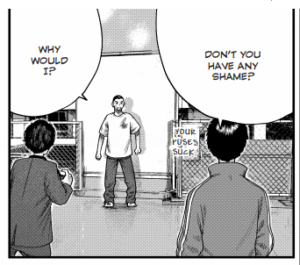
But here, in one panel, is what 100% sold me on this series. During a photoshoot for their brand, Jin is hamming it up for  the camera. Ryo asks, “Don’t you have any shame?” and Jin responds, “Why would I?”


BOOM. That is your lesson, right there.

We’re not stupid, of course – shame can absolutely be something other people create for us. In these first pages, however, shame is what we make for ourselves, by fearing to be ourselves. And that, my friends is the lesson I have spent a lifetime teaching people. Why should you be ashamed? If someone tries to shame you, they are the problem.

Again, we’re not children, we can understand that at least part of Jin’s answer here is cis privilege. But before we get angry at Jin, assuming he’s never been shamed, let’s think about him a little more clearly. He’s a big guy, not good in school, a tough – the kind of kid that school systems are designed to spit out into a life of petty crime and little hope. He’s probably never had a single teacher that even wondered if there was a spark of creativity and intelligence there. He’s probably been shamed. He simply doesn’t care. Why should he? Why should we?

And then Boys Run the Riot finds it’s own legs, as Ryo and Jin shamelessly embrace their creativity and newfound partnership. How Ryo will deal with the rest of his life is, as of yet, a mystery to me. As long as “no shame” is the mantra embraced here, I’m willing to see it through.

The art is both extremely good and extremely ugly in places, which seems like a specific stylistic choice. Ryo’s breakdowns are painful to watch, but as he starts to feel like there is a goal, he grows in strength and clarity. Jin’s long-limbed easy-going enthusiasm is infectious and goofy, but there’s an intensity to him that I expect we’ll explore in later chapters.

An interview at the end of this volume confirms what I assumed – that Gaku-sensei created this story because he wasn’t finding work about, by or for trans men. The notes at the end also say that the entire localization team on this series is trans, which pleased me no end on several points. One, how awesome for us and the team that there are enough trans folks in the industry to have a whole team; how wonderful for the creator and the readership that this book will be treated with the care and sensitivity it deserves – and how awesome that Kodansha put all of that into practice.

Ratings:

Art: 7 Hard for me to like, but it soars in places
Characters: 7 Same, but that, I think, is the story
Story – 7 as a place to begin. If it develops as I hope it might, it has room to grow
Service – Sort of? I’m going to reserve this score until next volume
LGBTQ – 10 but also not. We all know that coming out is a long process

Overall – 8

Thank you very much to Kodansha Manga for the review copy.  You can read the first chapter of Boys Run the Riot for free on Kodansha. Do give it a try. It’s long past time we have a fresh, hopeful look at life as a trans man.

Boys Run the Riot, Volume 1 by Keito Gaku will be available at the end of May on Amazon, RightStuf, and bookstores near you. There does not seem to be an ebook edition of this available at the moment. Volume 2 is slated for a late July release (you can pre-order on Amazon, RightStuf).

Two openly queer media in 3 days here on Okazu. It’s a good week. ^_^ Read this and let me know what you think in the comments!