 Last week I confessed I just wasn’t enjoying Saburouta’s manga Citrus, and asked you, my dear readers to jump in with a review. And once again you are the best readers ever. As a result, – it’s another Guest Review Wednesday and we have another Guest Review! Please welcome Amanda B who has graciously written up her look at Citrus, Volume 1 for us!
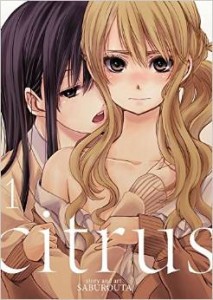
Saburouta, who made an appearance in Yuri Hime Wildrose Volume 7 back in 2007 with a smutty one-shot, has returned to the Yuri scene with a drama-filled, pseudo-incest manga titled Citrus. Citrus is currently in its 4th volume, running bimonthly in Comic Yuri Hime, and was recently licensed in English by Seven Seas (yay for more Iuri!). It has caused such a stir in the Yuri world that a Promotional Video was created (voiced by a few notable actresses featured in various Yuri anime titles) to recount the manga up through its 3rd volume! It’s pretty obvious this series is a guilty-pleasure read. Not everyone is into the whole “incest” factor, so discretion is advised if this isn’t your cup of tea.
The carefree and fashionable Yuzu Aihara’s world is turned upside down after transferring to an all-girls high school upon her mother’s remarriage. Not even making it through her first day of school she manages to sully her reputation and anger the beautiful, but snobby student council president, Mei. After returning home, Yuzu finds out that Mei just so happens to be her newly inherited younger sister, a detail mom forgot to mention. It is made evident that evening that Mei clearly has some boundary issues after randomly kissing Yuzu, at which Yuzu becomes literally dumbfounded about her newly appointed role as the “older sister”.
***
Support Yuri News and Reviews – Subscribe to Okazu with
***
Throughout the volume, Yuzu finds herself constantly conflicted between her increasing lustful desires, and trying to gain Mei’s respect in order to increase their family’s cohesiveness. One night when attempting to kiss Mei, Mei cries out for her father, whom we have yet to see, and the matter is not discussed further (at least in this volume anyway). After a series of disastrous events, Yuzu finds Mei’s grandfather (headmaster of the school) collapsed on the floor of his office and brings him to the hospital. After coming to understand Yuzu acted as the caretaker for her grandfather, Mei appears to be somewhat grateful before instantly returning to her tsundere mannerisms. The final arc of the volume centers on Yuzu coming to the conclusion (after consulting with bff Harumin) that her attempts to become an older sister figure have failed and that she is in fact, in love with Mei.
As a fan of Saburouta’s Yuri works, I am beyond pleased with the artwork. It is gorgeous! There is quite a bit of service throughout with various kissing scenes, particularly the shower scene. The story however is very chunky with a plethora of forced drama. Mei’s cold exterior warrants the obvious dramatic plot-hole I’m sure will be explored at some point. I get the feeling a good portion of the fandom for this series are in it mostly for the illustrations – watching pretty girls go at it is something I too enjoy.
Ratings:
Art – 10
Story – 4
Characters – 5 (definitely room for character development in the upcoming volumes)
Service – 6
Yuri – 9
Overall – 7
Sometimes I can’t help but wish Saburouta would just instead collaborate with another mangaka capable of writing a decent drama (maybe Shuninta-sensei) while she provides the illustrations. Volume 2 will be available in April.
Erica here: Thank you Amanda! Much obliged for the review.
I was reading Fujimoto Yukari’s essay in Eureka magazine’s “Yuri Culture” issue and something sort of dawned on me. In Oniisama E, we spend a lot of time watching Miya-sama and Saint Just’s unhealthy relationship on screen, but there’s actually another half-sibling relationship directly in front of us the entire time that is perfectly healthy – for a number of reasons, not least of which because Nanako doesn’t know it exists. Henmi and Nanako serve as sane, healthy foils for Rei and Fukiko, letting the audience know that it’s not normal to be so weirdly manipulative of one’s half-sister. Citrus is in desperate need of a foil couple, some representative healthy relationship, to relieve the thick atmosphere of “this is not and really cannot be a good thing.”