Archive for the English Manga Category


Good Witch of the West Manga, Volume 3 (English) on JManga

November 29th, 2012

The Good Witch of the West is an 8-volume fantasy fairy tale.

Firiel is a sweet, kind, poor girl growing up in a small village away from any excitement or turmoil. Her mother is dead, but she lives with kind foster parents and her father is nearby, although he will not see or speak to her. His apprentice, Rune, has no such compunction and the two of them spend as much time as possible together. Life for Firiel is good – not perfect, but good.

Until, that is, men in black attack the village and kill most of the inhabitants. Rune manages to save Firiel, but is himself captured. Firel is plunged into an incredibly complicated plot that involves the Witch Queen of her country who is coming to the end of her power, the cutthroat competition for her position, the secret of her father’s research and the conspiracies that seek to destroy the country.

Firiel learns that she is in fact, not a poor peasant girl, but a member of the Royal Family and a contender for the throne. She is befriended by Adele. a member of the nobility,  and is enrolled in a private school for noblewomen, in order to prepare for the vicious maneuverings of court. This is all told in Volume 1 and Volume 2.

As Volume 3 opens, Firiel immediately falls foul of the Student Council, followed by one of the nuns who teach at the school, but she also makes allies and some old friends enter the school to help her, including Rune (disguised as Runette, – “yeah, this shit never gets old,” says the wife.)

To increase the Student Council’s control of Firiel, they assign a spy to her, Rosalitte. During the school festival, Rosalitte is killed in an attempt on Firiel’s life. Firiel learns that she can challenge the Student Council President to a duel at the next festival and in introduced to tall, otokoyaku-like Igraine who will instruct her in use of a sword.

It turns out that Igraine and Rosalitte were inseparable until Ravenna, president of the Student Council, split them up. Now Igraine has two grudges against Ravenna. Firiel burns with desire to defeat Ravenna and makes tremendous progress in her lessons with Igraine. When Igraine confesses that she is interested in Firiel, our heroine has already had some intimate conversations with Rune, but she accepts Igraine’s kiss.

The story is a little messy, with elements from western fairy tales integrated sloppily with fantasy tropes, but as I read Volume 3, I had to say it was actually a pretty fun read. This title was brought to my attention ages ago on the Yuricon Mailing List (thanks Craig!) but I had never actually read it before now. When JManga picked it up, I thought this a perfect opportunity to finally get around to this series. Even with the obvious pandering of Igraine’s character design, the questionable costuming sense and Rune’s inexplicable appearance, I kinda like it. It’s exactly the kind of entertainment I want to throw my money at on a digital platform.

As a bonus, the JManga Android app is getting better all the time. They’ve lost that annoying poke to turn pages, replacing it with the more conventional swipe. I’d still like to see a pinch-zoom feature, but the app is loads faster than it was at first. It has much improved – I’m so very thankful to JManga for not launching it and walking away. Their continued tweaks are much appreciated.

Ratings:

Art – About as sloppy as the plot, but about as enjoyable – 7
Story – 7
Characters- Almost despite myself I find myself typing  – 9
Yuri – 4
Service- 2

Overall – 7

Fairytale fantasy with princesses and princes galore for just about any reader. Worth a read!



Cardcaptor Sakura Omnibus Manga, Volume 4 (English)

November 1st, 2012

Sakura has faced many trials in the course of Card Captor Sakura and here in Volume 4, she is going to face even more difficult trials, we are told…repeatedly. It’s true that Sakura will face down the original master of the cards, and have to transmute all the cards into “Sakura Cards” but the true trial seem to be deciding who she’s going to be in love with.

Yukito’s out – as we’re told several times, by several people, that Yuki and Toya are an item – for the few innocents who didn’t pick that up. More importantly, everyone else is paired up neatly in officially sanctioned inter-generational relationships and Sakura manages to figure out that she’s in love with one of the two people who have confessed their love to her. ^_^;;

Poor Tomoyo. Remember, y’all wouldn’t have had Tamayo in Strawberry Panic, without Tomoyo’s cheerful smile that hides a broken heart, as she drinks herself into oblivion in an all-white apartment in which her movies of Sakura play endlessly. (That’s how I’ve always imagined it, anyway. But I’m a jaded cynic. ^_^)

Aside from Eriol’s dire warnings of terrible trials, the actual trials Sakura faces are pretty gentle as befits this incredibly pretty, soft, fluffy magical girl manga in which everyone is destined to live happily ever after…

…except Tomoyo.

Ratings:

Art – 9
Characters – 9
Yuri – 2
Story – A little messy, especially around the Clow Reed bits – 7
Service – 5 for all the inter-generational relationships and  for Yuki and Toya and all the squealing

Overall – 9

I really love this series. It has loads of likable characters, pretty art and leaves me feeling good. Win all around.

…except for Tomoyo. ^_^;;

Many,  many thanks to Okazu Superhero Andreass L. for sponsoring today’s review and leaving me feeling good!


JManga Adds Yuri Manga Aoi Hana, Sweet Blue Flowers!

October 16th, 2012

The good new, among other titles, JManga has added Aoi Hana, Sweet Blue Flowers. The extra good news – the ALC team is working on it right now. ^_^ Whee!


Puella Magi Madoka Magica Manga, Volume 2 (English)

October 3rd, 2012

The other day, I found myself discussing the Puella Magi Madoka Magica anime with Okazu Superhero and good friend Bruce. We agreed that, for us, the sign of excellence in a series could be boiled down to one quality – the ability to withstand continuing critical review. No matter what angle you take, Revolutionary Girl Utena can withstand critical review – it has a lot of material to discuss, to analyze, to critique and criticize. Bishoujo Senshi Sailor Moon, as much as I adore it…really doesn’t hold up well under critical review. The repeated footage is not meant symbolically or ironically – it was just a money saver. The Monsters of the Day are not clever social commentary. Yes, the Senshi themselves are archetypes, but that’s about as far as one can take a discussion of Sailor Moon, before one has to invoke its effect on increasing the market for shoujo manga, or rely on discussion of shoujo tropes. By this standard then, both Bruce and I felt that the Madoka anime was excellent. It holds up under critical review of plot, character or visuals.

One of the key visual elements of the anime was Kyuubey’s unchanging face. It was that – and solely that – that was the first screaming red siren for me. He’s cute, carefully crafted to have an honest, open, trustworthy face. Everything about Kyuubey screamed “RUN!” at me. Which is why I wrote this helpful guide What You Need to Know To Become a Magical Girl, which so many people completely failed to understand.

Which of course, is the very basic premise of Madoka. We need to learn to think critically. Not cynically, not paranoically…critically.  We need to learn to ask good questions to get good answers – and we need to learn to understand the answers we receive.

In Volume 2 of Puella Magi Madoka Magica, Sayaka becomes the second sacrifice to lack of critical thinking skills. What questions might she have asked if she was older, more experienced or wiser? What might she have heard – both said and unsaid –  in the answers she received? But we cannot blame Sayaka, really, or Madoka. They are children, being manipulated by a creature with the balance of power and information on his side. And this brings me to the only comment I have about this book. The art ruined it. The whole point of Kyuubey is that we never know what he is thinking, that we only ever see that trustworthy face. By giving him an “evil” face at the end of the volume, the manga artist has crushed one of the key visual elements of the story, rendering it a comic for children, not for adults. Volume 3 will play out as we already know it must, but I no longer trust the manga to tell the tale well enough to hold up under critical review.

Ratings:

Art – 5
Story – 6, but only because the art has positioned itself as an enemy to the plot
Characters – 6
Yuri – 1
Service – 2

Overall – 5

Many, many thanks to Okazu Superhero Andreas L for giving me the chance to look at this manga critically. ^_^


Yuru Yuri Manga, Volume 1 (English)

September 25th, 2012

Yuru Yuri remains on the JManga best seller list, as it has since it premiered on the digital platform. Not surprisingly, I’m pleased to see it there, because we at ALC were able to be part of the team that brought it to you.  I was even allowed to contribute a short essay on the Yuri landscape in Japan to the feature story for the series. (And, I erm, just noticed that they called me the Yuri Master on the feature page. /snort/) As a result, I think I should disclaimer this review – I think we did a bang-up job on the thing and I have no intention of combing the book for mistakes. ^_^

That having been said, something popped up on Twitter yesterday that inspired me to do a quick review. I’ll get to that in a second.

The number one criticism of Yuru Yuri is, well, the lack of Yuri.

Basically, Kyouko sort of desires Chinatsu, who can’t stand her, Chinatsu loves, akogares and probably desires Yui, who probably knows but isn’t doing anything about it. Ayano has a made-up-in-her-head rivalry with Kyouko, because she hasn’t really figured out that she likes her, Sakurako and Himawari are a completely fictitious couple made up by the author to jerk the readers around. No one even notices Akari.

The only “real” Yuri in the series is in Chitose’s fantasies. Chitose is, of course, the stand-in for the readership. All the “Yuri” in the series is in our heads, because if you step back for a second, we are pairing up 13-year olds and how creepy does that make us? Massively creepy.

So for no reason at all, except because I find it amusing to do so, I’m going to ‘splain the real relationships in this series.

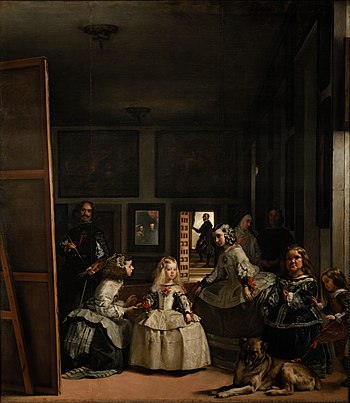
Here’s the picture that started this whole train of thought (Here’s a link to the original artist’s page on Pixiv. You’ll need to be logged in to see their page. Painting and links via Scott Green on Twitter)

This picture, “Yuri Meninas” is a mashup/parody of Velazsquez’s famous painting Las Meninas.

And I thought to myself, well, if this artist can see something in Yuru Yuri worth mashing up with Velasquez’s work, (often considered the best painting in the world), then clearly, I need to look at it again.

And so I have.

Yuru Yuri is, like Sasamekikoto, a discussion of Yuri tropes. Best friends, rivals in love, opposites attract, akogare out of control, etc. But where Sasamekikoto focused on tropes of plot common to Yuri stories, Yuru Yuri is focusing on character tropes common to moe stories…and making fun of the characters and the people who read so much into so little. In effect, Yuru Yuri can be seen as a commentary by the artist on the audience who works so hard to develop the characters which are, in reality, kept simple by design.

The main character of Yuru Yuri is not, as the story might imply Akari, nor is it Kyouko… the main character is Chitose. That is to say, the main character of the series is *you.* You are the one developing the series from 2-dimensional in every way, to anything at all that has some third dimension. Like Velasquez in Las Meninas, the reader must be involved with the narrative for it to make any sense at all.

So, because I as a reader (even though as I edit, I try hard to not engage with the story) am forced to form some opinion of it as I read, here is what *I* saw.

There is, in truth, only one couple here. Chitose and Ayano. To turn Ayano into the masochist she truly is, Chitose will, therefore, have to learn how to be a better sadist. She’s got a lot of work ahead of her. Sakurako and Himawari are a McGuffin. Himawari genuinely can’t stand Sakurako, and Sakurako is merely using Himawari. Chinatsu (who has been inexplicably described as “dark”) is a bore. Yui will come to realize this and then realize that she actually does like Kyouko…but only after Kyouko and Chinatsu become a couple.

So, that’s what this series looks like in *my* imagination. ^_^

No, not really.

In my imagination, this series doesn’t exist at all. ^_^

I am not, like Velazquez, reflected in the art. I am not represented by Chitose. I stand outside the story, outside the narrative and, instead of watching the subjects of the narrative, I watch the audience. I watch you as you paint the picture.

So, what I want to know is – what do you see when you look at Yuru Yuri? Where are you in the picture? Tell me in the comments!