Archive for the Guest Review Category


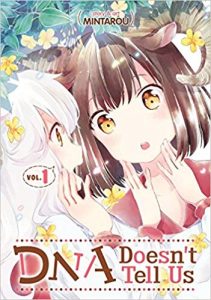
DNA Doesn’t Tell Us Manga, Volume 1 Guest Review by Day

October 3rd, 2018

It’s Guest Review Wednesday again and we sure have a Guest Review for you today! Welcome back Day who know hos their own category, where you can find all their reviews. The stage is yours Day…take it away!

What if, all over the world, animals suddenly began turning into teenaged girls? Well, in DNA Doesn’t Tell Us, Volume 1 (published in English by Seven Seas) what happens is that special schools would be formed for these young ladies to attend, complete with exploding uniforms (sometimes the girls revert to their animal forms, you see, and mere clothing rarely survives). Youko, our lead, happens to be one of these young ladies; once upon a time, she was a bighorn sheep, but after living for two years with a farmer, she’s now a student at Animalium in rural Japan. Animalium’s purpose is to teach former animals how to live in the human world as humans. Youko herself is displeased with being separated from her father figure, but she adapts fairly well to the situation and makes some friends.

What follows is fairly standard stuff for what is probably best classed with monster-girls-go-to-school tales, itself a fairly large subset of the burgeoning monster girl genre. Youko and her friends have a career day, there’s an athletic day, we spend an inordinate time peering into a high school locker room, Youko teaches her friends how to bathe like humans do… there’s a sexy lady in a skirt suit who runs the place, and who is, of course, there for those of us who don’t dig schoolgirl panties. But through it all, we get a pleasant surprise – Youko is far and away the most competent girl in the room, her time living on the farm as a human having already done a lot to ready her for the wider world. Given how common heroines are depicted as being “cutely” stupid and clumsy, it’s such a relief to run across a case where that isn’t so, and its genuinely enough to elevate this manga from tolerable to decent for me. Well – that, and that we get a good-natured story that, despite the fanservice, doesn’t descend into mean-spiritedness in its treatment of its characters.

I’ve made a bit of the visual fanservice thus far, so I feel its worth noting that while there is a decent bit of nudity, it declines from the quarter-way mark or so. There is a former Jersey cow later in the volume whose breasts are genuinely overwhelming, but, mercifully, she’s an adult, and she only shows up for a few pages.

As for Yuri… on the back cover, there’s a panel re-printed showing one girl biting another girl, with the caption “#girlxgirl”. I am sure that many readers fervently believe that the scene this is drawn from is a love confession scene which involves supporting characters Shin and Usami. I am equally sure that many readers of Okazu would feel much more skeptical toward it. A bit more grist can be drawn from Youko’s friendship with another sheep, her room-mate,and former Australian Merino, Fuwako. They actually seem genuinely fond of one another, which helps; its clear that Fuwako relies on Youko, and Youko enjoys spending time with Fuwako. She also regularly helps Fuwako get dressed, and we all know how sexy it is to have to clothe your romantic partner every day, right? Right??? Ahem; I’m being a bit mean, but although there’s more grist there, I myself still don’t see it, and its pretty obvious that the folks involved in this manga’s production want people to think its so without actually having to move it to the realm of text.

All in all, this is a decent if not particularly novel manga about girls in a special school with a solid heroine anchoring the whole thing, and I found it entertaining enough for a rainy afternoon. I am even considering picking up the second volume! If you dig monster/animal girl manga, but prefer to leave out the harem aspect many of those carry, this will likely float your boat. I wish the art was a bit less moe, but its polished and, sure, it’s cute (other than the poor Jersey cow woman), even if there’s no way any of the girls remotely resemble a teenager.

Art – 6
Story – 6
Characters – 6
Yuri – 2
Service – 5

Overall – 6

Thanks again, Day!


Sailor Moon R Movie and Sailor Moon S Movie Double Feature (Guest Review by Pat M)

September 12th, 2018

It’s Guest Review Wednesday and today I’m pleased to introduce you all to a brand new Guest Reviewer and long-time friend, Pat M! Pat’s giving us a two-fer today, after watching both Viz’s releases of the first two Sailor Moon movies in the theater last month. Please welcome our dear friend Pat and sit back and enjoy the double feature!


 

The Sailor Moon R and S movies recently hit theaters in a limited release by Viz. Sailor Moon is one of my favorite anime of all time, so I rode the nostalgia wave to a nearby theater to watch the double feature with subtitles.

Sailor Moon R Movie takes place after the second season of the same name. Sailor Moon S takes place after the third season of the same name.

In the Sailor Moon R movie, the gang are enjoying a day out at the botanical garden when an alien materializes before them and speaks directly to Mamoru. It turns out that Mamoru met Fiore when they were children. He gave Fiore a rose before the alien left Earth. It was an act of kindness that stuck with Fiore, and drove him to search out the most beautiful flower worthy of his new friend. This is Sailor Moon, so the flower that he finds naturally turns out to be an energy sucking evil monster that causes him to have plans of world destruction. He’s also very attached to Mamoru, and does not appreciate the fact that Usagi declares herself Mamoru’s girlfriend. Sailor Moon and the gang have to stop Fiore from destroying the earth with a giant seed-shaped asteroid that is on its way to spread evil flowers everywhere.

Both the movies are from the 1990’s. On a technical level, I think that Sailor Moon R had a better transition to high definition video and audio. The animation was smooth, and the sound was fairly good for something that wasn’t mixed with today’s digital audio in mind. I always mention the high production value of the R movie. The visual quality is higher than any of the other Sailor Moon movies. This is also the movie that has the song “Moon Revenge” in it. It’s a high power song sung by the whole cast, and it’s worth watching the movie for.

Unlike the other movie, Sailor Moon R does not resemble the TV series feel. The characters seem more serious. There is much less slap-stick humor. This isn’t necessarily a bad thing. Watching the R movie again after so many years reminded me of why Usagi is such a powerful character; she can’t bear to see anyone in pain. This is the driving force behind her character. Usagi is frequently the focus of slap-stick humor in the show. It’s nice to see a story in which she gets to display a maturity that makes it believable that she could grow into a legendary leader in the future.

The first major fight scene in the movie has always been one of my favorites. It takes up a good amount of time, looks great, and is brutal. The monster isn’t just weird, it’s creepy. It’s also important to note that the R movie gives us a rare glimpse into Mamoru’s past. Even Usagi admits that she doesn’t know much about his life before they met.

Sadly, there is no Yuri in the Sailor Moon R movie.

Art: 9
Story: 7
Music: 9 – Moon Revenge!
Characters: 7
Service: 2
Yuri: 0 

Overall: 7


In the Sailor Moon S Movie, Luna, the cat who told Usagi about her destiny to become Sailor Moon, stumbles around with a fever on her way home. She is saved from being run over by a nice scientist who happens to work in an observatory and is obsessed with the moon. In her delirium, Luna falls in love with him. Around this time, a frozen alien woman who resembles Elsa Gone Bad shows up and is intent on freezing the Earth. She’s after an evil crystal that Luna’s scientist found. It’s been sucking away his energy and turning him into a really rude and cranky guy who lashes out at everyone but Luna. Bad Elsa wants the crystal because it’s a piece of her comet and she can’t freeze the whole earth without it. I think that she just wants a bling broach for her open gossamer shirt, but who says that both reasons can’t be true. Luna wishes she could be human and spend time with her scientist, but alas, she’s a cat. Everyone shows up to save the world and blast Bad Elsa back to Arendal (or wherever she went after Serenity blasted her from the Moon Kingdom the first time).

The Sailor Moon S movie did not fare as well in the transition to high definition. There were several scenes in the movie that looked as if they had characters added to the cells after production. The lines for the additions were much thicker and darker, so they stood out in sharp contrast to the rest of the cell. These were almost always during crowd or street shots, but they were really jarring at whatever pixel depth the theater showed the film in. The animation quality for the movie was a step up from the show, but nowhere near the quality of the R film. Sound in the S movie was not consistent. There were times when one track would be very low, but another would blare loudly. An example of this is when the Outer Senshi first transform. The music was loud, but the dialog during it was so quiet that I couldn’t hear it at all.

Sailor Moon S felt much more like the TV show. Rei and Usagi fight like they always do. Chibi-Usa and Usagi are ridiculous to the point that they actually trick a monster into looking the other way as they escape just by pointing in unison in that direction. There’s also a romance in the form of a story for Luna that lasts from the beginning of the film to the end. While it isn’t as high on my list of Sailor Moon songs as “Moon Revenge”, “Moonlight Destiny” plays at the end and is a lovely song.

The Outer Senshi are in the S movie, so technically there is Yuri just by their presence. There is only one scene that I can point to as a Yuri moment, and it is so short that if you blink you’ll miss it. During the first café scene where Haruka, Michiru, and Setsuna are hanging out, one of the Snow Dancers crashes through the window and Haruka wraps her arm around Michiru before diving out of the booth with her.

Art: 6
Story: 5
Music: 7 – Moonlight Destiny
Characters: 8
Service: 2
Yuri: 3 (1 for Haruka, 1 for Michiru, and 1 for Haruka protecting Michiru) 

Overall: 6.5

Thanks Pat! I really appreciate the overview. I’ve noticed that sound is always a huge problem with these remastered versions…and it’s really apparent with large screens and good sound systems. (Some of us may remember the issues we had with sound on CPM’s version of the Revolutionary Girl Utena Movie. ) These movies have not yet had DVD/Blu-ray releases, but as soon as they do I’ll provide links for you all!


Pretty Derby – Umamusume Anime (English) Guest Review by Day

July 18th, 2018

I am super jetlagged and whiny (I know, I know, you totally sympathize with me being exhausted from too much food and travel) and here comes Day, riding up like a heroic white charger horsegirl, ready to save you from me making too many unfunny horse jokes. So let’s saddle up and Day will will lead us along the bridle path of Umamusume, streaming free and legally, with regional restrictions on Crunchyroll.

“In an alternate world which resembles our own in every respect but one – there are horse girls (the titular umusume) – we meet Special Week, a young horse girl headed off for the big city, where she plans to pursue her dream of becoming the “best horse girl in Japan”. Challenged early to define what this means, Special Week (nicknamed Spe-chan) flounders a bit before deciding that it surely involves running very, very quickly. And, she hopes, at some point running very, very quickly with her personal idol, Silence Suzuka, a popular and successful fellow horse girl. Silence Suzuka, it turns out, is also her room-mate at her fancy Tokyo training school, where horse girls from all over Japan train hard to participate in the horse girl racing circuit in Japan and abroad. Thus begins Spe-chan’s quest.

I went into Umamusume expecting a complete trashfest. I am shocked and happy to announce on the other end that that isn’t remotely what I got. Instead, Umamusume is a good-natured sports show which is quirky and typical in about equal measure, as it hits many of the usual tropes of the sports genre even as it throws in some more unpredictable plot elements. On the one hand, Spe-chan’s story is largely that of the spunky underdog who makes good on her dreams; on the other, Suzuka’s experience of triumph followed by near-tragedy, and how that interacts with Spe-chan’s own ups and downs, presents us with a rival whose story doesn’t simply end with their defeat by the protagonist.

And then there’s the fun details, in everything from the fact that the girls all nail horseshoes to regular shoes to the oversized telephone handsets perfectly designed for top-of-the-head horse ears. Every girl has her own special racing outfit, none of which are at all suited to running. And then there are the more alarming details, like the fact that, just like real horses(!), a horse girl who falls during a race can very easily die from it. Oh, and, lest anyone become upset if they discover this when watching and not because I forewarned – the single stupidest element of the mobage from which this was adapted has been preserved, so, yes, we get a few post-race idol concerts. You can skip them all.

As I mention having anticipated trashiness, the relative dearth of fanservice bears mention. In fact, there is so little fanservice that I wouldn’t even be mentioning it at all if the property didn’t look like the sort that would have a lot of it. Unlike many of its kin, Umamusume proves fully capable of showing off athletic girls without treating the audience to extended locker-room sequences, and there’s nary a dreaded bloomer in sight when everyone dons their training uniforms.

Having said that, we do get a few stabs at the ol’ “guy mistaken for pervert” routine, and its just as tiresome as every other time we’ve seen it. And while this “gag” disappears by episode three, subsequent developments just make it worse, as the guy thus mistaken is the otherwise decent and solidly-handled coach, known, bizarrely, only as “Trainer-san”. (I can only assume this is a carry-over from the icky tendency of idol shows to have all the girls merely addressing their producer as “Producer-san”.) I hated him off the bat, but by the end I was just irritated that the production crew were so committed to checking boxes that they did a disservice to the character. It was especially galling in light of the great rapport which develops between him and fellow trainer Hana Toujo, a dynamic which manages to steer clear of the misogyny-tinged nature seen in other similar shows wherein a man and a woman are up against each other in training young women in a competitive realm.

Yuri is pure subtext. Am I surprised? No, I really am not – but I am a bit disappointed, as the years-old PV gave us a smooching couple performing a pairs figure skating routine. The characters who were thus featured there are relegated to peripheral roles here. Spe-chan and Suzuka form a close bond which begins as idol worship, wraps into codependence, and finally emerges as one between equal partners by the close of the series, but the show is satisfied to leave it up to us to draw the obvious conclusion. Beyond that, Spe-chan has two mommies, although one of them is dead and may’ve had sex with a man at some point, given Spe-chan’s existence (“may’ve” because in the first episode we’re informed that horse girls come about as… impregnation by the gods, or something? Its a little vague on the details!). Also, there’s a character who is Oscar de Jarjayes, but a horse girl. Everyone is in love with her.

Production values overall are… not great. In an era of visually impressive sports shows like Haikyuu, Yuri on Ice, and Hanebado!, Umamusume is distinctly lackluster. Character designs tend toward the cookie cutter, and racing sequences range from merely acceptable to awkward. At least, though, this was one of the once in a blue moon moments where P.A. Works opted to leave the lacquer at home.

Taken altogether, Umamusume is a sports anime that is probably best thought of as being pretty standard for the genre in spite of the seeming oddity of the premise. However, its good-spirited nature, combined with just enough deviations from the norm in terms of plotting, leaves something better than the sum of its parts. While I won’t feel any great grief if no more is made, I’d watch a second season in a heartbeat.

Art – 5
Story – 6
Characters – 6
Yuri – 3
Service – 2

Overall – 7

Erica here: “Also, there’s a character who is Oscar de Jarjayes, but a horse girl.” LOLOLOLOL. Thank you, thank you. I will never watch this anime, but I am so very glad I was able to read this review! Now I can ride off into the sunset….


Yuri Manga: Kiss & White Lily for My Dearest Girl, Volume 6 (English) Guest Review by Christian Le Blanc

July 4th, 2018

Hello and Welcome to Guest Review Wednesday, where we welcome back returning Guest Reviewer Christian LeBlanc! It took me a little too long to ask him to do this, especially as he is undoubtedly this series greatest advocate in North America. So, please welcome him, thank him and let us know your thoughts on this manga in the comments. In the meantime, the floor is yours, Christian!

Before going too far into this review, let me first declare my subjectivity, so you can keep this in mind while reading: I am a huge fan of Kiss & White Lily for My Dearest Girl. I get commissions of Chiharu and Izumi when I attend conventions. I proudly wore the 2018 Yuriten K&WL t-shirt while tabling at a con, as well as when I went to my local comic shop the morning this volume was released. I often listen to the drama CDs, even though I only understand about 5 to 10% of what is said. I have a playlist in my head of songs that I think “work” for certain characters. I celebrated when I saw my favourite couple ‘aged up’ for the Yuriten 2018 main illustration, because this confirmed they were still together years later. I loved a single chapter of Volume 5 *so hard* that Erica asked me to write this guest review for Volume 6. So when I say “Everyone should run out and buy three copies of this book!”, you should probably temper that advice and just buy the one copy instead.

So! Kiss and White Lily for My Dearest Girl, Volume 6, introduces us to Amane Asakura and Nina Yuunagi, who are in an open relationship – except Nina doesn’t really want it to be, but is scared she’ll lose Amane if she says anything about it. This is complicated by the arrival of Ryou Hiruma, who develops a crush on Amane (Amane has been helping her out with notes and chores while Ryou’s hand heals…and the crush is mutual). This is complicated even *more* when Nina and Ryou develop feelings for each other – poor Nina gets so twisted up with guilt and insecurity that she has a bit of a breakdown at Ryou’s place, where the gang all ends up meeting and hashing things out.

To put it in even simpler terms: since Nina wants to be in a monogamous relationship with Amane, she feels jealous when Amane and Ryou start getting close, and ashamed when she, also, starts to develop feelings for Ryou.

I was hoping this review would help me ‘get’ their relationship and enjoy them more, but the opposite happened. As interested as I was in reading a story about polyamory, the more I re-read this section, the more I’m convinced that this is a very unhealthy depiction of one. Nina would be a sympathetic character, except she shoves Ryou into some wet garbage, has murderous thoughts towards her right after, and forces a kiss on her later when she starts to develop a (one-sided, at this point) crush on her. Amane would be sympathetic, except when Ryou tells her about the pain Nina is in, Amane takes it personally and gets mad at Nina for not being honest with her. And for her part, Ryou doesn’t tell Amane she wants to get closer until after Nina tells her to back off, allowing ‘spite’ to be a motivator in her relationship with Amane.

Our trio achieves perfect equilibrium by story’s end, and maybe they’ll all be happy together from here on out after they’ve had their touching heart-to-heart, but I can’t help thinking that as soon as Amane falls for someone outside their circle, their happiness will vanish into thin air faster than a fart in a hurricane.

In contrast, returning heavyweights Chiharu Kusakabe’s and Izumi Akizuki’s relationship is much stronger and healthier, and much more fun to read. Izumi wrestles with the concept of polyamory after receiving a flower from Amane (this happens early in the book, before Ryou even appears), but ends up charming the hell out of Chiharu when she gets caught returning the flower (in any other series, seeing your girlfriend handing a flower to someone else would result in chapters and chapters of drawn-out misunderstandings; Canno’s abundance of new characters forces her to abandon these clichés in order to keep things moving, which I find really fresh and appealing). For her part, Chiharu gets a surprise visit from her former crush Hoshino-senpai, forcing her to deal with the last of her lingering feelings towards her, which culminates in a beautiful scene between her and Izumi. We also get a mini-chapter with these two at the end, as well as a very quick check-in with the other couples from the series. There’s even a 4 koma that shows how Ryou hurt her hand, revealing herself to have been the reason Chiharu had to attend an emergency disciplinary committee meeting and be late for her date with Izumi (Canno puts a *lot* of thought into her linking elements).

If you didn’t like Chiharu and Izumi from Volume 2, I don’t know that this volume will turn you around on them. If, however, you’re on the right side of history and swoon over the cute interplay between Izumi’s boundless affection and Chiharu’s cool, sarcastic exterior that hides a painfully shy but deeply loving interior, then you’ll love this book. I think it’s fantastic whenever we get to see a couple being a couple – so many romance stories are about characters falling in love; we don’t get nearly enough stories like this about people just *being* in love.

There’s a really sweet moment where Chiharu tells Izumi the reasons why she’s late for their date – Izumi is stung, but she falls forward into Chiharu’s shoulder for comfort, instead of turning away in anger. That one small detail is incredibly touching to me, as is Izumi’s trust in Chiharu when she realizes, hey, she didn’t do anything wrong (it just took her by surprise).

There’s one even smaller detail which I think is even more important, and possibly more affecting. At one point, Izumi thinks to herself: “Like in a tv show, you have just this one special person…and they tell you you’re special too…maybe this thing with me and Senpai is the same old story. Someone somewhere decided on the ‘mold.'” To Izumi, her relationship with Chiharu is the most natural, normal thing in the world, because of course it is, and I love seeing anybody feel that way. I don’t know if Canno intended it to be such a powerful beat (Izumi’s only thinking it because she’s mulling over Amane’s proposal of polyamory, which Izumi had never thought of before), but it’s right up there as one of my favourite moments in comics, and I think it’s perfect that this was published in time for Pride Month.

Ratings:

Art – 10 (Very fittingly, the only rough spot is when Amane, Nina and Ryou have a group hug)
Story – 10 (I averaged 6/10 for Amane’s, Nina’s and Ryou’s section, and 14/10 for Chiharu’s and Izumi’s section. You know, to be fair and impartial.)
Characters – 10 (see above)
Service – 3 (There’s a topless scene, played with zero salaciousness, which I think is neat; no, I rate this a 3 just for the expressions on the faces of Chiharu and Izumi when they kiss)
Yuri – 10. “How on earth did they let you in high school?” Chiharu asks Izumi; because she tested so highly in Yuri, obviously, which is the most important pre-requisite for attendance at Seiran. Now that I think of it, even the cats outside the school are probably in a Yuri relationship: “You’re so cuddly. Cuuuuute! Maybe you’re sisters?” Oh, Nina. You’re so naive.
Overall – 11, and you should buy three copies.

Erica here: As it happens, I love this volume. In a series that for me is cut, rather than meaningful, this volume stands out as a really excellent and important volume. I liked it in Japanese and generally consider it to be my favorite volume to date.


Flip Flappers Anime (English) Guest Review by Eric P

June 6th, 2018

Welcome to Guest Review Wednesday where we’re dlighted to have a review from returning Guest Reviewer Eric P.! Please give him your attention..take it away, Eric!

Average middle-schooler Cocona—raised alone by her grandmother without having known her mother or father—is just living her life going to school every day, meeting with her friend, Yayaka, not quite sure what to do for her future. Then a mysterious, energetic girl named Papika drops into her life (upon a flying surfboard of all things) and whisks her away on adventures to an equally mysterious parallel universe called Pure Illusion. Each trip is a visit to different dreamlike worlds—one resembles a psychedelic Alice in Wonderland, another is styled like a dystopian-future desert battle, and yet another as a schoolgirl-horror setting—and Cocona and Papika navigate each one of them to find certain crystal shards under orders from an organization called Flip Flap. All that is known about Pure Illusion is that it reflects the dreams or even psychologies of people in the real world. The shards themselves supposedly grant wishes, but Flip Flap’s intent is to find them all before Asclepius, a rival organization, can use them to restructure the real world, and the girl leading the rival missions happens to be Yayaka.

All this makes Flip Flappers sound like an oddball series—and it is, but in an entertaining, charming way, yet one of the biggest criticisms it received was for its unevenness. The first half is focused on the adventures in Pure Illusion, where each new world is distinctly random and bizarre, and largely interpretative in their imagery and themes. Even if you never read the interviews with the staff, it is still evident they took a lot of inspiration and queues from surreal paintings. Yet this takes more of a backseat in the second half, in which by that time the story itself kicks into gear—Cocona discovers Papika’s connection with her, Cocona’s past comes to haunt and shatter her future as she discovers her life has been a cruel lie, and the climax can be considered a little Evangelion-esque. Upon first viewing it can be jarring for those that were hooked into the storyline by its more intriguing first half in comparison to the more conventional formula of the second. But when watched all at once upon second viewing, everything seen in the first half had been a set up for what was to come in the story’s second half, regardless of whether or not it still leaves as much an impression.

If there is one thing different between the two halves I do personally find at odds, it is the fan service. While the first half had some of it, it was far more minimal and subtle, whereas in the second half there were a small handful of more blatant shots, a couple of which of the girls’ undersides—just because. Not to mention that one of the new warrior girls that comes later in the story dons an especially questionable getup for someone her age.

My only major nitpick aside, as far as Yuri goes, there has been some debate on whether or not Cocona and Papika’s relationship was ever more than subtext. But based on what I read, it is indeed there. The Premium Edition release of this series comes with a hardcover booklet containing interviews with the staff, and the director is quoted saying, “I wanted to include elements like transformations, huge weapons, pretty female characters, as well as Yuri, all in a very cute package.” So based on that, unless Sentai’s translation is off, whatever depiction of Yuri one finds in the story is intentional. In Episode 7 alone, where Cocona finds herself in a world where she meets multiple variants of Papika, it is easy to interpret it as Cocona coming to realize her feelings for Papika are deeper than friendship. It is made indicative that Yayaka also has feelings for Cocona, which naturally complicates her own position in the rival organization. If one were to watch Flip Flappers with the English dub—which is very well done—all scenes of Cocona and Papika expressing their mutual affections to each other can certainly come across as far less subtext.

Having said all this, while the Yuri may be a focus, it is not necessarily the primary one. Flip Flappers as a whole is a mix of various genres, including action, magical girl, mecha, sci-fi, supernatural, as well as yuri. As said before, this series is an odd one, but that oddness is what helps distinguish it, becoming one of those types of series where viewers can get anything out of it. Almost everything seen is metaphorical of whatever the viewers make from it, including Cocona and Papika’s butterfly-styled transformations. Yet at its very core, it is a coming-of-age story with heart of a girl breaking out of her shell and flying off into the unknown where she learns to find and be her true self, while choosing to stay beside the one girl responsible for it all.

If one were interested in giving Flip Flappers a purchase, one should consider Sentai’s glossy Premium box set. While it may be pricier than the regular blu-ray, it does come with that mentioned booklet with both interviews and artwork (there is even a page detailing the work that went into the designs of the characters’ huge/adorable eyes), while also including some very nice artcards. So if one cares about any special features at all when Sentai normally makes their regular releases bare-bones, Premium is the way to go, and Flip Flappers is special enough for it.

Art – 9
Story – 8.
Characters – 7
Service – 4.5
Yuri – 6.5

Overall-8

Erica here: Thank you for this review! And a quick reminder for readers that Flip Flappers is also streaming legally and free (with regional restrictions) on Crunchyroll.