 Yuri Is My Job, Volume 12 came out in English from the fantastic team at Kodansha and it was…a lot. I had reviewed it in Japanese almost a year ago, and it was a lot then, too. After discussion with Okazu Staff Writers, I decided that it was big enough and complicated enough that no one person ought to have to shoulder it. So, welcome to the very first Okazu Staff Writers Group Review. Here you will find 5 perspectives on this volume, each from people whose opinions you trust, but who are all quite different people.
CW for this volume and these reviews: sexual assault, emotional manipulation, trauma.
Reviews by:
Luce | Christian LeBlanc | Eleanor Walker | Matt Marcus | Erica Friedman
Luce
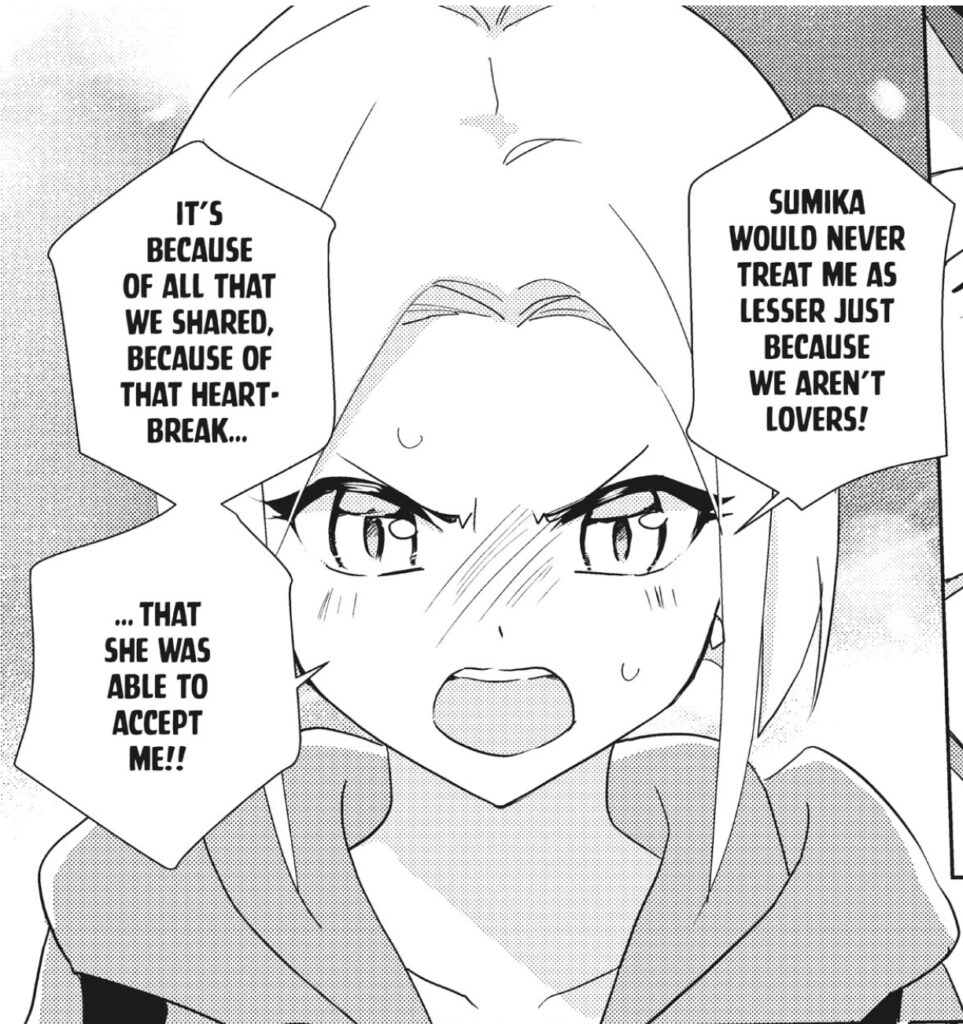
Goeido had always been a divisive character, I imagine. Since she was introduced back in volume four, she was shown to be manipulative and callous, something only expounded upon every time she showed up. Last volume, her and Kanoko went to a hotel together – just to ‘talk’. This volume, we get the culmination of that interaction, and boy howdy is it uncomfortable. Not happy getting Sumika and Nene to think that her and Kanoko are in a relationship, she essentially comes on to Kanoko, to prove to her that kissing and sex are important in a relationship. Kanoko is stuck, because admitting that kissing might be important means that Yano kissing Hime meant something, but if it was important, that implies that Hime didn’t mind this from Yano, something Kanoko cannot bear.
The sexual violence warned about on the contents page, I think, (although I’m concerned it’s a bit too easily missed, though I’m happy it’s there) refers to two separate incidents in this volume. The first with Goeido and Kanoko – where Kanoko unwillingly has her skirt and top taken off, and as far as the reader can tell, that’s as far as it goes (however, Goeido is at least twenty, but probably a little older, and Kanoko is 15/16). Equally uncomfortable was the second incident, where Kanoko, on the same day, forces a kiss onto Sumika, and feels up her breasts, without asking for any consent. Sumika pushes her away, and ultimately it shows up Kanoko’s extremely warped thinking, which honestly I have some trouble following. But they talk about it, which is good.
Goeido’s actions are reprehensible, definitely, and as an asexual person, extremely uncomfortable, but not for the reason you might think. I am fine with sex scenes in manga. It’s her implication that love cannot exist without sex, which I would like to vehemently oppose. I feel like this is meant to represent Goeido’s views rather than necessarily the mangaka’s, but it still sticks out as uncomfortable to me. For her, love and sex are completely linked in a way that no one else in the manga thinks about – and I can’t help but wonder if she might be aromantic allosexual, albeit terrible representation for an extremely underrepresented and demonised orientation. But to me, in many ways, it makes sense – her insistence that love is impossible without kissing and sex. Her ability to walk away from Nene when her job requirements changed. Nene states that every time they met up, they ended up in a hotel, having sex.
Honestly, I don’t even really like this interpretation, but it equally makes sense to me. I don’t like it because alloaros, as they are coined, are forgotten, or the characters that might most likely be alloaro are the ‘players’, the assholes who use people for sex then leave without a second thought, which is definitely not defining for the entire group, the same way other stereotypes are not indictive of entire other orientations. But in a manga where romantic love has been shown to tear people up, make them blush and just react in general, Goeido has always felt calculating and calm. Maybe she’s just in control of her emotions, apart from a few surprised expressions. But even with Nene, she’s always shown to be in control of the situation, never reacts much outside of a general pleasantness that she shows to almost everyone bar Sumika.
I think she’s a bit similar to Hime, actually.
Perhaps they are two sides of the same coin – Hime as the ‘good’ side, and Goeido as the ‘bad’ side. They both have a facade of innocent pleasantness, whereas their true selves are far more manipulative and callous. The difference is that Goeido seems to want to stir chaos and hurt people (especially Sumika), whereas Hime, when push comes to shove, wants to help and keep people together. Hime, though, has been forced to grow and change over the series, pushed by the immovable rock of Yano, refusing to back down and let her get away with her manipulations. Goeido hasn’t changed a single bit. She’s stuck on getting back at Sumika – and I’m pretty sure that’s why she came back to Cafe Liebe in the first place. Either to bait Sumika, or to get an in to get someone else to.
Perhaps Nene was onto something – maybe she was attracted to Sumika. As a beautiful lady, perhaps someone not being attracted to her heated so much she wanted to take revenge against everything that meant something to Sumika. Maybe she was just mad that Sumika saw through her facade. Who knows – part of me thinks this won’t be the last we see of Goeido, not that I especially want to see her again. I think I’ll be glad when the air starts to clear, as it might do next volume between Kanoko and Sumika, and we return back to Mitsuki and Hime.
Chris LeBlanc
I will admit, reading Volume 12 a second time to gather my thoughts felt even more uncomfortable than reading it the first time.
I have this idea that most online arguments could be resolved if people would just understand that different things work for different people. Goeido would disagree with this theory, however – I get the feeling she believes everyone else on the planet feels the same way she does about sex and romance, and anyone who claims to have different ideas about these things is being delusional. It feels like everyone in Yuri Is My Job! are on different pages when it comes to this, though, and while that usually makes for enjoyable dramatic conflict, let’s just say that Goeido crosses a lot of lines in this volume.
There’s a part later in the book where Kanoko claims to have been unharmed by Goeido, but this is clearly not the case, underscored by the black gutters and panel borders in this section (a technique normally reserved for flashbacks in manga). Happily, the visual tones eventually turn much brighter as Sumika tries to help Kanoko through this chapter, even leading to a cute bit where she tries slipping into Schwester-speak for a moment before dismissing it.
Eleanor Walker
There are many different kinds of love, and Goeido, one of our central characters for this volume believes that sex and love (and possibly violence, I would argue) are intrinsically linked, and one is not possible without the others. Moreover, anyone who disagrees with her is automatically wrong and must be shown the error of her ways. I am not generally a fan of sexual assault used as a plot device, but this volume handles it pretty well, and it works within the context of the story. However, the full colour spread of Goeido posing in lingerie to open the volume left me viscerally uncomfortable, especially in a series which hasn’t been terribly focused on fanservice. But my favourite moment was when Saionji shows up and reminds Goeido that not everyone thinks like she does.
Kanoko pretends that’s she’s alright after the event, but she definitely seems off to me, and I hope the next volumes have her getting help to deal with such a traumatic experience.
Matt Marcus
I struggled a lot with this volume. On the one hand, I understand exactly what Miman chose to do: they decided that Kanoko needed an extreme push to break her calcified conception of Hime and her relationships in order to drive her character arc forward. Narratively, it’s a sound maneuver, and it is effective insofar as it demonstrates how some people will desperately hold onto a belief despite knowing it will do them tangible harm, and how in turn they can reflect that harm onto others. On the other hand, I think what Miman chose to do was in poor taste and has negative implications to the themes of the series.
Goiedo was an interesting character to me. Sure, she was a bad person, but she was for the most part honest in her intentions. She was very clear with Nene that they were fooling around to make Sumika jealous and to have a bit of fun: nothing more, nothing less. It’s not really her fault that Nene’s feelings developed into romance…OK it kind of is, but she could have continued to exploit Nene’s feelings for her, but that wasn’t the contract they made. Yes, the relationship ended once it was no longer convenient for her which is a shitty thing to do, but nevertheless I found it compelling that she was a villain who meant what she said and held herself—and Nene—accountable.
What Goeido does to Kanoko, however, is simply beyond the pale. It’s one thing to play around with the heart of a sensitive girl, but it’s another to enact targeted psychological violence at the threat of serious intimate violence. To me, at that point she stopped being a believable plot device and turned into a plot contrivance. She is instrumentalized as a mouthpiece of a certain viewpoint on romance without any explanation as for why she believes it. There was an opportunity for this, as she is very familiar with A Maiden’s Heart and no doubt should have opinions on how it depicts relationships between girls and what it represents. As we see on the page, she has feelings on how the characters acted within the confines of the story, but does not take a viewpoint of how the story itself relates to the real world—in a series that is all about meta-narrative.
What tweaks me more, is that Miman wants us to believe that the assault happened…until Kanoko reveals later that it didn’t. And then Kanoko assaults Sumika. It all feels very emotionally manipulative, playing with very triggering subject matter. I think the same narrative turns could have been accomplished without it. Goeido can still be the villain; Kanoko can still panic and flail; Sumika can still be angry and hurt. It just didn’t need to be this.
This narrative turn also unintentionally creates problems for the meta-narrative structure of the series as well. There was always an ongoing tension between the sanitized, pseudo-romantic Class S performances in the cafe and the messier real relationships that were occurring simultaneously. So far, Goeido is the only character who transgressed the Class S “purity” by introducing sex into the story. Given how she’s also now unequivocally a predator, coupled with Sumika’s statement that she has no interest in a physical relationship with Kanoko, frames sexual desire as only a corruptive weapon. It aligns the “real” world with the fictional world of Liebe in that the relationship between girls is only good when it is the pure bond of the Schwesterns. It’s a turn that feels regressive, reminding me specifically of the muddled messages from the Yuri Kuma Arashi anime.
Hell, when you look at the whole of WataYuri, every kiss we’ve seen was given without consent—Yano on Hime, Goeido on Nene, and now Kanoko on Sumika. Physical romantic intimacy is thus represented as always a case of someone imposing their desires on another, starting at its origin (it’s worth noting that five of the six characters mentioned were experiencing their first kiss in this context). When Kanoko offers herself to Sumika, she says, “you have to hurt me as much as I hurt you,” clearly framing sexual intimacy as harmful. Obviously, one can have romance without sex—and that’s a great thing—but Miman seems to be saying that romance, at least between women, should only be without it.
We have had some great discussions about WataYuri in the Okazu discord, and one of the viewpoints raised by Erica and others is that one can read this series as celebrating the potential power of the bonds of sisterhood from Class S stories rather than rejecting it, which is an argument I can support; however, if the series also drags along the negative aspects of those tropes with it into the modern day, I’d rather such stories be left in the past.
Also the hotel should’ve been called Best Schwestern. I mean, c’mon.
Erica Friedman
I have now read these chapters three times. The first in the pages of Comic Yuri Hime magazine, where they were a genuine shock, again in the collected volume where I could take time to be truly angry at Yoko. As an adult, her actions are morally repugnant and criminal. I sat with my feelings about no one in the Cafe being able to see what kind of person Yoko was and, I’ll admit, considered dropping the story. I was that angry.
Now I have read the chapters for third time, this time in my native language and it allowed me a chance to delve into all the nuanced ways this arc has made me uncomfortable. Primarily – I do not like Kanako. I have never liked her as a character. Her obsession with Hime blinds her to everything and everyone else. When she hurt no one but herself, she was tolerable. When Sumika became involved, it was not. I am not a fan of “obsession” in literature, as it has been co-opted by serial killer/stalker “thrillers.” I have been trained to keep waiting for Kanako to snap.
Sumika’s own delusion is pretty high – she imagines that she is above romantic love and attraction and when intimacy with Kanako forces her to rethink that, she does not handle it maturely. Because she, too, is a child. We look at Kanako and see an innocent, naive girl, but forget that Sumika is only a teenager, as well. Kanoko’s inability to “see” other people and understand their motivations is a complicated matter. Yes, Kanako absolutely pings neurodivergent (as does Mitsuki,) but I, personally, have a belief that if you read that much, surely you begin to understand something about people. I did not understand people my own age, but I understood human nature as a whole at Kanako’s age, purely from reading books by and for adults.
So as we watch Kanako walk into Yoko’s hotel room, of course we are screaming at the pages of the book…but also I am screaming at Kanoko. How have she read so much and is unable to see that Yoko is not okay?
Yoko, too, has an obsession. Her only goal is to hurt Sumika. The why is not all that critical to the story, and it will be handwaved into an almost unbelievable act of hurting the thing one loves, as if Yoko is a child in kindergarten aggressively teasing someone they like because they don’t know how to act appropriately. As Matt points out, even though the why is not critical…there should have been an attempt at giving us a why.
This third time, I sat with all the layers of discomfort – not liking Kanako, but also forced to sympathize as she deals with all-too-real trauma. Not liking Yoko, on multiple levels, including the way she is presented to us as a sexual creature (encapsulated in a very uncomfortable-making two-page spread of Yoko in lingerie ), then her words and actions to Kanako making no real sense, as if she’s a cult member trying to proselytize. And Sumika, whose desire to protect Kanako is bifurcated into competing needs for intimacy and responsibility, with no clear understanding of how to do either. And back to Kanoko, who will deal with this trauma…but maybe not take the right lesson from it?
This is a rough volume, about characters making bad choices sometimes for good reasons, sometimes for appalling reasons. But it is an important volume to move both Sumika and Kanoko out of their childish delusions, into more adult delusions. The question I am left with is…is this what we needed or wanted from Yuri Is My Job!?
For such a silly premise, this story has had more than it’s fair share of me shouting at the characters.

 by
by  Matt Marcus is a serial enthusiast whose range of appreciations include guitars, watches, and a particular genre of Japanese popular media named after a flower. Outside of writing for Okazu, he cohosts various projects on the Pitch Drop Podcast Network, where he frequently bloviates about video games, anime, and manga. He also hosts a blog Oh My God, They Were Bandmates analyzing How Do We Relationship in greater depth.
 by
by