 by Matt Marcus, Staff Writer
The other day I attended an “empty the bar” party for a friend of mine who is moving to Hawaii. Naturally, most of the drinks served were tiki drinks, strong but easy-drinking concoctions of tropical fruit juices mixed with multiple types of overproof rum, often complimented with an earthy hit of allspice dram. The first drink I reached for, however, was not like the others: it was a Bardstown, a potent mix of apple brandy and rye, the kind of drink you nurse slowly as the ice in the glass melts, softening the bite of the booze. I took one large sip and nearly coughed it up onto the floor. I decided to set it aside and make the rounds through the other offerings—a mai tai, a zombie, a painkiller—but I would come back and take a sip of Bardstown here and there. I liked it, but I was not looking for something so intense in such a large dosage.
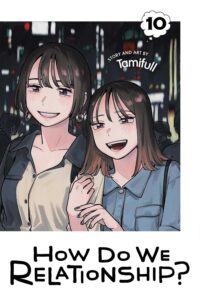
I was thinking on how to approach this review of How Do We Relationship Volume 10, and as I mulled it over, I was thinking about the discussions I’ve had within the Okazu Discord and elsewhere, especially after Erica’s review of Volume 11 in Japanese. I remembered that Bardstown, and the thought rose in my mind that you can think of manga series like cocktails. Citrus is flashy and trashy like a tequila sunrise—a poor decision in a glass. Whispering You A Love Song is a virgin Shirley Temple: bubbly, sweet, and at worst will give you a tickle up your nose. How Do We Relationship—when the mix is right—is a negroni. It’s complex, with top notes of herbaceous bitterness but lying beneath is a sweetness that carries you forward to the next sip. And if you have a low tolerance it will knock you on your ass. It’s not to everyone’s taste, and it may not be the right drink for every occasion, but those that love it will reach for it over and over again. The rub is, after all the heartbreak we’ve seen these girls endure, I’m sure that a lot of readers are thirsting for some sweet relief. But Tamifull is the bartender, and their hand is getting heavier on the pours.
In Volume 9, Saeko went through a rough stretch leading up to her coming-of-age ceremony only to be saved serendipitously by Miwa. Saeko opens up to Miwa about her past, and the two connect more deeply as friends than they ever had as lovers. Meanwhile, both are having mild struggles with their respective girlfriends, but with each other’s support they should be able to weather these small bumps in the road. The volume ended with a potentially awkward run-in with Tamaki that may blow their “we’ve only ever been friends” story.
Of course, if you’ve read the series this far you know that Tamifull loves to set up a cliffhanger to end a volume only to lead to an anticlimax at the start of the next. Despite a little bit of sulking, Tamaki ends up making use of the knowledge that Saeko used to date Miwa, because she’s in need of some advice. Miwa wants to have sex frequently and she just can’t understand why. But even knowing the “why” does not answer the “how” she will handle it.
What it boils down to is that Miwa and Tamaki have completely different feelings on sex. Miwa’s sex drive is high but has yet to be satisfied; Tamaki mostly feels like sex a chore, albeit one she can sometimes enjoy in her own way. They do have a conversation about it, but you can tell that they are not really understanding each other. Tamaki isn’t really being honest with herself about her needs and wants, and she is definitely unaware of the mixed signals she gives to Miwa. Miwa for her part is letting her anxiety overpower her ability to listen. The tension continues to simmer throughout these chapters.
Meanwhile, it turns out that Yuria struggles with depression (surprise!) and does not want Saeko around when she is in that mood. Adding to her feelings of personal failure at work, she feels miserable about Saeko’s decision to aim for a high-paying office job to help support her dream of starting her own salon. Saeko feels like she’s acting with the best of intentions, but she can’t convince Yuria to accept her choices. The injection of this point of conflict feels like a hard left turn for Yuria’s character in a way that seems calculated. On a metatextual level, I can feel the hand of the mangaka planting the seed of destruction for the relationship, which is a bummer especially after all the work and growth that those two have accomplished together. Nevertheless, it is darkly funny to me for this turn to happen right after I sang Yuria’s praises in my last review.
That’s not to say that this volume is all doom and gloom. When Tamaki reaches out to Saeko to talk about Miwa, it is a nice moment of vulnerability for her and an opportunity for Saeko to help her friend. Miwa also runs interference with Yuria and helps smooth over the current rough patch with Saeko, demonstrating how much she cares about Saeko’s happiness. Yuria and Saeko have a fun onsen trip together, and at the end of the volume they visit Yuria’s hometown to meet her twin sister and her fiancé. All of this great character growth building off of the last volume. That said, there isn’t much relief to be had because of the festering undercurrents that are flowing beneath both relationships. Think of it like replacing the Gosling’s in your dark & stormy with the Reed’s Extra.
I’ve noted in past reviews that the way this series tracks time is quite loose, and in this stretch I felt it most acutely so far. It was surprising for me to realize that by the end of this installment over a year has passed since the end of Volume 8. (Someday I will map out each volume on a timeline for the blog, which I will update eventually I swear.) That leaves an awful lot of time that we don’t get to see. In particular, we don’t really spend any time with Miwa and Tamaki enjoying an outing without some kind of tension undercutting or tempering the proceedings. What Tamifull choses to show has always leaned towards scenes that drive the plot forward, which naturally means conflict. It can be exhausting, unless you are someone who has a high craving for drama. After all we’ve seen Miwa go through, I think we deserved to have her be happy and satisfied on the page for more than a few fleeting moments.
There is one other pattern in Tamifull’s writing that I am starting to notice, which is that relationship developments for side characters function almost entirely to comment on or signal something about the main pairings; in this volume, it is Mikkun and Rika who serve that purpose. It can feel a touch on the nose, like when Tamaki voices her empathy for Mikkun’s old ex-/current/soon-to-be-ex-again girlfriend, who is described as sex-repulsed. Tamifull does mention in the author commentary that there are lots of dangling threads for the secondary characters that had to be cut to keep the story moving, and this is one of the consequences.
Personally, I’m still enjoying the story even if moments started to wear on me. There are plenty of elements of Tamifull’s writing that I continue to appreciate, such as the continuity of character. I briefly turned into Leo DiCaprio pointing at the TV when Tamaki observes that Miwa has a preference for romantic clichés, something that goes all the way back to the beginning of the series. Also, Saeko’s tendency play caretaker makes another appearance as she tries to keep Yuria from falling deeper into a self-care spiral. The dishwashing scene is a very well observed moment of caring for a partner who struggles with depression that really hit home for me. It’s the depth and nuances of small moments like these that constitutes the sweetness that lingers after the bitterness fades.
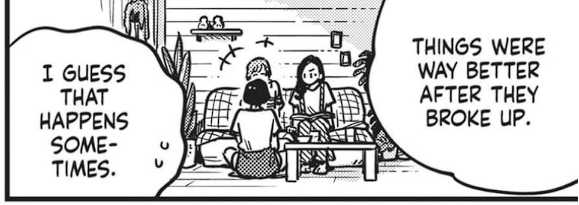
Apropos of nothing, I am always amused when a series sums itself up in a single panel
If nothing else, How Do We Relationship continues to serve up the most potent dose of painfully relatable love in the Yuri/GL space. If you’ve missed that stinging sensation on your palette from earlier in the series, you’re going to be savoring this volume.
Art – 9 You know you’re in too deep when you start to notice how the way the character’s noses are drawn has been subtly changing over the past few volumes
Story – 8 You can start to feel the needle move back towards the negative, which may be fatiguing for some
Characters – 8 There is some unevenness with Miwa and Yuria in the service of drama that feels a touch heavy-handed
Service – 6 Yes there is sex but I’m also counting Saeko in her job hunting suit in this score
LGBTQ – 10 Is there really any doubt at this point?
Overall – 8 The bitter top notes are starting to overpower the other flavors, but it is still plenty potable
Volume 12 is currently available in Japan and you can catch up completely with the simulpub chapters on the VIZ Manga site or app. A college LGBTQ drama so real, you’d swear you owe tuition.
 Matt Marcus is a serial enthusiast whose range of appreciations include guitars, watches, and a particular genre of Japanese popular media named after a flower. Outside of writing for Okazu, he cohosts various projects on the Pitch Drop Podcast Network, where he frequently bloviates about video games, anime, and manga. He also hosts a blog Oh My God, They Were Bandmates analyzing How Do We Relationship in greater depth.

 A young woman on the cusp of adulthood latches onto an older woman and pursues her, but a sheltered adolescence causes her to come off more child-like than her age might suggest. The older woman, burned by past relationships and not looking for another, thinks of the younger woman more as a daughter than a potential lover, but eventually finds herself reconsidering what they mean to each other.
 by
by