
The Secret of Girls

November 19th, 2025

Promotional poster for the Chinese baihe drama The Secret of Girls, showing the four main characters.Baihe (Chinese yuri) is having a mini-moment. Seven Seas Entertainment just released its first baihe novel, the Baiheverse site is making steady progress on its project of licensing baihe manhua, novels, and other works (including the short film When We Met), and enough other works are being teased for licensing that what has been a mere trickle of official English translations promises to become a growing stream (albeit nowhere near a flood).

Unlike baihe novels, which (like their danmei/BL cousins) mostly seem to traffic in historical fantasy, The Secret of Girls (original title 如果有秘密) is a realistic contemporary baihe drama, now available on the GagaOoLala premium service. As it begins, young Xu Jingxi (He Lei) is laid off from her job, decides to go traveling (for a reason that the GagaOoLala synopsis spoils, but I will not), loses her wallet, ID, and phone while helping another woman, and ends up prevailing on older hotel employee Wen Shan (Sun Cailun) to let her have a room in exchange for working at the hotel.

At first glance the setup is reminiscent of many other yuri works: a free-spirited extrovert who’ll end up softening the frosty exterior of an introverted tsundere. However, Xu Jingxi’s outgoing persona is a cover for her suffering, the nature of which is slowly revealed as her romance with Wen Shan progresses. But the series is about more than the ills of one woman: the back stories of both Xu Jingxi and Wen Shan, and their relationships to their mothers in particular, form a sharp critique of a patriarchal society that demands that daughters show filial piety but offers them little or nothing in return.

Suffice to say, The Secret of Girls is not a series with a “happily ever after” ending, but it’s far from being “tragedy porn.” This is in large part due to the performance of He Lei, who takes what could have been a simplistic character and makes her richer and more complex. (As it happens, He Lei also starred in When We Met, another tale of a younger woman winning the heart of an older one.) Sun Cailun is a worthy companion to her, portraying Wen Shan’s slow and subtle opening up to friendship and then love. I should also mention Li Keyi and Wang Miao, who play hotel owner Ling Yung and bar manager Qin Bei respectively. Their characters support Xu Jingxi and Wen Shan in their evolving relationship and contribute a more light-hearted tone and a very sapphic vibe: The two women live together and are clearly in a relationship of their own, and Qiu Bei’s bar “Her” is advertised as being “Where Ladies Meet.”

My main complaint with The Secret of Girls is with its packaging: It was originally released as 24 five-minute episodes on the WeChat app, and the amount of actual content is such that it could have been (and I think should have been) released as a feature film. However, GagaOoLala is presenting it as 16 episodes, with multiple minutes in each episode taken up by a lengthy OP (which spoils many of the scenes in the series and is untranslated to boot) and even more time taken up in several episodes by an equally lengthy credits sequence. Regarding other aspects, the GagaOoLala version has at least one scene that was almost certainly excised for the Chinese domestic audience; it makes explicit what was already very much implicit in the portrayal of Xu Jingxi and Wen Shan’s feelings for each other.

Rating:

Story – 7 (a potentially clichéd and maudlin plot redeemed by the writing and acting)
Characters – 9
Production – 6 (points deducted for chopping up the material)
Service – 3
Yuri – 10
LGBTQ — 5 (not explicit but very queer-coded)
Overall – 8

The Secret of Girls is not an easy watch at spots, but it’s definitely recommended for viewers who are tired of relatively superficial or melodramatic yuri series (looking at you, Thailand) and want to see a more realistically emotional human drama. It also marks a welcome second outing for He Lei, whom I hope to see more of in future baihe series.



Thank you Y/CON!

November 17th, 2025

From the left Lou, Erica Julie on Saturday at Y/CONWow, Y/CON was so much fun! I highly recommend it to anyone who can get to Paris for the event. First of all, everyone was so charming and enthusiastic, from Y/CON staff to every one who listened to our panels or came to get a book and chatted with me.
I did a presentation on the history of Yuri fandom, and had roundtables with author Rutile and Louis-Baptiste Huchez of Taifu Comics, in which we talked about Yuri internationally and with Dr Pralinus, about BL and Yuri and queer joy.  We of course did not have not have time, but our conversations were really interesting. I have so many people to thank I know I won’t remember everyone, so if I miss you, please remind me!

 Thanks to Alex, who was a wonderful driver, Shaby, Shane and Paul in the green room who helped us find the bathroom down the dark corridor of nothing and made us feel so welcome. Olivia, Elisa, Valentine for arranging everything, Lou for being a fantastic moderator and Julie for doing an outstanding job a translating my insistence on being aggressively, joyfully, queer as a form of political resistance. 

This last kept coming up over and over as we are seeing a resurgence of fascism globally. Dr Pralinus and I agreed on many things, but as they spoke of how queer people have always been here and we will always be here, even if we have to hide, I suddenly was hit with an epiphany that hiding is not the way. We have never been safer for hiding. As we see with protestors dancing and singing in costume, joyful resistance makes the oppressors look even MORE ridiculous. My message was that they are the weirdo minority, not us. So enjoy your BL, Yuri, trans manga and be loud about it. 

It was exciting to see Akata Editions, Hana and Taifu at the event, I’m jealous of French Yuri fans that they have schwinn’s Hana Monogatari available to them.

Before I wrap up I want to wave hi to Mang’Albine and Resuri, it was so amazing to meet you both in person and I will see you online!

I hope to return to Y/CON one day soon.


No YNN This Week

November 15th, 2025

No YNN this week, I’m off on an adventure and will report back asap!


I Wanna Be Your Girl, Volume 2

November 14th, 2025

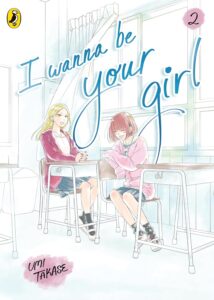
Cover of I Wanna Be Your Girl, Volume 2, Two young women in sweaters, one red, one pink over Japanese style school uniforms sit in a classroom. Curtains blow from open windows,By Eleanor Walker, Okazu Staff Writer

Volume 2 of I Wanna Be Your Girl picks up right where the end of Volume 1 leaves off, with Akira declaring that she wants to be the soccer club manager. Compared to volume 1, this volume focuses more on the individual characters rather than their relationships with each other, and it’s nice to learn a bit more about both of them and how they ended up where they are now.

Hime meanwhile, confides in another girl called Yukka about her feelings for Akira and the confusion they’re causing her. Yukka, as it turns out, has her own past trauma around queer love and that’s why she’s able to advise Hime so well. This section was actually my favourite bit of the entire volume because it’s pretty much how I felt about my friend back then too. To quote myself from my volume 1 review:

“When I was in high school, I had a crush on someone who I thought was a boy, but she told me she was actually a girl. My reaction at that point was “huh, that’s a bit weird but ok” and still kept kissing her.”

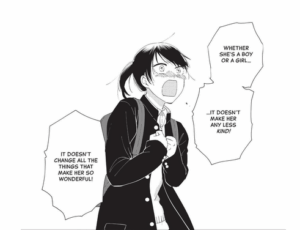
We then return to Akira and her new job as manager of the soccer team, and reality bites hard when some of the other members start misgendering her and someone makes a comment along the lines of “why isn’t she growing her hair out if she’s really a girl?” One person however, Hasegawa-senpai is utterly supportive, has nicknamed Akira “juice girl” and when others on the team misgender her he gently corrects them. And it turns out Akira might just have a bit of a crush on him. Just normal teenage girl things.

The other thing I liked about this volume is that it shows Hime going through her own kind of identity crisis as well. She’s wearing the boys’ uniform to support Akira, but she is ultimately still cis, and she can go back to wearing the girls’ uniform at the drop of a hat. She talks to her parents, who are thankfully supportive, and ultimately decides she will go back to wearing her uniform and shows up the next day in it.

Where would we be without a bit of teenage angst though? Hime and Akira run into Hasegawa-senpai, who at first doesn’t recognise Hime because she’s in the girls’ uniform, but then he calls her cute and that rips through Akira like a knife to the heart. Hime runs away crying to the rooftop stairs, a mysterious boy appears and invites her to the roof. Turns out, he has a secret of his own as well. He works at Hime and her friends’ favourite cafe, but cross dresses as a girl while he does so, also to support someone he cares about.

Ultimately, the volume ends with Akira resolving to talk to Hime and apologise for lashing out at her, thanks to the support of their friends, and I’m sure we’ll see that in the next volume.

Overall, this is a good continuation from volume 1 which dives more into the individual main characters, and they do still feel like realistic teenagers. However, I hope we get the teacher’s backstory at some point as well though which was hinted at in volume 1. With 2 volumes to go, I’m excited to see where Hime, Akira and everyone else ends up.

Story – 7
Art – 6.
Characters – 8
Service – n/a
LGBTQ — 10

Overall – 8 but again, probably a 9 if you’re a confused/closeted queer teenager.


A Mangaka’s Weirdly Wonderful Workplace, Streaming on Crunchyroll

November 13th, 2025

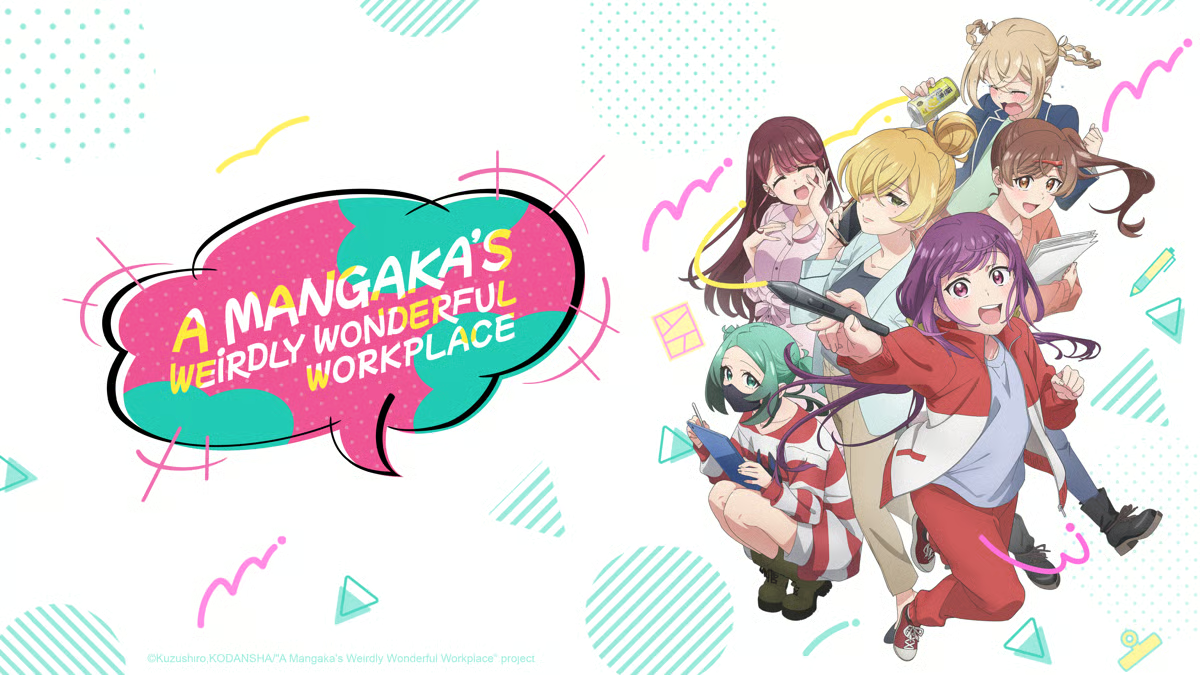
A voice bubble of aqua and pink, with the title A Mangaka’s Weirdly Wonderful Workplace, , next to an drawing of the ensemble of characters, led by a woman in a red and white track suite with purple hair, holding a computer stylus.Manga artists work hard. Like so many people in creative jobs, their hours are frequently full of nothing to do or deadline chaos. Even now, manga artists work on tight deadlines. The traditional meal for manga artists and their assistants was ramen, cigarettes and beer. But why, you might ask?  Because, also traditionally, manga artists pay their assistants out of their own pockets, as they work on the serialized chapters of their story, until a volume is made, then the artists would  get royalties from the sale of the collected volume.  For more established artists, they might have studios where assistants apply to learn from them, as well as do background work. Probably some young artists trade assists, each helping the other out.  If you are really interested in a relatively recent experience, I recommend Jamie Lyn Lano’s The Princess of Tennis: My year working in Japan as an assistant manga artist. The book is out of print, but you might find it through Interlibrary Loan or check out this interview with them on Youtube.  Jamie worked as an assistant to Takeshi Konomi, creator of A Prince of Tennis. As manga artists gain success sometimes their editors can find them help, and I imagine most know a few freelancers who can do some gig work these days.

You may be wondering if this model is different now? Probably a little yes, but mostly no. Crowdfunding, comic markets and digital publishing still mean deadlines, even if a creator is no longer crushed in the crucible of weekly series as often. I know younger artists are keeping more control of their IP and even older artists change publishers now, which used to be absolutely not a thing that happened. 

In A Mangaka’s Weirdly Wonderful Workplace, streaming on Crunchyroll, details a fictitious current set-up, centered on Futami-sensei an artist with a current hit manga series, who is drowning under deadlines, but still isn’t sure enough of her success or status to ask for help.  Futami appears to be a hot mess, but we are instantly made aware that she had a terrible editor, who undermined her constantly, so her lack of confidence is wholly understandable. Just in case we forgot what a shitbox he was, we’re reminded later that it is very definitely his fault that she’s so fragile. This tracks with some recent stories in which artists like schwinn have posted how their editor belittled their work. The pain in Futami’s experience feels personal and while I hesitate to claim it’s “clearly” autobiographical, I’ll remind you that Kuzushiro’s first breakout hit was Kimi no Tamenara Shineru, a Heian comedy about Sei Shonagon that ultimately went 14 volumes. It feels awfully personal. Which makes it more powerful. 

Futami’s current editor Sato and she have a very cute, fauxmance relationship. Still not entirely comfortable just being honest, and often too excited to remember to be professional, they quietly crush across the table at each other. It’s very cute and played very gently. Sato is a safe space, not a lover. 

The rest of the cast builds up quickly, Futami’s competent assistant Ha-san, remote assistant Nekonote and Nashida, a woman who is now saddled with the terrible editor who has killed her series. Nashida’s day drinking. It’s not funny how much trauma she’s suffered. But in her pain she is really very funny. Her repeated “editors and men, they are all the same” is a line delivered with such absolute deadpan perfection by Kobayashi Yuu that I twice laughed out loud. 

My only objection to the anime is the same as it is in the manga, which I read, but did not review here. It is very shouty. It’s just part of Futami’s personality. 

Ratings: 

Art – 8
Story – It’s a sit-com more than a story 7
Characters – 8
Service – None thus far
Yuri – 1, maybe two, for Futami’s akogare of Sato.

Overall – 8

This is meant as a workplace comedy, so expect inside jokes and “mangaka writes about being a mangaka” stuff, but so far the ensemble is fun, the cast excellent. Itou Miku as Ha-san, her voice is filled with gravitas and competent calm. If you don’t mind occasional shoutiness, this is a fun, and warm-hearted look at the life of a mangaka.