Yuri Network News (百合ネットワークニュース) – January 9, 2021

January 9th, 2021

Yuri Anime

Yuri scifi/horror anime Otherside Picnic is streaming now on the local legal streaming platform you use. For the US it is Funimation.com. The first episode is up for subscribers and it is getting very positive response! Feel free to drop by the Okazu Discord with your thoughts on this popular series!

We got our first look at the Outer Senshi with the Sailor Moon Eternal, Part 2 trailer that was released this week. Thumbs up from me. ^_^

Puella Magi Madoka Magica has announced an upcoming tenth-anniversary project and a new website with art by original character designer Aoki Ume. Alex Mateo has the details at ANN.

Via Senior YNN Correspondent Eric P, the first three seasons of She-Ra and the Princesses of Power out on DVD!


Yuri Manga

Yuri local travel/daytrip manga Futari Escape (ふたりエスケープ) has been collected into a first volume. If you ever wanted to know about the dinosaur museum in Fukui Prefecture, this is your manga! ^_^

I am actually, honestly delighted that the fine art Yuri manga, Koisuru Meiga (恋する名画) is getting a second volume. I really enjoyed the first volume.


Yuri Webcomic

Finally, someone has made a manga for me! ^_^ Tsukuritai Onna to Tabetai Onna (作りたい女と食べたい女) is about a woman who loves to cook and her partner who loves to eat! You can read chapter 1 in Japanese on Comic Walker.


Become a YNN Correspondent:  Contact Us with any Yuri-related news you want to share and be part of the Yuri Network. ^_^

Thanks to our Okazu Patrons who make the YNN weekly report possible! Support us on Patreon to help us give Guest Reviewers a raise and to help us support more queer creators!
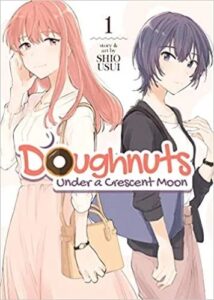
I’m in Love With the Villainess, Volume 2

January 8th, 2021

Remember how amazed we were in Volume 1, when the characters of Claire, Misha and Rae had a frank discussion of sexuality? Well, I’m In Love With The Villainesss, Volume 2 has looked at Volume 1 and said, “Hold my mead”….

Rae Taylor is an extraordinary young woman, because in fact, she is not a young woman. She is a corporate drone from our world who has found herself in the world of her favorite otome game as the player character. Instead of romancing the princes, however, Rae has opted for a new route; one in which she is romancing the villainess, the aristocratic and strong-willed Claire François. Here in Volume 2, the holodeck controls are off and Rae and Claire run full speed towards a resolution that even Rae with her knowledge of the game can not predict.

As a reader and as a writer, I ascribe to what we called at the Fanfic Revolution called the “one-handwave” theory. This theory allows every world is allowed one massive, ridiculous, inexplicable thing that must be accepted at face value and cannot be questioned. This volume of I’m in Love With the Villainess, *immediately* blew that theory to hell in the most hilarious way I have ever seen. And then it did it again. And again. The rules? They are for some other story. This story could not have cared less what rules say. Massively important plot points were handled with literal magical handwaves, while actual time and attention were given to discussions of same-sex attraction, gender dysphoria, and, of course, the social impact of income inequality and political upheaval. It was compelling to say the least. It was a little too on the nose for this week, in particular.

This volume is significantly larger than volume 1. Given the resolution there’s only one thing the author left undealt with so Volume 3, when we get it, ought to address that.

In the meantime, this was an amazing read. Whatever benchmark might have been set by Volume 1, was shattered with sound-of speed waves as this volume goes blasting by it. It got exponentially queerer as the story went on. Final tally – 6 queer characters among the main cast, and a happy ending for our principles. And an epilogue that made me ugly cry at 2AM.

I give it my strongest recommendation. If you have not read this series, I hope you will. I know isekai isn’t everyone’s thing, but this is a shining example of exactly what I was talking about in my essay about queer representation Author Inori doesn’t consider that the limits of the worlds that previously existed are the limits of what the worlds could be. They’ve taken an already played-out plot driver and used it to explore very real-world situations in fantasy cosplay and come up with a different resolution. Rather than just assuming what was is what has to be, this series models a new ideal.  I feel even more confident that this was the right choice for my Top Yuri of the year for 2020, and it is going to be very, very hard to beat for 2021. But you know….I really hope something does beat it, because that would be something. ^_^


Ratings:

Art – 7 Okay. I’m still angry we didn’t get a picture of Claire in the tux in V1.
Story – 10 Perfection
Characters – 10
Service – 3 Yes, but…somehow this time didn’t bother me at all.
Yuri – 10
Queer – 10

Overall – 10

“Miss Claire, watch over me now.” I am slayed.


Lucky Boxes and I’m In Love With The Villainess, Volume 2 aka no Okazu today

January 7th, 2021

Cleaning up some last items from the great office clean up renewal  and you know what that means…. Lucky Boxes to start 2021! Keep your eyes peeled for the post here on Okazu. ^_^

In the mean time, I’m taking today off to read I’m In Love With The Villainess, Volume 2, which dropped this morning and *nothing* is as important as me reading it right now. It’s amazing. Go read it and we can talk about it when we’re all done. ^_^


Girl’s Kingdom, Volume 1

January 4th, 2021

A few years ago, I was approached by a relatively new publisher of Yuri webnovels, GL Bunko. They wanted to bring their books to the western audience. I took at look at their first title, GIRLS KINGDOM 1 & 2 (that is to say, the first two webnovels of the series, collected. I found the book to be humorous and imperfectly – but sincerely – translated. And I had some hope for the series. I have since read and reviewed a few other GL Bunko novels and likewise find them to be highly entertaining. ^_^ It was a pleasure, then to hear that J-Novel Club has picked up GL Bunko titles and is now offering us Girls Kingdom, Volume 1 as a collected light novel volume.

Let’s get the main questioned answered right away – yes, this book is fun and at times, funny.

Written by Nayo and illustrated by Shio Sakura (whose work you’ve seen in other GL Bunko titles, like A Lily Blooms in Another World,) Girls Kingdom is centered around some classic Yuri tropes – the private girl’s school for obscenely wealthy young ladies with no grasp of the real world (TM), maids and a main character who has lived under a rock and signed up for a school having never once looked at its home page, much less read the handbook. Within these tropes, the story is clever. At this particular school half the students are obscenely wealthy young ladies with no grasp of the real world(TM) and the other half are young ladies vying to become their maids.

Misaki is a student with straightened circumstances who wants to study at Amanotsuka Girl’s School because it is free. Why it is free is not interesting to her, so she ignores all the information she is given and arrives at the school, an uncarved block. An uncarved block who is late to the entrance ceremony and happen to be discovered by one of the most powerful students at the school, Amanotsuka Himeko. Himeko confirms that Misaki has no interest in being a maid and straightaway makes Misaki her maid. And, so, Misaki is thrust into the cuthroat world of competition to become ladies’ maids to obscenely wealthy young ladies with no grasp of the real world (TM).

The remainder of the story is…well, honestly it’s gobsmackingly silly with dollops of tiresome fanservice, but because it’s so irrepressibly silly, it’s easy to enjoy. A quality that has, so far been my experience with GL Bunko. As you may remember the other series I’m reading from them is Kunoichi Bettegumi Igarashi Satsuki, (くノ一別手組ー五十嵐五月) about a samurai bodyguard and the very-probably-a-vampire she serves. These are not novels one needs to analyze deeply. They are novels one ought to read without letting your brain get in the way. But if excessive discussion of underwear and random groping is a deal-killer for you, then you will want to avoid this. There’s are twin maids, and you know that never goes well. ^_^;

Absolutely going to give props to translator Philip Reuben, editor teiko and the entire J-Novel Club team for making sense of this novel while  keeping the loopiness of the story intact.

As I said in my initial review, a “climactic “battle” of table manners fill the final pages of the book. If you did not already know how to eat escargot when you begin this book, you will by the time you finish.” which ought to give you an idea of where you stand with this novel.

Ratings:

Art – 8 Vastly improved from the original version, if, again, heavy on the service
Story – 7 Even sillier than I remembered.
Characters – 8 Enjoyable. Honestly
Service – 7
Yuri – Erm….kind of hard to judge, as its mostly fanservice and “maid’s loyalty” kind of stuff, 3? 5? I dunno.

Overall – 7

My very sincere thanks to J-Novel Club for the review copy. I definitely look forward to Volume 2, which ought to arrive with spring.

Thanks also to my Okazu Patrons who voted for this to be the first review of 2021!


Your Story, Our Story, My Story: When and Why Queer Representation Misses the Mark

January 3rd, 2021

Once upon a time, a long, long, time ago, a few devoted fans of anime sat hunched over their computer keyboards. The sound of the modem was loud and screechy, but it signaled their journey to Usenet, and groups where they could – for many, for the first time in their lives – talk with folks who had similar interests as they did. Among those fans were a small group of folks who were interested in characters who – it seemed to them –  were, androgynous, or butchy or otherwise queer.

Back in those days, when a new character showed up who definitely, probably had a crush on a character of the same sex or even more rarely a couple who were clearly a couple, this group would rejoice! We are represented! They would celebrate with fanfiction, and music videos and art and cosplay and other rituals.

As years passed, we were given more of this; more couples, more characters who represented the things we looked for in media. But the more we got, it seems, the less we’re satisfied. This is true not just with anime, but with every media. Why is it that attempts by media companies at representation now feel so flat and stale when formerly it was so exciting?


Your Story

Over the new year holiday I was reading articles about media franchises that were/are not for me, and the reactions of those various audiences….and thinking about how much work we, as fans, put into a franchise to make it our own.

Trans and queer kids read Harry Potter and felt the story about a kid who is othered by his family spoke to them, personally. It makes perfect sense that they did, of course, and their love for the series that validated their existence was fierce. Which made the ongoing betrayal of that fandom by the creator just that much worse. Molly Fischer’s Who Did J.K. Rowling Become? seeded an idea in my head.

Following upon that, I read Andrew Tejada’s Representation Without Transformation: Can Hollywood Stop Changing Cartoon Characters of Color?  and I saw the exact *same* questions being asked. As media does a better job of diversifying stories…why are we more unsatisfied than when we had no representation at all? I thought back to those Usenet days, when a character might appear on screen for one episode and still become a Yuri icon.

Because we had less representation, we were more easily satisfied with what we could get.

The gold area in the target was bigger- merely seeing someone like ourselves on screen or on the page…or even someone whose issues we could slot into our own….was enough to be cause for celebration. A gay character in a movie who wasn’t predatory, murderous or mentally unstable was a triumph. Something that showed a non-straight, non-cisgender person in a positive light – even if they were played by a straight actor, or the portrayal wasn’t perfect – was significant. The bullseye was easy to hit, because so few companies bothered even trying to shoot at the target.

Creative studio CLAMP was given endless amount of queer cred, simply because they had same-sex characters who sometimes touched, or had obvious affection for one another, even if it was often unspoken and invisible. They were not queer creators writing about themselves; they were a creative team giving us a glimpse of how they’d like to see us. We accepted it as how they thought we’d like to be seen. This is Your Story, they said, and we accepted gratefully.


Our Story

In 2013, Adachi and Shimamura (安達としまむら) was a light novel series in Japan. The first volume had come out 2012 and by 2013, there were two volumes. I read the first and was unimpressed. Over the years, as the series progressed and picked up fans, my initial review would on occasion receive unsatisfied comments, because I had failed to anticipate how the series would progress over 8 years.  ^_^ In 2013, some Yuri fans in Japan were delighted by this series which contained a reference to the author’s previous work and evolved into a romance.

By 2013, I had already seen Yuri go through a number of shifts and changes. We’d had Aoi Hana / Sweet Blue Flowers, for almost a decade by then. We were in a boom of Yuri, with three manga magazines, a handful of out creators, a lot of queer fans online.  Straight fandom was happy enough with another schoolgirl story, but queer fandom was already asking where were the adults?  Where were the lesbians? Where were the queer people in these queer stories?

We were no longer as satisfied with media crumbs as we had been. When in 2015, Yuri fans got a new gateway Yuri series, Bloom Into You, it had both lesbians AND adults! (This is exactly why I’d like to see more adult role models in teen lit. For a lot of queer teens, seeing one adult who is open, happy and out can make the most extraordinary difference.)

Yuri as a genre had already left girl-meets-girl stories behind, here we were able to see something that looked more like our story. But, even as we got closer, many of us were waiting impatiently for queer Yuri to become more widely available. When folks began to identify with Yuu as aromantic or asexual no one argued that they were wrong. What we said was, “this may be Our story, but it might not be Your story, so don’t be surprised if Yuu ends up not aro or ace.” The odds that the series might miss that mark grew, even as it hit other marks in the gold. Because the targets had become more specific, it became less likely that all of them might be hit.

Because we had more representation, mediocre representation fails to satisfy us.

We wanted more. We wanted what all marginalized groups have wanted – to be represented in our media. If this story is ours, we argue, then we should be involved. Valid criticisms of Disney’s movie Soul argue that they missed opportunities to make the story as authentic as they might have. Intentions aside, some folks felt it was praiseworthy for aiming in the right direction, while many critics saw it as Disney handing out another Your Story. I had a similar reaction to watching Kinky Boots, a story many older straight women had told me they enjoyed. I mostly saw all the old, tired stereotypes. This is “Your Story,” the straight audience was saying. Look, how happy it is!


MY Story

Fans aren’t always looking for specific reflection of their selves. Obviously not, as so much of fandom has been built upon media created by and for and, most especially about, people unlike us. We’ve been happy enough following Frodo and Sam and Luke and Han, and Kirk and Spock. It’s just that after decades of that, some of us want stories that make space for people like us.

The closer media comes to representing us, the higher the emotional stakes are for us.

Now, in 2021, when we see media that purports to represent us, we’re looking at, not just who it is for, but who made it, who is in it – who the cooks and servers are, as well as who is at the table. It’s not that we don’t believe that someone outside whatever we define as “us” can’t possibly tell a story well, it’s that we’d really just like to be included when our story is being told as a bare minimum. Without me in my story…is it really my story?

Even worse, if the so-called representation fails to hit the mark, there’s more emotional risk and, in some places, actual physical risk. If a mainstream media shows say, femme lesbians as good and butch lesbians as predatory, that could have serious real-world repercussions. Which is why you saw gay men angry about gay representation in The Prom. It might be their story…but the guy playing it wasn’t them. Worse, it annoyed the hell out of folks who thought an opportunity for a not-tragic gay story was missed.

When the shot comes close to the gold, but fails to hit it, for some folks, it might as well have missed the target altogether. When I watched the trailer for The Happiest Season, I thought, “Well, this may be Our Story, but it’s not My Story.” It’s a story that spent a lot of time in the unfun stereotypical pain of being closeted and very little time in the joy of being in love. I do not in any way object to other people enjoying it – but it’s not for me. At all.

A Yuri story in which no one is gay or there is no recognition of the couple as a same-sex couple from characters around them; where there is no society, they have no friends who are gay or a community…or media…or a functional Internet… feels obviously inauthentic at this point.


Hitting The Gold

For decades, we’ve accepted corporate entities and straight creators telling us “This is Your Story.”

Now, we are even getting Our Story told in a lot of media. And as we get more, sometimes, I might even get My Story and you get Yours. Certainly, in this day and age of crowdfunding and social platforms, there’s nothing at all stopping any one us from telling our own stories exactly the way we want to. And yet, I am still not quite satisfied. ^_^ Today, as I look into the next decade and the next century of Yuri, I plan on pushing myself and the media I consume towards one goal:

I want media that actively models the world I want to see for people who have not yet imagined it.

This is a real limitation of looking for our reflections in media – we’re looking to see who we were, and who we are. I want media that tells both us and those who are not us, who we can become.

When the media we create and the media we consume represents us in a way that expresses and models how we want to be seen and be treated, then we have queer representation that hits the mark.