Yuri Network News – (百合ネットワークニュース) – June 1, 2019

June 1st, 2019

Yuri Events

Please join me in Atlantic City on June 8th at AnimeNEXT for a 100 Years of Yuri presentation! There will be prizes for good questions!

The deadline for signing up for the 100 Years of Yuri Tour in Japan is July 9th. We need 4 more people to join our tour to make it a reality. I hope you’ll be part of this historical event! The tour itself is scheduled for September so we can finish off with the Girls Love Festival Yuri doujinshi event. ^_^


Yuri Manga

We have a release date for the sixth volume of the Kase-san series in Japan, Yamada to Kase-san (山田と加瀬さん。) This book will be hitting Japanese bookshelves in late July. We don’t yet have a date for the English edition, but I’d expect an early 2020 release.

Okujou PikaPika Romance Complete Edition (屋上ぴかぴかロマンス 完全版) a re-issued collection of Ohsawa Yayoi’s early shorts for Comic Yuri Hime, was released this month.

In celebration of the opening of Pride Month, Anime Feminist is giving us a three-pack of Yuri articles, the first of which is the honorable Vrai Kaiser’s The Beginner’s Guide to Yuri Manga. I hope you’ll pop in and give thanks and praise (and your own 2 cents, because obviously, you will, ^_^) in the comments. Please remember to be respectful, you are representing Yuri fandom and everyone’s opinions are correct for them.  One of the upcoming articles is by me, but I have no idea what the third is, so I’m looking forward to reading it along with you!


LGBTQ Comics

In my discussion with Emily Carrol, creator of When I Arrived at the Castle, I commented that we’re not yet seeing a renaissance of queer horror. I wasn’t faking my prescience with that – I’ve been feeling it coming for a while. Black Horror has been on the rise, which is awesome, so I honestly expected Queer Horror to be next. And here it is! Northwest Press’s collection Theater of Terror: Revenge of the Queers is a Kickstarter I’ve backed. I cannot wait.

The Nib offer’s this important LGBTQ history lesson with Dorian Alexander and Kazimir Lee’s comic, The Homophobic Hysteria of the Lavender Scare.


Yuri Literature

Science Fiction publisher Hayakawa (whose Yuri issue of SF Magazine I reviewed last winter) found that it was a pretty popular issue – it sold out quickly and had to be reprinted. Now they’ve  decided to do a Scifi Yuri Anthology, Asterism ni Hanataba wo (アステリズムに花束を), which will be released late this month.  The worlds of queer scifi and queer horror are ready for their closeup now.

This is not a drill. We are getting a 3rd volume of Yagate Kimi ni Naru: Saeki Sayaka ni Tsuite!  No link yet, but check out the ad in the back of Volume 2. This will take us and Sayaka into her life after graduation from high school. I am all a-flutter with anticipation.


LGBTQ Media

Yuritribe Lesbian Media Project is looking for folks who want to be a concrete part of their work. If you’re fluent in Japanese and want to or have worked in media creation, take a look at their recruitment form.

Get a dose of happy feels by watching And Then She Kissed Me!, a short animated film by Alexia Khodanian.

Got family or friends looking for queer family friendly reading? The Toronto Public Library offer Reading With Pride, a curated collection for “LGBTQ2S Families.”


Other News

Viz Media’s Urian Brown walks us through a private video tour of the British Museum’s Manga exhibit.

This week, I took the first concrete steps to developing an online course on Steven Universe! I plan on running it in the late autumn. It’ll be 4 weeks, 2 classes a week, with assigned pre-reading, a lecture, class discussion and a Google Docs workspace for writing assignments.  Keep your eyes open for the announcement. ^_^


Do you have questions about Yuri? Write in and ask and I’ll do my best to address them on the Okazu YNN Podcast, Become a YNN Correspondent by reporting any Yuri-related news with your name and an email I can reply to!

Thanks to all of you – you make this a great Yuri Network!


Yuri Manga: Eve and Eve (English)

May 31st, 2019

Eve and Eve by Nagashiro Rouge is a collection of stories that ran in several publications, including shorts from Comic Yuri Hime. By the time I had read the Japanese edition, the license announcement had already been made, so I decided to skip reviewing the JP volume altogether. So here we are today.

The stories that make up this volume are largely science fiction. These touch on end of humanity, robot x human relationships, artificial and human intelligence, among other themes.  Several of these also express a greater interest in pregnancy that I personally have. A number of the stories ran in a publication listed as Yuri Pregnancies, so there’s no doubt what the point of those are. They are also some of the first adult content we’ve seen in English-language Yuri manga since ALC Publishing published the Yuri Monogatari series.

Which brings me to the sex. Apparently, there are some people who believe that Seven Seas has censored or altered the sex scenes. This is patently untrue. Seven Seas has reproduced the Japanese collection exactly as it was printed. As I noted in a Twitter thread this morning, my guess is that some readers assume this to be true because of their misunderstanding of the 18+ label.

What gets an 18+ label in the United States and what gets an 18+ label in Japan are not the same. Regardless, most 18+ content in Japan is not explicit when it comes to genitalia or penetration. And, everything published without an 18+ label in Japan will definitely not be explicit. The Japanese volume of this manga is exactly as you see here. Vulvas are not drawn or even implied, there is simply blank space. 

In the west, manga with even a hint of sexual contact is labeled as 18+, especially if the participants are likely to be perceived as young. And, as Lara pointed out in the middle of the Twitter discussion, any LGBTQ content was, until recently, considered 18+ in manga. This is not because manga companies suck but because sucky people exist and no manga company wants their manga to be cause for litigation. All of ALC’s Yuri Monogatari had to be labeled 18+, which meant I could never get bookstore space. Because every volume had at least one story with a physical relationship, no one would carry the book without the 18+, either.

So, there is sex in this book. There is both nonconsensual and consensual sex (and your mileage may vary of which is what) and as explicit as it can be – and as it was for the Japanese edition of the collected volume. Any changes to the content was made for the Japanese volume. It is drawn in a way that requires you to imagine a woman’s body parts. For those who complain about the lack of explicit drawings, all I’m hearing is that they have a significant paucity of imagination. Sucks for them.

The two stories that piqued my interest when they ran in Comic Yuri Hime were a completely non-scifi exploration of the roles of uke and seme – here translated appropriately as top and bottom – set in a school, that I just liked as a cute little standalone comedy, and the final story about two women’s desire to express their love in a cosmic sense. This story becomes rather epic, but ends on a very human note.

Ratings:

Everything is variable, as this is a collection of short arcs or one-shots over time from multiple publications

Overall – 8

I didn’t love the collection because I do not have any interest in (and feel some antipathy towards) pregnancy, but I did appreciate the science fiction and the “Top or Bottom: Showdown.” 

Translation by Stephen Christiansen, adaptation by Asha Bardon and lettering by Raymond Rex are all excellent, especial in regards to the final, decidedly sci-fi story.

I’d also very, very much like to thanks Seven Seas for adding the original story publishing credits! I may well be the only person in the world that reads them, but I do and they are super helpful to me, so thank you for doing that! It’s such a help.


Yuri Manga: Kiss & White Lily For My Dearest Girl, Volume 9 (English) Guest Review by Christian LeBlanc

May 29th, 2019

Hello and welcome to Guest Review….Thursday. Yeah, I dropped the ball yesterday and simply forgot to post this. But I didn’t want you to miss this terrific review by Senior Kiss & White Lily Correspondent, Christian LeBlanc of 3DComics! So please welcome Chris back and give him your kind attention as he breaks it all down once again for us.

Let’s cut right to the chase: this penultimate Volume 9 of Canno’s high school “Yuritopia” Kiss & White Lily For My Dearest Girl (translation by Leighann Harvey, lettering by Alexis Eckerman) is a better end to the series than Volume 10, and if you enjoy these books well enough but happen to only own a few volumes, you owe it to yourself to add this one to your collection, because s*** gets real.

How real? Well, one girl forgets her toothbrush after sleeping over at her girlfriend’s house, someone else gets so angry at the world that they turn to cosplay to cope with it all, and in the climax of the series, another girl tells off their mom and then makes out with the girl she likes! (Suggested listening for this scene: your favourite pump-up music, be it something from Sailor Moon, Kill La Kill, or, if you want to get real campy, the opening 27 seconds of “Everything Louder Than Everything Else” by Meat Loaf.)<

With that out of the way, let’s back up a little and talk about our final new pair of characters. Asuka Sakurada finds herself repeating her final year of high school due to a basketball injury that made her miss too many days (it must have been a concussion or something, because she’s only shown with a broken leg in flashbacks, and I assume the poor girl would have had access to crutches). As a senpai forced to join her kōhai, she gets a *huge* chip on her shoulder about it, attending only the bare minimum of classes, refusing to integrate or socialize with anyone, etc. Her self-destructive attitude becomes extreme enough that she turns to that most delinquent form of rebellion, cosplay, which is how she meets Mikaze Hagimoto. Asuka cosplays a character who has a lot in common with Mikaze and vice-versa, the two hit it off, and we quickly see them making out on school benches, fashion wigs and all.

All of this is framed as a tragic romance, by the way – the first two words in the book are “It’s over.” If you’re like me and have a predilection for the melancholy, it means good times all around: put on your favourite gloomy Cure record and enjoy the tearful scenes that are to come. (I joke slightly, but it does get dark for poor Mikaze, who takes the break-up very hard indeed: the color has gone out of her world, she can’t concentrate in school, she starts skipping classes…we see later on in flashbacks that she spent at least one night alone with Asuka, which perhaps sheds light on why she’s having such a tough time, if things had gotten that intense between them.)

I think a much stronger ending would have seen these two making peace with each other as friends, but, you’ve already seen the cover, and you’ve probably read at least a few volumes of this series before, so you’ll just have to put on a different Cure record, I guess (one of their happy ones, that make you want to live). This is why Volume 2 will always be my favorite, by the way – Chiharu is rejected, but we get to see her *move on*, and she gets the entire volume in which to do so. Here, it feels like Canno wanted to explore a good break-up story, but had to wrap things up in order to get her characters posed happily for the cover shot; Asuka’s sudden change of heart even feels more like a plot requirement than anything sincere.

As for flagship characters Ayaka and Yurine, both characters get the plot resolution that the entire series has been building towards. Both of their chapters start with the same event (viewing exam results, the only thing that makes Ayaka feel alive…I worry about how she’s going to cope after high school, actually), and then follows either Ayaka or Yurine for the rest of their respective chapters as they resolve their plots in a neat bit of parallel story-telling. Yurine even gets a call-back to the very first chapter of the series, which makes it feel like a better ending than Vol.10, even without things “officially” wrapping up.

For analysis, let’s back things up again a bit. Ok, a lot: having lived and died centuries before Yuri began 100 years ago, René Descartes likely did not anticipate getting the opening quotation, “Conquer yourself rather than the world!” In this book, this means bringing about change through internal, rather than external, factors. Ayaka can’t change how her mom feels, but she can change how she accepts and internalizes the support she gets from others. Yurine doesn’t stop feeling alienated because of how she performed on any external exams, but by realizing she’s been gradually becoming a “normal girl” with her own community of friends all along. Mikaze tries to become someone “special” enough to win back her ex-girlfriend, but realizes it’s much healthier to try and accept the break-up, who she is, and that neither partner should have to change to suit the other. And Asuka stops cutting herself off from everything, after realizing she’s gone too far in cutting Mikaze out of her life. To drive the point home, Asuka’s pocket mirror keeps getting passed back and forth between her and Mikaze, further reflecting (sorry) this focus on the self and internal change.

In all, it’s a wonderful volume of Kiss & White Lily – we get closure for plots that have been in motion since the very first chapter (along with some related tender scenes), Ai Uehara and Kaoru Machida each get some good scenes to help lighten the mood (Ai could be one of Yuri’s best supporting characters ever, if we only got to see her more often), Asuka and Mikaze bring some enjoyably melancholy drama, characters in Kiss Theater flit in and out of cameos as always, and anyone who’s ever been on a cover of K&WL appears in at least one panel.

Canno’s Continuity Corner: there’s an incidental panel of Ayaka and Yurine starting Year 2 from Volume 3 (this time drawn as background characters); Lyrical Seira, which Asuka and Mikaze are cosplaying as, is the anime from their childhood that Sawa and Itsuki went on a movie date to see in Volume 5; there’s some bonus Valentine’s Day vignettes at the end featuring our cover-stars from Volumes 5, 6 and 7; we briefly see Yurine’s little sister again (poor Sumire – this marks her last appearance in the series, and she only gets the one panel, just like in Vol.7). In one of my favourite tiny details, the exam results show Nagisa and Hikari from last volume placing in the top 10, consistent with their characterization as high achievers – not only that, but Nagisa is even 4 places higher, which fits with how she had complained “Why does everyone always put Hikari and me on the same level? I have better grades!” while a visual of their test results shows her getting 98 vs Hikari’s 97.

Ratings:

Art – 9 The thicker blacks compared to the Japanese edition aren’t as destructive this time around; I looked, but couldn’t find any tell-tale moiré patterns. A point is still taken away for how much art gets trimmed off the edges, though. Canno’s art is gorgeous, expressions are delightful, and backgrounds really contribute to the atmosphere in a few key scenes.
Story – 9 Plot resolution, dramatic tension, sweetness, cosplay…this one has a lot going for it.
Characters – 10 Ayaka and Yurine have grown a lot as characters, and their relationship has evolved over time to reflect that. Asuka and Mikaze with their cosplay were a fun change of pace as well.
Yuri – 8
Service – 3 As Erica said in her review of the Japanese edition: “I’m not gonna lie, that kiss was pretty hot”

Overall – 10

I still remember back in April 2018, how excited I was when the 2-page colour illustration from the opening was teased on Twitter, showing Ayaka and Yurine holding hands while they emerge from a cold, snowy winter and walk off into the warm spring-like foreground together; I immediately retweeted it stating “THEY ARE HOLDINGS HANDS THIS IS HUGE THIS IS NOT A TEST” in all caps. It’s still one of my favorite illustrations from the series.

And, you don’t have to be a genius like Yurine to know how things will end up, but you’ll still want to see how it all happens in the final Volume 10, which is set to come out on October 29, 2019 from Yen Press.

Erica here: “anyone who’s ever been on a a cover of K&WL appears in at least one panel.” Foreshadowing the entirety of Volume 10, frankly.
Christian, you deserve an award for this review. It was absolutely brilliant and got both laughs and thumbs up from both members of the household here at Okazu Central. Well done.



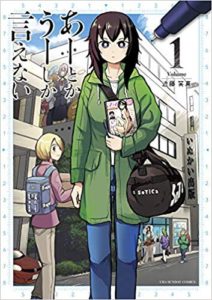
Ah toka Uh shika Ienai Manga, Volume 1 (あーとかうーしか言えない )

May 28th, 2019

The subject of today’s review isn’t really Yuri, although I’ve seen it on a number of Yuri lists. Despite that I want to talk about it, in part because I mentioned it recently during an interview. Ah toka Uh shika Ienai, Volume 1 (あーとかうーしか言えない ) is the story of Toda, a woman who is a very decent ero-manga artist, but who finds it challenging when it comes to expressing herself verbally. Tanaka, her editor, shows remarkable skill in interpreting Toda’s monosyllabic responses “Ah”s and “Uh”. Together, they make a great team.

After a few pages establishing their partnership, we learn how Toda debuted at “XtoC” magazine. That established, the manga becomes more about the cuthroat world of manga rankings. And within that, we get to see Toda and Tanaka working beautifully together.

About halfway through this book I wondered out loud whether I was enjoying it. I wasn’t sure if Toda’s communications issues was being presented as a gag, which I would have found intolerable, or not. But, after Toda and Tanaka spend the day doing research at an amusement part and Toda really starts to open up to her editor and together, they push Toda towards the top of the rankings, I found that I was enjoying it, after all. Specifically, the page with Toda smiling in front of the ferris wheel, telling Tanaka she was having fun. That pretty much set me into a positive spin about this story.

To encourage and support Toda, Tanaka has her move in with her. And in the end, Tanaka says that she likes reading the manga written by a person she likes. The end of Volume 1 comes and we are totally team Tanaka /Toda and rooting for them to beat the author/editors combos to the top of the rankings.

The two things I found to be standout notes on this series were, first, that any Yuri, if there indeed will be any, is not as important as the teamwork that Tanaka and Toda develop. It was pleasantly surprising to have a story which is openly festooned with sexual imagery to not be about sex or sexual objectification of the principle characters. Additionally, this is the second manga I have encountered in recent days, that deal with different forms of difficulties with verbal communication. Yesterday’s Lily Lily Rose presented us a child whose verbal skills were hampered by trauma. In today’s story, Toda’s overwhelmed by the words themselves. In both cases, understanding and supportive partners help the protagonists communicate. As a person who loves words, but who is likely to become overwhelmed when I am communicating verbally (and who is losing access to words more often, presumably as a result of MS,) I’m really feeling Toda’s struggle.

Ratings:

Art – Kind of amazing, really, because its required to present multiple styles and phases of creation 9
Story – 8
Characters – 8
Service – 7 There is quite a bit, as they work for a porn magazine
Yuri – 1 but it doesn’t matter

Overall – 8

I’m 100% behind the idea of a positive working relationship for two women as the backbone of this manga. Whether or not it ever becomes a romance is irrelevant to me.


Lily Lily Rose Manga, Volume 2

May 27th, 2019

In Volume 1, we met Nobara whose quiet live is upended when the daughter of her late sister arrives on her doorstep. Lily is a quiet girl, but slowly, she becomes more comfortable with her aunt and her aunt’s boarder, Maya.

As Volume 2 of Lily Lily Rose opens, Lily is doing well – she’s talking more, she’s playing with local kids. Nobara, however, is not doing well at all. Haunted by her late sister’s death, we accompany Nobara as she mourns the relationships she and Yurika had…and the betrayal she felt at her sister moving on to a life without her.

Nobara starts to take her anger at Yurika out on Lily. Lily withdraws into her noverbal state and Maya stands between her and Nobara. Maya rebukes Nobara and points out that Lily is not a stand-in for her sister and should neither be treated like one, nor blamed for Yurika’s failures.

In the meantime, we learn that Lily was there when her mother killed herself. She and her father could only watch from the shore as Yurika drowned herself in the ocean.

Nobara apologizes to Lily and the girl graciously accepts, but established clearer boundaries between them. They need to need one another, but neither of them will be allowed to become dependent, now.

As we established in Volume 1, Noabara and Maya are not lovers, but there is a comfortable closeness about them that does feel like they are partners. When Nobara and Lily are estranged, it’s Maya who step in to parent Lily. Crossdresser Saotome comes by for tea and refers to  Maya as Nobara’s wife. Nobara is honestly confused by this, so Saotome says, “partner, then” and goes on to note what is obvious to all of us…that whatever they see their relationship as, it has morphed into a kind of family, whether Nobara likes it or not.

As the series end, we see that the three of them have indeed become a family and we’re assured that Lily and Nobara will both be able to move on and grow.

Ratings:

Art – 9
Story – 8
Characters – 8
LGBTQ – 4
Service – 1

Overall – 8

This was an uncommonly gentle and sweet story by a creator who often fills her Yuri stories with incest and violence. It felt like  throwback to her days of gentle school ghosts in Himitsu no Kaidan (Volume 1 and Volume 2). The end of the story was sweet and satisfying and I’m glad I was able to read it.