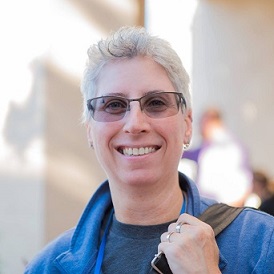
I know it’s been almost a month, but there were a few things between me and any thoughts about Anime NYC 2026, primarily a brutal illness. I am finally ready to discuss my event and I am still overwhelmed with good experiences and pain points that should be addressed for next year. We’ll take this chronologically, because while I did not actually get to see much of the event beyond the exhibition hall, somehow it was still an amazing weekend. ^_^
My time this year began by meeting Sen-sensei, creator of Horon of the Closed Country and Victoria Esnard of Red Strings Media (the same folks who bring us Galette magazine in English!)

Victoria and I thought long and hard about where to take Sen-sensei for her first meal in NYC. Victoria suggested something like Cheesecake Factory or a diner with an overwhelmingly huge menu. I wanted something…New York. As it turns out, there are no Cheesecake Factories in Manhattan, who knew. We also had a time constraint so we needed to stay in midtown. If you know anything about New York City you know that midtown is just about the worst possible place to find real food. Tourists come to midtown Manhattan for familiar chains or maybe an “experience” like a themed restaurant, but they do not come to midtown for any one of the thousands of excellent restaurants that express New York City’s rich, delicious and diverse tapestry of cuisines.
Magically, New York delivered! Practically across the street from our destination was Junior’s. I won’t pretend that midtown Junior’s is authentic. It is 1000% a chained up version of the real Junior’s in Brooklyn, which is a delightfully grungy, well-used Jewish deli with, yes, their own cheesecake that was famous for some decades before Cheesecake Factory made it out of California. Anyway, if your first real meal in NYC isn’t a Jewish deli, you’re doing it wrong. So Sen-sensei got to experience a real pastrami sandwich. Victoria conceded that Canadian “smoked meat” is pastrami, which I have been saying all along. ^_^ Of course we had a slice of cheesecake!
Full of good Jewish deli, we headed out to our destination for the evening…The Lion King. Both Sensei and Victoria loved the show. I found it interesting. To be honest, I had never once seen or heard any of The Lion King beyond the commercials. I knew nothing about the story except for the kind of obvious joke on The Simpsons. Having seen it now, I would not say that the story bears much resemblance to Emperor Leo / Kimba The White Lion, beyond the very basic premise, but I did notice some narrative and musical similarities to The Jungle Book, particularly in “” compared with “Bare Necessities.” Of course the villain was very, very, queer coded and I’m still conflicted over that. ^_^; We all agreed that Nala, played by Pearl Khwezi and Ntsepa Pitjeng-Molebatsi as Rafiki were the strongest singers by orders. I won’t be original when I say that the puppetry was very impressive. ^_^
I walked Sensei and Victoria back to their hotel and returned to my own, for my only night alone. The next morning I woke up with a sore throat and knew that the rest of the weekend was going to be a strain.
One of the on-going pain points with Anime NYC is the way they handle the various passes. As Press, we are not given any priority on lines, space in panel rooms or access to guests, except in the form of applying for interviews, for which we may or may not hear back. Pro badges likewise get no specific benefits (except for access to one bathroom on the 4th floor. This is a real problem if one is an Exhibitor. There does need to be better bathroom access for people working on the Exhibit Floors, panels and programming.) So on Thursday morning, as I wanted to help work on the Independent Manga Alliance booth and to speak to pros on the floor, for pre-event perspectives, and what to look forward to (I do not tend to report on panels, as so many other news sites do, instead I have always focused on speaking with the dealers, publishers and artists about their news,) I was unable to access the Exhibition Hall with either of my badges. This is unacceptable. Both Press and Pros have legitimate reasons to be in the Exhibition Hall before it opens to the public.
Thursday included the Licensing Summit, which I had signed up for, mostly for access to that 4th floor pro-only bathroom. As it turns out, Sen-sensei was feeling a little under the weather, so I kept her company while the remainder of the Manga Mavericks team did the licensing. It was a lovely interlude and conversation, so thank you Sensei! Once Sensei went off to do some meetings, I talked to folks not in the sessions (do you sense a pattern yet?) and had some interesting conversations with folks from parts of the industry I’m not familiar with, and some that I am.
Once that was wrapped up, we headed down to the table on the Exhibition Floor where basically I spent most of the rest of the con. ^_^ I was signing my book and selling the other books at our Alliance table. It was a lot of fun to see folks I know and meet lots of new people and chat with them.
Thursday night was the American Manga Awards. If you haven’t heard, Jan Mitsuko Cash while accepting an award, spoke out against the shitty pay rates in the industry and received a standing ovation from everyone…except the publishers. We’ll see if her bold words bring change. My second pain point for the weekend is this: Everyone at the American Manga Awards needs to be able to pronounce every name correctly. It is jarring and insulting to hear some names pronounced with care, while the same presenter butchers other names. The next morning I had breakfast with a few journalist peers and we all agreed that this is unacceptable.
Friday we had our Manga Mavericks panel, at which we announced some fantastic new manga to a very enthusiastic, crowded room.
The rest of the event is a blur of talking with folks, selling books, and running back and forth for reasons. I did briefly visit the Yen Press Booth for their “Green Yuri” get together, which was sincere and I did the stamp rally that Yen and the Brooklyn Museum (who were at the table to our immediate left) ran for the upcoming The Art of Manga exhibit. (To be honest, mostly because I had to go to the 4th floor to get to that bathroom, or I would have had to wait an hour every time, and the Yen booth was on the way. ^_^;)
I did get to wander the Artists’ Alley area a few times with Sen-sensei and visited some publishing friends at Yen, Peow2, Seven Seas and other companies during the weekend. But I came home with exactly zero things except a Horon poster, and my new business cards. ^_^
That last was a high point for me. I had asked for a Press Release to go out when I officially took on the role of Managing Editor for Manga Mavericks. All weekend long folks came up to me to congratulate me, which really felt nice. Also thank you to everyone who got my Birdie Wing in the style of Gundam Wing logo t-shirt. That was very gratifying.
I did take some pictures, but I am still, a month later, getting over the Flu that I picked up at ANYC. It has taken me this long to write this report! Which brings me to my final concern. Readers of Okazu, please mask and wash your hands. Every event is a super-spreader now and they don’t have to be! A friend just came home from DragonCon with various upper respiratory infections. Please, please, consider masking and washing your hands as often as possible. If each one of us wears a mask appropriately, I won’t have to take my life into my hands to attend. I masked all weekend, but I can’t protect myself from 172,000 disease vectors. Anime NYC and Javits Center don’t care, so it’s up to each of us to take care of each other.
I will share a couple of pics and links, because for everyone who told me that there was no Yuri at ANYC, I have to say, “I love you, but you just weren’t looking.”
Yen Press Green Yuri meetup – IG video
Butch Yuri Display at Manga Mavericks booth (not shown, By Your Side, and the pre-order shikishi for Sword of Paros.)

Also not shown Yuri and queer series from Seven Seas, Madcave, Peow2 and other publishers and original creators.
I know events this large can be overwhelming, but I assure you, NYC is a town that embraces queer work. If you can’t find Yuri at ANYC, look Okazu up next year, I’ll let you know where to go and what to look for. ^_^
My event ended with a visit with Okazu Sr. YNN Correspondent and reviewer Frank Hecker, then back to the Javits to say goodbye to Sen-sensei, Victoria and everyone else.
Thank you to everyone I spent time with at ANYC, especially the amazing Manga Mavericks team. I’m so pleased to be part of this group. We are doing incredible work for folks who love manga. I seriously love the fact that our offerings are eclectic, focusing on independent works that appeal to lovers of unique manga. I hope you’ll pick up some of our current and upcoming series.
Now I’m going to crash for a bit and hope to recover completely before the “Green Yuri” panel on September 16 as part of Queer and Feminist Perspectives on Japanese Popular Cultures Symposium 2026! See you online!
 Bear with me, as we play catch up for a few weeks on all the Yuri news that happened while I was out of action.

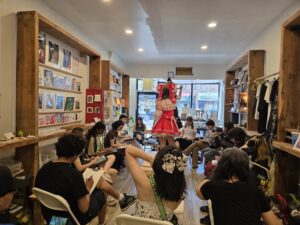 Hello from the depths of recovery! It turns out that I had Influenza A and am still fighting my way back to health. I’m down to only a few layers of cotton around my brain and wanted to get down some thoughts about August events I was able to attend, before they slipped away entirely.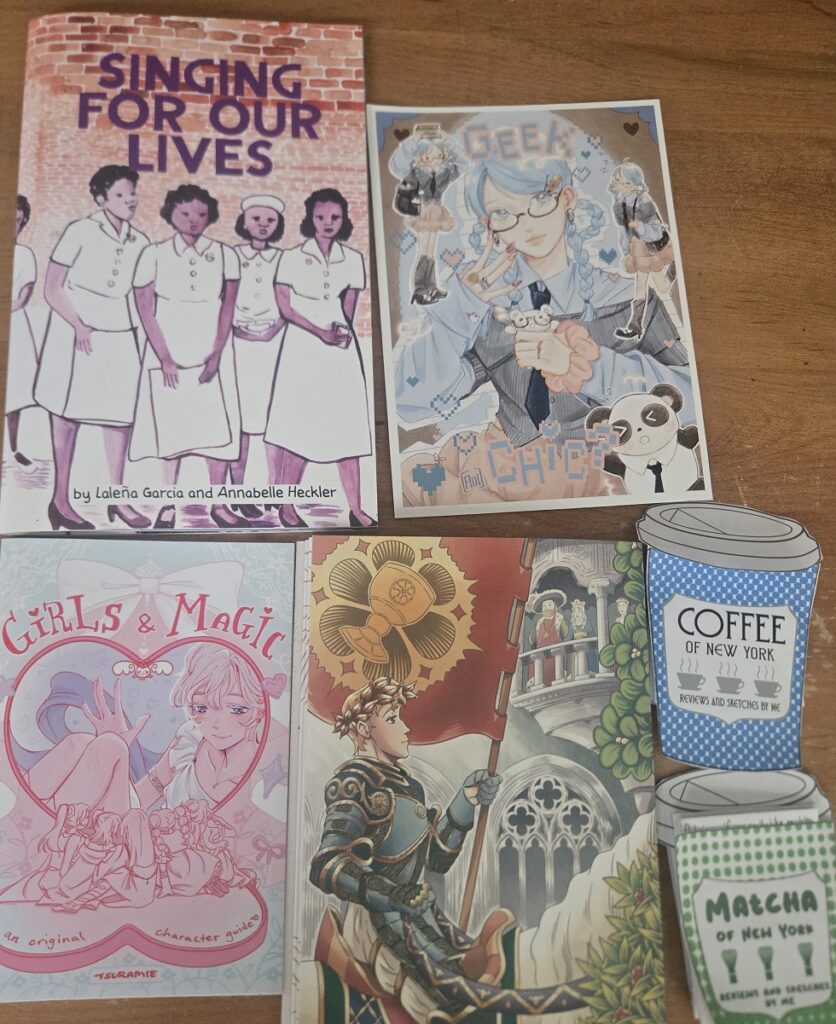
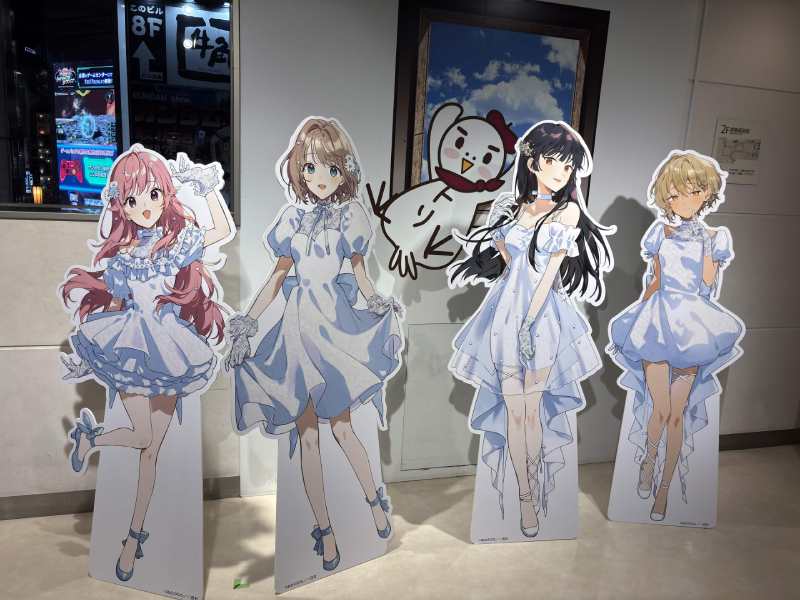
 In volume four, Yuzu gets a cold and Minami looks after her, Kamiya tries her best to talk Yuzu into telling Minami she likes her, and Christmas arrives with all the romantic implications it carries in Japan. In volume five, things get romantic on the school skiing trip, but misunderstandings abound. Can Minami and Yuzu finally just tell each other?
 I guess my problem with this manga is that the pining was quite cute for the first two or three volumes, after which it got too stretched out. The older I get, the more interest I have in stories that cover making a relationship work – getting over hurdles, managing intimacy and boundaries, and especially when the characters are in school, trying to work out where the relationship fits, if it can, in their futures. Series like Kase-san and… and You and I Are Polar Opposites have both been exploring this to various degrees, and it’s been really refreshing. It makes manga like this, where they dance around each other, and not even particularly convincingly, less interesting.