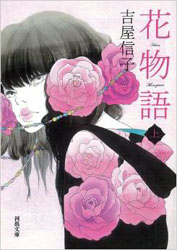
Yoshiya Nobuko’s Hana Monogatari, Part 1 (花物語 上)

January 10th, 2016

HMono1If I bothered to make New Year’s Resolutions at all, my one resolution for 2016 would have been that the first Japanese novel I completed would be Yoshiya Nobuko’s Hana Monogatari, Part 1 (花物語 上). It was, for most of the 20th century, the definitive collection of girl’s literature in Japan, as Laura Ingalls Wilder’s Little House series was in the 20th century for American girls, and as The Babysitters Club is to people younger than I am. ^_^ It is also considered by many people to contain early proto-Yuri work.

And so, after many days of diligently plowing through some amazing – and some amazingly awful – stories, I have fulfilled that non-existent resolution. ^_^

Hana Monogatari, “Flower Tales,” were originally serialized in girl’s magazine Shoujo Gahou from 1916-1924. Each story is named after, and sometimes refers in the story, to a specific flower. The stories follow young women in their teens and early twenties, most often in school, but sometimes as they strike out into adulthood.

The first part of the collection begins with a ribbon story – that is, a scenario that is meant to tie the stories together. In this case, it is a number of middle-aged women, sitting together and reminiscing about their youth. The first dozen or so stories are presented as a flashback, but about midway through the volume, the ribbon story slowly fades and we’re left with a remarkable collection of stories about girls and young women, written by a young woman in Japan in the 1920s.

I’m not going to summarize every story. I honestly couldn’t, simply because there were some where my comprehension was tenuous, to say the least. And I’m kind of on the side of grumpy old folks who say Japanese kids’ reading comprehension has gone down, if this was what was popular with middle school kids in the 1920s! Compare this to most Light Novels being published for adult otaku and Hana Monogatari is practically college-level reading. ^_^;

After reading a number of stories, I started taking notes when a piece really stood out. The first such story was “Cosmos,” sometimes noted as a clearly proto-Yuri story. I’d disagree with that, but that’s an argument for another time.  Cosmos is made up of a girl’s letters to her onee-sama as her mother is in the hospital, ending with her mother dying and the girl having to leave school forever. My note says only “Brutal.” It’s not the only one. Death is a common factor in many of the pieces. The worst of these often had a red shirt on the character from the get-go, such as the younger brother in “Tsuriganesou.” It was instantly obvious the kid was gonna die, but still, the news was presented without a hint of feeling or compassion and I actually flinched when the neglectful uncle bothered to tell his sister. “Ah, um, so…he’s dead.”

“Shiroyuri” was sweet and hopeful, while “Fukujusou” is one of the few stories with what can be considered a “happy ending” when a girl who was parted from her onee-sama meets her again as a young adult.

“Hinageshi” started really beautifully, with two girls meeting at school, dancing in a patch of red poppies flowers and talking while in the rocking chairs in the waiting room, but ended up rather emptily.

“Himomo” was a strange little tale of a girl who is giving and kind, so of course the other girls make fun of her for her sense of responsibility. She has a habit of taking care of what we might think of as a lost and found box. In it, she finds a little set of bookshelves, with lovely letter from a teacher who had to leave the school. I believe this was the first story I read that did not end in a melancholy fashion.

The first story with anything approaching what I would consider to be Yuri, was “Tsuyukusa.” Akitsu and Ryouko love each other, they “yearn” for each other. When they are parted it is harsh and abrupt – and rather cruel on Ryouko’s part. I immediately note the use of the name “Akitsu” – the same name given to one of the protagonists of Yaneura no Nishojo. I wonder who Akitsu was, and what she meant to Yoshiya-sensei. ^_^

“Benibara, Shirobara” was a sweet story that was sweet without melancholy. With the Red Rose/White Rose contrast, I of course saw the kernel of the Rosas of Lillian Academy. ^_^

There were two stories that were really the standouts for me. Of these, we’ll start with “Dahlia,” as I have already brought up Maria-sama ga Miteru. ^_^ This story follows a woman out of school, Touko. Touko has become a nurse in the town in which she attended school. When a former classmate is admitted to the hospital, the former classmate’s rather wealthy and prominent family asks Touko to be their daughter’s private nurse. The head of the hospital strongly encourages her to do that, as it will be good for her both monetarily and prestige-wise. But that night Touko is on the ward comforting a small child whose mother isn’t there and she realizes that this was why she became a nurse. She rejects the offer in order to help people who really need the comfort and companionship. Shades of Marimite‘s Matsudaira Touko lay heavily over me as I read this story, remembering Touko’s own story of early life in a hospital and the nurses there who were kind to her.

The last story of note was really noteworthy. Called “Moyuruhana,” which Dr. Frederick (the scholar who brought us the superb translation of Yellow Rose from Hana Monogatari, which I reviewed in February 2015) suggested be translated as “Smouldering Flower”. This story was…well, it felt sort of like a vampire story without any vampires. Midori becomes infatuated with “Mrs. Kataoka” a new teacher at school. The use of the English “Mrs.” is emphasized, rather than calling her Kataoka-fujin or -sensei. Midori comes to Mrs. Kataoka’s  room one night, where the teacher is described like a “Snow Queen”, pale in the reflected light of the snow outside. Mrs. Kataoka embraces Midori, whispering that young girls like her “are the best.” At this point I read the rest of this story as if it were a kind of Carmilla-esque tale and it worked *perfectly*.  Midori becomes increasingly obsessed, but when she tries to see Mrs. Kataoka again, she’s stopped from entering by a mysterious older woman who strokes a black cat (!).

A guy in a black suit arrives to try to pay off the principal, Wagner-sensei (ya see what I mean about Carmilla, yes?), to hand Mrs.Kataoka over, Wagner-sensei tells Mr. Suspicious to bag off, he threatens the school.

The climax of the story is in fine Gothic form as the school buildings go up in flame and neither Mrs. Kataoka nor Midori can be found and both disappear from the story completely. In the final pages, Wagner-sensei suddenly becomes the protagonist of the story by saving the school.

This was so eyebrow-raisingly amazing a story, I couldn’t wait to tell you about it. ^_^

The initial chapters/stories are short, but as her work grew in popularity, clearly she went from shorter stories to longer ones. As a point of contrast early stories run about 6 pages in this edition and the later stories go as long as 30 or more pages.

Color, too, plays a big part in the stories, as one might expect. Frequently the color of a flower is one of it’s significant qualities. Red roses, violets, tiger lily, daisies, and so on, so you can imagine the scene quite spectacularly clearly when I say “a field of red poppies” or “violets in the garden.” The mood of the story is often tied up in the color associated with it. Lavender twilights and melancholy, golden sunshine and daises, that kind of thing.

My admiration for Yoshiya-sensei jumped up by significant amounts reading this book. While many of the stories were tinged with a melancholy, she manages to play around with tone and voice quite a bit – especially as the stories progress.

Ratings:

Overall – 9

This was not an easy read, there were any number of deaths to deal with, but as I read her work, I’m coming to appreciate it more and more. Hana Monogatari deserves it’s status as the definitive example of early 20th century Japanese girls’ literature. I’m really looking forward to getting to Volume 2!


Yuri Network News – (百合ネットワークニュース) – January 9, 2016

January 9th, 2016

YNN_MariKSailor Moon News

We start this week with a hat tip to YNN Correspondent Elizabeth F, for letting us know ANN has the scoop on the upcoming third season of Sailor Moon Crystal. There’s a lot to parse in this article. First and most important, the director of the series will be Kon Chiaki, one of the few female directors to make it big in anime. She’s known for Nodame Cantabile and Junjou Romantica, and I can’t help but think that’s amazing news all around!

Additionally, Comic Natalie reports that Nico Nico Douga will be streaming the casting announcement for the new cast on January 27th, which is Tenoh Haruka’s birthday. I watched the original casting announcement with absolute glee and can’t wait for this one. ^_^ The series is slated for a spring 2016 debut – and I want to talk about that, too. The cast will be announced in a few weeks, and the premier is in spring, so *that* is the actual timeline for the animation. If you wonder why the broadcast animation always looks rushed, this is why. This is how Toei does things. It creates absurd timelines so everything is rushed on the front end (no doubt still a relic of Tezuka’s nightmarish TV animation schedules) and then fixes it after the fact, for Blu-ray release.

***

Support Good Yuri Comics and Manga – support Okazu!Subcribe with Patreon***

Yuri Manga

Comic Natalie reports that the first volume of Amano Kozue’s  Aria the Masterpiece Perfect Edition is hitting shelves this month.

ANN has the news that Viz is re-releasing the Kannazuki no Miko manga. The response this received, as compared to the news of the Outer Senshi was astounding. In 2006, KnM was the zOMG series, because there was otherwise so little Yuri. Now, as compared with all the Yuri we have the response was more like “Meh.” ^_^

On Mangablog a panel of experts talked about their Most Anticipated Manga of 2016, looking at translations that will be heading our way this year. Among them was Udon’s translation of Rose of Versailles! I look forward to seeing Oscar in bell bottoms in English. ^_^

The meta is strong in this one. Comic Natalie reports that Comic Flapper magazine has a new series, a “Trouble comedy”  –  “Ore ga Fujoshi de, Aitsu ga Yuri-ota de” (オレが腐女子でアイツが百合オタで). Whether it will be good remains to be seen, but it is definitely a product of it’s time, when meta stories for otaku about themselves are all the rage.


Other News

YNN Correspondent Ichigo69 on Twitter pointed out a Japanese survey of “lesbian sex” in Yuri manga, which quantifies the answer to the burning question, “Is Yuri really all just school girls?”

Let’s finish on a smile: A friend and long-time supporter of Yuricon, Gideon M. sent along this wonderful animated official music video for Studio Killers’ song Jenny. Do watch it, it’s great. ^_^


Know some cool Yuri News you want people to know about? Become a Yuri Network Correspondent by sending me any Yuri-related news you find. Emails go to anilesbocon01 at hotmail dot com. Not to the comments here, please, or they might be forgotten or missed. There’s a reason for this madness. This way I know you are a real human, not Anonymous (which I do not encourage – stand by your words with your name!) and I can send you a YNN correspondent’s badge.

Thanks to all of you – you make this a great Yuri Network!


Yuri Manga: Yagate Kimi ni Naru (やがて君になる )

January 6th, 2016

YKNN-275x390Nakatani Nio’s Yagate Kimi ni Naru (やがて君になる ) is a sweet little Yuri romance that I both enjoyed a lot and also have several real problems with.

Yuu begins high school with a major burden. A guy she went to middle school with has confessed his feelings and has been waiting patiently for her answer. Yuu really has just no idea at all whether she “likes” this guy. He’s nice, but her feelings for him are…nothing. She doesn’t find herself getting the kind of heart-pounding that the girls around her talk about.

Touko is a popular honor student and member of the Student Council who is well-known for rejecting all suitors. Thinking that she’s found someone like her, Yuu offers to help Touko in her duties for the Council.

But not too long after, Touko leans over and kisses Yuu, admitting that she’s fallen in like. Yuu feels conflicted – she likes Touko, and admires her, but she feels betrayed, as well. But after this, Yuu finds it in herself to give the guy who confessed an answer – she says a gentle sorry, and his response is a gentle thanks.

Yuu’s like and admiration win out over her confusion and she is by Touko’s side as the older girl runs for Student Council President in the coming year.

Touko and Yuu have a talk, in which Yuu explains her position and Touko hers, and they agree to continue as they are and see what happens. Which brings us to the end of the first volume.

Before I offer criticism, let me begin with praise. All the characters feel real. The school has boys in it and they are not disappeared and only one has been drawn faceless, a shortcut I find rather grotesque. This is a world with males and females and they aren’t all the same. There are admirable and decent guys, as well as admirable and decent girls. This, above all things, is a refreshing change in what has increasingly become a cloistered Yuri world.

The art is clean and typical for a shoujo manga – which this not. It is from Dengeki Comics and I think that’s notable. Yuri is not uncommon from Dengeki, but more often than not is of the highly service-y kind. So it is super encouraging to see them putting out a nice, rather than vaguely icky, Yuri series.

All this having been said, I need to bring up two important issues I have with this manga. The first is that it is presented as a romance. The story is apparently that we’ll side with Touko as her sincere feelings for Yuu are eventually returned. This is a problem. I’ve very active on Quora, a Q&A site on which one of the most common questions asked goes something like this: “How come this girl said no to me, when my like is so sincere?” I’m not making this up. The presumption many young men have is that their sincere feelings are a kind of contract, which must be returned by the object of their affection. If not, she is of course a bitch (or worse).

The thing that is obvious to many not-young women is that no guy is owed anything just because he has an idea in his head of what he’d like.  This is a very serious problem globally, apparently. These guys feel that their sincerity means they deserve the girl. And, to some extent, that is how this scenario is presented. Touko’s feeling are honest and sincere, so of course Yuu will come around to falling for her. But why? If Yuu doesn’t feel it, why do we assume she must eventually do so? This bugs me a lot. In real life, on Quora and in media.

Which leads me to the, I think, obvious conclusion abut Yuu. What if she’s asexual? If so, she’s never going to have those feelings for Touko or anyone. She might come to love Touko and continue to admire and like her, but never have sexual interest in her. So, then I can’t help but see Touko’s coming on (to be crude) to Yuu as another burden, rather than a blessing.

Both these things nag at me while I read this manga. And I worry that Yuu’s agency will be stripped from her as the narrative continues.

Ratings:

Art – 8
Story – 8
Characters – 9
Yuri – 6
Service – 1

Overall – 8, with the above reservations

The upshot is, that while this manga has some good qualities and it definitely is making a splash in Yuri circles, I think the story also has some problems, which I hope Volume 2 address satisfactorily, rather than just throwing Yuu into the Yuri factory.


Yuri Manga: Shortcake to Kase-san. ( ショートケーキと加瀬さん。)

January 4th, 2016

StKastH-275x389I’d like to give a copy of Takasaki Hiromi’s Shortcake to Kase-san. ( ショートケーキと加瀬さん。) to every Yuri fan in the world as an example of schoolgirl Yuri that presses all the buttons and almost completely manages to not be a skankfest of creepy.

Kase-san and Yamada-san, (who we met in Asagao to Kase-san and have followed through Obentou to Kase-san) enter their final summer of high school and together they enjoy the living fuck out of it. Pool, cake and a little heavy petting is pretty much the standard menu for every senior high school experience.

Of course, weighing on Yamada’s mind is their inevitable upcoming split as Kase-san will head off to Tokyo. Yamada has no particular plans, but was vaguely thinking about sticking around and going to the local university. In an emotional, yet strangely silly ending, they resolve this big problem and, we assume, live happily ever after.

There are a few panels that I, as an editor, would have redrawn, but it is apparent to me that there is no manga being published completely free of the burden of serving the imagination of the imagination-less. But with those few exceptions, this is a sweet, silly, and realistic look at young love.

Ratings:

Art – 8
Story – 8
Character – 8
Yuri – 8
Service – 3

Overall – 8
For my first review of 2016, I wanted something pretty damn good. This, as schoolgirl Yuri goes, is pretty damn good. ^_^


Yuri Network News – (百合ネットワークニュース) – January 2, 2016

January 2nd, 2016

YNN_Lissa

Happy New Year!

I hope you don’t mind that I’m not working hard at this New Year weekend edition of the YNN report. There’s still cake and wine left over from NYE celebrations and they are calling my name. ^_^

But it is because of New Year celebrations that we are even here today. I spent this year’s Eve watching the Kouhaku Uta Gassen –  the annual Japanese New Year’s eve singing contest television special – like Dick Clark’s special used to be, with a few contemporary singers and a bunch of Lawrence Welk-like fossils. The show has been adding in a lot of anime themes and popular VA singers, probably in a desperate attempt to get people under 40 to watch. ^_^

Well this year, they did a medley of anime songs, Pokemon, Yokai Watch, Sailor Moon, Love Live!, Neon Genesis EvangelionChibi Maruko-chan and Gundam  and probably some I’ve missed…still not why I’m mentioning this, although hearing Moonlight Desentsu on the TV was nice. ^_^ I’m mentioning it because they started to talk to someone in the audience and I became very excited – Uehashi Naoko, the creator of the Seiriei no Moribito series was on TV…. The new live-action Seiriei no Moribito series announced last summer is coming this spring on NHK! Waaah!

Balsa, Chagum, Tanda, Torogai, Shuga and the rest on TV. Squee. Ayase Haruka, (who was the Kouhaku’s Red Team host,)  is playing the role of Balsa.  No trailer yet, but as soon as there is one, you can be sure it’ll be on here. ^_^

Okazu News

The Okazu Patreon has been updated for 2016 with a new video and a new perq! Click the link to see the new video, and either the “Subscribe” button here to your right  —> or on the left of the Patreon page to become a supporter of Okazu. With your help we relaunched the Yuricon Store, we added a bunch of new Event reports on Okazu and Essays on the Yuricon page. We have a pile of thing we want to get done in 2016 and every little bit helps towards those goals!

***

Support Yuri News and Reviews –  Subscribe to Okazu withSubcribe with Patreon

***

Yuri Game

ANN Reports the addition of Yuri VN Atom Grrrl! to Steam. According to the description it is a “yuri Tarantinoesque comedy about sex, drugs, and revenge.”  If Tarantino used 6 year olds as actors. ^_^;

Here’s wishing you all a wonderful holiday weekend and a great new year!


Know some cool Yuri News you want people to know about? Become a Yuri Network Correspondentby sending me any Yuri-related news you find. Emails go to anilesbocon01 at hotmail dot com. Not to the comments here, please, or they might be forgotten or missed. There’s a reason for this madness. This way I know you are a real human, not Anonymous (which I do not encourage – stand by your words with your name!) and I can send you a YNN correspondent’s badge.

Thanks to all of you – you make this a great Yuri Network!