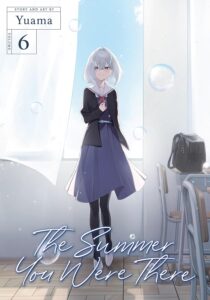
Okazu Staff Writers Eleanor and Luce have a discussion about The Summer You Were There by Yuama, where Shizuku, a depressed high school student, gets intercepted in throwing away her novel by Kaori, the girl who sits next to her in class. Kaori proposes that they fake-date for inspiration for Shizuku’s next novel, but Shizuku’s demons are not so easily tackled, and Kaori isn’t very well. Please be aware that there are spoilers for the entire series including the ending, and the series includes mentions of suicide, terminal illness, death and grief. It also deals with verbal and cyber bullying in the past, and how this has affected both the bully and the victim. The complete series, Volumes 1-6 are available from Seven Seas.
 Luce: I think this is a series that does warrant some discussion, because it has got some deeper topics in it, even if the way it attacks them is a little bit clichéd.
Eleanor: I would agree with that. I wouldn’t say it necessarily handles the topics badly, but I would say the way in which the story is set up and constructed is just like cliché after cliché after cliché. It’s just like you get the bullying, then the illness, then the bratty sister and it’s like, which cliché is next?
L: If we take it from the start, I think the bullying storyline was the thing that stuck out to me as the most impressive bit of the series. I felt it dealt with both the bully and the bullied really quite well.
E: I know if my high school bullies wrote me a letter and they were like ‘oh I’m so sorry’, I’d be like ‘fuck you, I never want to see your face again, get out of my life’, so I can relate to not wanting to forgive just because they’ve said they’re sorry.
L: I have to admit I’m coming from a point of view that I was not bullied in any significant way during school, so you’ve probably got a more informed perspective on it than I do.
E: Possibly more of a biased perspective depending on how you look at it.
L: I think it’s important to have both sides, and I think we can probably all agree that we weren’t our best selves in school. I know I definitely did things that I regret; not to the point of bullying, but sometimes I would get mad and said or did things that I shouldn’t have. So I suppose I connected with Shizuku in a way. I could see the way that her thinking developed from ‘oh people appreciate my honesty’ to her brutal honesty that becomes bullying. She looks about 8 or 9 when it’s happening? [Editor note: The story states fifth grade, which is 10-11 years old]
E: Obviously a bit older for me when I was bullied, so it was more like 11 to 13. Also pretty young though.
L: I found her reaction quite realistic, and the reactions of the people around her too. Initially being honest was something that she was quite proud of, something she’d been praised for, and she just took it that way too far as kids do. But the kick back was also quite realistic. Shizuku not quite realizing how badly she was starting to come across and that people actually had stopped agreeing with her – she had stopped hearing it. She mentions that the social exclusion was throughout the rest of elementary school and then went right through middle school as well. So you could see that she was bullying Ruri and that it was having a big effect, but she was still young enough that you recognized why she wasn’t clocking the effect that she was having. Shizuku reads as potentially a smidge autistic to me; particularly the bullying, because someone says something to her about being honest, she clocks it and she carries on with it. she cannot see how things have changed until that and then she just completely shuts down.
E: That was kind of the vibe I got as well. I’d be saying something and just not clock that nobody around me was interested or cared.
L: It’s very difficult for kids who are not neurotypical.
E: Yeah it’s funny how you get clocked very fast by your peers but being an AFAB child growing up in the 90’s there was no way in hell you’d get professionally diagnosed, because only boys have autism and ADHD.
L: For sure – at least that’s getting a bit better now. I hadn’t realized with the curry incident which kicks off Shizuku’s social exclusion, Ruri has a visceral reaction to curry even five years afterwards, which also feels quite realistic. She says to Shizuku that she made her hate something she loved, and I think a lot of people who have been bullied can probably attest to that, unfortunately. It can take a long time to go ‘actually no, I like this thing’ and override that, if at all. It seemed a bit odd for Ruri to agree to meet Shizuku, but it made more sense because it was through somebody that they both trusted?
E: Because they have that person in common, I think that bridge between them – it definitely highlights that, Ruri says that she only went because Kaori had asked her. I suppose that made it a bit more realistic, because again had it just been ‘oh my bully wants to apologize’, she wouldn’t have gone. I did really enjoy that meeting between them.
L: It was realistically fraught and tense. I did wonder a bit that Ruri would be like ‘yes, fine’. I’m really glad that that didn’t happen because again, it would have felt cheap.
E: I also wouldn’t have been surprised if she’d slapped her.
L: I think the only reason she didn’t was that slapping her didn’t fit in with her personality.
E: I agree, but I wouldn’t have been surprised if something like that had happened.
L: I really like how it was done; Shizuku wants Ruri to forgive her, but also does recognize that she’s not owed that at all.
E: Shizuku does realise that Ruri’s under no obligation to do so, which felt much better. I feel like had the series been made ten years ago, it probably would have just gone down the ‘oh, everybody’s happy now’ route, but I think as it’s more contemporary, it’s more realistic.
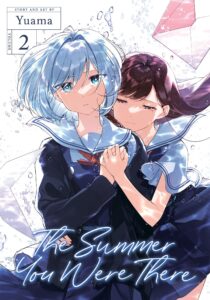
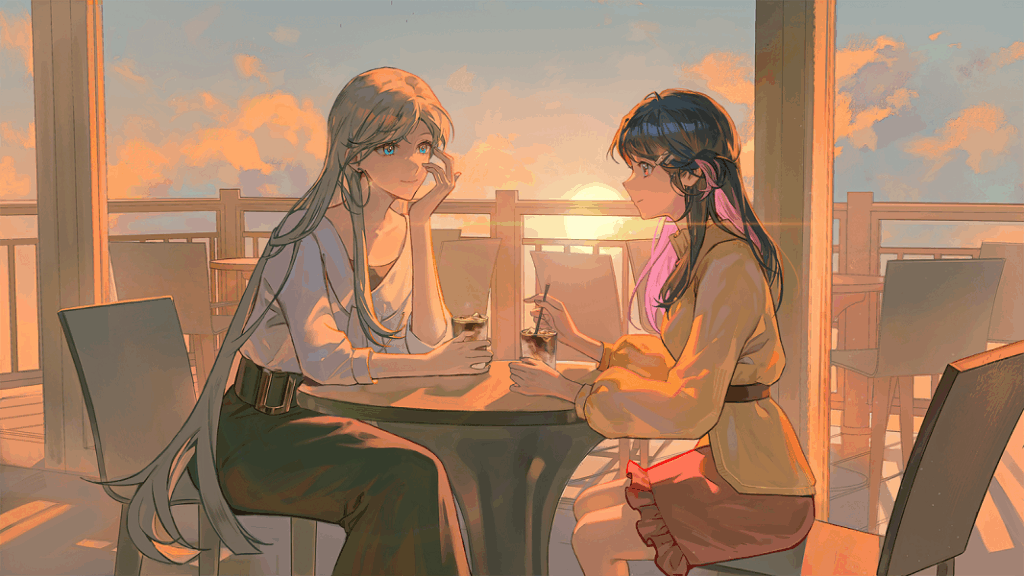
L: What I liked about that entire plot was when she apologized, Ruri says that she doesn’t forgive her, and I don’t think she actually says that she forgives Shizuku at any point. Even at the end, she says ‘I want to get to know you again, can we start over, I want to know how you are now’. She recognises that Shizuku has changed, and that she herself has changed – as it happened when they were younger kids, I liked that Ruri gave Shizuku that chance to show she’d changed. I also liked that in the epilogue, it shows Shizuku, Shio (Kaori’s sister), Ruri and Seri in a cafe together when they’re meeting for the anniversary of Kaori’s death. Yuama states underneath that image that these are not close friends, more like distant relatives that are coming together once a year to celebrate someone they loved.
E: I like that it was like ‘we can’t just wipe it completely clean, what happened happened, but we can be civil with each other’. Obviously they have this person in common that they all love, and they can put their differences aside for her, but they’re never going to actively want to spend time with each other. I just realized that the protagonist of Your Lie In April who is also Kaori – I think it’s a cursed name…
L: Cursed Kaoris! Speaking of Kaori, I think that was probably one of the most contentious bits, and I suspect the bit that you really weren’t fond of – I’d be interested to know your thoughts on how you felt that plot line went.
E: I thought it would end with everybody happy because that would be the ultimate cliche. I respect actually having a main character dying and having it be a tragic love story, but I just feel like we never really got very much explanation of why Kaori was interested in Shizuku to begin with. I know she found her manuscript in the bin and stuff, but it just feels like that’s a bit of a jump from ‘oh hey this is interesting you should maybe write more’ to ‘I’m going to blackmail you into dating me’. That all felt like too big a leap for me and I think that’s what annoyed me about volume 1. Kaori was obviously popular and I feel she could have got closer to Shizuku without the blackmail. Obviously it all starts to make sense later when we realise Kaori is a fan of the original web novel and knows more about Shizuku’s past than is shown, but reading volume 1 on its own gives no indication of this whatsoever.
L: I think she says some time later that she was aware of the bullying and she clocks that Shizuku is suicidal and steps in to try and avoid her doing anything.
E: It does make a bit more sense when you read it back to back rather than waiting six months between volumes.
L: One thing I did really enjoy was when Shizuku goes for a hike with her sister and and her dog – the dog is very cute-
E: The dog is good!
L: For sure! In fact, you can kind of see that that’s her only real link to the world at the start, as she’s shut everyone else out in shame. But she goes for a hike with her sister because Kaori asks her to, once it’s become obvious she can’t do it herself, since she wants to live vicariously through Shizuku. And her sister goes ‘it’s you again, you’re back here with us’: that is so powerful. Shizuku says at the end, ‘why did I think disappearing was just going to fix everything, that no one was going to miss me?’ and I think that’s a really powerful message.
E: Folks who are suicidal think it’s like ‘no one will miss me when I’m gone’, and that section shows that Shizuku is wrong in thinking that. My problem with Kaori is that she has a very manga disease. I’m always a little bit annoyed that it’s just ‘oh they’ve got a chronic death condition, they’re magically fine one minute and then suddenly they’re dying (when it’s convenient for the plot)’. There’s no in-between stages.
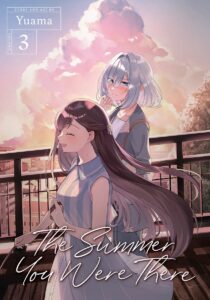 L: I think that bit was one of the weakest. I always find this difficult with characters with terminal diseases in manga – there’s no delineation between fine and unwell. They’re fine, perfectly fine and then they collapse. Especially when it’s like ‘I can hide it until I go in the house and have a massive coughing fit and cough up blood’ – that is not how diseases work! If they had a cold and they were hiding it, I can kind of understand, but most people are observant enough to go ‘you are clearly not well’ – particularly if you have a terminal disease that’s going to kill you within two or three months.
E: That annoys me with every single generic manga disease. Even if you don’t name it, you can tell when people have some sort of life limiting or terminal conditions. I have no medical knowledge, but just from being around people, most of these sort of life-limiting diseases are progressive rather than sudden, so it’s not that you’re fine one minute and you’re on the floor the next. Manga is not good at chronic or terminal diseases. I have found there are very very few that have a realistic progression and even if they have a fairly realistic progression they tend to have a magical miracle cure for plot reasons.
L: I was actually really happy because it made the ending really powerful. It was like ‘okay I can go on after this person has died, even though I love them, even though they meant a lot to me, I can go on’ and that was really powerful.
E: My father died when he was quite young and very suddenly, I was only in my 20s. Grief never fades, but it expands to fill the space around you, so I’d agree that’s pretty well done.
L: Grief is always going to be a difficult thing, particularly for someone you’ve been close to. I did appreciate Shizuku’s immediate grief response. I felt as someone who was suicidal two months ago, it felt quite realistic that she just went nope and had to be forced out of her room.
E: When my father died I just wanted to sit in my room and be an amorphous blob of flesh, not talk to anyone, not eat anything, just (barely) exist, so definitely relate to that.
L: I felt it was a good scene to have in there. On the whole, though, I felt some elements of it were a bit too neat, like Kaori being into the original version of the story that had been posted online anonymously – I mean, Kaori does like to read and she was ill, so it kind of makes sense that she might seek fiction online, but it’s also a smidge neat.
E: Everything kind of came through like that. She was the biggest fan of this thing and she was so sad when it stopped updating so yeah, that’s one of the things where you go “okay, that’s a little too convenient.”
L: I suppose that kind of for me that kind of links in to Kaori, she feels a bit all-knowing. She’s a little bit more of a plot device than a character. She does have character and I do quite like her, but it’s like ‘oh she knew about the bullying actually and oh she knew about the writing actually’ and she’s never very surprised by anything, apart from when Shizuku goes ‘oi, lean on me, I’m here for you’.

E: It felt a bit weird in that way. I think it would have been nice if she didn’t know about the writing and that her finding the manuscript in the bin was the first time she’d found out about it. I think I would have enjoyed it better if that had been the case, like if she’d just gone ‘oh I followed you to the bin in case you threw yourself in it and I really enjoy reading so I really wanted to read this’ I think maybe would have made everything else hit a bit better and had a slightly better footing at the start of it
L: It’s neat in the way that a mystery is neat sometimes, everything ties up together.
E: I do like towards the end they did show a little bit of progression in the disease like she can go out on leave, but in a wheelchair that makes sense for the stage that she’s at, and shows that she’s not well.
L: I’m not 100% sure that the hospital would let you out when it’s hot and you’re that unwell, but I could let it go for plot, as it felt more like a last request type of thing. I quite liked Kaori’s breakdown in the aquarium because I think that that’s when she basically says ‘girl I knew you were suicidal and that book read like a suicide note and it probably was, and I couldn’t let you die without trying to save you because I won’t have that chance again’.
E: Looking back on what I thought of my review of volume one because they had the aquarium date then as well, so it’s a little bit of a nice throwback to that. It all makes more sense in hindsight but I think it just ultimately all comes back to, like you said it would either be much better read month to month when you don’t get a whole bunch of story and then a massive cliffhanger at the end of the volume or you can sit down and read all six volumes in one go.
 L: As you say, it’s definitely been that kind of series – I mean the first page was ‘nothing’s been the same with that summer of hers, that first and last summer’. It’s something along those lines, so it’s very early on that you know that something happens. First was this gradual sense that something is not okay, things are getting worse. I appreciate how that’s been done. From the illness point of view, I think volume six is actually fairly realistic. She’s rushed into this operation, we know she’s got a 50/50 chance of survival and we genuinely don’t know if she’s going to survive, and she’s actually not well again after that point. It felt really kind of chilling but realistic that Shizuku just gets this text that she’s gone.
E: When you get a phone call from your mother at midnight, you know it’s not for a chat. You get in the car and drive NOW. Looking back on it he (my father) was probably already gone by the time we got there, but I can appreciate the medical staff’s efforts, they definitely did everything they could.
L: I thankfully haven’t had that experience, but when my granddad was dying, it was very much ‘get here now’, and actually I think he’d already gone as well by the time my mum got there. So I appreciated the narrative choice that Shizuku wasn’t there at the end. We assume that Kaori’s family was probably there, but she is just a friend at that point. They’ve been messaging back and forth between each other for a lot of the series, and their last communication is via text. Then Shizuku just gets this message that Kaori has died, rather than this heartfelt final face-to-face talk, and somehow that makes it much more brutal and cold. She can’t even face looking at her body, which I think a lot of people who’ve had someone close to them die can attest to finding difficult. It’s one of those things, it’s like on one hand, you feel like you should go and see them, and on the other hand they’re just not there any more, they’ve gone and that’s worse.
E: There’s a panel in there with Shizuku just sitting waiting for news, with nothing around her. I’m a big fan of “less is more” in manga. But also, when the doctor told us Dad was dead, it felt like the entire world just vanished around me and was just blank space, so I think it’s a very good portrayal of the sheer shock and emptiness you feel at that moment. It’s very obvious she’s sitting on something but it’s like the world around you has just disappeared.
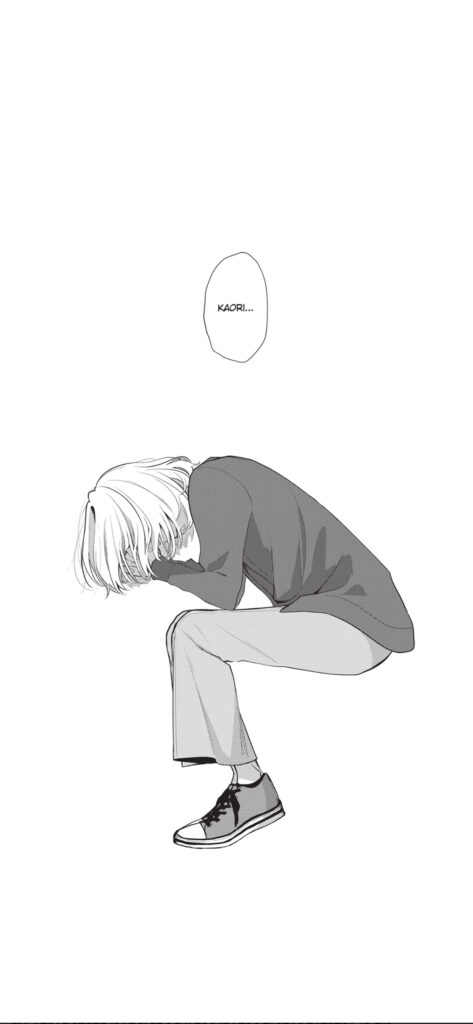
L: That panel was great, there were quite a few really interesting panels. The only bit I didn’t really like about the ending was her saying she’ll never love anyone else again. Girl, you are 16. [Editing note: Please note, when we were discussing, we missed the line where she says it’s been five years since Kaori’s death, and assumed it was one year afterwards, but we have decided to leave the section as the sentiment remains true]
E: I didn’t need to see her with anybody, but it felt very much like that is a fairly realistic reaction for a 16 year old girl who’s just lost her first love.
L: I feel like it is fairly really realistic, but give her a few years, maybe go to university and some time to process it.
E: As much as it’s very cliche to say, time really is the best cure; I think you grow into grief like that. It’s not something that is healed that easily.
L: That was more of a niggle really. It’s only been a year, she’s only 16 or 17, so I like to think that a few years down the line, she’s bringing her girlfriend here, going ‘this was my first love and I really loved her, she was really important to me’.
E: I almost wondered if that was what they were going to do. I don’t think they needed to do it in the main series, but if there was like a one shot after, or a little short story, I think that could’ve been a nice touch.
L: Going onto the book that she’s writing, I feel like the series grows into its premise: at the start, it’s very kind of ‘just wanted to write these two girls getting together kind of fake dating because she wants to write a novel’.
E: I read the first one going into it completely blind. I bought it because I liked the author’s previous work The Girl I Want is so Handsome!, and was so annoyed by the volume that I definitely mailed my copy to someone on the Okazu Discord server because I was like ‘get this thing out of my house’. I ended up buying the rest of the series digitally, and whilst I don’t regret reading it, I can’t see myself reading it again, certainly not for a while anyway.
L: This is a very different vibe from her other work! It’s definitely one of those that you kind of need the first two volumes to see if it’s for you. But the initial plot, with the book that she’s writing, becomes quite a point of communication for things they can’t just say to each other, particularly Shizuku. It was quite interesting that she didn’t know how to end it, but she finds a way to do it and she’s really glad that Kaori got the message. I thought that was really good because she managed to say ‘I love you’ without saying it. I did like the texts between them towards the end, especially in the last few days, that was a nice way of kind of wrapping up that side of their relationship. Until that moment, we don’t really see Kaori’s point of view on their relationship – for Shizuku, it’s clearly become an actual love, but we’re not sure if it’s real for Kaori or not, so that was a nice moment.
E: I think we can see that she wants to say it for quite some time but she doesn’t know how. She is quite an awkward person and she remains quite an awkward person throughout the whole thing which I did appreciate as well. I liked at the end how she’s kind of cut her hair a bit but she hasn’t gone completely wild.
L: For sure – moving on and up but not forgetting. To wrap this up, have you got any final thoughts or summations on the series? Anyone you’d recommend it to or not? For me, I found this to be quite a powerful series, if you can overlook some plot convenience with the illness. Shizuku’s depression and the start of her recovery with Kaori’s help felt well done, and the storyline with Ruri was equally well done. I have my quibbles about the generic manga illness, but the ending landed for me as a tragic but satisfying ending. I think you’d need to be in the right place for this manga, and it may land too hard for some people, but I’d still recommend it. It’s surprisingly hopeful.
E: I stand by my original thoughts on volume 1. However, I would also say that it definitely transcends what initially seems to be a very silly premise, albeit with a few annoying contrivances which really didn’t need to be there. The grief definitely felt very realistic and well written, and the art has noticeably improved since The Girl I Want Is So Handsome. I agree with you that you’d need to be in the right place mentally for it, but if you want something different than a happy ending and a convenient miracle cure, you could do far, far worse than this.
Ratings:
Yuri – 8
Art – 8 (with some stand out panels)
Characters – 7
Service – 0
Story – Initially: 5. Final: 7
Overall – 7
- If you’d like to discuss this or any other Yuri series, please consider joining the Okazu Discord and/or supporting the site at the Okazu Patreon!