Yuri Manga: Hakugin Gymnasium, Volume 1 (白銀ギムナジウム 上)

February 6th, 2015

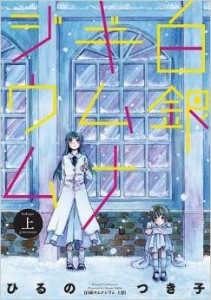
Hakugin1Hirono Tsukiko’s Hakugin Gymnasium, (白銀ギムナジウム 上) is a non-linear tale of love and loss, betrayal and redemption. You know, like pretty much every other romance ever written. ^_^

In this first part of two, we meet Fiona and Eimi, two girls who reside at the Hakugin Gymnasium, an orphanage/ boarding school. Eimi was abandoned by her parents but somewhere out there, they still exist, while Fiona has no idea if her parents are alive or dead. Since the two of them were left at the Gymnasium on the same day, they are inseparable. But, when Eimi’s real parents reach out to her to bring her home, there’s nothing Fiona can do. And so, her beloved Eimi leaves her behind. As soon as she’s old enough, Fiona leaves the Gymnasium, walking away to create a solitary life for herself without the person she loves most in the world.

Time passes and Toutou and Eris, two younger students who admired Eimi and Fiona and their closeness, have now grown up to be about the same age Fiona and Eimi were when Eimi left. Toutou is increasingly aware of feeling for Eris, but instead of turning towards her, Eris is falling for a guy. A guy who is 100% clear about Toutou’s feelings and is pleased with himself for stealing her love.

More and more, Toutou finds herself thinking about Fiona, and wondering if the ache she feels in her chest now is similar to Fiona’s when Eimi left. Toutou goes through a crisis in which she finds herself about to harm Eris, and breaks down. To her surprise, she learns that her feelings are fully returned. Outside the room, Miss Maria, the head teacher, cries at the pain that awaits them

In the final chapter of this volume we learn something we had not previously known. Although we knew all along that Fiona’s feelings for Eimi went beyond friendship, in a short flashback we now can see that Eimi’s feeling were the same. And again, we see Miss Maria trying desperately to protect them from what appears to be inevitable unhappiness.

While in Japan in October at Toranoana’s Yuri section, I saw this book and it’s sequel. (Yay for technology. I wasn’t sure if I had ordered this book through Amazon JP yet, so pulled out my phone, checked my orders online and voila! knew I hadn’t gotten them.) So I picked up this volume. That night I flipped through it and realized that I really needed both volumes. The narrative was slightly too non-linear – and it wasn’t looking happy there by the end.

Never in my life have I been so happy that I waited until I had both books to read a series. 

You’re going to want to have Volume 2 right there when you read Volume 1. Trust me on this.

The name of the orphanage is interesting.  Hakugin (which means “white silver”) Gymnasium, (where Gynmasium is pronounced with a hard ‘g’. Gim-na-zhi-um) is set in somewhere in the Europe of the imagination, where girls wear long skirts, high laced boots, and poor orphanage/boarding schools have a grand piano. It’s quite likely a reference to Moto Hagio‘s early BL work Juichigatsu no Gymnasium (11月のギムナジウム), which famously, she has said she originally considered centering around girls, but instead chose to make about love between boys.

The art is a style I very much like. Like the title, it hearkens back to an earlier time. More like Himitsu no Kaidan (another classic boarding school story, reviewed here on Okazu: Volume 1 | Volume 2). I found the whole thing an attractive and compelling read, if maybe not the cheerfulest thing I’ve read this month. ^_^;

Ratings:

Art – 9
Story – 7 very non-linear. No adherence to Aristotelian principles here.
Characters – 8 Surprisingly very well developed
Yuri – 8
Service – 3 Partial nudity

Overall – 8

So here, in sometime, someplace Europeanish, we’re getting a story about love between girls. Two stories, in fact – one apparently happy, one apparently tragic. But we have a volume yet to go.


Yuri Manga: Tonari no Robot (となりのロボット)

February 5th, 2015

TonarinoRobotTonari no Robot is a bittersweet little love story about a humanoid robot and her friend, a human girl.

The robot, known as “Praha” to her build team, is called Hiro by Chika. Hiro and Chika met when Chika was 4 years old. And over the years they stayed friends, Chika aging as humans do, while Hiro outwardly remains the same.

I say outwardly, because Hiro is not just a robot, she is meant to closely approximate human behavior and learning. Over time, her build team helps her be more and more like a human (although they themselves aren’t all that normal) and of course Chika helps. Chika is an example of human complexity every single day and while she does not age, Hiro does changes because of this.

And, when Chika tries to teach Hiro about things like love and physical intimacy, Hiro’s build team is forced to accommodate new, unexpected situations.

We learn in the second half of the volume that the Praha type is meant as one of several types of humanoid robot types, designed for generalized and specialized functions. As we spend more time with build team, and less with Chika, Hiro’s Chika-less life seems not nearly as fun as it was when she was attending high school along with her friend.

In the final chapter we learn why – Chika has moved on and become an adult. Now 27, she is no longer this child who befriended Hiro, or a schoolmate. And, although the ending is happy, I am reminded by the final panel why all such human/robot stories are doomed to be bittersweet. Aging gives the human existence a time-frame, boundaries, limits on what we have time to do.

Throughout this volume, I was constantly reminded of Yokohama Kaidashi Kikou and how the humans in that story were almost markers of time passing, while Alpha’s one deep, abiding relationship is with another android. We do not have to be sad that humanity is fading away in YKK, Alpha and Kokone will always have one another. Not so Chika and Hiro. Even the build team will one day cease to exist, but Praha might continue on like my poor beater car, still chugging away long after it is obsolete. Or, worse, Praha will fail and the Praha team will be long gone, and old and no longer needed and no one will be there to help Chika in her old age.

And so, I call the book bittersweet. Nothing in the book itself is bitter, but as a human reading it, I can’t not think about inevitable loss that is to come.

***

Support Yuri News and Reviews –  Subscribe to Okazu withSubcribe with Patreon

 ***

I guess I’m feeling my age today, because the book itself is not at all depressing! ^_^ It’s sweet, it’s cute, it’s got moments of adorable embarrassment, and traditional “robot misses the point” cuteness and above all, Nishi UKO-sensei’s art is, as ever, exquisite.

Ratings:

Art – 10
Story – 8
Characters – Chika is adorable and Hiro cute in that dorky robot way, but I really liked the bitchiness and ranting of the build team members best. Completely real.
Yuri – 9
Service – 4 There is a bit in the middle

Overall – 8

Although I felt a twang or two in the heart region while reading it, the fault lay neither in our stars nor in Nishi UKO-sensei’s work, but my own fragile operating system.

Note of interest – Praha, and the other robot build names, are Czech.


Yuri Manga: Citrus, Volume 1 (English) Guest Review by Amanda B

February 4th, 2015

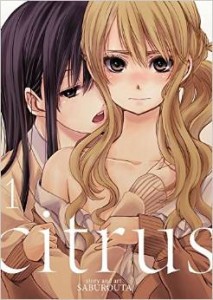
CitrusV1SSELast week I confessed I just wasn’t enjoying Saburouta’s manga Citrus, and asked you, my dear readers  to jump in with a review. And once again you are the best readers ever. As a result, – it’s another Guest Review Wednesday and we have another Guest Review! Please welcome Amanda B who has graciously written up her look at Citrus, Volume 1 for us!

Saburouta, who made an appearance in Yuri Hime Wildrose Volume 7 back in 2007 with a smutty one-shot, has returned to the Yuri scene with a drama-filled, pseudo-incest manga titled Citrus. Citrus is currently in its 4th volume, running bimonthly in Comic Yuri Hime, and was recently licensed in English by Seven Seas (yay for more Iuri!). It has caused such a stir in the Yuri world that a Promotional Video was created (voiced by a few notable actresses featured in various Yuri anime titles) to recount the manga up through its 3rd volume! It’s pretty obvious this series is a guilty-pleasure read. Not everyone is into the whole “incest” factor, so discretion is advised if this isn’t your cup of tea.

The carefree and fashionable Yuzu Aihara’s world is turned upside down after transferring to an all-girls high school upon her mother’s remarriage. Not even making it through her first day of school she manages to sully her reputation and anger the beautiful, but snobby student council president, Mei. After returning home, Yuzu finds out that Mei just so happens to be her newly inherited younger sister, a detail mom forgot to mention. It is made evident that evening that Mei clearly has some boundary issues after randomly kissing Yuzu, at which Yuzu becomes literally dumbfounded about her newly appointed role as the “older sister”.

***

Support Yuri News and Reviews –  Subscribe to Okazu withSubcribe with Patreon

***

Throughout the volume, Yuzu finds herself constantly conflicted between her increasing lustful desires, and trying to gain Mei’s respect in order to increase their family’s cohesiveness. One night when attempting to kiss Mei, Mei cries out for her father, whom we have yet to see, and the matter is not discussed further (at least in this volume anyway). After a series of disastrous events, Yuzu finds Mei’s grandfather (headmaster of the school) collapsed on the floor of his office and brings him to the hospital. After coming to understand Yuzu acted as the caretaker for her grandfather, Mei appears to be somewhat grateful before instantly returning to her tsundere mannerisms. The final arc of the volume centers on Yuzu coming to the conclusion (after consulting with bff Harumin) that her attempts to become an older sister figure have failed and that she is in fact, in love with Mei.

As a fan of Saburouta’s Yuri works, I am beyond pleased with the artwork. It is gorgeous! There is quite a bit of service throughout with various kissing scenes, particularly the shower scene. The story however is very chunky with a plethora of forced drama. Mei’s cold exterior warrants the obvious dramatic plot-hole I’m sure will be explored at some point. I get the feeling a good portion of the fandom for this series are in it mostly for the illustrations – watching pretty girls go at it is something I too enjoy.

Ratings:

Art – 10
Story – 4
Characters – 5 (definitely room for character development in the upcoming volumes)
Service – 6
Yuri – 9
Overall – 7

Sometimes I can’t help but wish Saburouta would just instead collaborate with another mangaka capable of writing a decent drama (maybe Shuninta-sensei) while she provides the illustrations. Volume 2 will be available in April.

Erica here: Thank you Amanda! Much obliged for the review.

I was reading Fujimoto Yukari’s essay in Eureka magazine’s “Yuri Culture” issue and something sort of dawned on me. In Oniisama E, we spend a lot of time watching Miya-sama and Saint Just’s unhealthy relationship on screen, but there’s actually another half-sibling relationship directly in front of us the entire time that is perfectly healthy – for a number of reasons, not least of which because Nanako doesn’t know it exists. Henmi and Nanako serve as sane, healthy foils for Rei and Fukiko, letting the audience know that it’s not normal to be so weirdly manipulative of one’s half-sister. Citrus is in desperate need of a foil couple, some representative healthy relationship,  to relieve the thick atmosphere of “this is not and really cannot be a good thing.”


Lesbian Novel: Dolly Dingle, Lesbian Landlady

February 2nd, 2015

DollyDLLA few years ago, I discovered Monica Nolan’s genius with the Big Book of Lesbian Horse stories. Following that, I’ve read and reviewed Bobby Blanchard, Lesbian Gym Teacher, Lois Lenz, Lesbian Secretary, and Maxie Mainwairing, Lesbian Dilettante.

Dolly Dingle, Lesbian Landlady continues the saga of the lady-loving ladies of Magdalena Arms in Bay City. Like the earlier entries in the series, Dolly Dingle, is simultaneously a romp through lesbian pulp novel tropes, a drawing room comedy and a mystery story.

The elderly landlady of The Magdalena Arms is taken ill and resident Dolly steps in until Mrs. DeWitt is well again.  While acting as stand-in landlady, Dolly starts cleaning up the old place, until she learns that it’s not just that the carpets that are worn and out of repair. The finances are in serious disarray and if Dolly can’t think of some way to get them all out of a predicament, the Arms will be closed and torn down!

Unfortunately for her, Dolly is also trying to balance her own career, and not one, but two, love affairs, neither of which seem to be going quite the right way.

Will Dolly decide whether it’s Kay or Arlene she loves? And what is with all that stuff in the basement? Will Dolly and the gals save the Arms? Find out in this thrilling – well, highly amusing – installment of the Bay City series by Monica Nolan! /end AM radio announcer voice/

As always, I adore Nolan’s campy mixture of mid-century YA literature and pulp prose (that is, apparently, entirely on purpose.) The mystery this time started in one place and ended in another, but it was a terrific ride getting there. And ultimately, the mystery part was more developed than the love affairs.

A notable addition to the ever-changing cast is Jackie, an African-American nurse. I hope we’ll get her story in the near future…and I’m still holding out for a barracks romance story one day. ^_^

Ratings:

Overall – 8

As always, I’m looking forward to the next pulp novel adventure in Bay City. ^_^


Usotsuki Lily Manga, Volume 11 (うそつきリリィ)

February 1st, 2015

Uso11In Usotsuki Lily, Volume 10, we met Kanae and Keiko, two women who clearly like each other, but who don’t know how to tell one another, and Taiyou, the young man who asks Kanae out while working for her.

At the beginning of Volume 11 of Usotsuki Lily (うそつきリリィ), this is the status quo: Taiyou is in mega-bummer mood because, although he really likes Kanae, he knows that she and Keiko like each other. And he can see that, although he and Kanae are “going out”, they aren’t really. But he really likes Kanae.

He asks his older sister for advice and, rather sensibly, she suggests owning the relationship. But it’s Ten, the lead, En’s, younger brother, who makes the real breakthrough in Taiyou’s funk. Ten is open about liking guys. Although “gay” is not used here – dousei 同姓- “homosexuality”or “same-sex” is. Ten explains that he’s on Keiko’s side.

Taiyou and Ten embark upon an ill-advised plot to get Keiko and Kanae together. Let me be clear here. I, personally, believe every single plot complication in all of fiction that is not “tell the person the truth” is ill-advised. ^_^

So Taiyou and Ten (who actually is interested in Taiyou) appear before Kanae to tell her they are going out. Kanae is confused by this, unsurprisingly. To convince her, Taiyou kisses Ten, at which Keiko appears, and kicks him in the head while shouting the PG-rated version of “What the fuck is wrong with you!?!”

Keiko yells at Taiyou that Kanae chose him instead of her, so he’d better treat her well. Kanae is shocked to hear this – yes, of course she likes Keiko, but didn’t know she felt the same, etc, etc. And so, the chapter comes to an end with Kanae and Keiko together. Taiyou girlfriendless and Ten having been kissed by the guy he actually likes but as a fake thing.

One of you lovely folks mentioned in the comments of the Volume 10 review that this arc ended all d’awww… and I see your point, that Keiko and Kanae are together at the end and all, but felt that Ten takes absolutely unnecessary lumps in the process. In fact, he’s the best character of the arc, being the only one able to see the truth, speak the truth and handle the truth. In my mere two volumes of this series, Ten is my favorite character – and my candidate for “I hope he get plucked out of this needlessly complicated drama and plopped into a nice story.” ^_^

But there we go – we know from Girl’s Lily that Keiko and Kanae will go on to live happily ever after and consider marriage. So for them, definitely, d’awww.

Ratings are for this arc only:

Art – 7
Character – 7 for everyone but Ten, who is a 9.
Story – 6 Still ‘Story A’ with adults, and the handwave of young men as catalysts.
Yuri – 5 Same as above
Service – 1 Taiyou and Ten kissing, for the crowd that is interested.

Overall – 7

Not bad, certainly addresses some real issues.  There was a lot of room for improvement, but for a Margaret book, pleasantly positive, reasonably realistic.