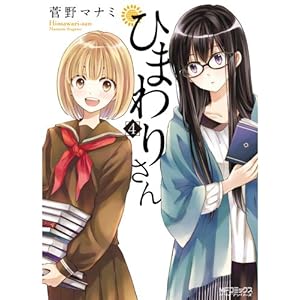
Himawari-san Manga, Volume 4 (ひまわりさん)

February 11th, 2014

When you pick up a copy of Himawari-san, you can just…relax. There’ll be no high drama here. There’s no plot complications because there’s no plot. A volume of Himawari-san is time spent with an enjoyable book for no other reason than that it’s enjoyable. For comparison, check out the reviews of Volume 1, Volume 2 and Volume 3.

In Volume 4 of Himawari-san, we delve just slightly more into the current Himawari-san’s past, her relationship with her brother and with the previous Himawari-san. Unexpectedly, the previous owner of Himawari Shoubo, was a extroverted young lady who was singlehandedly responsible for bringing the current Himawari-san out of her shell. Even as I write that, I wonder why I supposed the previous owner would be as introverted as the current one…perhaps because when one thinks of “small book store owner” one immediately thinks of bookworms who care about books more than people.

Nonetheless, both Himawari-san’s brother and she were captivated by the previous owner, much as Matsuri is captivated by the current owner, as we are reminded several times. Matsuri’s friends are now comfortable with Matsuri’s crush and, as Christmas approaches at the end of the book, we find that both Matsui and Himawari-san are growing accustomed to it, as well.

Ratings:

Art – 9
Story – 7
Characters – 8
Yuri – 4
Service – 1

Overall  – 8

This is a series imbued with the sweet smell of old books, the sepia tones of nostalgia and bittersweet feelings of crushes long gone.  A heartwarming read for a cold winter’s day.


Shinryakumono De Manga (シンリャクモノデ)

February 9th, 2014

I discovered Takemoto Izumi first with his pin-up super spy series, Transistor Ni Venus. (For which I even wrote a fanfic, I was so charmed.) I then spent some time puzzling over his series Sakura no Kiwa, completely befuddled as to why I didn’t hate it. ^_^: Takemoto-sensei has been churning out ever so many series for a number of different publishers, but something about this series totally hit my funny bone. And so, here we are at Volume 1 of Shinryakumono De  (シンリャクモノデ).

The title can be translated as “Invaders” or “Aggressors,” but as is completely typical of Takemoto-sensei’s work, his idea of “aggression” is sillier, more random and fluffier than most people’s.

The story takes place on an Earth-like planet, we shall say, and every chapter begins with a reminder that we have been invaded throughout time. Each chapter follows an “invasion” that varies widely. In one case, a lizard detective and his human assistants track down ghosts in a haunted house, or a high school student watches as the sky rips open and giant seed appears on the school grounds. The seed opens to allow a sheep to wander out, and is replaced with another  seed that contains a giant hairy monster, which, when told to go away, does. A third seed appears and an alien girl comes out, not to invade, per se, but to apologize and lay a kiss on the heroine of the story.

This alien appears again later, in a story in which a high school girl, who is much admired by her female schoolmates, finds her bedroom invaded by cat-sized animal-eared girls. The alien appears once more to apologize for the inconvenience, retrieve the “invaders” and bestow a kiss.

Another “invader” is a species of ivy…a chapter with which I really sympathized. We have ivy on the house. It really does invade. A tentacle monster “invades” a beach party, but its only act of aggression is to repeatedly move the girls’ luggage to the beach across the bay. In the final story a girl awakens to her memories and powers of being a god, sorta, kinda.

Ratings:

Art – If you like his goofy art style, 9, if not, less
Story – Variable, I’d say it averages at 8. Perfect bedtime reading for me
Characters – Sadly, there’s not much chance to really get to know them, since the volume is all shorts
Yuri – Mild, the alien girl and the girls crushing on Yuki. Let’s say 3
Service – Some light “pretty girls are pretty” service, but his is not a truly service-y art style

Overall – 8

The entire thing is enjoyably wtf.


Yuri Network News (百合ネットワークニュース) – February 7, 2014

February 8th, 2014

YNN_MariK

Yuri Manga

Takahashi Mako’s recent one-shots for Comic Yuri Hime are being collected in a volume called Cokytos (コキュートス), which appears to named after be one of the rivers of the Greek underworld, along with Styx, Lethe, Phlegethon, and Acheron, so there’s today’s random Okazu fact for you. You’re welcome. ^_^

Volume 2 of Citrus, the title just licensed by Seven Seas, is looking at a March release.

Leia Weathington Tumblred about her upcoming second volume of The Legend of Bold Riley, with some cover art previews. Here’s my review of Volume 1, so you know why I’m looking forward to Volume 2 so much!

***

Other news

Fantagraphics is looking for a Junior Design person. If you want to get into “the industry” and have design skills, hop to it!

K-Books in Akihabara has a series of Sakura Trick sweets. Why not? ^_^

Card Captor Sakura‘s Wand is being realized in diecast metal, for those of us who didn’t spend enough on the series back in the day. ^_^

Respect!Films and Sequart have teamed up to do a documentary on Women in Comics history. They’ve opened a Kickstarter for their She Makes Comics project.

***

That’s a wrap for this week! Become a Yuri Network Correspondent by sending me any Yuri-related news you find. Emails go to anilesbocon01 at hotmail dot com. Not to the comments here, please, or they might be forgotten or missed. There’s a reason for this madness. This way I know you are a real human, not Anonymous (which I do not encourage – stand by your words with your name!) and I can send you a YNN correspondent’s badge. Thanks to all of you – you make this a great Yuri Network!


Passionate Friendship: The Aesthetics of Girls’ Culture in Japan

February 6th, 2014

passionateDeborah Shamoon’s Passionate Friendship: The Aesthetics of Girls’ Culture in Japan traces the development of girls’ literature and, eventually, Shoujo manga from the end of the 19th century through the 1970’s, with particular attention to the girls’ magazines of the 1930’s, the Magnificent 49-ers and the birth of Shoujo, Josei and BL manga. Shamoon addresses Yoshiya Nobuko’s writing, but does not talk about “Yuri” as a genre. Nonetheless, anyone interested in the formative years of Yuri and its literary precedents may want to read this book. There is some definite value in here, and I promise to spend time on the good points, but before we get there, there are several major negatives with this text that I want to address, in ascending order of importance.

The first serious problem I encountered with Shamoon’s work is her tendency to dismiss all theories but her own, particularly if she can hold up a shield of a Japanese scholar’s work to support her theories. You might not see this as a problem, unless, like me, you have an issue with absoluteist thought.

At no point in time does Shamoon ever imagine that another interpretation – especially that of the audience which reads the work –  might be as valid as her own. Any suggestion, any filter other than her own is immediately dismissed, something that strikes me as…kind of ridiculous. When I am repeatedly cautioned to stop interpreting what I read through the filters that make up my life experience well, there’s really no polite response for that. Instead of acknowledging that other scholars have other interpretations, she brings them up only to wholly, completely, utterly dismiss them.

Whether I actually agree that girls’ literature revolves around a “culture of sameness” as Shamoon does, I would not here suggest that this is a terrible idea. Tween and teen girls culture is, largely, defined by the pressure to fit in. In that sense, I agree with her, but in the sense that Shamoon proposes her theory to define the illustrative style for early 20th century Japanese girls’ lit, I would say that she’s missing a major factor here. Which brings me to my second point.

It’s not until well past the first half of the book, into the chapter about Takahashi Makoto’s (Sakura Namiki) influence on Shoujo manga, that Shamoon acknowledges the literary and artistic constraint of commercial art. As a friend so succinctly put it, “Commercial art must sell.” Well yes, and Shamoon acknowledges this has an effect on Takahashi’s art. But she completely fails to acknowledge what every commercial artist knows…deadlines are brutal. There is not enough time in the world to get things done, so we create macros, templates, stencils, tones and other shortcuts. Some of the illustrations she chooses to make her “culture of sameness”  point could far more simply be explained as artistic stylings made sensible by deadlines. Anyone who reads manga knows that manga artists often begin with the same face or one of a few body types, then elaborates on instantly identifiable characteristics. Change hair and skin tone slightly and you have a new character (or the same character pretending to be differrent, as Sailor Moon fans all know.)

Which brings me to my third and most important point.

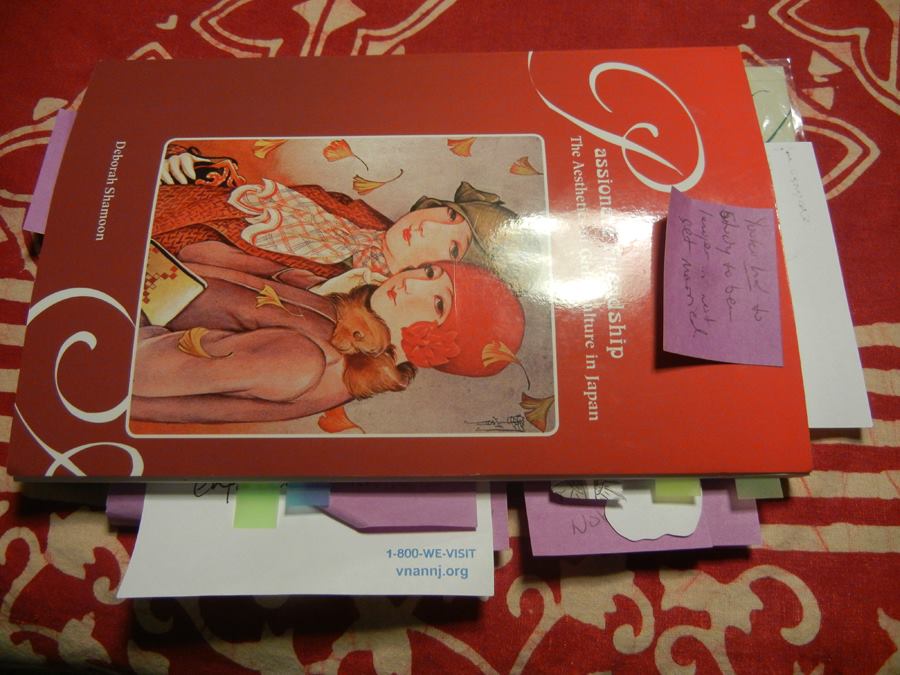
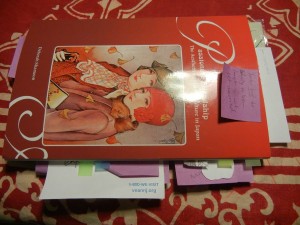
This is what my copy of the book looks like:
Thoughts

What you can’t really see is that I began making notes on these cute little sticky strips, then graduated to the small sticky pads, then the 3″x4″ size, then, in a moment of crisis switched to a 7″ note pad, entire pages of which were filled. I eventually moved back to the small stickies, but *a lot* of them.  And here’s why:

In Shamoon’s chapter on Yoshiya Nobuko’s work, she begins by “cautioning” us to not use the obvious filter of reality and allow Yoshiya’s actual life with an actual female partner to cause us to mistakenly interpret her work as in any way lesbian.  She then follows that eye-roller up with the conclusion that because Yoshiya does not write about a separatist vision of society, or exhort her readers (tween Japanese girls of the 1920s and 30’s,) to adopt a separatist vision of society, her works cannot be seen as feminist.

Let me refer back to my second point – commercial art must sell. Yoshiya was a female writer, living on her writing, in early 20th century Japan. Her work was subject to male editorial supervision and had to be approved by government censors. And even within the restrictions of writing stories that would sell to their target audience, on deadline, that would be approved of by male censors and editors, she wrote a novel in which two women chose to step away from society and make a life together (Yaneura no Nishojo), one in which a woman creates an alternative adoptive family for herself, after redeeming her reputation which has been smeared (Ban-sensei) and told tale after tale of young women growing up, some marrying, some not, but all finding their way into adult life (Hana Monogatari Volume 1, Volume 2.) Creating one’s own family outside the constraints of society is, IMHO, the very essence of feminism…the right for every woman to choose for herself what her love, her family…her life….will be. If we take off the incredibly narrow blinders Shamoon would have us wear, Yoshiya’s work is unremittingly feminist in nature.

I did say that there was value in this book. And there is. Shamoon’s more factual passages, historical discussions of girls’ literature, magazines and manga are exceptionally useful to a student of Yuri or BL. As a result of reading this book, I have recently concluded reading Otome no Minato, by Yasunari Kawabata (for which I have a posted a 2-part special review.) And I’ve added Ban-sensei to my to-read pile, because I can already see some great analogies with manga and anime series you’ll know in what appears to be a very Dickensian tale. So, yes, definitely worth the time it took me to read it. But I would have loved it, had Shammoon not been so intent on refuting all other scholars and insisting that Yoshiya could not be read as feminist (much less lesbian) because none of her books follow Straw Feminist doctrine.

Ratings:

Value as a Chronology – 8

Overall – 6


LGBTQ Comics: QU33R Anthology

February 4th, 2014

QU33R“LGBTQ characters are also appearing in mainstream comics, and the code of silence that [Mary] Wings fought against  has been broken. But there still remains a profound need for distinctly queer comics.” – Justin Hall, from the Foreword of QU33R.

Where No Straight Lines, Hall’s historical retrospective of western LGBTQ comix and comics, told us where we came from and  how we got here, Rob Kirby’s new anthology, QU33R: New Comics from 33 Creators, tells us where “here” is.

I’m frequently asked whether western comics have an equivalent of Yuri or BL and I always reply, “Of course! There have always been LGBTQ comics artists and therefore there have always been LGBTQ comics.” But the question is not – and really has never been –  “do they exist?” but “Where can I find them?” There are fewer and fewer weekly gay papers and more and more webcomics, which makes it both much easier and much, much harder to find anything to read. I used to read “This Modern World” by Tom Tomorrow in the Village Voice, now I follow him on Twitter.

A search engine search on “gay comic” or “lesbian comic” actually turns up some excellent stuff…it also doesn’t turn up really excellent stuff that gosh, it would be great to know about, but if Google doesn’t show it above the cut on Page 1, it’ll never get seen. And you may not know about Diane DiMassa, because you weren’t a lesbian in the 90s. Heck, you may not have been born in the 90s. It’s perfectly okay to not know a 30-year old series, but how much cooler is it to read Jennifer Camper, or Kris Dresen or Ivan Velez, Jr. or Carlo Quispe and then meet them at a comics event and think, “Holy crap! I just met a legend!”

This book is full of today’s comics, some talking about yesterday, others about tomorrow and a few delving into an alternate today. With my deep and abiding love of ridiculous lesbian tropes, my favorite story was Jennifer Camper’s hard-boiled assassin story, “Another Night in Carbon City”. I was also deeply moved by Steve MacIssac‘s, “Vacant Lots,” a story of coming back to his hometown, a completely different guy than he left, and seeing how life had changed those who motivated him to become who he is. (Oddly, enough, my mother just brought up one of the two people who function the same way in my life. It’s always bizarre when Mom mentions her, because she remembers I didn’t like her, but not that she emotionally tortured me for years, or that I have long, long ago let it go. All that is left is Mom’s memory that I didn’t like her that she always has to remind me about.)

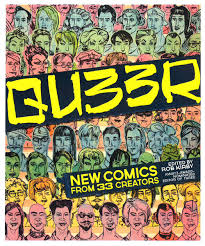
The book cover reminds me of comics collections of my youth; colorful, densely packed with art and giant words over the art. The interior pages have a feature that all anthologies everywhere ought to include – a visible reminder of the artist’s name prominently displayed on every page. I really liked not having to flip back and forth to remind myself who I was reading. I also liked (and always like) when the contributors get a bit of space to talk about themselves in the back.

If you have ever asked yourself something along the lines of “what do LGBTQ comics in America look like?” you’ll definitely want to pick up QU33R, available in 3 digital formats, hardcover and paperback from the terrific folks at Northwest Press (for whom I have to thank for this review copy. Thanks Zan!) Northwest consistently puts out terrific LBGTQ comics and I hope that, if you’re interested in LGBTQ comics as well as Yuri manga, you’ll give QU33R a chance.

Ratings:

Overall – 8