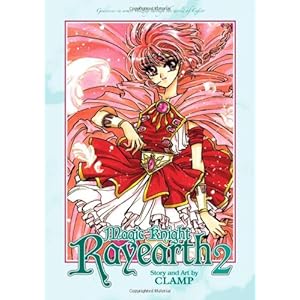
Magic Knight Rayearth Manga, Volume 2 (English)

June 18th, 2012

Unlike the second season of the anime, Volume 2 of the Magic Knight Rayearth manga does not have a Yuri subplot. For which I am eminently thankful. In fact, the lack of Nova and her annoying mother went a considerable distance to cleaning up the exceedingly messy plot. What’s left, then, is a far more straightforward, much less morality-play like story.

Umi, Fuu and Hikaru, having returned to Earth after fighting Zagato, are…unhappy. They want to go back to Cefiro. Fuu particularly, has reason to go, as Ferio is there. And one day, when they meet up at Tokyo Tower, they find themselves transported back, but not to any place they recognize as Cefiro!

It turns out that now that Emeraude is gone, Cefiro is collapsing. Clef and the others are gathered in a castle floating above the planet surface. The Magic Knights return to find what’s left of Cefiro under attack from three nearby planets – Autozam, Fahren and Cezita.

Joined by old allies, the Magic Knights have to find a way to protect Cefiro. This is complicated by the fact that their enemies all turn out to be decent people who are just trying to help their own worlds – and the knowledge that the Pillar system of Cefiro is innately, dangerously flawed.

The story is mostly taken up with relationship building, rather than fighting, and the conclusion, while predictable, was far more satisfactory than the scattered, messy ending of the anime.

A great deal of the story follows our enemies and, instead of giving us reason to hate them, we learn to like them. Eagle and Lantis are presented very much as a couple, but when Hikaru comes en scene, she could reasonably be paired with either of them – or both – in a way that makes sense. Moreover, their dynamic is subtle enough that a child could read this without any concern.  Growing Ascot up into a tall, handsome young man for Umi was a nice touch and even Ferio gets a power up. All in all, a satisfying ending.

Which is odd, when you consider that the end is a modified form of colonialism. Having destroyed the Pillar system, the Magic Knights replace it with a completely alien system. This would all be very uncomfortable if the worthies of Cefiro were not already ready to see the back end of the Pillar system. So, its okay then, phew.

Ratings:

Art – Less wonderful than Card Captor Sakura, but still very CLAMP-ian
Story – Less messy than the anime
Characters – Less annoying than most, until Mokona’s true identity is revealed
Yuri – Less than none
Service – Less than usual

Overall – I’m less enthusiastic about this series than CCS, but more than I expected.

Many, many thanks to Okazu Superhero Amanda M. for sponsoring today’s review!


Interview with Yuri Manga Artist Morinaga Milk

June 17th, 2012

I am so very delighted today to offer you an interview I’ve wanted to do for a really long time.

Many of you have heard of Morinaga Milk, and quite a lot of you have enjoyed her work over the years. From her doujinshi work until 2003 when she sprang onto the pro Yuri scene with Yuri Shimai magazine; from her collection Kuchibiru Tameike Sakurairo (which has now been re-released by Hobunsha in a two-volume set, with some additional material: Volume 1 and Volume 2), through her mega-hit GIRLFRIENDS (which is available in English from  from Seven Seas), Morinaga-sensei has been a staple of the Yuri scene.

It is my great pleasure to offer you this interview with Morinaga Milk-sensei today!

——————————————————-
Q1: Will you please tell us a little bit about yourself?
——————————————————-

Born in Tokyo, live in Tokyo.
Gender is female.
I love to draw Yuri manga.

——————————————————-
Q2: How did you become a mangaka? Was it a childhood dream?
——————————————————-

It was a childhood dream to become a manga artist.

When I was about 20 years old, my submission was chosen for a an award, so I made my debut illustrating a Light Novel.
When I was 21, I was scouted by an editor who had read my doujinshi, so I became a manga artist.

——————————————————-
Q3: Which artists are your role models?
——————————————————-

When I was a child, I read Hagiiwa Mutusmi‘s shoujo manga, and started to draw manga.

If I couldn’t be a writer, I wanted to create anime, like Bishoujo Senshi Sailor Moon, which I saw.
I wanted to be able to write stories of women in love.

——————————————————-
Q4: If you were not a mangaka, what kind of work would you be doing?
——————————————————-

I wanted to work in a bookstore or a manga cafe.

——————————————————-
Q5: What were your motivations for creating Yuri Manga?
——————————————————-

I don’t know if this can be called a motivation but,  when I saw the female characters in my beloved Bishoujo Senshi Sailor Moon, it seemed natural that they were Yuri couples. Since then, I’ve been been drawing only Yuri manga.

——————————————————-
Q6.1: Please tell us a little bit about your process.
How long does a chapter take to draw?
——————————————————-

Each chapter takes about one week to write the dialogue and one week to draw, for a total of about two weeks.

——————————————————-
Q6.2: How many assistants work with you?
——————————————————-

I have two assistants.

——————————————————-
Q7: What has been the reaction in Japan to GIRL FRIENDS? What do you think about GIRL FRIENDS being translated into English?
——————————————————-

I don’t think it’s very popular in Japan. I don’t see it for sale in bookstores near me.
Only maniac Yuri fans seem to be reading it.

I was very happy when I learned that it would be translated into English. But since I don’t read English, I don’t know if the translation will capture the right nuance at all.

——————————————————
Q8: You’re recent work has been very realistic in tone. Can you tell us what  you’re thinking when you draw? What message are you trying to convey?

——————————————————-

Falling in love is painful, and there are many things to worry about, or that will make you cry but, falling in love is not pointless, despite all that. That is what I am trying to convey, I think.

——————————————————-
Q10: What question do you have for overseas fans?
——————————————————-

I like High School girls, so I draw manga set in schools. Do overseas fans feel that its strange to read manga set in Japanese schools?

——————————————————-
Q11: What message do you have for overseas fans?
——————————————————-

Thank you so very much for reading my manic manga.

When I think that there are people overseas, where I cannot go, reading my manga, it feels very mysterious and happy.

It would be wonderful to one day meet my overseas readers, I think.

——————————————————-

Thank you very much for your time, Morinaga-sensei! Your overseas maniac fans are thrilled to be able to read your work in English. ^_^

***

小松さんによる日本語の翻訳: http://willowick.seesaa.net/article/276194964.html


Yuri Network News – June 16, 2012

June 16th, 2012

I honestly  cannot believe that we’re almost halfway through 2012. Wow.
Yuri Anime

Crunchyroll has announced that they will be carrying the second season of the Yuru Yuri Anime. Details of when it will air are forthcoming. Here’s a promo commercial for the series. (And you should probably watch JManga for an upcoming announcement about the manga series. Ahem.)

A new commercial for the upcoming Magical Lyrical Nanoha As the Second Movie is available for your viewing pleasure.

***

Yuri Manga

The Pre-orders for Morinaga Milk’s Girl Friends in English are up on Amazon! The first omnibus Volume will be released in October, 2012, and the second volume will hit the shelves in January 2013.

***

Other News

Takarazuka is doing a Legend of the Galactic Heroes musical. This is hardly the first anime or manga inspired story, but it seems there’s more of them, these days. ^_^

In a more serious vein, this week something happened that upset a great many people. It was brought to my attention that doujinshi scans had been put up for sale on the Amazon Kindle store.These were not legit, the artists have not given their permission for this and make no money on them. To many of us who have been watching scanlations devolve from a morally grey area to an outright criminal pursuit, this was not surprising, but it was upsetting. Doujinshi are an acceptable undermarket in Japan that is allowed to exist because it benefits the companies and the original right holders. Companies tacitly give permission for their characters to be used as long as their work does not impact the originals’ sales or copyright. In other words, as long as sales are kept low and niche. When a book gets too popular, it can lead to litigation.

My friend Komatsu-san contacted one of the artists, who was very upset that her work was being sold without her permission, of course. As I have said many times it is this issue of permission that is the core of the fallacy of scanlation as a noble pursuit. Scanlators do not ask for permission. By failing to do so, they simply cannot argue that what they do is ethically sound. The problem with permission is, it might not be granted, And since scanlation circles want what they want, they simply take it, without ever asking for that permission.

In this case, the scanlator managed to take that intent to the inevitable lower level – since the creator never even knew their work was scanlated, why not just sell it? They make a few bucks, no one gets hurt. Unfortunately, someone is hurt – emotionally and potentially financially, since the seller putting that scanlation on the English Kindle market means that the artist is now subject to *western* copyright laws. And the doujinshi was from a licensed series.

Okay, so it’s pretty obvious to me that no one has the right to take other people’s stuff without permission. And I think it’s obvious to everyone that selling that stuff is really over the line illegal. Unfortunately, because of the ecosystem of scanlations, a lot of people really, genuinely disagree with me about that first point. Hopefully we can agree on the second point.

I think this will be a growing problem for some time, until the new digital publishing market solidifies. Maybe then a valid scanlation translation market can develop. I think that would be nice. Until then, I think we’ll be seeing more of this issue.

The upshot of this week’s situation is that I contacted Amazon and asked that they remove the listing. I identified as a publisher, explained the language barrier and the existence of scanlations. Amazon removed the listings. Then Amazon wrote back telling me that they don’t accept takedown requests from people other than the IP holder. I wrote them again, with a long, comprehensive email about the doujinshi market and the way this situation developed, and asked them to reach out to me for a fuller explanation…and I suggested that they get used to receiving such emails from interested third parties, because this situation is unlikely to get better. I later learned that a coalition of folks for creator’s right in Japan actually was ready to bring a lawyer into the issue.

I and many others see this as a natural, inevitable devolution of the moral compass of scanlators, who have convinced themselves that they do something important, that their wishes are more important than creator’s rights and that they *own* their work in some legitimate way.

It’s long past time that we, as fans, hold other fans to a standard of decency. Even if you continue to read scanlations, surely you can see that selling them is beyond tolerable.

If you see a listing for an illegal sale of scanlated work, please report it to Amazon ([email protected]) or tell me, and I will. Thanks.

***

That’s a wrap for this week.

Become a Yuri Network Correspondent by sending me any Yuri-related news you find. Emails go to anilesbocon01 at hotmail dot com. Not to the comments here, please, or they might be forgotten or missed. There’s a reason for this madness. This way I know you are a real human, not Anonymous (which I do not encourage – stand by your words with your name!) and I can send you a YNN correspondent’s badge.

Thanks to all of you – you make this a great Yuri Network!


Yuri Novel: Ibara-hime (いばらひめ)

June 15th, 2012

Ibara-Hime, by Suzumoto Beni, with cover by Hibiki Reine is, I believe, a doujinshi novel or shousetsu.

The story begins with two travelers, a young, beautiful girl named Rustica and Iru=Eve, a pilgrim and servant of the Goddess.

Iru=Eve is not a big talker, so most of the book is presented as an internal monologue. We learn that both Iru=Eve and Rustica (pronounced Roo-steak-ah) are, in some sense, running away from something and, as the story plays out, we learn what those things are.

Rustica is beautiful, but rejects the terms “angel,” “doll,” “flower” and other expressions of dainty beauty, while Iru=Eve is stoic and diffident. Their stories encompass gender and sexuality in an alternate universe setting that has a slight Russian fairytale feel about it.

I say their stories encompass gender and sexuality, but not in a way that we, the reading audience, might want. In their world, marriage partners are determined by a mark that appears on your finger when the time comes, and the person with the matching mark is your partner. There is no other form of relationship than Goddess-sanctioned heterosexual marriages.

Iru=Eve’s story is tragic, of course. She and two childhood friends, Iru=Yunoa and Iru=Azael hung out every day, playing, napping by the river, until the Torun, the mark of marriage, appeard on Iru=Azael’s and Iru=Yunoa’s fingers. This is unfortunate, and more so because Iru=Eve and Iru=Yunoa start to have feelings for one another. But  Iru=Yunoa and Iru=Azael marry and move away and Iru=Eve takes to the road to deal with her conflicted feelings.

Rustica confides that she has run away from home herself. She’s small, delicate and beautiful, but , like Iru=Eve, has no marriage mark yet in her late teens. She doesn’t want to marry, really, and more confusing to her is that her body, as beautiful as it is, is still a child’s body and has not matured. She is not even sure she’s human, much less female.

Iru=Eve realizes that she cares for Rustica and wants, very much to protect her- and she recognizes that this was the same feeling she had for Iru=Yunoa. Is it love? She doesn’t really know, since “love” is a thing that you feel only for your chosen marriage partner.

More importantly, Iru=Azael appears, accusing Iru=Eve of murder. They fight, and Iru=Eve manages to defeat her former friend and escape with Rustica. Later, on a dark, windy night, she tells the young woman the rest of her story.

When she returned home after her friends’ marriage, she found Iru=Yunoa miserable and lonely. Her dear friend starts to solicit more intimacy (by which she means a hug or two), and eventually convinces Iru=Eve to run away with her. Can you see where this is going?  Yes, one dark and stormy night, Iru=Azael catches up to them and accuses Iru=Eve of stealing his wife and, rather predictably, Iru=Yunoa lies and says this was all Iru=Eve’s idea. In the ensuing sturm and drang, Iru=Yunoa dies and Iru=Eve takes off on the run.

But, now, she decides to face the truth. Despite the fact that she’s long past time to have her Torun appear and despite the fact that her order probably considers her a murderer, Iru=Eve returns to her town and to her teacher, with Rustica at her side. Her teacher decides that the Goddess will determine if she is innocent or not, so when Iru=Azael arrives, he commands that the two of them duel. Iru=Azael loses, but Iru=Eve does not kill him, in a rather supreme effort of skill. Declared innocent, Iru=Eve asks Rustica if its okay if they just travel together, y’know, forever. Rustica gladly agrees and the book comes to an end.

There were a lot of predictable bits of this story. But there were also some excellent elements. The world is not fully fleshed out and, probably not surprisingly,  I’m creeped out by any society that includes genetic/scientific/political predetermination of obligatory heterosexual partnering. Nonetheless, there were decent elements of storytelling among the clichés.

Interestingly, one of the most unique elements was the typesetting. Where most Japanese novels are set vertically, and read right-to-left, this was set horizontally and read left-to-right. This added to the “foreign” and fantasy feel of the novel.

Ratings:

Overall – 6

I would have really preferred to have more illustrations of the characters than the one cover picture, but only because I really like Hibiki’s art. The story itself didn’t warrant them. ^_^;


American Comic: Womanthology Heroic (English)

June 13th, 2012

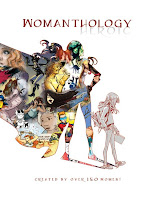
By now, I hope all of you have heard of Womanthology Heroic, the anthology created by over 150 women comic creators. It had an amazingly successful Kickstarter (to which I contributed, so in the back, among the many, many names of supporters you’ll find mine ^_^) and is quite possibly the most beautiful book I have ever seen in my entire life.

The project came about on Twitter, where a number of female comic creators finally just lost their bacon at the industry trope of “women don’t x comics” (where x can stand for “like,” “read,” “draw,” “make” etc.,) despite the masses of evidence to the contrary.  It’s pretty apparent that there were plenty of folks – women and men –  who were very ready to read something just like this.

Womanthology is…a book of treasures. I’m not going to single out a story or three. It’s not for me to tell you which are the best stories in a collection of good stories. Buy the book, open it up and begin to read. Art and stories are variable, but none of them are less than excellent. You’ll like some better than others, some will touch you more deeply, but those particular gemstones are for you to find in this box of treasures.

Womanthology is…inspirational. Yes, some of the stories are about empowerment, but really not. What they are about sometimes is what it takes to grasp the power in ourselves. But that is so beside the point, because the underlying presumption in this collection is that we already have power, and we can use it any damn way we like. Some stories are just plain creepy, or sad, or silly. Some stories work with stereotypes, others bash them gleefully. There is love of the female form and psyche and not one person tries to “fix” that.

Womanthology is…luscious. Full color pictures, stories that run up to 6 pages, but many that are a chunky page or two. Some have morals, some have plots, some have messages, some are just explorations of “wtf can I draw today?” The paper is thick, the cover is beautiful and my first words upon getting this copy was, “There is no way I’m giving my Library this. I’ll get them a separate copy.”

Womanthology is…educational! I love the Pro Tips that run throughout the book, with real advice about art, writing, networking, getting and making jobs. For that alone I’d say every female who wants to be part of the comic industry needs to get this book. If I taught an art class, I’d make this my text book.

Womanthology is…layered. Read it through for the shorts, then again for the bios and info about the creators, then again for Stacie Ponder’s comic strip that runs through the entire book on the page bottoms, then again for the Pro Tips. You’d find something to love all over again every time you do. It’s too much of everything to take in one reading. Read it as you might eat a box of delicious chocolates, a few pages at a time.

Womanthology Heroic is about, by and for, women and girls who create, read and love comics. If you buy one book this year, it should be this one (especially if you’re buying for a library.)

Ratings:

Overall – 10 (But really way more than that.)

The really cool thing about this book is that so many of the creators are on Twitter, and many of them have their websites listed on their bios, and you can talk to them directly to tell them how much you love this book. And, of course you can always shout out to @Womanthology. I’m sure they’d love to hear from you.