Blue Friend Manga, Volume 3 (ブルーフレンド)

June 4th, 2012

In Blue Friend, Volume 3 (ブルーフレンド), Kanako starts her first day of high school by making friends with a group of three girls, all of whom seem fashionable and fun, so she thinks high school life is going to be pretty swell. She really doesn’t get that girl in class, Ao, who just seems rude. But quickly, her relationship with her new friends starts to sour as Aki presumes on their friendship. Finally, Kanako has had it, and tells the group she’s done with them. Aki begins to retaliate with time-honored bullying, to the mortification of the other two girls. But Kanako walks away without a glance behind her and becomes close friends with Ao after all.

Ao’s outspoken, opinionated personality has a striking affect on Kanako. She’s able to say what she thinks and not hide her feelings and, as a result, she thinks she’d like to be friends with Ao. Ao’s reaction is extreme – she’s been alone for so long, she had no idea how to “be friends.” But she tries.

Kanako tries to be stronger, Ao tries to open up and intermittently, they accidentally get one step too close and the tension between them rises. When Ao kisses Kanako in a puricula booth – because she was told it was totally normal by some schoolmates – she realizes that her feelings aren’t “normal” and she pulls away from Kanako. But Kanako has learned to speak her mind now and she forces the truth from Ao. She later gets a kiss of her own in, but in all honestly, there’s miles to go for both of them before they have room for those kinds of feelings.

The situation with Aki gets worse, and she steals a phone strap that Kanako bought for Ao. Ao finds it, but not before Aki’s jealous bullying is outed for what it is, and she is roundly scolded by her friends and Kanako. The other girls ask Kanako to be their friends again, but Kanako refuses, saying she’s found a better friend in Ao. The two are reunited and after an embrace, we are assured that they’ll walk towards the future together through sweet and bitter.

Although this is really a story about friendship, with the barest edge of tension between them, I liked it loads. For one thing, all of the girls tell the bully off, including what would normally be her henchchicks. Basically, the bully is the lamest character, not inexplicably powerful. Phew. Secondly, it’s okay to have the girls just be friends…to develop the kind of friendship that in Japan is traditionally assigned only to men. A bosom buddy, through thick and thin. There’s an old saying which I can’t be bothered to look up about how women’s relationships can’t last. You know, because we’re weak in the brain and when a guy comes along, we go all gaga over him and become rivals, or something. So just having Ao and Kanako being friends is fine with me.

As a sequel to the first two Volumes of Blue Friend (here are my reviews of Volume 1 and Volume 2 ), it was refreshingly not locked in a story of mental unwellness, or a struggle against bullying. In the way that the first arc sort of “fixed” some of the more horrible tropes of classic shoujo Yuri, this arc “fixes” the bullied student trope. For that, I’d recommend it to a girl child I liked.

Ratings:

Art – 7
Story- 8
Characters – 7
Yuri – 2
Service – 1

Overall – 7

It might not quite be Yuri, but there is tension between them and maybe one day, it’ll be something more. Or not. It’s fine the way it is.

Yuri Novel: Note Yori Yasui Koi ( ノートより安い恋)

June 3rd, 2012

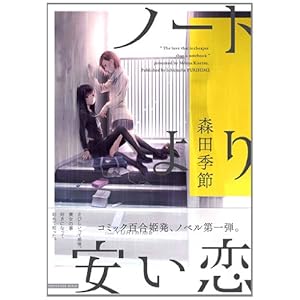
There are two problems with Note Yori Yasui Koi (ノートより安い恋) “The Love That Is Cheaper Than A Notebook,” by Morita Kisetsu. And both of them come from the same place, I think.

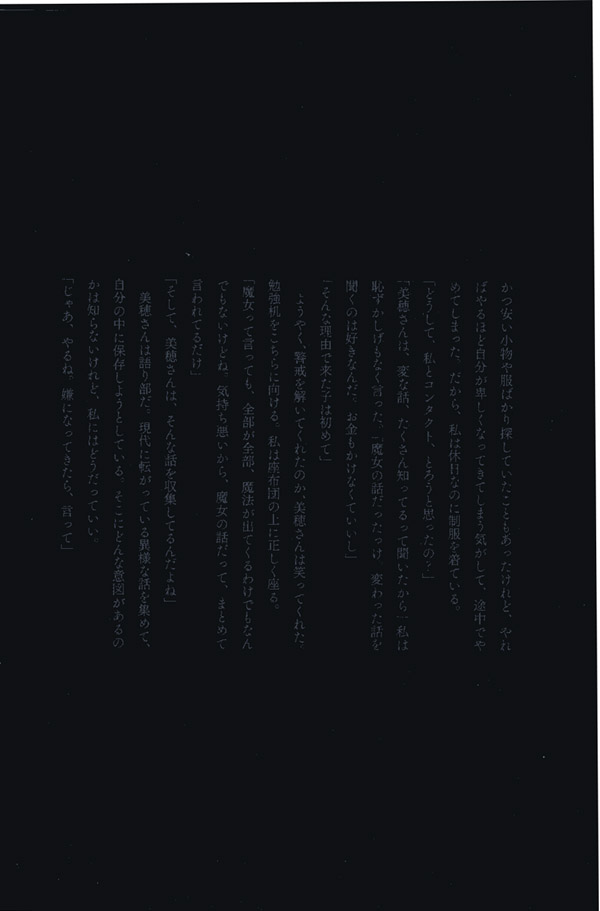
But before we even get to the problem with the book, let me start with this – the collection begins with dark grey letters on a black background. Seriously.

Go ahead…click the image.

But that wasn’t really the problem with this collection. The first – and most pressing – problem was this: Of the seven stories included in this collection, how many of them do you think are about two females who are in love with one another? If you said, “None,” you’d be correct.

The second problem is an extension of the first. Each story features a couple who are unequal in status (sempai/kouhai, adult/child, god/human, witch/human) and each story is basically focused around one conversation between that couple, but repeated seven times or so in the course of 50 pages. There’s a palpable lack of tension between the protagonists and conviction or caring on the part of the writer. Instead of a collection of Yuri, by which *I* mean stories where two females fall in love, or are in love, with one another, this is instead a collection of Yuri by which Yuri Hime means a female taken out any kind of real life context, plopped down to share the story frame with another female and any conversation between them will somehow be contrived to be considered “Yuri.”

I’m continually frustrated by Ichijinsha’s inability to find a single good author of anything remotely lesbian-ish for their “Yuri novels.” This collection of short stories isn’t dire, but it’s not entertaining, either.

The two stories that were the best were the least real .

One in which a girl, tired of life, meets a witch in the woods and lives with her, until she falls for her. They share a single kiss which destroys the witch, but frees the girl to rediscover her true love, a female classmate (which the author cleverly has her refer to as a boyfriend so we don’t get the secret before the witch does, I have no idea why.)

The second is the relationship between a girl who becomes the priestess for and wife of a god, under somewhat suspect circumstances. After the god conducts a dramatic battle in the form of a dragon with her brother, the river god, both human and god live happily for some portion of time thereafter.

The all-human relationships in this collection are confined to schoolmates, all with a not-particularly compelling hook and one ten-year old who meets and befriends a slacker college student in a completely platonic relationship.. None of these stories contain much of anything that remembles love, although there are a few kisses. And the most excruciating mention of “bodypainting” ever.

The one thing that is remarkable about the book is the slick presentation. The book comes clothed in a thick plastic cover that is perfect for travel. Too bad the contents weren’t worth protecting.

Ratings:

Overall – 3

This is a very non-Yuri collection of Yuri stories. It’s not bad, it’s just not good. There’s no…passion…in any of it. Your mileage may vary of course.


Yuri Network News – June 2, 2012

June 2nd, 2012

Yuri Manga

The third and final volume of GUNJO by Nakamura Ching is on sale! (羣青 下 ). This series still remains the most amazing manga I have ever read. I hope you’ll support the artists and buy the book.

Fujieda Miyabi’s Twinkle Saber Nova, Volume 4 (special edition) is up on Amazon.JP. I’ll be honest, I didn’t even realize this was continuing!

Distressing news from Tsubomi, Higashiyama Show’s Prism is suspended for the moment because of concerns about plagiarism from photos on the Web.

***

Yuri Anime

Okazu Superhero Eric P. wants you all to know that the trailer for Funimation’s reissue of Yoshitoshi Abe’s Haibane Renmei is live on its own webpage, along with episodes available to watch online. (You’ll need to have registered and endured their horribly slow site, but for free streaming, it’s a decent deal.)

***

Other News

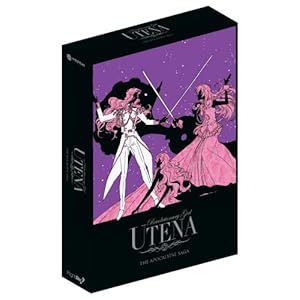
We have a winner of the Revoutionary Girl Utena Apocalypse Arc Box set contest on Yuricon! Thanks to Nozomi/RightStuf and to winner JoAnne S.  – and to all of you for participating!

***

That’s a wrap for this week.

Become a Yuri Network Correspondent by sending me any Yuri-related news you find. Emails go to anilesbocon01 at hotmail dot com. Not to the comments here, please, or they might be forgotten or missed. There’s a reason for this madness. This way I know you are a real human, not Anonymous (which I do not encourage – stand by your words with your name!) and I can send you a YNN correspondent’s badge.

Thanks to all of you – you make this a great Yuri Network!


Out of the Office for a few days

May 31st, 2012

Just fyi, due to life, I will not be posting for the next few days. Feel  free to revisit the over 2000 previous posts that are here for yucks. I’ll see you back here next week.


Yuri Anime: Revolutionary Girl Utena Movie/Adolescence Of Utena (English)

May 28th, 2012

Included with the third Revoutionary Girl Utena box set from Nozomi/RightStuf is the Revolutionary Girl Utena Movie: Adolescence Of Utena.

I credit this movie, specifically, with being the beginning of my “career” as a spokesperson for Yuri. Because of my interest in the movie, my discovery of a Yoshiya Nobuko reference in the movie manga, and my interest in the literary and artistic references drawn upon for the series, I ended up being invited to present this movie at the Frameline Film Festival in San Francisco, the British LGBTQ Film Festival and the Tampa LGBTQ Film Festival back in the early 2000s. I was able to meet and interview Ikuhara Kunihiko at Big Apple Anime Festival and because of this movie, CPM was an early sponsor for Yuricon events. I have a lot to thank this movie for. Not least of which is for being a fantastic movie.

It is a fantastic movie, with extraordinary visuals, and two of the most spectacular scenes I have ever seen on a screen – the dance on the dueling ground, and the castle car. As much as I consider the TV series a more subtle and sophisticated creation, its the movie I watch more often.

I find I have never once published the intro I gave this movie a decade ago when it first came out in English, so rather than explain to you what I said, here is the actual intro I gave the film, in front of hundreds of people who liked anime and the series…and thousands of people who had no idea what the hell they were getting in to.

In 1994, on Sundays at 7 PM, the Shinjuku Ni-chome, Tokyo’s gay and lesbian district would come to a screeching halt. Why? Because for the first time ever, Japan was watching a lesbian couple on their TVs, as part of the popular animated series, Sailor Moon These characters, Sailor Uranus and Sailor Neptune, were very clearly portrayed as a couple – with personal issues to work out, as well as greater ethical dilemmas – all within a framework of defeating the Monster of the Day as sailor-suited magical heroines.

The director of that pivotal season of Sailor Moon had instructed the voice actresses to play the characters as if they were a married couple. In 1997, that same director Ikuhara Kunihiko, along with veteran comic artist Chiho Saito and the creative team at Be-papas, turned their sights once again to the “magical girl” genre of Japanese animation. The result of their collaboration was the wildly popular series Revolutionary Girl Utena.

This 39-episode television series utilized symbolism from earlier popular shoujoai or, “girls love” series – character designs and settings, were inspired by pioneer of shoujoai, Ryoko Ikeda’s Rose of Versailles and Brother, Dear Brother. Ikeda herself had incorporated imagery into her works that were established at the beginning of the twentieth century, by lesbian author Yoshiya Nobuko. Yoshiya’s Flower Tales set the standard for girls’ literature, and ultimately girls’ comics and animation, as well. Yoshiya was also responsible for the creation of the “shoujoai” genre with her story Two Girls in the Attic, another story whose themes and imagery echo strongly throughout the Utena series.

What you are about to see is the movie based upon the earlier television series. It was not meant to be a resolution of the series, it was meant to be a reflection of it – the same story as seen through a slightly distorted lens. The movie highlights the conventions of Japanese animation, even taking them to extremes. The subtle surrealism of the television series has been left behind and replaced with overtly surreal elements, a non-linear narrative and perhaps most confusing, scenes that are wholly dependent upon knowledge of the television series. What does this mean to you, the viewing audience? Well, it means that the best way to view this movie is to simply let it wash over you, like the roses over the dueling ground.

What significance does this movie, this cartoon, have for gays and lesbians? Many Japanese – as do many Americans – see comics and animation as being just for kids. But as we know, as we breathlessly waited for Willow and Tara to kiss on Buffy, the Vampire Slayer; every image, in any media, is progress. And with gay and lesbian youth, images that appear on television or in the movies have an even greater impact. This movie, like the television show it is based upon, adds one more positive image to the library.

In the United States, Yaoicon was formed to increase awareness of the portrayal of gay men in Japanese comics and animation, while at Yuricon, we’re focusing on our own line of translated and original comics, and next year will be holding a ground-breaking event in Tokyo to celebrate lesbian stories in Japanese animation and comics with their creators. We at Yuricon firmly believe that our support, our creativity and our energy will bridge the enormous gap between fans here in the West and in Japan, and feed back into Japanese lesbians’ and gays’ efforts at being recognized openly.

And with that hopeful thought, I’d like to present to you, Revolutionary Girl Utena: The Movie.

***

We did hold that event, and we have continued to bridge that gap. I’ve traveled the world, spoken on several continents about Yuri, presented movies and manga and anime to people in hundreds of countries through this blog.

As I watched the movie this weekend – again – I’m reminded that in many ways, it did give us the power to Revolutionize the World. How cool is that? ^_^

Ratings:

Overall – 10