Yuri Network News – April 28, 2012

April 28th, 2012

Yuri Panel

Don’t forget, tomorrow, 5PM Eastern US time, log on to the Yuricon Live Stream Channel for the first ever Live Online Yuri panel! Bring questions, we’ll have time to take one or two questions by chat.

***

Yuri Manga

Mahou to Houko to Kurobuchi (魔女とほうきと黒縁メガネ) seems a Hakamada Mera-esque story about a loli and the glasses-wearing girl she likes.

Tsubomi volume 18 (つぼみ) will be on sale in June. Joining the lineup is bb-sensei, who brought us A Channel. As you might imagine, I’m just thrilled. -_-;

I’ve mentioned this before here, but Eden of Xeno, a Yuri-themed online doujinshi magazine, also has a blog by the CEO, Nakayoshi Tomino, (who is a really swell person, btw!)

***

Yuri Anime

Squee! New trailer for Magical Girl Lyrical Nanoha As the 2nd movie.

***

Other News

Well, it’s official. The audience of Yuri Danshi is the editor-in-chief of Comic Yuri Hime. They’ve launched a Yuri Danshi Character Song and Drama CD as a deluxe edition of Volume 2, with a web page for the series. That explains that.

Speaking of “that explains that” YuruYuri is doing a woman-only event on May26 (oh, sorry, “girl”-only…) But it’ll be streamed live online for male fans of the series. I know I’m cynical, but I’d put money down on this being mostly attended by the female staff of Ichijinsha publications, roped into going to this and being streamed for creepy guys to watch online. I mean, seriously.

ANN’s Zac Berstchy sat down with the CEO of Viki.com to get the full story on the crowdsourced legal fansub site. Read it here. For the record, I’d love to see them get Candy Candy too, but does he know about the legal baggage that comes with the series? Not sure. ^_^

In other news, NHK World Radio has an English-language segment on the Gold Ring manga, collaboration between Qais Sedki and Japanese manga artist team known as Himekawa Akira. The interviews were set up by my friend Komatsu-san and I hope you’ll all give this a listen. I really hope that the English-language edition of this becomes available soon, so you can all read this shounen fighting manga based around the sport of falconry.

In keeping with this week of Moribito-based reviews, I learned that Moribito, Guardian of the Spirit was also translated into Italian. And, Italian writer Massimo Soumaré includes Moribito in his discussion of Asian horror in a two-part article: Part 1 and Part 2. (I also learned that this is not, technically, the first volume of the series, it’s the second, but the first isn’t a Balsa story. And that there’s a Balsa cookbook!)

Big news from Japan yesterday. Manga artist, BL pioneer and one of the Hana no Showa 49 group, Moto Hagio, will receive Japan’s highest civil award, the Medal of Honor with Purple Ribbon this year. She is the 14th manga artist – and the first female manga artist – to receive this award.

***

That wraps it up for this week.

Become a Yuri Network Correspondent by sending me any Yuri-related news you find. Emails go to anilesbocon01 at hotmail dot com. Not to the comments here, please, or they might be forgotten or missed. There’s a reason for this madness. This way I know you are a real human, not Anonymous (which I do not encourage – stand by your words with your name!) and I can send you a YNN correspondent’s badge.
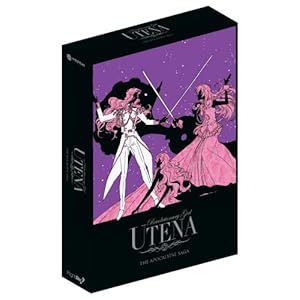


Revolutionary Girl Utena Anime, Volume 3, Disk 1 (English)

April 27th, 2012

The difference in tone between the first disk of the third box set, the “Apocalypse Arc” and first disk of the “Student Council Arc” of Revolutionary Girl Utena is so profound, the gap so enormous, that I’m having trouble finding words to express my thoughts on it.

The Student Council themselves are different. They have faced their darkest thoughts and are no longer terrified by them. It almost comes as a surprise to them that still they have weak spots to be be exploited. And yet, there they are, on the dueling ground, for reasons that they themselves don’t really understand, fighting.

The End of the World shows himself to us, and in many ways, he is aptly named. Akio, the Morning Star, Lucifer, the fallen angel…the End of the World, in the sense of a border or a boundary outside which is…what?

There are significant changes in the dynamic between the characters. Everything is fraught with sexual energy, even relationships we desperately wish were not. (How many of us grit our teeth when Akio put his hand on Utena and pulls her closer?) Kozue and Shiori attempt to embrace their own sexuality, only to find themselves left as wreckage on the side of the road. Nanami is made fun of, brutally, blatantly, so we must see her as a buffoon, naive and soft. This will lead to one of the most mind blowingly profound moments in the series.

But of all the changes, the most fraught, the most profound is the change that has come over Anthy. In the beginning of the series she was (apparently) a passive player in the game. Now Utena and she share a room – to some extent, a bed – and in the transformation and subsequent duels, Anthy plays a more active role. It’s impossible to ignore her or write her off as a victim with a nasty sense of humor. There is something very important going on in regards to her, although we do not yet know the full story. Watching this disk, I am reminded of the concept of shakti and suddenly, Anthy’s physical appearance makes sense on a deeper level than it ever has before. Is she the divine feminine power, the agent of change that charges the male manifestation of divinity’s power and makes him “able to do”? I think so.

In the beginning, Utena was the Prince who longed to save Anthy, the Princess. Now Anthy appears more as a goddess, giving Utena the power to…what, revolutionize the world? Really? Does that mean anything? With each episode, the tension around that phrase and around the phrase “The End of the World” becomes thicker. To see what it all means, we must simply keep watching.

Ratings:

Art – 9
Story – 10
Character – 9
Yuri – 4
Service – 4

Overall – 10

I don’t want to look, but I can’t stop watching.


Novel: Yume no Moribito (夢の守り人)

April 26th, 2012

And here we are at the third of the Moribito series, the last one I have completed. I’m working on another now, but it’s slow going, so you’ll have to wait until I’m finished for that review. ^_^

In Yume no Moribito, we turn away from Balsa for a moment, to take a good look at Tanda. He and Balsa have known each other since childhood, and since then, they’ve been close. But in all that time, neither of them have made the inevitable leap into a “relationship.” Although it’s apparent to pretty much everyone that they belong together, Balsa will not make any commitments, and so, neither will Tanda.

But, while Balsa is staying with him after returning from Kanbal, Tanda learns that Crown Prince Chagum has fallen into a deep sleep and will not wake up. This might not have meant anything to anyone else, but in Tanda’s home village, his own niece has fallen into a deep sleep from which she will not awake. Tanda becomes convinced that it’s not a disease that’s causing the comas, but something that is keeping the children’s spirits from returning to them. Her father calls it a “curse” but Tanda rebukes him and decides that he will enter her dream and find her.

The rest of the book is taken up with Tanda’s adventure. Balsa is once again in the position of watching over his body, while Tanda’s spirit wanders in another world.

Once in the dream world, Tanda discovers that a spirit from this world is appearing to children as someone they know and asking them to join it. In his neice’s case, it appeared in the form of a minstrel she had fallen for. Tanda rescues her, but returns to the dream world to find and rescue Chagum.

Chagum, it turns out, had been called by his beloved, recently deceased older brother, Sagum. Tanda does manage to find the Prince, and with his help, he saves the other souls that have been captured in the dream. But as they approach the threshold of return, Balsa must join them to save them from the creature that has called them. Chagum and Balsa have not seen each other for about 18 months. Not surprisingly, Chagum is taller and starting to look more like a man than the boy she knew. They have a brief, poignant reunion and part again, Chagum to return to his body in the Imperial Palace and Balsa and Tanda to the village.

This series, like so many Japanese novels I’ve read was a lot of setup for a brief, but brilliant climax. But the adventure definitely takes second place to the relationship dynamic between Balsa and Tanda and the reunion scene between Chagum and Balsa.

Ratings:

Overall – 7

Some of the later novels in the series follow Chagum, so I’m waffling about reading them, but we’ll see. I liked him, but for me, it’s all about Balsa. ^_^

Now, back to Kami no Moribito for me!


Novel: Moribito Volume 2, Guardian of the Darkness (English)

April 25th, 2012

In Moribito, Guardian of the Spirit, we learn Balsa’s tragic backstory, and why she cannot return to her country, Kanbal. In Moribito 2, Guardian of the Darkness, she returns to Kanbal to face her past.

Still in New Yogo, Balsa learns that the King who had had her father killed unjustly and caused her foster father Jiguro to take her out of the country as a child, has died. She decides to return to her country – and to her tribe – to face the wounds she still bears.

Of course, on the way, an adventure breaks out. As with the first book, it is two young people that help her figure out what has gone wrong where. And indeed, several things have gone terribly wrong. The land is suffering because a ritual has gone undone for too many years, the wrong person is in charge of her tribe and there is a conspiracy against her life.

Because it is Balsa, and not someone else, we can be content to watch her work out the pieces until she knows what must be done – and what must be done, right away, is the long neglected ritual in which a future tribe leader faces down the darkness.

Accompanying the true heir to the title of leader,  Balsa faces the spirits of the darkness and the joys and horrors until, at last, she comes face to face with her own ghosts.

The scene where she fights for not only her own life, but for her tribe’s future and her own mental well-being had me in tears. I was, and am, so glad that this was translated into English!

Once again, I recommend this book for a young person with an interest in myth and action. But more than the first book, this novel was all about Balsa – her childhood, her adulthood, her life. And for that, it was absolutely, fabulously awesome.

Ratings:

Overall – 9

At the end, she turns her sight on home…New Yogo…and Tanda. Awww. ^_^


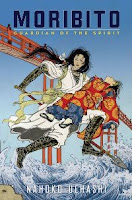
Novel: Moribito, Guardian of the Spirit (English)

April 24th, 2012

Over on the Yuricon & ALC Publishing group on Facebook, I’ve started posting pictures of a few bad-ass female characters just for fun. Last week, I posted a picture of Balsa from Serei no Moribito. I’ve never really talked about the anime series here, because it’s not Yuri, but I’m reading the Light Novels and find that, despite the fact that they are not Yuri, I think they are worth talking about. So, here we are talking about them. ^_^

The first two volumes of the novel series were translated into English by Scholastic books. Much like the anime series, they didn’t get much play in critical or blogger circles and basically just slipped under the radar, which was a damn shame

The Moribito anime, to be brief, is stellar. I consider it, without question, to be the very best anime I’ve ever watched. Everything about it was excellent – characters, story, animation, music. The fact that the story is family-friendly and that there is someone for everyone in the family to identify with, just makes it that much better. Young, old, male, female, there’s someone to like. The strongest indicator that this was something special was when about 5 episodes in, both my wife and I realized we liked the kid. That never happens. And, not only did we like the kid, but by the end of the series, we loved him. Prince Chagum is an extraordinary character. All of them are.

The story, for those of you not familiar with it, is an episode in the life of a spear-wielding female bodyguard, Balsa. She has a tragic backstory of her own, but in the anime – and the first volume – she is drawn into an adventure of a lifetime. The second Prince of New Yogo is the target of an assassination attempt by his own father. His mother, the Second Queen, hires Balsa to save the Prince’s life. Why Chagum is being targeted and what happens, makes some of the most compelling anime ever made. The entire series is available and Media Blasters did a great job of it.

But today, we come to discuss the first novel of the series, Moribito, Guardian of the Spirit. Physically speaking, this book is gorgeous. The paper is a soft cream color and trim and text are a dark blue that gives the pages a slightly other-worldly feel.

The story follows the same outline as the anime, but is not nearly as detailed nor does it have as much character development as the anime. The long days while Balsa and Chagum build trust and a relationship are nowhere to be found in the book. The plot remains the same, but in a minimalist way, The action scenes remain intact and anyone who has watched the anime will recognize the story. For one of the few times in my life, I recommend the anime over the novel.

However, if you know of a budding young otaku and want to really encourage reading, hand them this book. It’s a good story, with likable protagonists, fantasy/myth elements and a lot of cool spear-wielding by Balsa.

Ratings:

Overall – 7

If you’ve read the first book and want to know whether the rest of the series is worth it, tune back in tomorrow, when we take on the next in the series. ^_^