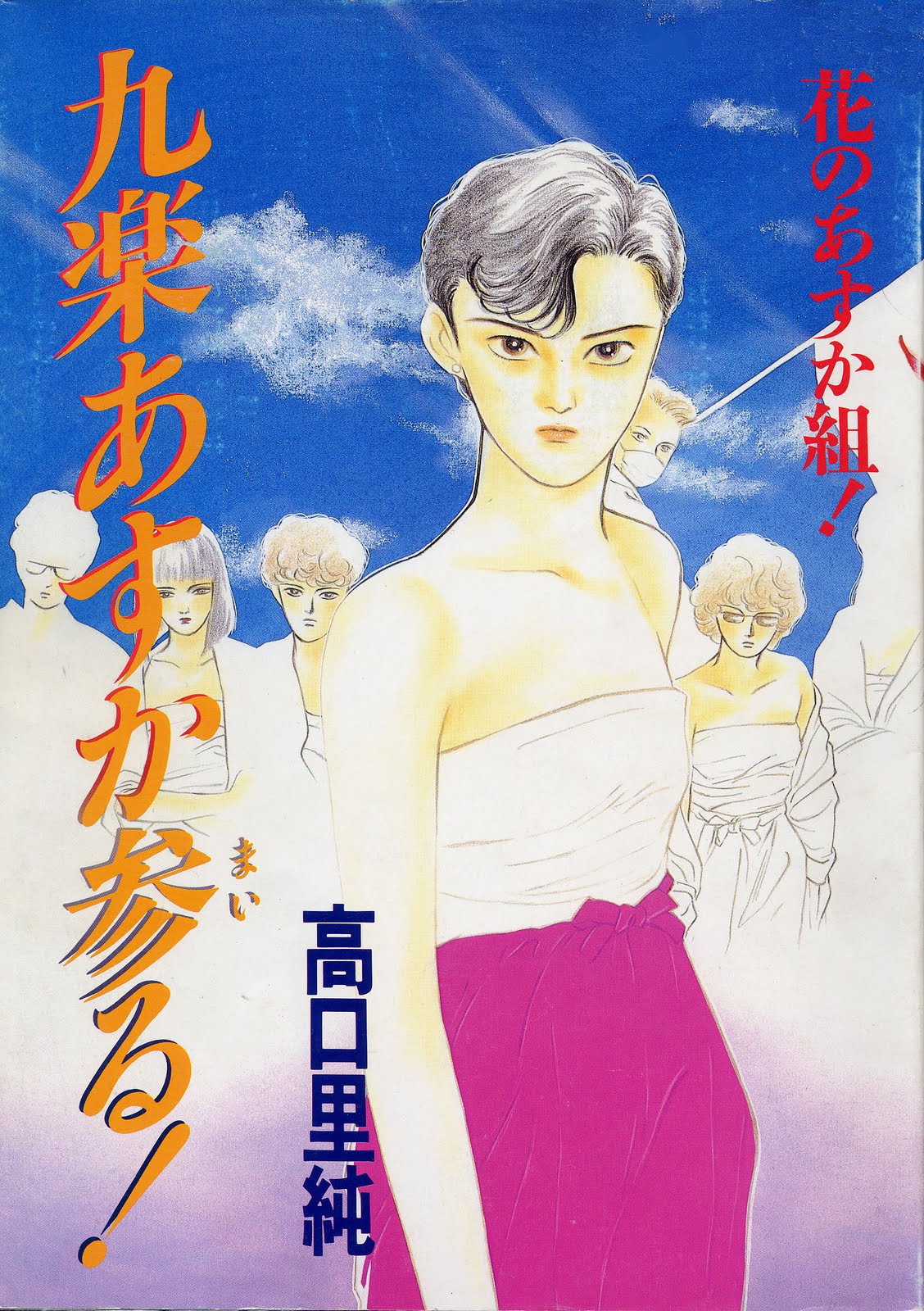
Yuri Artbook: Kuraku Asuka Mairu! (九楽あすか参る!)

June 6th, 2011

Today, we’re taking a trip through the dustier recesses of my historical collection for one picture. Just kidding – it’s really for two pictures.

I’ve talked about Hana no Asuka-gumi! (花のあすか組!) a number of times over the years here. I’ll  never get tired of pointing you towards it, because it was one of the most amazingly crack-tastic series ever. In fact, as I consider that statement, I realize that all three of the Big 3 girl-gang series I love were mad as porridge knives. From school-based organized crime rings to giant snakes, both YajiKita Gakuen Douchuuki and Sukeban Deka were plain nuts. In comparison, the organization that controls all the girl gangs in Tokyo, the Zenchuu Ura, and the elite fighting squad-infested labyrinth under Ranjuku Detention Center of Hana no Asuka-gumi make perfect sense.

When Hana no Asuka-gumi was in its ascendancy, back in the 1980s, when both manga and TV series were fixtures of girls’ lives, a collection of the cover art and magazine color art was put together. Published in 1988, the Hana no Asuka-gumi artbook, Kuraku Asuka Mairu! (九楽あすか参る!) is page after page of Asuka in any number of outfits, as tough-as-nails gang girl to tough-as-nails gang girl. All three zillion of the secondary characters get some page time, as well. The no-nonsense girls of the Nishiku Omoteban, the Area Masters, the crazies that inhabit Ranjuku Detention Center, Kazuga, Bara-no-Miya, Miko,  and most importantly, the Zenchuu Ura’s mysterious leader Hibari-sama…and Yohko.

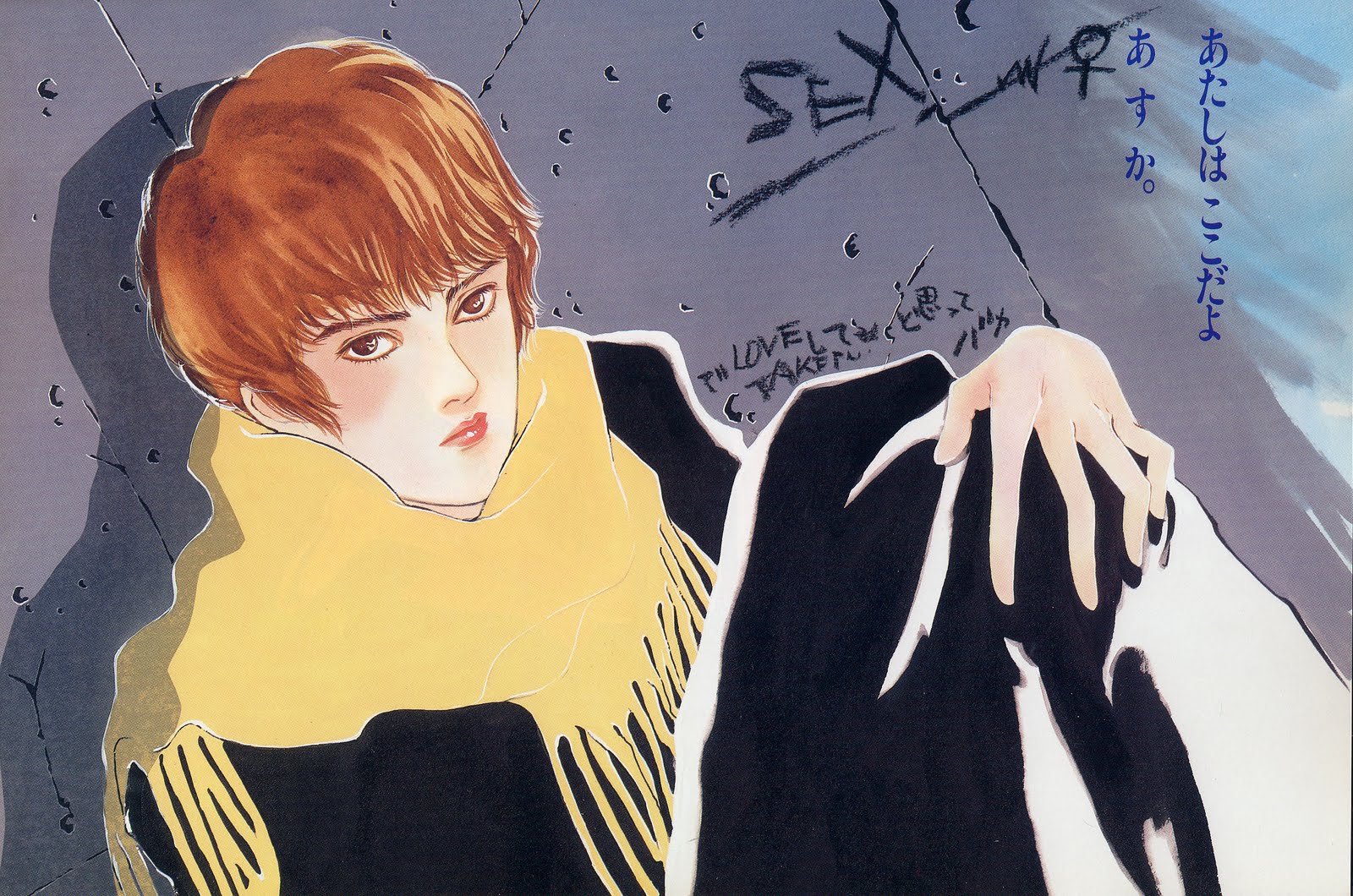
Which is why I wanted to talk about this book. There’s a few color pictures of Yohko, and some black and white line art. But there are two pictures in the book that nail the overall obsession that both Hibari and Yohko have for Asuka. (Click on the images for larger versions.)

This is the frontispiece for the book. The English is part of the original:

The banana curls belong to the always half-seen Hibari-sama. “Make Asuka come to me, Kazuga,” pretty much sums up her obsession in a sentence.

And this is the centerfold:

If “SEX” on the wall doesn’t convince you, let me translate the Japanese for you: “I’m here, Asuka.”

Just sayin’.

The rest of the book includes interviews with the creator, Takaguchi Satosumi, the actresses from the TV show, info about the original movie, (as opposed to the new movie, which was awesome,) the books, media and goods related to the show. I don’t know if I’ve ever mentioned this but, for a while, Asuka’s gold coin was available on Yahoo JP auctions. I never bought it, though. ^_^

If there is one single reason you should learn Japanese, one series so compelling that you really *must* read it, it would be this one. As long as I’m alive, I’m gonna keep talking about it, so really, you might as well read it. ^_^

Ratings:

Overall – 10

The art is truly variable from great to “aagh!” but I love the series so much, I’m giving it a wildly subjective score. Deal.


Honnou to Senshokutai, Instinct and a Chromosome

June 5th, 2011

KC Dessert is a very interesting manga imprint. A broad definition would be that it tells josei stories for older teen or college age women.This means that the stories often detail relationships, with the slight feel of “things young women have to deal with.” In the past, I reviewed KOOLS, a collection that included a story about a young woman learning to be comfortable with herself as a lesbian, a story about rape and one about relationship abuse. They were overall all well told, and well executed. KOOLS, the story about the lesbian was a particularly well-done story. Think of KC Dessert as for girls too old to read 17 magazine (meaning 17 and up) and too young to read Cosmo. That’s the closest I can come to what audience this imprint reaches.

In Hyaku-Oku Nengo no Kimi no Koe Mo, there are two such stories. Both stories feel exactly like soap operas to me. The first follows a girl as she makes her way through conflicting relationships with men, but the second, “Honnou to Senshokutai,” (translated in the book as Instinct and a Chromosome) tells the story of Nanako, who confesses her love to a schoolmate in high school only to be told that she’s disgusting and should just die already. Nanako does not die, but does take herself off to the big city, where she attends a woman’s trade college. Almost from the first second, she starts to fall for one of the lecturers, Yuri.

With just a little awkwardness at the start, they two become a couple and begin making a life together but, as happy as Nanako is, she knows that Yuri is bisexual, and cannot relax. She is positive that Yuri will walk away from her one day. After a few weeks during which Yuri is continually busy, so  they have not seen one another, Nanako tracks her lover down…only to be told that Yuri is breaking up with her to marry a man from her father’s company. She’s an only child, she explains, as she hand Nanako the key to her apartment. “Do you *want* to get married?” Nanako asks. Yuri says that she does.

Nanako grieves, of course and, when a nice-looking guy tries to pick her up she falls apart. She tells him she’s a lesbian, to which he replies, “Yay! I like women too!” It’s all so unpredictable and goofy that she pretty much tells him the whole deal. He takes her for some food and a ride and she decides that she’ll try to have sex with him. Unfortunately for him, Nanako is wholly skeeved by the process. The guy is really quite nice and understanding about it, but eventually she has to stop him, because she just can’t do it. She leaves him, sleeping, and walks home, miserable at her loss, and realizing that she really loves Yuri.

When Nanako arrives  home, she finds a tearful Yuri curled up in front of the apartment. “I lied!” Yuri says, “I don’t want to get married. I love you!” And so they reunite, joyfully, with more promises of ever after.

Like KOOLS, “Honnou to Senshokutai” was a relatively straightforward, unadorned look at love between women, This was not a Yuri story, it is about a woman who is a lesbian and a woman who is bisexual who are in love with each other. And they live…okay, let’s just go there and say we’ll presume they live happily-ever-after. ^_^

In one sense it is a much-more realistic look at what Story A would look like. In another, it’s a great story to ‘splain a little bit about being lesbian to the clueless. Ultimately, it’s a nice soap opera where the girl gets the girl.

Ratings:

Art – 8
Story – 6
Characters – 7
Lesbian – 10
Service – .5

Overall – 7

Many, many thanks to today’s sponsor, Okazu Superhero Katherine H for allowing me the chance to read this worthy story!


Yuri Network News – June 4, 2011

June 4th, 2011

Yuri Miscellany

Comic Ryuu, home of any number of random Yuri-ish manga over the last few years, has announced that it is going on hiatus after the August issue (on sale in June) to plan for a big relaunch in December.

Prism Comics is looking for queer artists to appear at their booth at San Diego Comic-Con. Contact them directly if you’re planning on being there and want to sign in an openly LGBTQ space. They are looking for folks who are already planning on attending with Professional credentials, and there is a charge to partner. Prism Comics list the benefits of partnering as:

— You get 100% of all sales

— We keep inventory and sell your books when you aren’t at the table

— We handle credit card transactions

— You get backdrop display art space at the booth that’s up during the entire show

— You get more than half a full table space to display your stuff while you’re at the table

— Having a lot of LGBT stuff in one area helps introduce your work to new readers!

I’ve worked with Prism several times and have always found them to be a fantastic, down-to-earth group of people, with a very minimum of drama. I’ve also met some insanely cool folks through Prism, like Jennifer Camper, JD Glass and Alison Bechdel. So, if you’re going to be at SDCC as a Pro and want to maximize your LGBTQ visibility – go ahead and contact them. Tll them I sent you.

From YNN Correspondent Ashi, Epsiode 7 of Battle Girls – Time Paradox, has a scene with several scrolls of classic stories. But one volume was written by the keeper of (the scrolls, and she called it Yuri Monogatari.

(Lawsuit!!! Joke, joke. ^_^)

On Twitter, fan translator AXYPB approached me looking for help – he did a fan translation of Sono Hanabira ni Kuchizuke wo, and is looking for feedback from anyone who might have played it. Drop him a line if you can help.

***

Not-Yuri Miscellany

I’m not in the habit of posting whole press releases here (because they usually make incredibly boring reading as they repeat the headline three times, each time with more detail,) but I am far too lazy right now to abstract from this one – and I am very pleased to see a manga company not my own recognize the role libraries have played in getting manga to young people:

VIZ MEDIA OFFERS LIBRARIANS FREE HEROES OF MANGA LIBRARY KITS

New Kits Highlight Popular VIZ Media Manga Properties And Help Foster Literacy And A Love Of Japanese Pop Culture Among Library Patrons Of All Ages

San Francisco, CA, June 2, 2011 – VIZ Media, LLC (VIZ Media), the largest distributor and licensor of anime and manga in North America, gives librarians across the country a useful new tool to promote reading, literacy and love of manga (graphic novels). The company has made available Heroes of Manga Library Kits, full of items to entice patrons to explore the exciting world of Japanese pop culture and comics.

Manga is one of the most requested categories in libraries today. The Heroes of Manga Library Kit features some of VIZ Media’s most popular properties, such as NARUTO, FULLMETAL ALCHEMIST, NURA: RISE OF THE YOKAI CLAN and POKÉMON, designed for a range of readers from All Ages to Young Adult. Each library kit contains 50 book covers, 300 bookmarks, 50 buttons, 5 assorted VIZ Media bags, and a full-color poster featuring NARUTO, and is available for FREE to library professionals. For more information, or to receive a kit, please submit information here before June 8, 2011. Please allow 4-6 weeks for delivery.

“VIZ Media celebrates its 25th Anniversary this year and throughout our history, we have made it our mission to help fans of all ages foster a love of reading through manga,” says Candice Uyloan, Director of Marketing. “Our latest campaign provides librarians with a free Heroes of Manga Library Kit that contains a variety of fun premiums that highlight some of our most popular properties. Our first efforts to promote the kits resulted in such an enthusiastic response that we have decided to extend the program and increase the number of kits produced. We invite librarians to send in for their free kit today and use the goodies exclusively created for them to inspire their patrons to explore the exciting world of comics from Japan!”

VIZ Media manga titles are regularly recognized by leading library associations for their imaginative stories and high quality. The Young Adult Library Services Association (YALSA) recently recognized several notable VIZ Media manga titles recommended for those ages 12-18, meet the criteria of both good quality literature and appealing reading for teen readers. For more than 50 years, YALSA has been the U.S. leader in selecting books, videos, and audio books for teens.

For more information on VIZ Media manga titles, please visit www.viz.com/manga.

***

Katherine Dacey, aka The Manga Critic, has a wonderul review of Rica ‘tte Kanji!? up, and it’s motivated me to get back to work on it, after a week or two of not, because day job sucked my time away. I am more committed than ever to getting this delightful book in front of everyone who wants to read it. Thanks Kate!

And last up in this collection of goos and gaws, my monthly article on Hooded Utilitarian aroused incoherent rage and some rather interesting, and some cognitively dissonant commentary and I made a new friend. Oh, the column is about how sick to death I am of fans dismissing open discussion about racism, sexism, homophobia and other topics in comics by telling people trying to point out the *obvious* racism, sexism and homophobia in comics “Don’t take it seriously, it’s just a comic…” as if images and words have no effect. Read here. I don’t rant, but I do pound my fist on the table a bit. ^_^

***
That’s a wrap for this week.

Become a Yuri Network Correspondent by sending me any Yuri-related news you find. Emails go to anilesbocon01 at hotmail dot com. Not to the comments here, please, or they might be forgotten or missed. There’s a reason for this madness. This way I know you are a real human, not Anonymous (which I do not encourage – stand by your words with your name!) and I can send you a YNN correspondent’s badge.

Thanks to all of you – you make this a great Yuri Network!


Umesato the Third! Manga (三時代目は梅くくり!)

June 3rd, 2011

There’s just something about a hapless thief. We love them.  It’s just that much better when a thief has to fight another thief to get back what is rightfully theirs or to lay the blame at the right feet. Whether it’s Indiana Jones, or John Robie,  when we want a rollicking adventure, a hapless thief-type character always scratches that itch.

Umesato the Third! (三代目は梅くくり!) is just such a tale. High school student Kukuri is the third thief with the name “Umesato” and she feels she has pretty high standards to uphold. With her partners “Niki-‘nee” and Maruo-san, Kukuri works hard at thieving, less so at school and always seems to come out behind in the final count. When another group of thieves helps themselves to her bounty, it’s simply intolerable.

The setting for Umesato the Third is slightly futuristic. If you’re a fan of belts that allow people to fly and hovercars, you’ll find yourself right at home. Unlike many sci-fi settings, this isn’t urban dystopia – it’s typical Japanese suburbia, just a few gadgets into the future.

There’s a fair amount of mild service here – Kukuri and Niki walk around in crop tops and bicycle pants, and Maruo-san, although he seems to have some conscience ends up seeing them partially dressed rather often. When Kukuri takes off, we’re rather more often than not treated to an underwear shot. As seinen series go, it’s mild. The violence is more mild than I would have expected from a Birz title as well – totally in keeping with the movie-feel of the story. In fact, this would make a cute live action, I think.

Yuri is random, but not unpleasant. Kukuri has an admirer and friend, Hana (with hover car) who is occasionally drawn into Kukuri’s schemes. After destroying her car in a high speed chase, Hana is chastising Kukuri for getting her in trouble and Kukuri (most likely to shut her up) kisses her. It’s a pretty intense kiss and is seen by one of the plot complications. It’s played for laughs more than anything, but Hana’s pretty obviously not complaining.

Ratings:

Art- 8 On the goofy side, which made it more fun
Story – 8 Same as above
Characters – 8 Same again
Yuri- 4
Service – 3

Overall – 8

There was nothing world shaking about this series, but as a rollicking good tale about a hapless thief, it was a lot of fun.


Tetsudou Shoujo Manga (鉄道少女漫画 ), Guest Review by Bruce P

June 1st, 2011

 It’s been a pretty busy week here, so thankfully, we have not one, but two Guest Reviews lined up. Today we welcome back Guest Reviewer, Okazu Superhero, Friend of Yuri, one of my chief lackeys and all-around terrific guy, Bruce P for a much-anticipated review of a manga I enjoyed the hell out of. ^_^ Take it away, Bruce!

Trains and girls. Outside of the manga world there would seem to be little natural affinity between the two. But as a walk through Comiket will show, surprising and unlikely combinations like this are the stuff of stacks and stacks of doujinshi: U.S. Green Beret uniforms and girls, for example, or British Royal Navy uniforms and girls, or (moving to another aisle) electrical power generating equipment and girls, World War II tanks and girls, and so on. What a cool world it is, when you can have your favorite fetish posed enjoying your other favorite fetish, reality notwithstanding. It’s all somewhat reminiscent of a machine shop calendar. A large number of such hobby-combination series are now appearing as manga or being made into anime; manga that combine trains and girls are among them. Most are not very wonderful, but Tetsudo Shoujo Manga (鉄道少女漫画 ) by Nakamura Asumiko is an exception. It is excellent – and it includes Yuri, as any excellent manga should.

The manga consists of five independent stories and an epilogue, all marginally connected by railroad settings. Three of the stories have run in Rakuen le Paradis. One of them is Yuri. They are Josei in style, and generally involve the exploration of troubled relationships. While a relentless series of troubled relationships might sound like the makings of a long afternoon, Nakamura-sensei brilliantly balances the tone with humor, which derives mostly from her artwork. Her comic timing is spot-on.

The non-Yuri chapters are an interesting mix, taking place at different railway stations, on trains, or in one case at a secret model railway club. Just a single example: A woman is riding a train on the Odakyu Railway line to Hakone as she runs away from her husband. He’s a schlub, and she’s sick of acting as both mother and housemaid to the guy. She has the understanding and assistance of his younger brother. Unknown to them, however, the husband is not far behind, just one car back. He catches a young pickpocket with her hand on his wallet and compels her to assist in his plan for revenge: writing the character ‘meat’ on his wife’s forehead. And you wonder why she is running.

After confronting the fleeing woman and younger brother, the husband gives up and runs off the train. But the pickpocket shames him for being such a jerk, and tells him to get back in there and fight, and by the way don’t be such a jerk. The train is gone, but thanks to the pickpocket’s detailed knowledge of the timetable (a natural result of her livelihood), she gets him onto an express that allows them to catch up. They are helped by the fact that she lifted the younger brother’s wallet, and he and the wife are now stuck, unable to leave the station. They all meet up, husband promises to reform, and the couple shares a tearful reconciliation. Younger brother can now turn his attention to the cute young pickpocket – and since he is an Odakyu station agent out of uniform, they will have a lot to talk about.

The Yuri story (“Rittai Kousa no Eki”) starts with Mizuho on a station platform annoyed by a violent argument a woman is having on her phone. Mizuho descends to a lower platform only to be targeted by the woman’s falling phone and bag, knocked from her flailing hands by a passing train. Mizuho, a pitcher on her school baseball team, nonchalantly throws the bag all the way back up, instantly attracting the deep interest of the woman (who is never named). Mizuho has no chance to return the phone before catching her train, and on opening it she is intrigued by the background photo of the woman being kissed by another woman. When they meet on the platform the next day she hands back the phone and is embarrassed to admit seeing the photo. Not a problem, the woman says, they are breaking up anyway, hence the screaming. Mizuho realizes she can talk to the woman, even if only in oblique terms, about her own issue – a teammate is in love with Mizuho, but Mizuho does not love her back. The best thing would be to turn her down, the woman advises, eyes practically glittering. As the woman helps Mizuho, she in turn helps the woman, finding a ring that had dropped from the bag, the loss of which was causing a lot of yelling between the ex-lovers. At the point of the woman’s deepest funk over the breakup, Mizuho proposes in a somewhat blatant metaphor that the woman might want to take a different track toward a new destination – pointing to the line she herself rides. Cautiously jumping on the metaphor, the woman, contemplating how much younger Mizuho is, asks if it would really be OK (Can I use my Suica pass card on that line?) to which Mizuho answers firmly yes (Of course! It’s a JR line!). Love by semaphore.

A short part 2 finds the woman attending a game where Mizuho is pitching, which makes Mizuho so nervous she gets shellacked. Dreadfully embarrassed, she breaks that night’s date for extended practice, but finds the woman still waiting when she gets done. It is a relationship that is taking off nicely. The woman can be very sweet when she is not violently angry; one has to hope for the best here.

The epilogue chapter pulls all the threads together – and lets them go again. A man rides from Shinjuku to Enoshima, then Chigasaki, Atsugi, and Iriuda, all locations from previous chapters. Along the way he observes with bored half-interest the characters from the previous chapters in fleeting, unconnected vignettes, popping in and out of his sight like fireflies on a summer evening. He sees Mizuho rushing in concern to meet her lover on the station platform, where she asks the woman about some minor injury. And then he moves on. A quiet ending to an enjoyable manga.

Ratings:

Art: 8 Josei style with some cheerfully distorted proportions. Sparkling with humor. The art pulls the stories from merely interesting to exceptional.

Characters: 7 The characters are not all likeable. The men in particular tend to be either morose or cranky. A set of character types that sit around a model railroad in one chapter are precise, if unkind, portrayals of creepiness. By way of balance the pickpocket is such a great character; she deserves more stories.

Stories: 7 Ranging from almost strictly dramatic to humorous. Not overwhelming, but all showing some interesting angles.

Yuri: Rittai Kousa no Eki: 8 Other chapters: 0

Service: No. Not even for the one panty shot.

Yuri/Train Fan: I liked it.

Overall: 8

Tetsudou Shoujo Manga is a wonderful example of a ‘hobby’ manga that manages to keep the hobby part under firm control. Nakamura-sensei obviously loves trains, is happy drawing Yuri, and that combination works very nicely for me.

Erica here: Bruce – she keeps it under control, except in the model-building chapter, don’t you think? That story was a wank, but it was, ultimately, harmless. I also would give this series an 8, even if I am not a train enthusiast . Thanks, as always for the review. It’s such a pleasure to read your perspective. ^_^