Maria-sama ga Miteru Drama CD: Parasol wo Sashite

September 3rd, 2010

The good news is that, phew, that’s behind us now. No more Rainy Blue ever again…until the manga catches up. D’oh!

Well, for the moment, we can wallow in the comfort of the 14th Drama CD of the Maria-sama ga Miteru series, Parasol wo Sashite, in which Yumi gets back both her favorite umbrella and her beloved onee-sama.

This Drama CD is a 2-disk set, each disk has about 45-60 minutes of material.

The first disk has the half of the book in which Yumi meets Katou Kei and her older relative, the entirely adorable Yumiko. The second has the appearance of Youko and the revelation of what Sachiko has been going through for the past few months.

Two scenes in this story were critical to my understanding of the characters. When Touko snaps at Yumi outside the cafeteria, it occurred to me that, at that point, Touko has no idea that Yumi does not know what’s up with Sachiko. So, to see Yumi having fun with classmates is upsetting. Of course, yes, Touko’s a absolute jerk about it, which adds to the drama of the scene. But in the second half of the book, Touko knows that Yumi doesn’t know, which is probably one of the very first bricks in the wall she builds between Yumi and herself.

The second scene that really blew me away, was the scene with Kei’s older relative, Yumiko. Kei imagines her to be a taciturn old lady and Touko later points out that she was clearly used to frowning alot. But something about Yumi’s unexpected kindness opens up Yumiko in a way that I think she could never have expected. Yumiko tells Yumi something so important that I missed it the first 30 times I read/watched/read/listened to this scene. She says, simply, that if Yumi loves her onee-sama, she should tell her. Verbalizing this changes Yumi’s whole perspective…and Yumiko’s own life.

Of course it was nice to encounter Sei and Youko again, and “meet” Kei.

And the whole bit at the end that had gotten cut out of the anime, about Youko being too competent to forget an umbrella, then not having one, proving that she was totally discombobulated and Sachiko’s mother obsessing over convenience store food were told in full, to my immense pleasure.

The second disk also includes a bonus track, in which the actresses point out that it had been almost a year since they recorded Rainy Blue and how they were all kinda tense about that not being resolved.(Most of them have now read the novels, something I find fascinating.) But the thing that makes the bonus track priceless is right in the very beginning, when they are all talking about how emotional this CD is and Itou Miki says that saying “I love you Yumi,” was really emotional for her. When Itou-san says the words, “I love you, Yumi,” Ueda Kana immediately replies, “I love you too, Onee-sama!” And I, and the entire cast of Maria-sama ga Miteru screamed of “Ow! That hurt!” as our hearts exploded from the cuteness. (^_^) Toyoguchi Megumi says something like, “Aw, c’mon, I don’t want to see that!”

So, although it took a really long time to get…Parasol wo Sashite was totally worth it.

Ratings:

Overall – 9.5

Now that I think about it, this novel had *three* adorable adult characters – Sachiko’s mom Sayako, Kei’s relative Yumiko and “Miffy-chan,” the middle-school teacher who returned Yumi’s umbrella.


Lesbian Light Novel: Vertigo

September 2nd, 2010

Vertigo (ヴァーティゴ) by Fukami Makoto, is a story of a cop and her ex-army partner as they track down and defeat a criminal operation that has been killing people all around Tokyo.

On the one hand, Vertigo is an incredibly crappy science fiction novel, with “cybernetic’ everything and “nanotubes” used in the stupidest, least convincing way possible. All the women are clothed in form-fitting bodysuits (with the occasional tactical vest thrown in for good measure) or otherwise scantily clad, yet somehow fully protected. For instance, Reo’s halter top there on the cover is “armored mesh.” Uh-huh.

On the other, Vertigo stars two strong female leads, neither of which back down in a pinch, neither of which flinch from a fight, whether hand-to-hand or projectile.

On the one hand, the art for the book portrays women with such exceptionally large breasts, hips and contoured nipples and crotches that it pretty much ruins your ability to see them as anything but human-shaped milk cows. You can get a sense of that from the cover image. To drive my point home, here is a picture of Nako, a side character, one of Reo’s ex-lovers. The picture is Not Safe For Work or Brain. Don’t come screaming to me if you click it.

On the other, one of the characters, ex-army, now police detective in training, Hashibe Reo, is an out lesbian in a long-term relationship that is not broken up or even threatened by anything in the plot and there’s a discussion of when same-sex marriage became legal in Japan and how it was a good thing all around for everyone. Reo loves her lover Rina and Rina loves her back – they are considering marriage. And we end the book pretty sure that Reo and Rina will get married, after all.

On the one hand, dedicated police detective Natsume Shizuka kills her own neglectful mother who she thought had been dead for years.

On the other, Shizuka ends the story with a nice girlfriend, a new job and a happy ending.

One the one hand, the plot combines Chinese terrorists, an illegal fight club, (a scene in which Reo and Shizuka are inexplicably required to kiss each other by a passing stranger, but otherwise has nothing to do with the plot,) a possible Christian cult, and an evil pharmaceutical company.

On the other, the actual plot had just about *nothing* to do with any of the above. Except the evil pharmaceutical company.

On the one hand, gang rape as a form of torture was used as a main plot point, and on top of that, the book included childhood flashbacks of threats of rape and a brother that was forced to do child porn and subsequently killed himself.

On the other, the after-trauma situation was handled with grace, sensitivity and honesty.

Reading Vertigo has been a challenge on several levels for me. The kanji, sci-fi/military/police procedural as it is, was *way* above my level of comprehension. I was dedicated and experienced enough to grasp a lot from the context and lucky enough to know more than the average otaku about hand-to-hand combat, so I actually understood (and enjoyed) the bit about Capoeira and could figure out a lot of the rest. But man, do I so not know the words for a lot of normal business things. ^_^

It’s pretty apparent from the predictability of the plot, that this was written to become a movie – and if it does, I’m sure it will be successful. It has pretty much something for everyone (well, everyone likely to go see a scifi-action-suspense-movie like this.)

I can’t say I liked it, but I also can’t say I didn’t. It was both really awful and really good at the same time – sometimes in the very same sentence. In conclusion, I have to say, Vertigo was an aptly named novel.

Ratings:

Art – AAAAUUUGGHHHH MY EYES!!!!!
Story – 2 and 9 all at once
Characters – 9
Lesbian – 9
Service – 10 Googolplexes

Overall – I’m feeling dizzy. Pick a number. That’s what it was.

Today review marks a wonderful day – the addition of yet another new Okazu Superhero! I want to welcome and thank with all my heart and the parts of my brain that don’t hurt, Mari Kurisato, for sponsoring today’s review!


MMF: Yotsuba&! the American Audience

September 1st, 2010

Yotsuba&!, Vol. 1When it comes to reviewing manga in English, I appear to be an anomaly. I read more manga in Japanese than in English and many of the series I most enjoy, I read as they are serialized in the magazines. I prefer to read my materials untranslated, even (especially) if it means it will take me three months to read a novel, instead of two days.

As a result, I have a hard time seeing past a series’ origin. I know the audience for which the series was originally intended, and I find it awkward to pretend that that does not affect the story.

Yotsuba&! was, as many other people have pointed out, a series that was serialized in Dengeki Daioh magazine. Unlike those many people, I actually read Dengeki Daioh for many years and now still read it from time to time. Which is why I cannot pretend that Yotsuba&! is a book for children. Dengeki Daioh is/was also the home to such heart-warming stories about adult men and the pre-pubescent girls they love as Blood Alone and Gunslinger Girl. Call it shounen or seinen, this is a magazine for otaku men, who think that LovePlus (or a soda can) is a viable alternative to a relationship with a real human and who like to imagine themselves with a little girl sitting on their lap. And look at her underwear from time to time.
It’s also been noted by many people that when manga comes to America, most of the gender/age lines blur or completely fade. Stories targeted to the college age set in Japan are inexplicably targeted to young teens here, then censored for being inappropriate. Stories for children, because of the obsession with underwear and nudity one encounters as part of the “humor”in manga, and because of the Puritanism of America, all of a sudden find themselves with Mature Content warnings.

So when it was announced that this month’s Manga Moveable Feast was being hosted by the Good Comics For Kids crowd, my head exploded. I do not, no matter what the good people of Yen Press and other manga bloggers say, consider Yotsuba&! a “Good Comic for Kids.” I get why people can say that. Yotsuba is a delightful child. The comic is light-hearted, it has characters of all ages and personalities, so there is likely to be *someone* any age group can identify with. It’s a fun story; you can see young Dads of young children laughing and smiling, think of their own kids when Yotsuba does something wacky. Mom next door represents Moms wondering what the neighbor’s kid is thinking. Asagi, Fuka, Ena, Yanda and Jumbo all provide masks for ourselves, whoever ourselves may be, so that we can smile and watch Yotsuba and laugh with her…or at her, whichever makes us happiest.

I love Yotsuba&!. I love it in Japanese and love it in English and hope everyone reads it. It’s something a kid *could* read, especially with an adult to share the amusement.  But I can’t call it “for kids,” because it’s not. Tora Dora! is not “for kids,” neither is To Aru Kagaku no Railgun, and this isn’t, anymore than Akikan was.

Manga reviewers have taken the girl from the farm and want to pretend that, while she’s standing on 42nd street looking at her options, none of them are less than savory. That’s cool. More power to them. I’ll stick to knowing who is reading it in Japan, and why. And that’s cool too.


Lucky Star Manga, Volume 5 (English)

August 31st, 2010

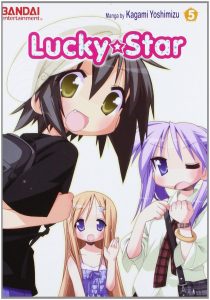
Lucky Star, Vol. 5 has something I’ve never seen before in the Lucky Star franchise…Yuri.

In the main, the formula remains the same; Konata is an otaku, and she is surrounded by an increasing number of characters who are identified by their hair in combination with their fetishes/gags. This is definitely not high art….

I’m finding, though, that the now strangely large cast (strange, because so few of them were actually introduced to us, but somehow just showed up in the story and we were supposed to know who they were or, if we didn’t, the interstitial character profiles were all we had to identify them by) actually works for me. With so many characters, the one- or two-joke per person works better with what is quickly approaching infinite possible combinations. It took a village to raise Lucky Star.

The first snatch of Yuri is, not surprisingly at all, in Hiyori’s head. (There’s an allegory in there, I’m sure of it!) Someone mentions Konata kissing Miyuki and it’s all fan delusion from there on. I really like Hiyori, because she’s very self-aware. She knows just how dangerous mentioning something like this to her is. ^_^

The next shot of Yuri comes from two of the teachers – the one who looks just so cute and little you can’t really believe she’s an adult and the school doctor. … Gee when I say it that way, it seem so fetishy and pandering, huh?

And lastly…wait. You know how a martini is made? You know how some people joke that the vermouth is pretty much waved over the cocktail? That’s kind of the way the final bit of Yuri is – we see Minami and Tsukasa standing next to one another and each thinks warm and fuzzy thoughts about the other. We whisper the word “Yuri” over the panels and lo and behold! a Yuri Manga is born.

Ratings:

Art – Color helps a little…
Story – Realistically dull slices of life
Characters – Color helps a little…
Yuri – Here and there
Service – If LovePlus seems like a perfectly acceptable replacement for a relationship with a human, then yes, an LF is you

Overall – 7

A mysterious, unnamed Okazu Hero sponsored today’s review! If you’d be so kind as to tell me who you are, I can credit and thank you properly!


Yuri Manga: Yuri Shoujo, Volume 2

August 31st, 2010

Thank you for attending the unveiling of the 2011 line of “names used by every Yuri character.” Our previous years’ names have all been very successful with Yuriko and Natsuki and we’re all so pleased to be returning to the traditional with this year’s names…Hana, Kana and Sakura! /applause/


One of my biggest complaints about the Yuri Hime Wildrose series is, as a series of short, plot, what plot porn pieces, the stories are unsexy, poorly-constructed, pandering and just plain unfun. In my opinion, 5 volumes was more than enough to step up the writing and create a story that was more than “Girl A – /meets/is in love with/argues with/falls in love with/is going out with/drugs/ – Girl B.” I know that anthologies – especially intermittently published ones – are going to have to make do with what they can get, but I think that “better” ought always to be the goal. I reviewed Volume 1 of this anthology last December and I definitely think Volume 2 of Yuri Shoujo is “better.”

Like so many other “Story A” anthologies, this collection doesn’t take the relationships past “zOMG, I’m in love with her/we’re in love with each other!” but the actual stories themselves are…very good.

I’m a fan of PWP fanfic, I know how little it takes to get us fans to accept that two characters should be together. Where Yuri Hime Wildrose rarely managed to give me that little bit, this volume of Yuri Shoujo is giving it to me in spades. More than a few times I found myself re-reading a story and thinking, “That was a really good set up,” or “That was an unusual approach.” Enough of the stories are well-written enough that I can only think of one I didn’t like – and that was because the characters were sort of plopped in front of us and suddenly, for no reason, they “like” each other.

The first story was about illicit, hopeless, one-sided love. I found it touching and poignant, rather than the usual kind of tiresome “ugh” feeling.

Mitou Kana (of Circle Sakuraike) deserves an award for making me enjoy a story where girls have animal ears. Yes, really, it was cute, god help me.

“Dakara, kore ha watashi no himitsu” was a really standout look at the damage love can do to people. This story was still in “Story A” territory, and we only get “zOMG I love her” but it was worth it for a unique spin on the setup.

Kitao Taki (also of Circle Sakuraike) combines sports and girl’s love, as she so often does. This time, the sport in question is one I did for years – swim team. It dawned on me as I read the story that every time I think of being on swim team all those years, I see one particular woman’s back in my mind, as she stands on the starting block. I have no idea what her face looks like, but I apparently have her back memorized. ^_^

Even the fantasy stories take a step up from “same old, same old.”

In conclusion, this anthology is everything Wildrose is not. Stories told well, by good artists/writers, about girls who love girls.

Ratings:

Overall – 9

I consider this book a must-buy, if you’re a fan of good stories that are well-written and happen to be Yuri.

My sincere thanks to Okazu Superhero Dan P. for sponsoring this title from my Amazon JP Yuri Wishlist! I apologize though, because you picked another good one. ^_^