Yuri Network News – August 28, 2010

August 28th, 2010


Yuri Manga

Today is “Read Comics in Public Day” and ALC Publishing is celebrating with a contest!

Take a picture of yourself reading any Yuri Manga in public, send us the link to @Yuricon on Twitter, post it on the Yuricon and ALC Publishing page on Facebook or send it to the Yuricon Mailing List, and you’ll be entered to win “I Love Yuri” goods. We’re even giving away one Amazon gift certificate!

Don’t send the picture to me by email, or link to it here. This is a Twitter/FB/mailing list contest only! And by “in public” we do mean where other people can see you, thanks!

Heads up, a Strawberry Panic Omnibus is headed our way in late September! That’s all of the collected chapters of Strawberry Panic, for just over $10 if you pre-order now.

Manga expert Jason Thompson wrote up a very lovely overview of Rica ‘tte Kanji!? and Yuri Monogatari in his ANN Column, “House of 1000 Manga.” Thanks, Jason!

***
Yuri Anime

YNN Correspondent Eric P. is very excited to share the news that Section 23 has picked up the licenses for Uta-Kata and Taisho Yakyuu Musume/Taisho Baseball Girls. I very much hope you will all support the second title, as it is a truly remarkable series, for many reasons.

***
Snatches of Yuri

A Day Without Me writes in to tell everyone of a Yuri sighting in hentai series Aki Sora and Aki Sora Yume. ADWM says, “Essentially, to sum it all up: Kana has a crush on Sora, Nami’s twin. Nami offers to practice kiss Kana since Nami looks so much like her brother. Nami gropes Kana, who freaks out, but stops when this happens and apologizes. I was totally flabbergasted at this point, since generally this would just lead to coerced sex or flat-out sexual harassment. Nami continues to try to help Kana get her brother after this, although there is a very heartbreaking kind of moment where she does kiss Kana after Kana passes out from accidentally seeing Sora naked.

Now, the second episode of Aki-Sora: Yume no Naka isn’t being released until November, and it is supposed to focus more on Nami and Kana instead of the sibcons. It could very, very easily become totally trashy at that point. But at the moment I am feeling impressed and a teeny bit hopeful, so I thought I’d pass along the information.”

***
Other News

Right Stuf/Nozomi Entertainment announces an Azumanga Daioh limited-edition Lithograph available in November.

New YNN Correspondent Jeanette T. writes in to bring our attention to a live-action series called ラブ・コレ~東京 Love Collection Tokyo. It is “not about schoolgirls” and has, as part of the cast a lesbian couple that is portrayed sympathetically – and openly. Here’s a link to the description of the series on Japanese lesbian media site Tokyo Wrestling. I’ll certainly be keeping an eye out for it.

And while we’re on live-action news, the Maria-sama ga Miteru movie Perfect Book, full of photos and stuff is now available! S.Q.U.E.E.

***
That’s a wrap for this week.

Become a Yuri Network Correspondent by sending me any Yuri-related news you find. Emails go to anilesbocon01 at hotmail dot com. Not to the comments here, please, or they might be forgotten or missed. There’s a reason for this madness. This way I know you are a real human, not Anonymous (which I do not encourage – stand by your words with your name!) and I can send you a YNN correspondent’s badge.

Thanks to all of you – you make this a great Yuri Network!


Roundup of Random PreCure Things

August 27th, 2010

Today will be a few dribbles of things Pretty Cure-related. If actual shoujo anime and manga don’t interest you, cut your losses now, because it’s all girly stuff all the way down, today. ;-)

To start from the beginning, there was Futari ha PreCure, which is available to be watched for free and legally on Crunchyroll.

This was followed by a second set of PrettyCure heroines, PreCure Splash Star. I reviewed the Splash Star movie manga last year.

Okazu hero, my good friend and all-around PreCure fan Komatsu-san kindly sent me a copy of the Splash Star movie, PreCure Splash Star: Chikuwaku Kiki Ippatsu! to enjoy. As I expected, the movie is exactly like the manga, only we have to hear the voices of the cute, fluffy sidekicks which were, as expected, quite annoying. :-) The monsters were actually less menacing in the anime than in the manga, which makes sense. The critical scenes when Saki and Mai are being berated by their cute, fluffy sidekicks were very enlightening. Where Mai was being entreated gently and reminded that she is not alone at all, that someone needs her, Saki was being screamed at to STAND UP, DAMMIT. It fit their femme/butch personas very nicely. Their subsequent reunion and power-up was, as expected, full of desperate longing, tempered by a desire to kick the baddie’s ass. I think I preferred the manga, because I can shift the pacing and voices around at my whim. But the movie was a nice adaptation.

After Splash Star, there were a number of other PreCure series, none of which really ever captured my attention.

Then Heartcatch PreCure showed up. I reviewed the anime a few months ago. If anything, the Yuri quotient bumped up with the addition of Itsuki, the cross-dressing President of the Student Council to the PreCure team. Itsuki’s Takarazuka Top Star charm isn’t lessened at all with her transformation into Cure Sunshine. It’s not just Tsubomi that’s wowed by Itsuki’s cool, an entire episode is taken up with another member of the fashion club, Naomi’s, desire to become closer to Itsuki.

The manga for the series, which runs in Nakayoshi magazine, has little of the Yuri quotient. The focus is on the cute, the power of teamwork and the transformations, which are lavishly drawn all over page after page, in the middle of teeny-weeny little plots. The manga for this series can be summed up as form over function, and surprisingly for me, I prefer the anime.

Komatsu-san, wanting to make sure that I can never stop loving this series, sent me a copy of the Heartcatch PreCure “Marugoto Book,”which contains shiny color pages of all the goods I should be buying, and a short extra comic about a totally different Cure.

Komatsu-san also sent me a copy of the Heartcatch Vocal Album, which has full-size versions of the opening and closing, and image songs for all of the Cures…including Moonlight.

There I am, listening to Hisakawa Aya singing a plaintive song as the emotionally broken Moonlight and thinking, “wow…how nostalgic.” Because of course, one of the first anime soundtracks I ever bought was a Sailor Moon album, with Hisakwa Aya singing as Sailor Mercury. This was a pretty fun CD. I’ll be adding a few of the songs to my iPod.

For those of you waffling on the anime – Cure Moonlight is slated to return this autumn. Be there to write slashfic between her and Dark Cure or be unsquare!

As always, my sincere thanks to Komatsu-san for fostering yet *another* obsession in my already unbalanced brain. ^_^;;

Ratings:

Overall, Heartcatch PreCure is a solid 8. If they really do up Dark x Moonlight, I can easily see it shifting to 9.


Yuri Manga: Sakura Buntsuu さくら文通

August 26th, 2010

Before there was Yuri Hime, before there was Rose of Versailles, before there was Ribon no Kishi…there was Hana Monogatari. I’ve written about this series of short stories before: by Yoshiya Nobuko, the Hana Monogatari series was one of the earliest and most successful examples of Japanese literature for young women. In the same way that the Little Women and Little House on the… series defined American girls’ literature, Hana Monogatari set an enduring standard (and indeed, many of the tropes we still see in shoujo manga) for Japanese girls’ lit.

These Flower Tales ran in magazines for young women, were set in the Taisho period (1912-1926) in which they were written, and told stories of young women in school, forming friendships, relationships and becoming adults. Each story was named after a flower, hence the title. There are a few stories of the collection that have what we, today, might see as girls’ love. The ones I know of are “Cosmos” and “Yellow Rose,” but as I have not read the entire collection, I don’t know if they are it. And to be fair, neither are what a modern audience might look for as “Yuri.” (As I’ve said many times, ALC’s Yuri Monogatari series is named as a nod to this defining work.)

It is impossible *not* to think of this early 20th century collection when reading this collection of stories by Himawari Souya, Sakura Buntsuu (さくら文通)

The first story, “Cosmos,” takes place in the modern day, but is not truly contemporary. Miyako, having been packed off to an aunt’s to get her away from her cell phone life, finds herself falling for a mysterious girl who frequents a garden of cosmos in front of a mansion. It appears that the girl is merely a spirit who cannot depart, but a twist of fate brings the two together in our plane of existence.

The second story, “Kuchinashi” (Gardenia) is even set in the Taisho period. I have little doubt that the Japanese audience would immediately see is as an homage to Hana Monogatari. Gardenia’s meaning in the language of flowers is “secret love,” and that is exactly what the story is about. A love that, 90 years later would have been free to exist, must remain a secret girlhood memory.

“Sakura Buntsuu” (Cherry Correspondence) is also set in the Taisho period. A note book drops from a bridge in front of Sakurako. In the notebook is a letter, addressed to her – containing a confession of love. She tells the other girls in her class about it, and one of them is a little unkind. But when she waits to see if her own letter, left in the bole of a sakura tree, is picked up, it is of course the other girl who was the confessor. Sakurako saw her true heart in the letter.

“Hare ni Mau Yuki” (Dancing Snow on a Clear Day) tells the sweet story of a princess and her dashing female champion.

And the final Yuri Hime story, “Hoshi ni Onegai wo” (Wishing on a Star) is a rather emotional story of two friends who have lost their beloved friend, remembering her on a starry night.

The book gets a new chapter, one that I don’t believe ran in the magazine, “Sakura Buntsuu: Another Story” in which the story from the earlier “Sakura Buntsuu” is updated to modern days; the hole in the tree where the letters are placed looks awfully similar to the one in the original story. In my head, it’s the same school. 90 years later and this time, the relationship can blossom happily. ^_^

Ratings:

Art – 7
Stories – 8
Characters – 7
Yuri – 7
Service – 1 (with one exception, which was a 5, see below)

Overall – 7

There was another story that I skipped, FYI. It fits neither the rest of the book nor this review and it does not makes me happy, so as far as I’m concerned it simply doesn’t exist.


Yuri Manga: Watashi no Taisestuna Tomodachi, Volume 3

August 25th, 2010

In Volume 1 of Hakamada Mera‘s Watashi no Taisestuna Tomodachi (わたしの大切なともだち), we met Ebisawa Shouko, an otaku girl with low self esteem who is repudiated by an old childhood friend. When that friend, Tachibana, loses her memory, Ebi-san inserts herself back into her life with a little white lie, that they were the best of friends. Tachibana joins Ebi-san at a design school that was meant as a stop-gap measure during Ebi’s ronin year.

In Volume 2, Ebi-san and Tachibana are swirled up in the more demanding requirements of their friend Waka, and her famous manga artist sister Hiako.

Volume 3 picks up in the middle of summer vacation, and during a deadline crisis for Hiako-sensei. Ebi-san and her classmates are roped in by Waka to assist her sister. At the end, Ebi-sawa has shown such dedication and talent, that Hiako asks her to be her assistant…and protege. The first is a positive thing for Ebisawa, but the second is life changing. Ebisawa starts to lay her self-esteem issues to rest.

However, at this point, Tachibana has been relegated to the position of supporting character. She’s seen and heard repeatedly obsessing over ice cream, but there’s barely any interaction between her and Ebisawa.

And when the next arc – masterwork projects for the school festival OMG! – begins, it’s *still* not about Tachibana and Ebisawa. This time, it’s Waka, driven, focused, imperious and demanding, who is the center of the story. Waka alienates her classmates, who feel as if she doesn’t understand how *hard* they have to work to get half as far as she does on sheer talent. Offended to the core, because she feels that she works twice as hard as everyone else, Waka stalks off. In the meantime, everyone else struggles to work on their own projects.

Waka comes to a realization that her project is, in fact, not *her* project, but *their* project, and she returns with abject apology, and an offer that all six of them will have their names on the project. Fences mended, we all produce award-winning work. Ebisawa’s project is the prototype for a manga she wants to draw about her “most important friend.” Tachibana’s project is also a manga, the story of how she lost her memory when she was hit by a meteor.

When the school festival draws to a close, Tachibana apologizes to Ebisawa for dissing her that day. “I’m sorry I killed Tanabata,” she says, referring to the nickname she had before she lost her memory.

The next chapter covers Ebisawa and Tachibana’s story from Tachibana’s point of view. How, even as she said what she said, she knew it was hurtful but couldn’t stop herself. Her memories returning, she realizes that she and Ebisawa *were* best friends for so many years and it’s up to her to reclaim that – but now she feels she has no right to do so.

They graduate. A year passes, but Tachibana does not attend the friendly get-togethers the classmates have…nor has she seen or spoken to Ebisawa in all that time.

Tachibana’s two highschool friends from the first scene are still friendly with the new, formerly slightly addle-brained, now increasingly-depressed Tachibana. Ebisawa has gone on to some reknown as the creator of her manga which, the two say, is like a love letter. When the two visit, they can see that Tachibana’s bumming about not speaking to Ebi-san, so they decide to interfere. They email Ebi-san a link to Tachibana’s blog.

Ebi-san reads the blog, which Tachibana writes, she says, because she lost her memories once and she doesn’t want that to happen again…so she writes everything down so even if she loses her memories, she has them somewhere. Honestly, movingly, she tells the story of how she hurt and repudiated a good friend and how much she regrets what she said. Ebisawa, tears running down her face, runs out to see Tachibana. Tachibana is miserable, brooding over the loss of Ebi-san, and thinking “it’s not like she’s going to come running around the corner,” when Ebi-san comes running around the corner. They reconcile, with tears.

As the epilogue dawns, it appears that Tachibana and Ebiasawa are now living together. Their friends from design school are dropping by and the resulting gag was predictable, but amusing.

And the books ends.

I had hoped for much more from this story, to be honest. The digression into the “exhausting life of a mangaka” was interesting (and a trend I’m seeing more and more in manga as artists attempt to explain to their readers just what they go through to get the work out there…) but I feel as if the main plot basically happened as an afterthought, or off scene, while all this other stuff was going on.

The ending read very subtexty to me, but gosh darn I really would have liked to see it be a little more overt texty. I don’t live with all my friends, but I do live with one…the one who is *my* most important friend. And Ebisawa’s manga was “like a love letter.” So…yes, I think this was Yuri, but only by implication. While the author took a volume and a half having us watch something else, could Ebi-san and Tachibana not have had a second to think, “Damn I miss her…and want to hold her and…”? Meh. That’s what I think.

Ratings:

Art – 6
Characters – 7
Story – 6
Yuri – 2
Service – 0

Overall – 6

By the end, everyone was very real, but the story was only marginally satisfying.


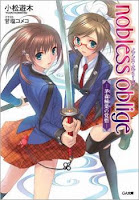
Light Novel: Noblesse Oblige ~ Kayamori Kuzuha’s Resolution

August 23rd, 2010

Kayamori Sakurako is the granddaughter of the head of the Sacred Tree Blue Heaven Style of sword fighting. On her first day of high school, her grandfather names her his heir, and awards her the sword name “Kuzuha,” the fourth woman in the family to bear the name.

When Kuzuha gets to school, she comes across a young man attacking a schoolmate of hers. Although the schoolmate is also a kenshi, a swordfighter, she’s trying to protect the people around them and is, as a result, losing. Kuzuha jumps in and saves the other girl, who turns out to be Kajimoto Ami, a member of the school’s self-policing organization, Luminous Force. Thus Ami and Kuzuha meet…fatefully.

You know how you’re listening to someone talk and you suddenly realize you have no idea what they are talking about and you have to say, “I’m sorry, now who was that and what was going on?”

I felt like that through the entirety of Noblesse Oblige ~ Kayamori Kuzuha’s Resolution. (ノブレス・オブリージュ ~茅森楠葉の覚悟~)

Which is not to say that this was a bad book. It wasn’t. I just kept wondering things like, “so what’s going on here and why do we care?” and “why was this book written, again?” This may makes it seem like I wasn’t enjoying it, but that’s not true. This was a nice novel, in fact, it had some really excellent elements, I just felt like I was missing something, as if it was a franchise extender for a game or something else that I couldn’t find.

I can’t synopsize the plot of this book, because there isn’t actually a plot. The point of view starts as Kuzuha’s, then switches to Ami’s for the rest of the book, except when it switches back in the middle of the story to Kuzuha’s.

The book takes place at Seibou Girl’s Academy, an elite academy for daughters of the nobility (kazoku) and the knightly class (kenzoku). Ami seems to be the sole commoner at the school. That she is part of Luminous Force, protege to the Guardian of the West, does not make her popular, but neither does she seem to be bullied. She is hounded by a random girl who demands that she admit that the reason she’s a Luminous Force member is because she and her mentor, Sayaka-sama, are LOVERS. Ami’s reaction is wonderful. “Lovers?” she thinks. “First I’ve heard of it.”

Kuzuha is trying to integrate being the public heir to her family’s fighting style into her life. She visits another of the Luminous Force members, Guardian of the South, the seventh of her line to bear the name Nanami. Kuzuha’s maid and Nanami fight, but when Nanami attempts a killing blow, it’s Kuzuha who stops the blade with her bare hands. In return for injuring her, Nanami spoils Kuzuha a bit at school.

Ami and Kuzuha are set up by another member of Luminous Force, Eastern Guardian Koyuri, to fight as part of the school festival, but Kuzuha takes a dive. It later turns out that she had never before picked up a shinai in her life, having always practiced with live blades. Ami finds herself sympathetic towards Kuzuha and really, really wants to be friends with her. The more she gets to know about Kuzuha, the more she respects and admires her. It’s obvious that Kuzuha is a truly excellent swordswoman, and the loss to Ami was a gift to the other girl, to cement her position as a member of Luminous Force,

One day, Ami is waiting for the bus when Kuzuha pulls up in her family’s private car. Inexplicably, she tells Ami that she’s found glasses like Ami’s and wants to do her hair up like Ami has. She’s girlishly excited when the her maid tells her they look the same. After asking to borrow Ami’s sword, she leaps out of the car and runs after…the guy who attacked Ami in the second chapter. The kid, not knowing Ami well, except superficially, believes he is fighting Ami, so when he is summarily defeated by Kuzuha’s Pure Sky Cut, they are all pretty sure he’ll never bother her again. When they reach school, they learn that Nanami has taken Kuzuha into Luminous Force as her protege.

Ami retaliates for that act of kindness by bringing Kuzuha’s best friend into Luminous Force so those two can be closer, too.

The final scene, Koyuri pairs Ami and Kuzuha up for a re-match, this time, for real. The end of the book is actually kind of silly, and everyone is laughing by the final page.

And I still have no idea what the book was about. ^_^

However, the sword fighting was really pretty good, until the very end with the Pure Sky attack which is right out of comics. The book had me hooked when Kuzuha’s maid, Kofuyu, mentioned that she uses only a wakizashi to fight. As I’m inordinately fond of wakizashi, (indeed, it’s the only kind of Japanese blade I’m comfortable with, having trained all those years with a two-edged sword, and because of a certain wakizashi I once had the pleasure of bearing…) I just got all tail-waggy happy at that scene.

The other element which was excellent was the complete lack of Yuri. It’s not like there weren’t lead-ins all over the place: Kuzuha’s close relationship with her maid Kofuyu, Nanami and Kuzuha, Ami and Sayaka, Kuzuha and her best friend Suzune, Ami and Kuzuha…and you know what? None of them were anything even close to being treated with stupid service. In fact, all the relationships seemed totally organic and normal considering the unreal setup. The one I expected to be totally Yuri-fied was Sayaka and Ami, since they were *clearly* the Sachiko and Yumi of the series, but it never once went there. Sayaka was cool, kind, sympathetic, friendly, scolding, but nothing more. She was a firm/kind mentor, Ami her protege. The end.

When Ami watches Kuzuha defeat the guy, disguised as Ami, her desire to embrace Kuzuha was really, honestly, just to give another girl, a friend, a hug.

Ratings:

Art – 7
Story – 7
Characters – 8
Yuri – 1
Swordplay – 8
Service – 1

Overall – 8

So despite the fact that I really haven’t a clue what this book was about, or who it was for, or why it was written…I liked it. There’s a sequel, about the other Luminous Force member, Harumi. I’m sort of even tempted to get it. ^_^