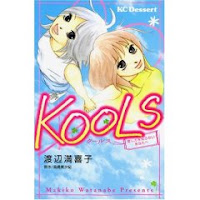
Lesbian Manga: KOOLS

April 6th, 2008

KOOLS is a collection of three one-shot josei manga stories. They make a perfect lead-in to today’s digression – the difference between josei manga and Ladies’ Comics.

Here in the west josei manga is categorized as manga targeted towards women 18-30. However, if you look at Japanese publisher websites, you’ll see that they often market their magazines in four flavors – “For boys” “For girls” “For women” and “For men.”In reality, shoujo magazines target an audience of (roughly) 7-12 year olds and anything older than 12 becomes josei. And even some of that shoujo stuff runs older that I’m comfortable with. In other words, teen, older teen, mature readers all are lumped under “women,” not “girls.” The upper age limit for josei is also approximate. For many years I read Feel Young magazine, in which there were constantly comments by readers much older than 30 – sometimes even as old as me. ;-)

Now, while josei manga can be translated as “Lady’s Comics,” they are in no way the same things as Ladies Comics, which is an entirely different genre in Japan. Ladies Comics are “adult” titles, by which I mean that they are smut. Aurora Publishing, which is the western imprint of Oozora Shuppan (the publishers of the lesbian-themed Ladies Comic Mist,) are putting out the first translated Ladies Comic – Luv Luv. Here’s what Aurora has to say about the title: “Aurora Publishing, Inc. brings “passionate manga for women” to America with their new Luv Luv imprint. Extremely popular in Japan, but never before available as a genre in the U.S., Ladies Comics, or Redikomi, are romantic, hot and sexy manga about modern women and the men they love.” I love the use of “modern” there – the codeword for post-sexual revolution women who think sex is fun and not just a marital obligation. The term is so 70s. ^_^

To sum up, most of what we think of shoujo, is actually josei. And josei manga is in no way the same thing as Ladies Comics.

Which brings me to today’s topic, KOOLS. This book came out under the imprint KC Dessert comics – all of which are targeted towards older teens, but have “adult” situations. Because high school girls like to read about sex, too. These are josei manga, not Ladies Comics. KOOLS is, as I mentioned, a collection of three stories, all of which are sincere, have genuine moments of sweetness and are about as “After School Special” as I’ve ever read in a manga.

The first story, “KOOLS,” which stands for “Kiss Only One Lady,” is the story of Sae, who slowly, but steadily comes to grips with the fact that she is lesbian. She meets, fall in love with, joins a softball team with, moves in with, breaks up with and then gets back together with Tomo, who is quite possibly the best lesbian ever in the history of manga. The subject matter is told as a story, but there’s a definite edge of educational about the thing – the moral of the story is, “it’s okay to be gay.” Along the way, the audience is also introduced – gently – to other sexual minorities, and the unique forms of discrimination that can occur, even within a small community.

Sae is not a bad person, Tomo just has the misfortune of being her first, so when she all of a sudden has a crisis of identity, its Tomo who bears the brunt. But Sae, with the support of their softball team, (named the KOOLS,) comes to grips with herself and we are lead to believe that the end looks bright and rosy for them. It’s a very pleasant ending to what, ten years ago, would have been a tale that ended in tragedy or marriage.

The two stories that follow are gritty reminders that we genuinely cannot confront issues of rape and abuse enough times. In the rape story a party girl is gang raped, but does not report it, because she is sure that no one will believe her or that they will make it out to be her fault. Through the tough love and friendship of a total stranger, she moves through the pain, and into a new life, where she is able to once again face the idea of being with a guy. Eventually, she finds the strength in herself to testify against the men who raped her, when they are arrested for another rape.

The last story is set in high school, where a nice girl is going out with the hunky guy – who beats her. The story covers all the ways women lie about their abusers, to themselves and to other people. The violence escalates, but again, someone else intervenes. In this case, as the abusive boyfriend goes off the clock and starts to take it out on the woman who has stepped in to protect the girl, she is told to run and get the police.

The last two stories are rough. Nothing is held back. There’s no implication or whitewashing – these are brutal situations told brutally. And the advice is stated just as brutally – it’s up to you to stop it. Now. Hotline phone numbers and crisis center information is given plainly and simply in the notes.

I admit to finding the first story less satisfying since it was lumped in with the latter two. It gave the whole book a sense of it being a “things girls might have to deal with” handbook. For obvious reasons, I would prefer to simply see a story about two women who fall in love, with no teacher’s guide for discussion attached. However, as an educational story, it was a pretty good narrative with characters that didn’t stand out as silly stereotypes or behaviors. No Takarazuka butches, no lipstick lesbians behaving like old men – just a bunch of women, who happen to love other women.

Ratings:

Art – 8
Story – 7
Characters – 7
Yuri – 10
Service – You know, I really don’t want to think about that. In a perfect world, 0.

Overall – 7

KOOLS a refreshing contrast to Yuri series and makes a nice story to give a friend or relative without sounding too preachy. Once again, thanks to Erin who pointed this out to me.


This Week in Yuri

April 5th, 2008

Hi all – this week’s roundup begins with a leak. But not by me. ;-)


Wizard Universe
reports that the Bakuretsu Tenshi manga, Burst Angel’s Adolescence is going to be released by TOKYOPOP. You may remember that I reviewed that manga several years ago, and found all three volumes (reviews of which you can find at included in the Bakuretsu Tenshi category page) infinitely superior – and more Yuri – than the anime. I look forward to their appearance in English.

As I mentioned in passing in an earlier review this week, artists Zaou Taishi and Eiki Eiki are going to be at the June Yaoi Jamboree in Phoenix Arizona. As well as being known for gender-bendy titles under her real name Tsuda Mikiyo, Zaou and co-creator Eiki are well-known for their long-time collaboration as BL doujinshi artists…and are the creators of Comic Yuri Hime collection HaruNatsuAkiFuyu. If you’re in the Phoenix area, see if you can drop in and ask them about their experiences writing for a Yuri audience!

The new Maria-sama ga Miteru novel came out this week, Margaret ni Ribon (a title that will make fans roll their eyes, as both “Margaret” and “Ribon” are well-known Shueisha magazines for girls…in fact, the Marimite manga ran in Margaret for a while.) The new novel is garnering top Yuri points from the fandom, but…you know, this *is* Yuri fans we’re talking about. It doesn’t take much to see Yuri, whether it’s there or not. LOL In any case, the novel has some stories that are about the old Rosas, Eriko, Youko and Sei, which certainly appeals to me! Let’s see how much longer Konno-sensei can slow down time and put off Sachiko’s graduation. :-)

Lastly, the Yuricon Environmental Committee has done some tending of the website – this time we have the Mission Statement and History translated into Japanese! Take a look. Feel free to help! Many thanks to our translators Katey and Ana for their fabulous work so far. :-)


Yuri Anime: Strawberry Panic, Volume 1 (English)

April 4th, 2008

Strawberry Panic is a series with a fairly consistent pedigree. It began as a series of one-shot stories in Dengeki G’s magazine where the short, almost non-existent action in each vignette served to caption a exceedingly moe picture, about girls in “Yuri couplings.” It proceeded from there to be made into an anime, a manga (that also ran in G’s I believe) and a series of light novels, which were probably serialized somewhere that is also a typical fanservicey publication.

It’s nice that lots of girls, as well as guys, love this series, but that doesn’t actually change the fact that it was meant to be pandering, service and, ultimately, parody for a Yuri Fanboy audience. I expect someone will inform me exactly where the LN was serialized in the comments because this series’ fandom seems to need to express “facts” about the series to give it a frisson of legitimacy. Frankly, I don’t see why it can’t just be crap you like. As Bruce Pregger says, “Just because it’s bad, doesn’t mean you can’t enjoy it.” My corollary to which is, “Just because you enjoy it, doesn’t mean it’s good, either.” ^_^

In any case, in Strawberry Panic, new student Aoi Nagisa arrives at Astrea Hill to attend the notable and superior St. Miator Academy. Immediately, she’s thrown into intrigue when the star of the school, the Etoile, Hanazono Shizuma, takes a fancy to her in front of the entire student body. Nagisa is overwhelmed by Shizuma, and is further thrown into confusion by her roommate Tamao’s behavior, which can only be described as “pervy.” We also meet simple, sweet Hikari who has fallen for the Prince of her school, and is further thrown into confusion by her roommate Yaya’s behavior, which can only be described as “pervy.”

The first volume of the anime, (for which I must thank the gentlemen at Media Blasters) covers the first six episodes of the series, in which Nagisa is confused about everything related to the school from meals, to the Etoile, to her uniform and curfews. Pretty much everything she needs to make a complete and total ass of herself in every possible situation. We are told several times that her transfer was rushed, an “emergency,” but it does beg the question – does no one think to just sit her down with a copy of the school handbook? The conversation the day after we watched this, went something like this:

“Wow, A-ko-san, you’ve really got the hang of the school in such a short time. I’m impressed.”

“Thanks, B-ko-san. I made sure I read the school handbook when I transferred in. It’s so embarrassing to not know the important details.”

Just so.

In any case, I watched the anime with a critical eye for two things – one, if I was totally mistaken originally, and the whole series was an obvious parody which I simply missed while I was busy being pompous, and; two, the translation.

The first is answered easily – no, I was not mistaken, although I was undoubtedly pompous. lol The first quarter of the series is played “straight,” if you will allow the use of that phrase. Other than the obvious rip-offs of Catholic School, Onee-sama-ing, midnight tea parties, and other pretty well-known memes taken from previous Yuri series (most of which would be familiar to Japanese viewers more than western ones,) there is no obvious humor in the series. It’s played for moe cute, precious and pervy….not in that order. I forgot to count the number of *almost* kisses, but there’s at least one in every episode, which made me gnash my teeth originally and wasn’t much less irritating this time around.

Secondly, the translation. Up until right towards the very end, it was very good. Most of the usual honorifics were kept, right until the very end where strangely “-oneesama” was not, so we get that jarring turn of phrase “Big Sister Shizuma.” No one says that in English. Why “-oneesama” wasn’t kept as an honorific befuddles me – especially when I warned them ahead of time that I planned on being picky about that, as a fan and a reviewer. Also towards the end, in perhaps the fifth or six episode, there suddenly was a tendency to translate in that dubtitle way – you know, what they meant, not what they said. It left me with the impression that either they changed translators halfway through or by the last two episodes, the translator was simply getting tired.

And then there’s the QC…or more properly, lack thereof. In the last episode, there’s multiple typos in the subtitles. MB folks, I love you. But you NEED to QC this stuff. You can’t send it out the door looking like this. Seriously. It doesn’t look professional. Seven Seas is doing such exceptional work on the manga and Light Novels. The anime really needs to be able to stand up to the print series.

But don’t let my nitpicking detract from the genuine, laudable efforts by MB to keep the honorifics in place. “Shizuma-sama,” “Tamao-chan” and everyone “-san” is really a lovely change of pace in official releases.

Ratings:

Art – 8
Story – 7
Characters – 7
Yuri – 6
Service – 9

Overall – 7

It’s not fabulous. It’s very good. It’s definitely a good deal for the money. It’s very official – fans of Strawberry Panic *should* buy it and support bringing more Yuri anime over here. But. It could still be better.


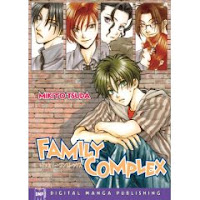
Family Complex Manga

April 3rd, 2008

Can “fake” Yuri be enjoyable? In the case of Family Complex, the answer is definitely yes.

(Before I forget, my thanks today go to Zig, for sponsoring today’s review. A new sponsor for Okazu, and much appreciated!)

If we are honest as Yuri fans, “fake” Yuri comprises the largest percentage of Yuri that we encounter. Fake Yuri includes, but is not limited to, such things as: straight characters who are seen draped over one another in a way that the easily deluded see as them being a couple; best friends who are 10 years old and seem to be “in love” with each other (or, more commonly, one of the friends is “in love” with the other one); the subject of desire is not really a human girl but is instead a guy dressed as a girl, or an android, or an alien or something that is anything other than a human girl.

All of the above are so common as Yuri plots that most Yuri fans don’t really think twice about accepting them as Yuri. There are of course an endless number of ways in which Yuri is included in stories without the involved characters being in any way lesbian. These are just a few examples.

In Family Complex, Tsuda Mikiyo embraces several of the most popular “fake” Yuri themes. With a twist. ^_^

The basic premise of Family Complex is simple. Two attractive parents have four beautiful children…well, three beautiful children and a plain one. As with another Tsuda work, HaruNatsuAkiFuyu (which she wrote as as Zaou Taishi,) the children’s names reflect the four seasons Harumi, Natsuru, Akira and Fuyuki. Each of the chapters of the volume follows one of the four children and their particular sense of alienation and discomfort with the world.

In each case the story, and the character, are handled with compassion, humor and in the end, they are all grounded solidly in the love they receive from their family members. So, overall, it’s a painless, sweet and often amusing look at a very close family. For that alone, it’s a pleasure to read. No missing parents, abusive siblings, horrible family life at all. In fact, in at least one case, the biggest problem appears to be that the family is too close and they love each other too much – but never in a particularly creepy way.

Yuri rears it’s fake-y head thrice.

Natsuru, second child and oldest sister, goes to an all-girls’ school, where she is draped over her best friend constantly and so, of course, everyone assumes they are a couple. They aren’t. It’s played for laughs and nothing else. But – the laugh is on us, because at the end of the book, in one of the omake (extra) chapters, we see that Natsuru has followed her best friend to college and spends her time chasing boys off her. Uh….really? I see.

The final chapter of the main story follows the youngest daughter, Fuyuki, who is typically paralyzed into silence while she overthinks things. Of all of the chapters, this was the one I found the most amusing. In the end, her family convinces her to speak her mind, which brings about in her a crazed transformation into a really brutally honest and forthright chatterbox. Again, in the omake chapter, we see Fuyuki, now grown up a bit. She has cut away her goth-loli locks and is now wearing her hair short and, interestingly, macking on the girls. Uh-huh.

Lastly, the fakiest of the fake Yuri in the book is revealed when we learn about the parents’ history and how they met. It is also revealed that Dad makes a pretty girl when he cross-dresses and that Mom and Dad were often, when they were younger, mistaken for a Yuri couple. Gotcha.

To be fair, there is also fake BL in abundance and some more fake cross-dressing in the book, so Tsuda covers all of her normal gender mindfuck bases for a home run of fake sexual minority issues.

And, as a bonus, we get a series of interesting, but deeply strange, extra chapters, which include not only stories about the characters of Family Complex, but also about Tsuda’s emergency eye surgery and her inability to remember which name she has written any particular story under, which I found very amusing. I also thought it interesting that she draws herself and her co-creator Eiki Eiki intermittently as human beings, as well as the more usual animal avatars. It’s not often we see a mangaka draw herself as an actual person, and not some drooling SD character or anthropomorphized creature.

In terms of reproduction this volume is slick until towards the end, where the pages start getting out of whack. Borders, word balloons and pictures start to be cut off at odd angles. It looked very strange and I wondered what on earth had happened during the layout or printing. But since the manga is meant for fluff fun I wasn’t going to scream about it.

After thinking about it, I decided that I actually prefer Tsuda’s art to Eiki Eiki’s. The lips aren’t as distracting, even if the characters all look exactly the same. Good thing Tsuda wrote notes identifying taller grown-up Akira, or short-haired Fuyuki, or I wouldn’t have had a clue.

Ratings:

Art – 8
Story – 8
Characters – 7
Fake Yuri – 4
Service – 3

Overall – 8

The omake were, in many ways, the most enjoyable part of the book. But as a whole, it was definitely a good-feel read. Much better than Tsuda’s more well-known series, IMHO.


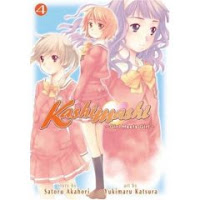
Yuri Manga: Kashimashi Girl meets Girl, Volume 4 (English)

April 2nd, 2008

Let’s recap the story so far in Kashimashi ~ Girl Meets Girl:

In Volume 1, Tomari has difficulty coming to terms with the fact that her best friend, Hazumu, has become a girl.

In Volume 2, Tomari has difficulty coming to terms with the fact that she has always loved Hazumu

In Volume 3, Tomari has difficulty coming to terms with the fact that she is *still* in love with Hazumu and is willing to fight Yasuna for her.

And now, in Volume 4, Tomari has difficulty coming to terms with the fact that Hazumu’s life may be coming to a premature end.

Looking at it this way, it sort of seems like Tomari’s really the protagonist, doesn’t it? ^_^ And, in a way, she is.

Hazumu, by her own admission, is incapable of making any decisions. Yasuna has made her decision, but will not do anything change the status quo, as befits her gentle, “proper girl” personality. Which leaves Tomari holding the whole ball of wax in terms of crisis, climax, angst and any other random emotions wandering around.

To my surprise, I find that I never originally reviewed this volume in Japanese, probably because it felt like, at the time, that the story pretty much screeched to a dead halt, and we were waiting for the series to run out of chapters so it could end. Now that I’m looking at it from a different perspective, it pretty much just looks like the next plateau of a fairly formulaic series. In every volume so far, the basic premise of Kashimashi has been watching Tomari tortured by something everyone else appears to have haphazardly accepted. Of course they haven’t, they’ve been wracked with doubt and despair, but as our focus is turned primarily upon Hazumu and Tomari, we’re not able to see it any more than Tomari does.

Just as Tomari finally does come to accept her (and Hazumu’s) feelings, Yasuna forces the situation to become more complex, by existing. She ends up acting as a catalyst for Tomari’s and Hazumu’s growth, without every really doing anything specific. In this case, it is the rumor of her leaving for New York that makes Hazumu scoop her up and kiss her. The irony of course is that Tomari has just learned the lesson “If you give in to the fear of losing something, you’ll never be able to keep it safe,” but Hazumu hasn’t.

As always, the adaptation and translation for Kashimashi is superb. Tomari is now, along with everyone else, referring to Hazumu as “she.” Tomari has also stopped speaking like an old man, which is nice. The page tones seemed to have reproduced a little roughly, leaving some moire patterns on pages with large toned areas, but unless that’s important to you, it’s easily enough overlooked. Once again, I really want to say, this book has the smoothest, most natural translation/adaptation I’ve ever encountered. It never fails to impress me.

Other than the fact that nothing really *happens* in this Volume, it’s quite excellent. If one took the essentially ridiculous plot complications away (aliens, time running out, etc), it would be a nice slice-of-life piece about a newly transitioned girl and the girls (and boys) who love her.

Ratings:

Art – 8
Characters – 7
Story – 7
Yuri – 9
Service – 4

Overall – 8

My thanks to Ted the Awesome (new nickname, as discussed at Anime Boston,) for sponsoring today’s review!