New Anime Season Winter 2008: Mai Otome 0 ~ s.ifr OVA 1

February 29th, 2008

How many of the Mai series have you followed? I slogged through some of the HiME and Otome manga before calling it quits and I avoided Arashi completely. (For some reason, the manga is so much more vile than the anime and light novels, it’s genuinely intolerable to me.) I’ve watched all the anime, read the light novel and listened to two of the Drama CDs. Much of which I have reviewed here at Okazu. :-)

Which brings us to today’s topic, the newest of the anime releases, Mai Otome 0~S.ifr, OVA 1. (Available in English from Funimation.) This series clearly looks like a step back in time, an origin myth if you will. And like all epic beginnings, it starts off with good epic CGI, epic action and epic background music.

Sifr Fran, our heroine, starts the episode off having been kidnapped by our old friends, the Schwarz. She is saved by a Windbloom combo of Bruce Windbloom and his Meister Rena, with an assist from Sister Shion and her Meister Raquel and one of the Five Pillars of Garderobe, Elliot Chandler.

Once Sifr is safe and sound, we introduce everyone, including Arika’s eventual mother Rena Yumemiya, who pretty much doesn’t look at all like what we would expect. And if you have been keeping up on all of the different iterations, you may recognize Shion and Raquel as Shion and Mayo from the Mai HiME: Destiny light novel. For sanity’s sake, I refuse to even think of that at the moment – it’s just easier to take S.ifr as a whole new ball of wax and learn everyone the way they are presented to us.

Rena is greeted with much Yuri loving by Elliot. Apparently Elliot and Rena were in school together and Elliot misses Rena *a lot*. This is followed by some teasing of Shion, that in a lot of ways was very annoying, because even as they were implying that Yuri relationships exist in both Garderobe and Church, they explicitly state that its forbidden in the Church, and it’s a dirty little Otome secret. UGH.

We’re also treated to some bath service and nudity, because apparently we like that kind of thing.

Sifr is still the target of Schwarz, and while Elliot appears to be on our side, she receives an order from the Garderobe headmistress to kill Sifr if Schwarz gets a hold of her. Schwarz helpfully attacks, there’s some good action that Sunrise animates quite well, much better than the “peacetime” scenes, all of which precipitates two things. Peace-loving, violence-hating Rena is forced to materialize fully and fight off a Miyu unit, M-9, and Elliot is forced to show her hand. Rena wins the first battle, and ties on the second and the world explodes as Schwarz flies off with Sifr.

Personally, I’m betting no one died.

Lots of stuff to come in the second OVA, including Rena getting her sapphire robe, and erm… stuff.

Ratings:

Art – 8
Story – 7
Music – 8
Characters – 7
Yuri – 5
Service – 5

Overall – 7.5

For a first episode, I think S.ifr had pretty much every bang we can expect for our buck. I particularly liked the fact that there were less panty shots than usual, (replaced with the slightly less scuzzy obsession with adult breasts) and there were definitely more adult characters per square inch than in all the other Mai series. I’m looking forward to getting to know Garderobe’s new Headmistress, especially. She has EPL written all over her. ^_^


Yuri Drama CD: El Cazador de la Bruja, Volume 2

February 28th, 2008

My goodness,the El Cazador Drama CD, Volume 2 is a cute Drama CD. Set somewhere just past halfway into the series, after Ellis has started to realize that Nadie is more than a friend, but well before Nadie clues in, this Christmas story finds our two adventurers on the run with Santa Claus.

Not *the* Santa Claus, of course. In this case, the story begins with Nadie telling Ellis that she remembers a Christmas in New York City. Ellis presses her for details, which Nadie is loathe to share. When she – reluctantly – begins the story, it goes something like this. “Santa Claus was running away.”

At which Santa Claus comes running out of a store and into their car, importuning them to floor it. After some banter, they take off. Nadie is amazed at the irony when Clive, the Santa in question, turns out to be the *same* Santa as that in her New York story.

The opening credits are an opportunity for Ellis to keep changing the title of the story, inserting “New York” in every version, until Nadie puts a stop to it.

Eventually Ellis learns the New York story, and why Clive is (still) on the run. There’s gunfights and poignant moments, and Ellis using her newfound powers, and LA being a freak, and Ricardo being whipped by Lilio into dressing as Santa (red poncho) and walking around with a llama with a red nose. And each scene narrated dryly, as usual, by Jody “Blue Eyes” Hayward.

In the end, Clive was wearing a red shirt for a good reason, and Ellis and Nadie are forced to confront Clive’s mother, now a nun, with the gift he had made for her. Ellis’ innate honesty and goodness force Clive’s mother to forgive her son and they move on, having once again changed the world one person at a time.

The story is a little thin, but there were a few excellent scenes and one very un-excellent scene. ^_^

The best scene, IMHO, is Blue Eyes asking one of her henchwomen to stay for a drink, since it’s Christmas Eve and all. She begins interrogating the woman – likes, dislikes, hobbies, etc. None, comes the answer. Blue Eyes makes fun of the woman a little, but when the questions are turned on her and she doesn’t have any better answers, the henchwoman notes that they are the same. Scene fades out. My imagination doesn’t. ^_^

The most horriblest scene involves LA singing the Amigos tacos song. Try imagining it. That’s not nearly half as bad as it actually was. 0_0

And the funniest scene comes right at the very end in a 12-second track, when Ricardo, Liliio, and the llama, drive by Nadie and Ellis. ^_^

The bonus track was very long, with quite a lot of conversation from the main cast. Miyano Mamoru, LA’s actor, is quick to point out that LA is not, in fact, a pervert or hentai – his feelings are genuine love for Ellis. I agree, but it doesn’t make him any less horrible.

Hisakawa Aya is bemoaning the fact that Rosenberg’s voice actor, Miyake Kenta, isn’t with them this time and wouldn’t you know it – he walks in at that very moment! “Uso!” Hisakwa says, and a conversation that has nothing at all to do with us listeners erupts. ^_^

No physical extras, but the cover art is just about exactly as cute as the story inside.

Ratings:

Art – 7
Story – 7
Characters – 8
Yuri – 3
Service  – 4

Overall – 7

While not as love-love as the first El Cazador DCD, the second is still fun.


Yuri Manga: Voiceful (English)

February 27th, 2008

Books like Voiceful are exactly the reason the Yuricon definition of Yuri includes “intense emotional connections” between women. Because sometimes it’s not “love” yet, and hasn’t gotten anywhere near “desire” but it’s still some seriously intense bond that could easily become something more. (Another good example of that is Haibane Renmei, in which the circumstances preclude a love affair, but don’t stop Reki and Rakka from being intensely attracted to one another.)

Before I forget, thanks to Eric for sponsoring today’s review!

The creator, nawoko, says in her endnote that Voiceful is pretty far from Yuri. In one sense she is correct, but I think anyone who reads Kanae and Hina’s story will be able to see the Yuri, without the need for Yuri goggles.

For a summation of the content of the book, and my first impressions, please read my review of the Japanese edition. As I have been doing, today’s review will cover the adaptation by Seven Seas.

I think this is one of the best in Seven Seas’ Strawberry Line so far. The color page, the cover and the tones are clearer than usual. Towards the end of the volume, the stories get a little darker. The stories at the end of the volume are the earlier Yuri Shimai stories – I have no idea if that is related or not.

The translation is quite good. I know I wasn’t the only one who had some trouble with “Opening,” the final story (how ironic, huh?) and the translator did a very good job of making it make sense. The emotion between Kanae and Hina comes across beautifully, as well.

As always the editing and adaptation are smooth as silk and the honorifics remain in place. Nice job, everyone. ^_^

The book also contains some preview pages for First Love Sisters, as an “extra.” Since FSL is the other Ichijinsha book in the Strawberry Line so far, that seems like a natural fit. I’m interested to see if Seven Seas is able to (or wants to) pick up any further Yuri Hime comics – and which ones they might get.

Ratings:

Art – 7
Characters – 7
Story – 7
Yuri – 4
Service – 1, some slight undressedness

Overall – 7

While not the absolute best Yuri Hime collection Ichijinsha has put out, Voiceful is a nice way to ease into the genre. If you have a friend who isn’t really a big fan, or you know a young babydyke whose parents would object to Strawberry Panic (and what sane person wouldn’t? ^_^) Voiceful makes a gentle point of entry into the Yuri world.


Yuri Manga: Otome Cake

February 25th, 2008

Takahashi Mako’s Otome Cake is a very good example of the editor’s craft. Many writers and artists don’t really understand the need for an editor – their work should stand on its own merit, and who does this talentless ass think they are, anyway? ^_^; The editor for this volume was no ass, I can tell you that.

If you have been keeping up on my reviews of Yuri Shimai and Yuri Hime magazines, you’ll be aware of the fact that I have not ever been a fan of Takahashi’s work. The stories are filled with too many things I don’t like, for me to be able to see past them. The characters tend to look younger than their already too-young years, they are often suffering from mental illness, overtly or implicitly, they look like abused street rats and act like kids in war zones.

In short – creepy, violent, loli, with a light dash of Yuri for flavoring. (Not at *all* to my taste. I prefer my Yuri full-bodied and mature.)

However, Otome Cake isn’t bad. Somehow, the editor for this volume pulled out the least horrible of Takahashi’s stories, connected them with the thinnest possible thread of a theme on the connecting pages, and lo and behold, you have a collection that wasn’t bad, considering.

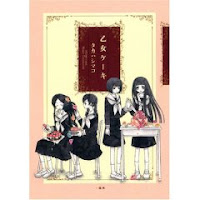
The cover has a gaggle of girls who all look like Charles Addams’ characters wielding a knife over a poor innocent cake. The dead eyes really help. ^_^

There’s nothing deep here – Yuri tends to be “I love her” and that’s about it, with the occasional kiss. Nothing after the happily ever afters – and not always happily ever after, in fact. The stories deal with mostly failed, first or unrequited loves, with a few exceptions, but the editor has chosen wisely and well, and the overall impression of the book isn’t as heavy and dark as Takahashi’s stories sometimes feel. The final story really helps – a light, cute story about two girls, a cake and a kiss on the school roof. It leaves us, if you will, with a pleasant taste in our mouths.

Ratings:

Art – It’s not really *bad*, but it makes me feel icky – 6
Story – 6
Yuri – 5
Service – 5

Overall – 6

Honestly, the thing I liked best was the cake being eaten in the pages separating the stories. :-)


Lesbian Comic: Honey & Honey

February 24th, 2008

One of the questions I get quite often is “Are the terms seme and uke used in Yuri (or do lesbians in Japan use them) the way they are used in BL?”

Like just about every question I get, the answer is yes – and no. (I’m starting to sound positively Elvish these days, with my inability to provide straight answers to deceptively simple questions.) ^_^

Since educating people on lesbian relationships and gender roles is part of what Takeuchi Sachiko’s Honey & Honey is about, this seemed like a good time to address that question here.

First, let’s talk about the terms, seme and uke. Seme (pronounced “seh-meh”) refers to the pursuer, the person who initiates a sexual relationship. Uke (pronounced “oo-keh”) is the receiver, the person who receives those advances. These positions in the relationship are based on power, and preference. They date from early Japanese male homosexual relationships, where the uke was traditionally younger and had less power than the seme, who was an adult male with some social status. These terms are similar to what we mean today when we say someone is a “top” (seme) or “bottom”(uke.) In BL stories, the seme is the more masculine in terms of gender role, while the uke tends to be more feminine. These are of course generalizations and yes, I know, there are exceptions to the rule. In general, the positions of seme and uke represent who has the power in the relationship. Why do I say “power?” Because this is modeled after a heterosexual model where the man  (or manlier man or woman) is presumed to hold the power and status.

In contrast, the commonly used lesbian terms tachi (pronounced “tah-chee”) and neko (pronounced “neh-koh”) are more aligned to our English terms “butch” and “femme,” rather that a direct match to seme and uke. As I discovered for the last Now This is Only My Opinion, tachi comes from tachiyaku, the kabuki term for an actor of a male role. Neko, in the only etymology I could find, was supposed to be from the combination of nemu and ko – e.g., the girl you sleep with. In Honey & Honey, Takeuchi says that tachi tend to play the male role, and neko the female, in a lesbian couple. (Women who switch back and forth are called reba, because they “reverse” roles.) As with butch and femme, there’s a certain natural tendency in some women towards one or the other.

When tachi are, in fact, playing the “man’s role,” they, well, they treat their women kinda crappy. Because that’s what men do, you know. In the US, butches tend to be way more solicitous of their femmes, because they are the Queen, and we live to serve, as I once found myself explaining in a lesbian bar in Japan. I was assured at the time that American butches are way nicer than Japanese tachi. If Masako in Honey & Honey is indicative, I’d say that I was told right. But I’ll get there in a sec.

Here’s where it gets weird. ^_^ The reason that I find the terms seme and uke awkward when it comes to lesbian relationships is because when it comes to female couples, it’s the femme that tends to be the seme. They make the rules, they call the shots. So, while yes, seme and uke are used, if you look at, say, Haruka and Michiru from Sailor Moon, there is no doubt whatsoever that it’s Michiru who is seme there, despite Haruka’s role as tachi. Seems counterintuitive, but that’s how it looks from this side of the mirror. ^_^

Now that we’ve cleared all that up, let’s talk about Honey & Honey. Like the sequel, Honey & Honey Deluxe, this book was designed to explain lesbian and sexual minority life to straight women, with gentle humor. Everything from “how did you know you were lesbian?” to breaking up, from debunking “all lesbians were abused by men” to dating basics. Sachiko (neko) and her girlfriend Masako (tachi) go out together to buy underwear and have dinner and face confusion, derision and misunderstandings from friends and family, as well as find support, love and community.

I can’t say I really *like* Honey & Honey, in part because Masako, as both tachi and a bisexual, tends to behave very callously, and stereotypically. Instead of representing bisexuality as simply finding both sexes equally appealing, Masako acts like an omnisexual pervert, acting like she’ll stray at any second. And as a tachi she tends to treat Sachiko unsympathetically. I realize that this is probably meant to be played for humor, but it sort of wore on me.

However, as with the sequel, the story does what it is supposed to do – it educates the nonke (straight/heterosexual) audience, explaining what lesbian life is about; the good, the bad, the annoying, the funny, with a cheerful attitude of “you’re a woman – you’ll understand what I mean.” In the beginning note Takuechi makes it plain that lesbian life is not painful or sad or lonely at *all* – in fact, she’s having a blast. For that alone, it’s worth reading the book. ^_^

Ratings:

Art – 6
Story – 6
Characters – 6
Lesbian – 10
Service – 0

Overall – 6

If you’re a young person, trying to swim upstream against all the “but…” questions from friends and relatives, grab a copy of the this book and hand it over to the questioner – that’s *exactly* what it’s for.