Archive for the Artists Category


Yuri Manga: Saigo no Seifuku New Edition (新装版 最後の制服), Volume 2

June 20th, 2011

We left Volume 1 of the new edition of Saigo no Seifuku (新装版 最後の制服) with two unresolved relationships.

In Volume 2, the situation instantly becomes more complicated, rather than less, with the addition of…a boy!

Boys are causing no end of trouble in the dorm in fact. Kimiko’s boyfriend dumps her and, upon overhearing him and his friends being unkind about her dorrmmate, Tsumugi punches his lights out.

In the meantime, Aiko is vexed because Fuuko has decided to date some guy for whom she really has no feelings. This prompts a sudden confession from Aiko. Now that Fuuko knows the truth, what will she do?

In the meantime, Asagi is still planning on gaining Beniko’s affection, but completely fails to even gain her attention.

This brings us to the end of Volume 2 of the original 3-book series. For those of you who bought and read the Seven Seas translation, here is what you missed:

Upon graduation, Asagi calls Beniko out during her speech, for never having noticed or cared that she had feelings for her. Beniko is surprised, partly because she really hadn’t noticed or cared and partly because now *everyone* in the school is watching her.

Fuuko finally admits that she loves Aiko too, but they will not be able to be together, as her mother has taken ill and she is transferring schools. They have mere hours together before they must part. But they continue to write one another as time passes. Aiko is struck by momentary doubt about Fuuko’s feelings, but a visit in person from Fuuko sets her straight. They plan, upon graduation to attend the same school and live together.  For them, the book ends with a rose-colored future.

Meanwhile, Anzu does manage to convey her feelings to Tsumugi, although she knows her cause is hopeless. But she knows that Tsumugi loves her cooking, and she decides she’ll continue to work on it, so she can one day make something delicious for the one she loves.

Asagi remains a selfish ass right to the very end. Why Tama doesn’t punch her in the gut, I will never, ever understand.

And, finally, we get the epilogue we hoped we’d get for Beniko and Tsumugi, as they move in together and Beniko *finally* has her way with Tsumugi, once again proving my theory that in Yuri, the butches are the uke and the femmes the seme. It was quite nice to see them both grown up. This was, in fact, the ending I’d hope we’d get…and we got it, so yay us!

Ratings:

Art – 7
Story – 8
Characters – 7
Yuri – 9
Service – 2

Overall – 8

This series may well be the best example of my opinion changing over time. I started off really not enjoying Hakamada Mera’s art and now, as I read the end of this series at last, I find it was no longer a distraction. I was able to simply enjoy the story for what it was – a high school Yuri story with two happily-ever-after endings and a little sex and candy for good measure.


Yuri Manga: Saigo no Seifuku New Edition, (新装版 最後の制服) Volume 1

June 13th, 2011

 Reading Saigo no Seifuku, New Edition, Volume 1 (新装版 最後の制服) was an exercise of a sort for me. When I first read The Last Uniform in 2006, the art absolutely repulsed me. So much so that I struggled for years to give Hakamada Mera any respect. Her stories were always cute, slightly bland, but the oversize heads drove me batty. As time went on, the heads got a little smaller, moe became more common and far worse giant heads on little bodies were thrown at me and now, years later, I find I barely noticed the giant heads anymore. I think, honestly, some re-drawing was done here, because the heads weren’t nearly as huge I remember them being. In fact, there were one or two pages where I found myself staring at a weirdly drawn jaw, the way I used to, but only a few.

So, here we are, many years after Saigo no Seifuku originally detailed the love triangles at Tsubakigaoka Gakuin. But before we get into the original stories, we’re given a few new ones, establishing both Ai and Tsumugi as completely, goofily besotted with their respective objects of affection.

The first couple we “meet” are Ai and her roommate, Fuuko. Fu-chan is that kind of cheerful, apparently doofy girl that we’re never really sure means “like” the same way Ai does. Well, the new edition clears that up. And Beniko and Tsumugi are as close (and as far) as ever to some kind of an actual relationship.

The original tales are retold – how Anzu arrives at school and is assigned to Ai-chan and Fu-chan’s room, thus throwing Ai-chan into a tizzy. And how Tsumugi admires Beniko from afar (well, as afar as the next bed over) until Asagi tries to mack on her girl. Meanwhile Anzu has a crush on Tsumugi that she really doesn’t communicate properly to the upperclassman.

Without a doubt, my favorite part of the book is Asagi’s friend, who wears braids, so is referred to as “braids,” who writes slash fanfic about the dorm residents.  Asagi asks her to pair characters up for a little thrill. Included in this new edition are a few of those fanfics.

Ratings:

Art – 7
Story – 7
Characters – 7
Yuri – 7
Service – 2

Overall – 7

Add character pages with uniform and character discussion and you have a shiny new deluxe edition of an “old standard.”


Revolutionary Girl Utena Anime Box, Volume 1 set Dub Review by Eric P

June 10th, 2011

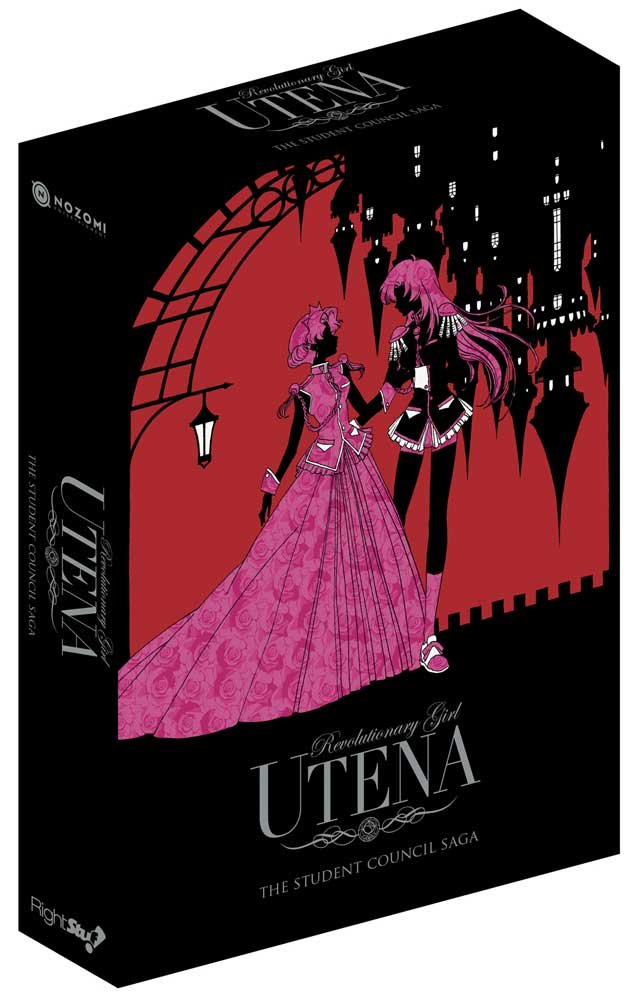
Revolutionary Girl Utena: Student Council Saga Limited Edition SetOnce again a Prince steps in to give me a night off! As you may know,  I don’t listen to anime dub tracks. ( And in the case of Revolutionary Girl Utena, with Mitsuishi Kotono, Kawakami Tomoko and Hisakawa Aya in the Japanese voice cast, there is nothing that can convince me to listen to it, sorry.) Luckily, Okazu Superhero and long-time Friend and Supporter of Yuricon, Eric P has gallantly kneeled before us and offered his services as a dub reviewer! Thank you so much Eric!  The floor is all yours…


Before we get started, and so everyone knows, this is a review of the English dub by itself, and not as it is compared to the original Japanese acting (which I have watched). Alright, now let’s get started:

After getting the whole Utena Central Park Media set through a special mailing order for just $100 back in the day, I didn’t know what to expect diving into this series. I watched the first episode subbed for about seven minutes or so, before I decided to start all over and switch to dub. It was not because I disliked the Japanese voice acting. Everything about Utena within those seven minutes—its opening theme song, its animation, artwork, tone, atmosphere, characters—charmed and enchanted me from the get-go. The problem was I felt reading the subtitles distracted me a little too much from taking in the full experience. So the English version was what I watched first, and at the time it worked for me—the mostly low-key acting fitted the story’s weird, surreal tone.

With RightStuf’s re-release I watch the dub again for nostalgia (and for this review), and by now I can acknowledge its flaws. It is a mixed bag, with few weak links sprinkled throughout that gives it a feeling of flucating. It hardly mattered for me the first time since I was so invested in the story and the magic. But for any viewer with high expectations, it could be those weak links that would turn them off and make even the stronger performances sound less strong. The best (worst?) example would be the English voice for Nanami. When talking plainly, she sounds like a spoiled rich girl probably would, but after a short while she comes across too flat in too many moments.

Thankfully the two lead characters, Utena and Anthy, get well-suited English voices. Rachael Lillis as Utena is sufficiently spot-on, and Anthy’s voice by Sharon Becker has a kind of charm to it for me; I always liked how she said “Miss Utena.” There are still points where it seems like the ADR director and the actors were looking at the imagery, interpreting it as vaguely low-key, and were directed accordingly. Unfortunately that does not always work. In the scene where Anthy calls out to Utena during her duel with Miki, the restrained tone just doesn’t fit well at all. Speaking of Miki, while he is not acted badly, his voice still an example of one of those dub voices sounding far older than he’s supposed to be (although , in my opinion, all the characters look like they are in their early 20’s, even though they’re supposed to be 13-15). Fortunately for some, fan-favorite Jury receives a cool-sounding voice. Saionji, the wife-beating creep, sounds suitably creepy, and the shadow-girls sound as mysterious and strange as they come across in the animation. But, without a doubt, the single strongest performance is Toga as voiced by Crispin Freeman, the future veteran of many stellar roles, among them including Alucard from Hellsing and Kyon from Haruhi Suzumiya.

In the end, the dub feels dated, which some may either find oddly charming or off-putting. But, no matter what, the series itself remains as multi-layered and wonderful as it always has been.

It was actually kind of hard determining the final ratings, so here goes…

Ratings:

Overall –  I dance between 6 and 7 on this, so I’ll give it a 6.5

Erica here: Thanks again Eric! Much obliged.


Revolutionary Girl Utena Anime Box Set – Volume 1 Disk 2 (English)

June 9th, 2011

Revolutionary Girl Utena: Student Council Saga Limited Edition SetOne of the most amazing things about Revolutionary Girl Utena is that the heavy-handed symbolism, which was left without specific meaning quite on purpose, can effectively mean anything you want it to mean. As a result, whether you say the series is about adolescence and maturity, or delusion and reality, or hope and despair, or kangaroos and elephants, you are quite correct.

Disk 2 is about all those things. It’s also about one huge whopper of a lie.

This disk begins with the end of Miki’s arc, in which we learn that Kozue’s perspective on Miki’s childhood trauma is quite different – this will remain the case throughout the series. Kozue’s wounds are never Miki’s. And, for the first time, we are able to see the lie in effect…and just how much somebody else’s problem it is for everyone in the series.

This arc is followed by an episode that, based on a short conversation on Twitter, seems to have made quite an impact on fans. As I put it to my wife, in a series full of weirdness, Nanami episodes are profoundly weird. In episodes that include aggressive elephants, Touga boxing a kangaroo and exploding curry and personality switching, the thing that *I* noticed the most was that Miki and Utena have the closest thing to a “normal” conversation that we’ve seen so far in the series, as they discuss Nanami…and even then it’s not all that normal.

And then we move on to Juri. Beautiful, athletic, smart Juri. Juri the jaguar, in whose presence even the teachers quake. Juri, voiced magnificently by Mitsuishi Kotono and who was for many, the first lesbian Yuri character they ever saw in anime. Her episode still wrang me dry. It hurt to watch her so angry – eternally so, as we never really know what will become of her. Hurt, betrayed, too smart to not know what the real problem is. Too angry to not lash out at Utena who does not yet understand that kind of pain. She will, but not yet.

As I watched this disk I realized that the entire series up to this point is predicated upon a single lie. There will be more lies later, but right now – there is one. Saionji and Miki believe – or hope – that it is true. Juri presumes it is a lie, but then Utena defeats her and she will have to lie to herself to continue to presume it is a lie. Touga…well, Touga will come later.

The lie is simple and has already been repeated so many times that probably you don’t think of it as a lie by the second disk.

The lie is…

…that whomever is engaged to the Rose Bride can command her utterly.

Think for a second. When has Anthy ever done *anything* Utena wants her to? She can’t even get Anthy to stop calling her “Utena-sama.” At this point, Anthy isn’t even hiding herself in the lie, because no one around her can see the lie even exists. They all believe or pretend to believe that it is a truth. Anthy simply does whatever best suits the situation to bring about the outcome desired by the End of the World.

Utena’s one real wish for Anthy won’t be expressed for some time to come and it won’t be realized for even longer – so, then, what *does* being engaged to the Rose Bride mean? To find that out, we must keep watching.

I am reminded that Revolutionary Girl Utena did many anime-viewers a harm by being so absurd, so surreal and so amazing – practically Dada-esque in its complex simplicity – that nothing was able to come close for years to some. Maybe, nothing has really come close yet.

True story – I was watching the Utena movie for the first time with a 15 year old who knew nothing of the story. We had rented it from a Japanese video rental store. It was raw. We watched it transfixed and, when the roses began to overflow the dueling ground she turned to me with huge eyes and asked, “This is what anime is all about, isn’t it?” “Yes,” I said. “This is what it is all about.”

Ratings:

Art – 9
Characters – 10
Story – 10
Music – 10
Yuri – 8
Service – 3
Voice acting – 10

Overall – 10

Revolutionary Girl Utena – *this* is what it’s all about.


Revolutionary Girl Utena Anime Box Set – Volume 1 Disk 1 (English)

May 31st, 2011

Slightly more than 10 years ago, anime had already taken over my life. The predominant anime/manga magazine at the time was Animerica which covered what was hot in Japan, and what was starting to trickle over here to the US. At that time, what was hot was a series called Shoujo Kakumei Utena, which was licensed by Central Park Media as Revolutionary Girl Utena. I have great emotional attachment to this series for many reasons. I met some of my best friends in this fandom, CPM was the first company to take Yuricon seriously and was very supportive of us…and it was Utena that I presented at several film festivals, which can arguably be called the beginning of my “career” in Yuri.

When the re-mastered anniversary set of Utena was released in Japan, I expressed skepticism that we’d ever see it, much less at a reasonable price. Thankfully for all of us, I was horribly wrong about that. ^_^ And so here we are, with the remastered Utena, Student Council Arc, in a reasonably priced box set with lovely box design and the extras, both physical and video, from the anniversary set.

Because this series has meant so much to me over the years, I’m fairly sure that nothing I say could even remotely be approached as anything but massively emotional and entirely subjective and I won’t pretend it’s anything else.

If you have never seen the series, you should. If only because it was one of the most unique, genuinely surreal takes on typical magical girl tropes ever. This isn’t deconstruction of the magical girl genre – it represents a wholesale embracing of the most typical elements, with broad nods to its roots in earlier shoujo series. Everything from art to character design can be traced back to something else, but the internal symbolism sets it apart from its predecessors. Just to remind you – the wacky symbolism has no predetermined meaning, is what Ikuhara said to me in an interview. What you think it means, is what it means.

The story, very roughly, is presented as a fairytale. A young girl who was grieving the loss of her parents is “saved” by a Prince and given a token – a ring – that would bring them together once again. So moved by the Prince’s princeliness, the girl was motivated to become a Prince herself. But was that such a good idea? The Shadow Girls (the series’ Greek chorus) ask us.

And we are challenged to answer this question for the entire series. Was it, honestly, a good idea? But we don’t have time to think about it deeply at first, because that girl, Utena, Prince that she is, saves a damsel in distress, ends up having to fight a duel for another damsel, and is drawn into an increasingly bizarre story. As are we.

The duel music is a special thing of its own. When the first notes of “Zettai Unmei Mokushiroku,” the song that accompanies Utena’s transformation scene, started up, I got shivers. I’d forgotten how powerful the music here is. Duel music is an experience, let me tell you. A friend once described the lyrics as a “magical cookbook on acid” and I have to say that I think that sums the lyrics up nicely. Watching this series for the first time in ages, I was instantly sick to death of “The Sunlit Garden” theme all over again, as we all were a decade ago. ^_^

The animation is fantastic – and I notice it has many of the qualities I liked so much in Simoun, with that watercolor look about the backgrounds. The voice cast was top-notch at the time and it stands the test of time – they all still nail their roles.

Which brings me to the…

Scandalous Artbook!

The book included with the box set includes key art designs, essays by the director and other key staff members and…an unattributed essay on shoujo anime and Utena. Within this essay is the unfortunate line “…anomalous breeds of relationships such as homosexuality and incest…” Even as I announced the Yuricon and RightStuf contest to win a copy of the Boxset, someone on Twitter expressed displeasure that RightStuf did not rewrite that line – or at least disclaimer it. In a heated discussion, that person later asked me if I considered it censorship to have changed what they considered to be hate speech.

I thought this conversation important enough to mention here. As you know, freedom of expression is much on mind these days – indeed, every day. So I wanted to make a few points about this essay – and about RightStuf’s rights and responsibilities in relation to it.

Let me first thank the folks at RightStuf, because their reaction was to plainly state they thought that line was ass and that they didn’t agree with it at all.

It’s been many years since we’ve started localizing anime for a western audience and almost universally, fans want the least amount of change possible. TRSI is very good at changing things as little as possible. For the record, yes, if TRSI had rewritten or bowlderized this passage, I would consider it censorship – and I reject utterly the idea that TRSI has the responsibility to change or disclaimer it. They have no responsibility to protect you from having to read an opinion that disagrees with your own.

Now, on to the opinion itself – it may not be your opinion that incest and homosexuality are anomalous forms of relationships, but I think the anime itself presents that opinion. Whether we like it or not, both homosexuality and incest are presented as anomalous concepts – forms of “immature” sexualities. Even the movie, with naked Anthy and Utena street luging down the road kissing, is summarily dismissed by Japanese creators and viewers as not being lesbian – and our insistence that it is lesbian puzzles them. A Japanese viewer at the Tampa LGBT Film Fest said, flat out, that it did not seem lesbian to her, to which I replied that to her it was clearly, obviously, akogare, in which Anthy felt gratefulness and deep admiration for Utena. She nodded strongly at that. I then explained that we don’t *have* an analogous concept to akogare, so it reads lesbian to us.

Aside from whether I agree with that opinion, I think it fair to say that I try not to judge incest as being lesser than any other form of attraction. The commenter who protested was enraged that homosexuality was presented as equivalent to incest. I am not without my specific prejudices, so I won’t blame them for feeling that way, but I don’t agree that they are not, in the context of the anime, anomalous.

Finally, there is the issue of referring to that line as “hate speech.” I’m about to take a plunge that will no doubt come back to bite me in the ass. ^_^ In MY opinion, hate speech is about intent – speech used specifically to insult, intimidate or incite. Calling me a dyke is an insult. Commenting that I’m fucking dyke and should be raped is hate speech, Saying all dykes should die is hate speech. Saying that dykes just need a good man is an (incorrect) opinion. See the difference? The first is meant to offend me. The last is meant to express knowledge and is pretty arguably incorrect, based on personal experience, research and, one hopes, common sense. The middle two are threats and intimidation and are, pretty clearly hate speech. The essay in the artbook is not hate speech. It’s an opinion that can be disagreed with, but it does not intend offense, insult, intimidation or threat. Therefore, I argue that it is not hate speech – it’s just a potentially disagreeable opinion.

In any case, I don’t think TRSI has any responsibility to change that opinion. I did ask them if we knew who had written it. They confirm that the text was presented exactly as it appeared in the Japanese edition and it had no attribution in the original. In other words, it’s it *someone’s* opinion. You are free to disagree with it, of course – certainly I do. However, blaming TRSI for it seems unfair in the extreme. They were doing what we ask them to do – translating things without interfering too much.

Which brings me to the very last issue- there are no honorifics. Other than that, I thought the translation fine and dandy. And, for some reason unknown to myself, the lack of honorifics didn’t bother me this time. No idea why.

As mostly always, I didn’t watch the dub, so if anyone out there wants to review the dub – send it along! We can’t have too many Utena reviews here. ^_^

Ratings:

Art – 9
Characters – 8
Story – 8
Yuri – 4 Utena is Wakaba’s Prince, then Anthy’s
Service – If violence against girls is a hot point for you, then 7. Otherwise, 1

Overall – 8

This was a gateway series for a lot of Yuri fans. It’s weird, it’s distressing, it’s magnificent, it’s wtf. It revolutionized the world. It is definitely worth watching.