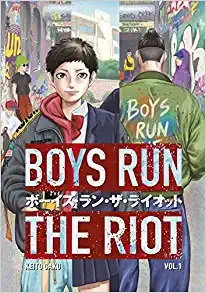
Boys Run the Riot

April 18th, 2021

Ryo has a secret and it is becoming increasingly difficult to keep it under wraps. Ryo is a boy, and yet, here he is forced to wear the girl’s school uniform and suffer from both the indignities of being perceived as a girl and having a female body. Ryo’s escape is to buy boy’s clothes and be the person he is.

When Ryo is discovered by Jin, a classmate who has a reputation as a tough, he assumes the jig is up. Instead, Jin turns out to be someone with a dream of his own, as vaguely formed as it it. Together Jin and Ryo will “create a brand” of clothing together! Ryo struggles with the idea, but eventually adopts it as his own. As Volume 1 of Keito Gaku’s Boys Run the Riot progresses, it becomes apparent that this story will be the story of Jin and Ryo gathering people who are struggling to be who they are, to be part of their brand.

I had a lot of feelings as I read this volume. I’m not unfamiliar with gender dysphoria – about clothes, particularly, and Ryo’s struggle with the girl’s uniform brought back a lot of unhappy memories for me. As a result, I found him sympathetic, but also found him very annoying and immature which…well, yes. For a long while here, Ryo is not likeable, lashing out at everyone and everything. His fear is wholly understandable, and when at last he lets Jin in, the change is remarkable.

But here, in one panel, is what 100% sold me on this series. During a photoshoot for their brand, Jin is hamming it up for  the camera. Ryo asks, “Don’t you have any shame?” and Jin responds, “Why would I?”
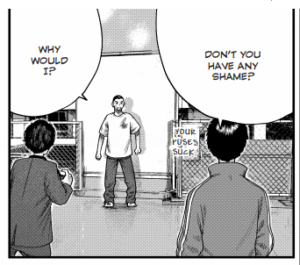

BOOM. That is your lesson, right there.

We’re not stupid, of course – shame can absolutely be something other people create for us. In these first pages, however, shame is what we make for ourselves, by fearing to be ourselves. And that, my friends is the lesson I have spent a lifetime teaching people. Why should you be ashamed? If someone tries to shame you, they are the problem.

Again, we’re not children, we can understand that at least part of Jin’s answer here is cis privilege. But before we get angry at Jin, assuming he’s never been shamed, let’s think about him a little more clearly. He’s a big guy, not good in school, a tough – the kind of kid that school systems are designed to spit out into a life of petty crime and little hope. He’s probably never had a single teacher that even wondered if there was a spark of creativity and intelligence there. He’s probably been shamed. He simply doesn’t care. Why should he? Why should we?

And then Boys Run the Riot finds it’s own legs, as Ryo and Jin shamelessly embrace their creativity and newfound partnership. How Ryo will deal with the rest of his life is, as of yet, a mystery to me. As long as “no shame” is the mantra embraced here, I’m willing to see it through.

The art is both extremely good and extremely ugly in places, which seems like a specific stylistic choice. Ryo’s breakdowns are painful to watch, but as he starts to feel like there is a goal, he grows in strength and clarity. Jin’s long-limbed easy-going enthusiasm is infectious and goofy, but there’s an intensity to him that I expect we’ll explore in later chapters.

An interview at the end of this volume confirms what I assumed – that Gaku-sensei created this story because he wasn’t finding work about, by or for trans men. The notes at the end also say that the entire localization team on this series is trans, which pleased me no end on several points. One, how awesome for us and the team that there are enough trans folks in the industry to have a whole team; how wonderful for the creator and the readership that this book will be treated with the care and sensitivity it deserves – and how awesome that Kodansha put all of that into practice.

Ratings:

Art: 7 Hard for me to like, but it soars in places
Characters: 7 Same, but that, I think, is the story
Story – 7 as a place to begin. If it develops as I hope it might, it has room to grow
Service – Sort of? I’m going to reserve this score until next volume
LGBTQ – 10 but also not. We all know that coming out is a long process

Overall – 8

Thank you very much to Kodansha Manga for the review copy.  You can read the first chapter of Boys Run the Riot for free on Kodansha. Do give it a try. It’s long past time we have a fresh, hopeful look at life as a trans man.

Boys Run the Riot, Volume 1 by Keito Gaku will be available at the end of May on Amazon, RightStuf, and bookstores near you. There does not seem to be an ebook edition of this available at the moment. Volume 2 is slated for a late July release (you can pre-order on Amazon, RightStuf).

Two openly queer media in 3 days here on Okazu. It’s a good week. ^_^ Read this and let me know what you think in the comments!



Yuri Network News – (百合ネットワークニュース) – April 17, 2021

April 17th, 2021

Yuri Manga

We’ve added some new items to the Yuricon Store:

Volume 1 of the Otherside Picnic manga is something I’m really looking forward to. In part because IMHO, they got the UBL creatures in a way the anime just didn’t. We’ll be getting this at the end of the summer.

Neko to Sugar Pot  (猫とシュガーポット) is a short story collection by Yukiko.

Mayu, Matou, Volume 4  (繭、纏う) is up on the store. Check out this awesome photoshoot for the series on Comic Natalie! This series is licensed in English by Yen Press as Cocoon, Entwined.

YNN Correspondent David Mankins and a few others spotted the exciting news that Ameco Kaeruda’s Sexiled Light Novel series has a new manga starting up in Japan on Webry. Check out Onna Dakara (女だから)’s first chapter online in Japanese now!

YNN Correspondent Laurent Lignon wants us to know that their favorite Yuri manga, Yoru to Umi (夜と海) is getting a third volume. You can find Volume 1 and Volume 2 on the Yuricon Store and we’ll get V3 up shortly. ^_^

Also on the to-go-up pile are two series from Comic Ruelle & Comic Jardin – Sal Jiang’s Black & White (白と黒~Black&White~) and sono. N’s SHWD, both of which are getting collected volumes as part of the magazine’s Yuri Fair. ^_^

Ohi Pikachi has announced the fourth and final volume of Hayama-sensei to Terano-sensei ha Tsukiatteriru (羽山先生と寺野先生は付き合っている) which is released in English as Our Teachers Are Dating! by Seven Seas.


Anime News

ANN’s Egan Loo has the trailer and details on the Kaegki Shoujo! anime. It looks lovely.

Paul Chapman on Crunchyroll News brings us a magical transformation from Blue Reflection Ray.

Alex Mateo on ANN  has the preview of the new movie from Revue Starlight (劇場版 少女☆歌劇 レヴュースタァライト)!

By request from the newest member of our Okazu family, the  Kashimashi Girl Meets Girl Collection Blu-Ray has been added to the Yuricon Store!


We’re only a handful of patrons away from being able to give Okazu writers another raise, the second this year – and being able to support another queer creator directly!  Your support makes a huge difference. Three more $5/month patrons and we can do that much more.

Help us support our Yuri ecosystem – become an Okazu Patron today!


LGBTQ Media News

This week Netflix premiered Ride or Die, the live-action adaptation of Nakamura Ching’s Yuri manga GUNJO. There’s been a fair amount of press, positive and negative. Here are a couple of pieces I think are worth reading:

Max Gao’s NBC article Stars of Netflix’s lesbian thriller ‘Ride or Die’ on their on- and off-screen connection was well worth your time.

I had no qualms with David Erlich’s impression in A Sexually Charged Friendship Turns Murderous in a Refreshing New Japanese Netflix Drama for IndieWire.

A fan Twitter account for the actress who played Rei, Mizuhara Kiko, has translations of some of the star’s interviews from Japanese and links to the originals.  Culture  and style magazine CREA also has an interview with Mizuhara-san.

I dropped a short review yesterday on Okazu, I’ll have a more detailed one for ANN coming up.

Seven Seas announced Volume 3 of Love Me For Who I Am, which hit shelves this week.

Kodansha’s offered up a cover reveal and launch date for Gaku Keito’s manga about a trans boy, Boys Run the Riot. I’ll have a review of this for tomorrow, I hope you’ll look forward to it!

Via YNN Correspondent Megan, Crunchyroll is losing Wandering Son, Takako Shimura’s anime about transgender tweens, so if you want to watch or rewatch, you have until April 21st.


Events

Via YNN Correspondent Mariko S, Tokyo House Party is doing Mahou Shoujo Month of virtual events with, “A History of Magical Girls and Feminism in Japanese Art,” on April 24.

Reminder that My Lesbian Experience With Loneliness creator Nagata Kabi will be a featured guest at the all-virtual Toronto Comic Arts Festival,  May 8-15, , so don’t miss that!


Other News

Kyoto Tower is running a Godzilla vs Kyoto event this summer, which I am including here because I really like the poster by Nakamura Yusuke. ^_^

I have to end this week with this hilarious skit from Saturday Night Live, Lesbian Period Drama. Thanks to all the YNN Correspondents who sent it it in. The wife and I watched it through a bunch of times as soon as it hit the Internet. ^_^ Carey Mulligan was an added bonus. If you haven’t yet seen it, put down that drink first.


Become a YNN Correspondent:  Contact Us with any Yuri-related news you want to share and be part of the Yuri Network. ^_^

Thanks to our Okazu Patrons who make the YNN weekly report possible! Support us on Patreon to help us give Guest Reviewers a raise and to help us support the Yuri ecosystem!


Ride or Die on Netflix

April 16th, 2021

Ride or Die on NetflixIf you are a regular reader here at Okazu, you know that I have loved the darkly violent Yuri manga GUNJO from the day I received a message about it on Japanese social platform Mixi, back in 2008ish. I’ve written reviews of various chapters I read in Morning Two magazine and all three of the volumes in Japanese in my GUNJO category here on Okazu.  In 2018, I was able to meet with Nakamura-sensei (over what was possibly one of the hilariously worst lunches I can remember. This was supposed to be a BLT. It was inedible.) At the time, we worked out how we might do a translation for GUNJO into English. And she mentioned that she was in talks about a live-action adaptation.

Translator Erin Subramanian and I have completed the translation for Volume 1 of GUNJO, into English, which is purchasable by the chapter on Nakamura-sensei’s website. We’re hoping to see a collected Volume 1 on ebook sellers near you one day soon. As we completed Volume 1, the pandemic hit and the project was paused. Today’s review was, in large part, why it paused. Last night Netflix released Ride or Die, the live-action movie based on the manga by Nakamura Ching.  Ride or Die, directed by Hiroki Ryuuichi, is not GUNJO. It is, however, within spitting distance of it.

Like GUNJO, (I ended up using this spelling when Morning Two magazine chose it over Gunjō, so forgive me) Ride or Die contains graphic violence and marital abuse. Unlike the manga, the movie also contains several explicit sex scenes, both straight and lesbian. If any of this makes you feel uncomfortable, you may well want to give this movie a pass. Interestingly, for the lesbian sex scene at the end of the movie, the staff brought in an “intimacy coordinator,” which Max Gao writes about in his article on NBC, Stars of Netflix’s lesbian thriller ‘Ride or Die’ on their on- and off-screen connection. This intimacy does change the end of the story considerably, but whether you think it works better or worse will be an entirely personal decision. In my opinion the end of the manga is very hard to beat for perfection. ^_^

Another change from the manga is that the characters – who remained nameless and were referred to as “Megane-san” and “Lesbian-san” by Japanese fandom – here are named. They get to share moments of genuine joy in this movie, which was probably the most disconcerting change for me. I don’t think it was a bad change, it merely signaled that we would not get that manga ending. Overall, I think both Sato Honami as the abused Nanae and Mizuhara Kiko as Rei, the woman who loves her enough to kill for her, did an excellent job. There were moments when Sato looked so like Megane-san that it was quite extraordinary and I found myself commenting on it every time.

As you may remember in my other movie reviews, I dislike the slowdown of pacing that seems to be to be a common occurrence in Japanese live-action manga adaptations. In the case of Ride or Die, it was the sex scenes that I felt went on too long, and the movie would have benefited from them being cut slightly. But this was pretty much my only complaint. This, I think, came from the choice of director whose career began in pink films and whose body of work tends to favor graphic sex and violence. 

Some of you may wonder about the title, Ride or Die, which I’m sure many of us see as an already tired trope. Nakamura-sensei mentioned that the title change was something she approved of and I’m inclined to agree. It allows us to view the movie as something separate from the manga…but also to see this is a subversion of the trope itself. This is not a “ride or die” scenario in the most typical sense. The characters are, yes, being followed by the police, but not hot on their heels. There’s just no urgency as they wander randomly through their lives together until they and we have all the pieces.

Ratings:

Cinematography – 9
Story – 9
Characters – Portrayed beautifully, so 9 but they are sometimes deeply unlikable
Service – 10
Lesbian – 10

Overall – 9

I’ll watch it again, for sure. If you get a chance to watch it, let us know what you think in the comments!



Sora-iro Melancholic, Volume 1 (空色メランコリック )

April 15th, 2021

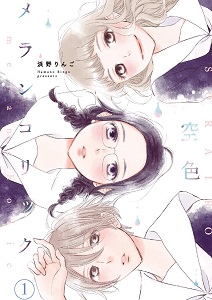
Fumino, known to her friends as Bun-chan, is really irritated by that cool, mischievous Kiko-sempai. For on thing, she’s pretty sure that, while her best friend Mahiro really likes Kiko-sempai, things will go badly and Mahiro will be hurt.

Hamano Ringo’s Sora-iro Melancholic, Volume 1 (空色メランコリック ) is the fist volume of this series that runs in Galette magazine.

When Mahiro loses something that Kiko-sempai gave her and Bun-chan finds it, she pretends she knows nothing about it, until something snaps and she gives it back. Even then she isn’t entirelyhonest about it. There is something about Kiko-sempai that just annoys the daylights out of Bun, although we’re able to put our finger on it pretty quickly. Kiko-sempai also seems to be aware of it. Bun-chan is jealous of Mahiro and of Kiko-sempai.  And Kiko knows it. Initially it looks like Bun-chan is jealous that Mahiro is thinking about Kiko so much, but maybe that’s not the problem.

When club activities forced her to go out shopping for materials with Kiko, the older girl confronts Bun-chan by kissing her, thereby making her confront the way she feels about the older girl. As the volume comes to a close, Mahiro can see that something has happened between Kiko-sempai and Bun-chan, and, maybe, she too, can guess.

This series is ongoing in Galette magazine, and the characters have changed considerably from these early chapters. In a later chapter, too, Bun-chan will have a very edifying conversation with an adult who also fell in love with a girl during her school years. I look forward to that being collected up. I like Hamano-sensei’s sketchy art style, and while these early chapters seem very typical Yuri, one can feel a depth that this part of the story barely touches upon.

Ratings:

Art – 7
Story – 7
Characters – 8
Yuri – 7
Service  – 0

Overall – 7

The cover design is lovely – what you can’t see in the picture here is the lustrous pearly quality of the book cover. In fact that’s probably how I think of this series – a pearl seed, still developing. We’re waiting to see what kind of gem we’ll have at the end of it all.


Mamoru Oshii’s Vlad Love, Guest Review by Megan

April 14th, 2021

Welcome to another Guest Review Wednesday on Okazu! I’m ecstatic to be welcoming back Guest Reviewer Megan who is once again here to talk to us about Mamoru Oshii’s “girl-meets-girl” anime. Please give her your best Okazu welcome. Take it away Megan!

Vlad Love, director Oshii Mamoru’s return to TV anime 40 years after Urusei, is now streaming in full on Crunchyroll. How did this bizarre passion project work out in the end? 

In the first review for episode 1, vampire girl Mai met blood-donation maniac girl Mitsugu, and we were also introduced to voluptuous school nurse Chihiro. In the next few episodes we’re introduced to Mai’s powers and an eclectic cast of characters interested in Mai, from cosplay club captain Kaoru who wants to dress Mai up, to killjoy student council president Jinko. The cast ends up forming a blood donation club and the rest of the series is episodic scenarios like a school play or a short film by Cinema club captain Maki. 

Vlad Love hits its stride when it combines this bunch of personalities with a suitably absurd scenario, and happily the show swings more often than it misses. The show may have been marketed as a slapstick comedy, but there’s other sorts of comedy beyond just that on offer here, from acerbic wit to non-sequitur Oshii references to obscure old films and much else besides. Some of my favourite moments were when the show toned down the zaniness more than I expected, like episode 7 which seemed relatively low-key by Vlad Love’s standards – until it was all recontextualised when you see the payoff – or in truth lack much of – in the short film itself. Episode 8, a joke that could have felt played out before it even got off the ground, is carried by Park Romi’s performance and Mizuno Uta’s wonderful classic shoujo-style art. 

Another highlight is episode 6’s Castlevania parody, which as a longtime gaming nerd and ‘vania fan already seemed designed for me, but still got a lot of things right up to the questionable mechanic of hearts powering sub-weapons. Oshii and co. evidently did some research, and while there isn’t exactly particularly deep cuts of vampire lore here, I couldn’t help but smile at moments like the reveal of Mitsugu’s dad’s identity. 

The show doesn’t win every time though. The first half of episode 4, for example, gets oddly uncomfortable as Mitsugu is kidnapped by an all-male ‘torture club’. Other sections, like most of episode 9, failed to land for me because, while I might have been sure a section was referencing some old Japanese or Western media or folklore or such, I didn’t actually know what the reference was to. This also isn’t a show interested in much in the way of character development – the supporting cast is essentially one-dimensional and the characters don’t change much over the course of the show. This isn’t as deep a flaw as it might otherwise be since the show is expressly a comedy, but some more development for the mains would have been welcome. 

Another instance of a lack of development is the show’s Yuri. As we saw in the first review, ep 1 was focused on establishing Mitsugu and Mai’s relationship, and ep 2 builds on this a bit further with a moonlight “night flight of love” for the girls. The next few episodes mainly focus on the other club members vying for Mai’s attention, and by this point we might share Mitsugu’s frustration that everyone else is monopolising Mai. There’s finally a bit of development in the next episode, 6, as Mitsugu and Mai share a quiet moment complete with piano and a sparkly background. Mitsugu tries to confess, but Jinko intervenes before she can actually get the word Suki out. There’s some moments here and there in the remaining episodes, like Mitsugu comparing the two of them to a married couple, but no real payoff in the finale, which was disappointing. Indeed, the show overall just sort of stops after Mai’s backstory is finally revealed rather than coming to much of a conclusion. 

On the technical side, Vlad Love doesn’t have the most impressive animation compared to some other Winter 2021 anime, but this doesn’t matter much since the art style and animation more or less always fits the comedy in the way it needs to. There’s some nice creative direction touches and of course Mizuno’s lovely art from time to time. The music is fitting too, with a mix of mysterious-sounding and intense tracks, and even some piano pieces for the sad backstories and a romantic moment or two. The vocal performances are also strong across the board – as mentioned, Park Romi steals the show here, but pretty much everyone sounds good, and I liked how several of the girls had quite mature-sounding voices. 

Overall, I had a good deal of fun in my time with Vlad Love. The show didn’t live up to its full potential, especially in how elements like the Yuri and character development ended up feeling rather undercooked, but it does deliver on a combo of retro-style anime comedy and… well, whatever random references Oshii wanted to put in there. As an anime fan for some years now it’s very rare to see an anime that feels quite as much of a passion project, designed without much care to current conventions or what a production committee would find marketable. For this reason as well as the show itself being a good time, despite the flaws I can recommend giving it a go if you don’t find the style of comedy a turnoff. 

Ratings:

Art – 8, not technically impressive but fits the comedy very well. 

Story/Characters – 7, episodic comedy so not much ‘plot’ to speak of, situations and characters are mostly fun, but a few setups that don’t work as well and cast remains quite one-dimensional

Service – 7, quite a bit (Chihiro’s character design is worth a few points alone) but mostly stays on the side of light-hearted rather than leery. 

Yuri – 4, it’s there but only in scattered moments beyond the first two episodes

Overall – 7 

As a bonus for reading to the end – here’s a mini-review of Vlad Love’s series guidebook! It’s quite a bulky volume (the Ikuhara anime guidebooks I own, for example, are usually under 200 pages), but the size is justified by its comprehensiveness – it has just about everything, from key visuals and character designs to key animation and storyboards, galleries of Mizuno’s art to staff interviews at the back. There’s not much particularly revelatory here, though I was amused to find the Chihiro shots covered up by “self censorship” were, in their original form, well… the book is a solid pickup for fans of the show or people interested in the animation process. 

You can find me here on Okazu’s comment section, and my twitter account @AnimeSocMegan. As always, thank you very much for reading and here’s ‘till next time! 

Erica here: Thank you again Megan! I can’t help but notice that the end of episode one was subtly changed in fact to lower the Yuri level, for the CR version. I don’t think he had the interest in going through with it, only to tease it a bit, like so many of the older directors used to.
In my opinion this series suffered from no clear idea at all, really. It was awfully like a story idea thought up over a few beers and then they got some money and had to do something. My feelings about the series are summarized in this movie clip. “He’s a genius.
But I’ll give it this – I watched all of it. ^_^