Taiwan Travelogue: A Novel, by Yáng Shuāngzǐ

December 16th, 2024

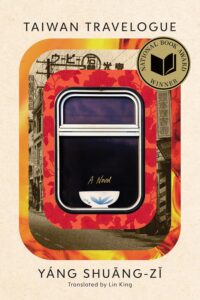
Abstract book cover: In the center is a train window, with a porcelain bowl on the sill. The shape of the window is surrounded by increasing large frames of Chinese textile pattern in red and orange, a faded photo of 1930's Taiwan and a pattern or red, orange and yellow flames on a beige cover.It is 1938. Taiwan has been annexed by Japan as part of their colonialist policies. A young, successful novelist named Aoyama Chizuko is brought to Taiwan to write about the island. She rejects the request to support the political aim, but decides to live with “islanders” to learn more about the place. She is assigned a young woman to be her interpreter and guide, a woman whose Japanese name shares a syllable with her own – Ō Chizuru.

This novel, which begins in a period-appropriate disguise of a rediscovered volume of a lost novel by the famous writer Aoyama Chizuko is so layered, so nuanced and yet so bluntly real, that it is quite possibly the very best book I have ever read.

I am fond of the “third-party, sending the second party a copy of a first-hand document” conceit that we see throughout turn-of-the-20th century British and American literature. It adds a sense of wonder as we read what is meant to be understood as the “real” narrative of an extraordinary occurrence.

In Taiwan Travelogue: A Novel, by Yáng Shuāngzǐ, this sense is added to the many layers of language, social and political framing to create what the author refers to, in her final note as ” a piece of amber, one that coagulates both the ‘real’ past and the ‘made-up’ ideals.”

The layers in this novel include the sociopolitical landscape of Taiwan in 1938, but is most deeply reflected in the languages that make up this novel. Meant to be understood as a English translation of a Chinese translation of a Japanese work about Taiwan, the complexities of Taiwanese Mandarin and Hokkien, subsumed by Japanese – and what those all represent to the characters – takes up a lot of real estate in the novel proper. The “translation notes” by Yáng who presents herself as the Chinese translator of this Japanese-language novel, a novel she in reality wrote originally in Chinese, and which has been masterfully translated into English by Lin King, whose translator notes sit astride the back of Yáng’s “notes,” but are the actual translator’s notes, adds a mind-blowing other layer into the fictional “history” of this novel.

Above all this, is a deep love of food. Food is even more the vehicle by which Aoyama and Chizuru travel the island than the actual transportation they ride. Food, hotels, houses, schools, all evoke a specific place and time and mood here. Seasonal food is a sign of the passing of time as it has been for centuries before refrigeration and overseas shipping changed how we eat.

Yáng herself is a popular contemporary Bǎihé author, and this is a story about the intense emotional relationship between two women. Is it a love story? I think that question could be asked and answered in several different ways. No..and yes…and no again. There is genuine affection, and a seething cauldron of other emotions to draw from. I’m being very circumspect here so as to not spoil anything because if you cannot yourself understand the emotions here, they will, eventually be explained.The setting also allows for a secondary, more typical girls’ school “S” type story as a subplot that ties into the larger plot in potentially surprising ways. Again, layers within layers.

There are strong echoes of Yoshiya Nobuko in Aoyama Chizuru. And although Aoyama, unlike Yoshiya, rejects becoming part of Japan’s imperial propaganda machine, Yáng is careful to note in her Introduction that we need to be mindful at all times that Aoyama is a representative of a colonizing force. Indeed, it was nearly impossible for this reader to not be mindful of this – certainly every Taiwanese reader would have been. This simple fact – and the awareness of this – is the black hole at the center of the story, putting out so much unseen energy, and sucking in all things into it’s gravitational pull.

With all these layers, if you take to heart Yáng’s caution in the Introduction, the rest of the book is not a puzzle to be solved, however. It is simply a beautifully written love story to food, a sad tale of two women, and a coldly furious polemic against colonization. In the end, this is truly one of the finest works I have ever read in my entire bibliomaniac life. I sincerely hope that every reader of Okazu gives this book a try.

Ratings:

Overall 10/10

It is an outstanding bit of writing by Yáng Shuāngzǐ and an extraordinary work of translation by Lin King. Absolutely deserving of the 2024 National Book Award for Translated Work. 

Taiwan Travelogue is available now from Graywolf Press.



Yuri Network News – (百合ネットワークニュース) – December 14, 2024

December 14th, 2024

In blue silhouette, two women face each other. One wears a fedora and male-styled attire, one is in a dress and heels. Their body language is obscure - they may be dancing, or laughing or fighting. Art by Mari Kurisato for Okazu

Yuri Light Novel

inori.-sensei has announced a new light novel! Homonculus no Namida: Kieta Kimi no Renkinjutsu (ホムンクルスの涙 ~消えたいキミへの錬金術~). This will be simultaneously published in Japanese and English as Homunculus Tears: Alchemy for the Brokenhearted through Amazon KDP, in Spanish from Sekai Edition and in German by Dokico, with illustrations by Aonoshimo-sensei.

The Executioner and Her Way of Life by Mato Sato is slated to come to a completion in March 2025 with volume 11. Rafael Antonio Pineda has the details on ANN.


Yuri Games and VNs

There have been a record-breaking number of entries for the 2024 Yuri Game Jam. The counter currently says 110 submissions! We’ll have a review of a few that our writer really liked coming up soon. As I read my feed, I discovered one of them is Three Peach Hill, by m ebel, about a fox-girl and the woman who woos her.

The creators of  Kyuuketsuki no Hanayaome  – Vampdoll no Hanayome The Novel Game  (吸血鬼の花嫁 ヴァンプドールのはなよめ The Novel Game) took to X to ask folks to wishlist their game on Steam.


Help us pay our Staff and Guest writers competitive wages –
Become an Okazu Patron today!


Yuri Manga

ANN’s Joanna Cayanan want you to know that Assorted Entanglements by Mikanuji is set to conclude with a solid ten volumes.

I forgot to mark down the source for this, hopefully someone will help me out and remind me. Another Yuri series that is struggling in Japan has been identified as Kimi no Tame no Curtain Call (君のためのカーテンコール) by Satoru Shiho, with art by Shigeta Megumi. This appears to be an odd-couple style high school romance.

Galette Web noted on X that the English-language Galette Magazine, Volume 1  has shipped to kickstarter backers! A few folks have received theirs already. I’ll certainly report in when I get mine. ^_^ Supporters for Galette through Galette Fan Club will also receive a digital copy of the magazine in English.

Hanakage Alt has also stated that all of the Sempai no Kouhai Yuri manga kickstarter signed books have been sent out.

Akiyama Haru provided a 14-page sample of her new book Watashi no Blue Garnet (私のブルーガーネット), Volume 1, on X. Volume 1 is out now in Japan.

Light novel Doushi Shoujo yo, Teki o Ute (同志少女よ、敵を撃て) the story of a girl left orphaned by the war and the passionate conflict she wages with her Russian military instructor, Irina, is now a manga.

And from Comic OGYAAA! on X, Koi Yori Aoku, Volume 3‘s (恋より青く) release is being celebrated with a cute acrylic standee of the principles, Takamine and Sakakura.


Support Yuri journalism on Ko-fi!


Anime News

See You Tomorrow At The Food Court manga is getting an anime adaptation. Crystalynn Hodgkins has the details on ANN.

Discotek announced the release of the original Cutie Honey anime series. It’s not really Yuri, but it sets up a decades long ship that will never go away. ^_^

Somi, a company known for their vinegar, is partnering with The Rose of Versailles movie to…um, sell vinegar! They are running a contest with a possible prize of a trip to France.

I still doubt that this is at all Yuri, or even Yuri-ish, but Momentary Lily is slated for a January streaming start on Crunchyroll, according to ANN’s Alex Mateo.


Other News

Manga Erotics F, which has been out of print for ten years, is launching an online presence. This was the magazine in which Shimura Takako’s Aoi Hana/ Sweet Blue Flowers ran. Anita Tai has the news at ANN.

Good news for researchers needing access to Japanese art and imagines. NCC Japan now has a image use protocol and form for gaining access to images for reseaarch. These probably do not include much manga, but this is a good resource to bookmark.

Via Senior YNN Correspondent Sean Gaffney, ZeroReq011 note the power of Cute Girls Doing Cute Things Cutely (often abbreviated on the Okazu discord as CGDCTC ^_^) in Not Your Average Anime about Cute Girls Doing Cute Things on ANN.


If you’d like to support Yuri journalism and research, Patreon and Ko-Fi are where we currently accept subscriptions and tips.  Our goal now, into 2024, is to raise our guest writers’ wages to above industry standard, which are too low!

Your support goes straight to paying for Guest Reviews, folks helping with videos, site maintenance, managing the Yuricon Store and directly supporting other Yuri creators. Just $5/month makes a huge impact! Become part of the Okazu family!

Become a part of the Yuri Network, by being a YNN Correspondent: Contact Us with any Yuri-related news you want to share with us.


Maitsuki Niwatsuki Ooyatsuki – Monthly With Ooya, Volume 5 (毎月庭つき大家つき)

December 12th, 2024

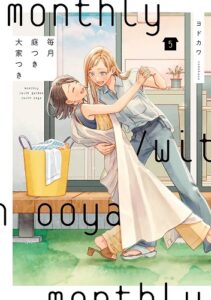
Two woman laugh as they dance. A woman in jeans and button down shirt dips a woman in a casual outfit wrapped in a cloth in front of a basket of laundry.In Volume 4, Asako and Miyako move ever closer. Asako takes Miyako to visit her parents and it’s charming and heart-warming. The pair address Asako’s issues around her birthday and other “learning to be a partner to you” kind of things.

So, when we reach Maitsuki Niwatsuki Ooyatsuki – Monthly With Ooya, Volume 5 (毎月庭つき大家つき) the final volume of Yodokawa’s slice-of-adult-life story, what is there left to cover? Well, the initial premise provides us a chunky plot complication.

You will recall that landlord Miyako was, not too long ago, a lead singer with a popular idol group, Elm. Over the New Year holiday, Miyako and the members of Elm spend some time together…and are seen by paparazzi. Immediately, a rumor pops up that Miyako will return to Elm and take over once again. Miyako, having walked away from that life forever, is in distress and Asako isn’t really able to help.

Once again, this manga pulls out a resolution so elegant, so adult and so thoughtful that it is a tremendous pleasure to read what happens, and the consequences of the decisions made. Honestly fantastic. Fandom is shown as not being as fickle as tabloid press, which rushes to judgement, but there is a undercurrent of “this could go very dark.” Luckily, Yodokawa is not drawing that kind of series. Instead we get more instances of women supporting one another and a new relationship in which the partners are there for one another. Just what I needed to read this week.

My favorite panel is one that made me laugh out loud, very loudly, as Asako and her manga artist friend (and ride-or-die Elm fangirl,) Hatomori both react to the “breaking news” that Elm’s leader Miyako is now – gasp! –  a landlord! Fabulous art, and you can just *hear* them both saying “Oh, wow, who knew” in as flat and sarcastic a tone as one can get.

I have enjoyed every volume of this series, and while some part of me wises it did not have to end, I’m thrilled that it ended so well. I am also thrilled that you are able to read Monthly In The Garden With My Landlord, Volumes 1-3 in English from Yen Press now and Volume 4 will be on the way next spring.

Ratings:

Art – 9
Story – 10
Character – 10
Service – 0
Yuri – 10

Overall – 10

This story was never about the destination, but about the journey. And the journey has always been filled with friendship and emotional support.


Jeongnyeon: The Star Is Born

December 11th, 2024

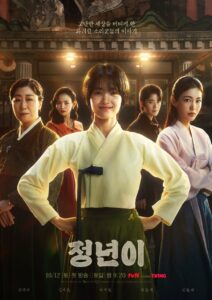
Promotional poster for the Korean drama series Jeongnyeon: The Star Is Born, featuring Kim Tae-ri (center) as Jeongnyeon. Other characters (from left to right) are the director Kang So-bok, the current prince and princess Seo Hye-rang and Moon Ok-gyeong, and Jeongnyeon’s rival Heo Yeong-seo.by Frank Hecker, Staff Writer

The Takarazuka Revue has inspired several manga and anime. Now comes Jeongnyeon: The Star Is Born, a Korean drama (currently streaming on Hulu and Disney+) that features an analogous 1950s-era all-female gukgeuk troupe performing plays based on classic Korean tales and featuring songs sung in the traditional pansori style. Jeongnyeon the series features Yoon Jeongnyeon the performer (played by Kim Tae-ri), a natural-born pansori genius who goes from working as a fishmonger to joining the Maeran Theater Company as a trainee and competing to become its new “prince.”

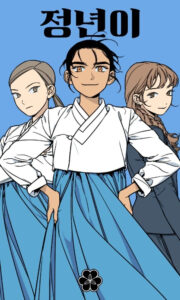
If you’ve heard about Jeongnyeon at all, you’ve likely heard that it’s based on a yuri webcomic of the same name, and that the explicit yuri elements were erased in the live-action adaptation. This is true: in the webcomic Jeongnyeon has a girlfriend, Kwon Bu-yong (the rightmost figure in the webcomic image below), who starts out as a fan of Maeran. There’s also a side character who was disrespected as a woman and decided to henceforth live life as a man. Neither are present in the TV series.

Nevertheless, Jeongnyeon is still of interest to yuri fans who enjoy dramas about the theater in general and all-female theatrical troupes in particular. And there is plenty of drama to be had: Jeongnyeon finds her quest to become a top star impeded by the violent opposition of her mother Seo Yong-re (Moon So-ri), who has a mysterious past and a hidden connection to Maeran’s imperious director Kang So-bok (Ra Mi-ran). She also finds herself beset by bullies, incurring the wrath of director Kang for various offenses, and enmeshed in a triangle of sorts with her rival would-be prince Heo Yeong-seo (Shin Ye-eun) and their would-be princess Hong Joo-ran (Woo Da-vi). Meanwhile, scandals past and present threaten the positions of current prince Moon Ok-gyeong (Jung Eun-chae) and her princess Seo Hye-rang (Kim Yoon-hye), and the future of Maeran and indeed gukgeuk as a whole hangs in the balance.

Promotional image for the webcomic Jeongnyeon, showing Yoon Jeongnyeon (center) and Heo Yeong-seo (left) in the trainee uniforms of white blouse and long blue skirts, and Kwon Bu-yong (right) in her own dark-blue uniform.The yuri elements discarded in the transition to screen reappear elsewhere as subtext: Ok-gyeong has the transmasc aura of the previous side character and with Hye-rang forms the troupe’s resident couple: They live in the same house, are casually affectionate with one another, and are even raising a young girl together. With Bu-yong absent, the show’s focus is solely on the Maeran trainees, and Joo-ran becomes a (very) thinly-veiled love interest for Jeongnyeong. Finally, in a rare example of heterosexual erasure, Yeong-seo loses the boyfriend she had in the webcomic and is free to devote her attentions to Jeongnyeon and Joo-ran. Almost all the remaining men have only minor roles or function as obstacles to the core group of women; the only other men featured, Jeongnyeon’s father and grandfather, are dead as her story begins.

As a show considered on its own merits, Jeongnyeon has a uniformly excellent cast, high production values, and a compelling if often bittersweet plot. Kim Tae-ri, who first came to fame starring in the Korean lesbian drama The Handmaiden, studied pansori for multiple years in preparation for the part, and it shows. I thought she played the role of Jeongnyeon a bit too broadly in some early episodes, but otherwise she’s completely convincing. Shin Ye-eun takes a common trope—the hard-working performer who’s overshadowed by an untutored genius—and makes Yeong-seo a complex and compelling rival to Jeongnyeon. Finally, Woo Da-vi is unjustly neglected in the show’s promotional materials, but her character is the emotional heart of the series. Joo-ran’s scenes with Jeongnyeon are some of the show’s most affecting, and certainly the most romantic.

As a story, Jeongnyeon harks back to Hana Monogatari and other “S” fictions, in which young women have relationships of “passionate friendship” (and sometimes more than friendship) with other young women, relationships ended by adulthood and (typically arranged) marriages. Gukgeuk itself lost its mass audience to television and its elite audience to Western opera (exemplified by Yeong-seo’s mother, a famous soprano who looks down on Yeong-seo’s chosen career). So, even if other events didn’t intrude, the time the characters would have with each other would be fleeting.

As a production, Jeongnyeon was created in a modern society marked by often violent misogyny and homophobia, and can be seen as a response to that. The series was written and directed by women, and its main cast are all women. The women in Jeongnyeon start and staff their own troupes and put on their own theatrical productions. They claim for themselves ownership of stories that are classics of Korean culture and sing in a style originally pioneered by men, a style that in its frequent harshness is the very opposite of the ultra-feminine stylings of the stereotypical present-day idol.

While yuri fans have bemoaned the changes made in the transition from webcomic to live-action, the mainstream South Korean audience has taken this example of “quiet feminism” to heart and propelled the show to high ratings and the number 1 position in its time slots. If Jeongnyeon: The Star Is Born is anywhere near as popular outside South Korea—as it deserves to be—perhaps one day there’ll be an official English release of the webcomic, and we can experience the story of Jeongnyeon as it was originally conceived.

Ratings:

Story — 7 (a bit too much coincidence in the initial setup, and a somewhat flat ending)
Characters — 9 (complex characters vividly brought to life)
Production — 9 (impressive recreations of multiple theatrical productions)
Service — 1 (Ok-gyeong in a suit and fedora counts, I think)
Yuri — 5 (the subtext is strong with this one)

Overall — 8 (a kiss apparently left on the cutting-room floor might have made this a 9)

Yuri fans who can look past the (self-)censorship of a canon yuri story will find an entertaining and emotionally resonant drama elevated by standout performances by Kim Tae-ri and the other leads, along with splendid recreations of classic gukgeuk performances.

Note: If you want to further explore the real-life history of all-female theater in Korea, see Ha Ju-yong, “Female Masculinity and Cultural Symbolism: A History of Yeoseong gukgeuk, the All-Female Cast Theatrical Genre,” The Review of Korean Studies 24, no. 2 (December 2021), 107-144, doi: 10.25024/review.2021.24.2.107. This open-access article has a wealth of detail, including promotional posters and ads, photographs of performers, and even example sheet music for one of the songs.


Lycoris Recoil, Volume 1

December 8th, 2024

In two vertical panels, we see two girls in similar Japanese school uniforms. One, a blonde with a red bow in her hair, wears a red uniform, with grey skirt. The other a girl with long black hair, wear blue with a grey skirt. Both hold guns.Lycoris Recoil is the story of two young women, both contract killers, who have been burned by the organization that uses them as tools. One of them has secrets she cannot share and a mysterious past, one has very little memory at all. As they work together, they will see in each other something important for themselves, and will protect one another – even against the people that made them the perfect instruments of death that they are.

Oh, sorry. That’s Noir, isn’t it?

Well…it is also Lycoris Recoil, Volume 1. We meet Takina, who is clearly too good for the organization who uses her, DA, to control. So they exile her to a cafe front for their best and least-controllable agent, Chisato. Togther, they will serve coffee – here it would be great to say “and justice,” but that is not what it is – and do jobs for DA and whomever they serve.

It’s no accident that Lycoris Recoil is similar to Noir. It’s a winning formula, after all. Fans are always willing to pencil in the details that they think ought to be there, when they are give a general storyline – girls with guns, in this case, sort of on the run, is a broad, but popular, concept. Yuri fandom is, of course, happy to equate intimacy with romantic interest, even if the series itself does not commit, e.g. Noir. ^_^

To continue the comparison, where Noir gave us a “beloved Mirielle” that was instantly downplayed by Bee Train. Lycoris Recoil gave us a Chisato willing to put herself on the line to save Takina, and a dream sequence in the novel in which Takina literally awakens to her feelings. No actual relationship, just intimation of intimacy. Which is why when I noted on the Internets that I do not think of them as a couple, a lot of fans took that very personally. I could certainly see that they might one day become a couple, but as the series ended they are partners probably on the run for all eternity. You know, like Noir.

I’ll stop now. ^_^

Volume 1 cleaves pretty closely to the anime, but fills in enough info that if you haven’t seen the anime, you can follow the manga easily.  (Except the obvious, and never-answered questions about the existence and functioning of DA, but we just have to accept that it is.) There is a lot of action, and the art by Yasunori Bizen really holds up to those scenes.

If you are a fan of the anime, this is a fun way to relive the story that got you hooked the first time. The translation by Kiki Pitkowska is solid and where Adnazeer Macalangcom could replace the s/fx, they did, which I always think adds readability to a manga.

It’ll make a nice gift for that friend who love cute girls with guns, for sure.

Ratings:

Art – 9
Story – It’s all plot to drive action. In that, it succeeds 8
Character – 8 Except, Mizuki being a drunk is still not funny
Service – 3 Chisato in underwear because
Yuri – 0

Overall – 8

Thanks very much to Yen press for the review copy!