GIRL FRIENDS Contest Reminder

March 8th, 2013

In February, I reviewed Morinaga Milk’s GIRL FRIENDS, The Complete Collection, Volume 1 and I announced a contest –

To enter to win a complete set of this delightful Yuri romance by Morinaga Milk, in the comments write a message of encouragement and hope to a young LGBT person who isn’t sure about their self or feelings right now – or even a message to your younger self. Please include your name,  – if you plan on being Anon, please give yourself a nickname so I can let the winner know they’ve won.

I’ll be reviewing Volume 2 very shortly, so get your messages in (to enter, please use the comments on the review of Volume 1) and be entered to win both volumes of the Complete Set.  Good luck! ^_^


Light Novel: Book Girl and the Undine Who Bore a Moonflower (English)

March 7th, 2013

BookGirlv6In 2011, I reviewed a Light Novel, Book Girl and the Famished Spirit. In that review, I noted that there was a character who had all the signs of being a classic anime/manga lesbian. Attractive, smart, accomplished and far more mature than the characters around her, Maki was a perfect candidate for the “Yuri” character. Her apparent obsession with Tohko, the Book Girl of the title, clinched the deal for me.

In the first volumes of the series, Maki is a peripheral character, half deus ex machina, half Mephistopheles. And while she appears from time to time just enough to torment Tohko, her existence has not been a major presence. Until now.

Book Girl and the Undine Who Bore a Moonflower revolves around Maki, her family history and a curse and a duty that she bears and would very much like to be rid of.

As in the other Book Girl books, we are introduced to the “book” around which the entire narrative is built, given the true history behind the relationship of that book to the story and a new, alternate ending to the historical narrative and the current matter at hand. If that sounds a little complicated, it’s only because it is – and that is exactly why it’s worth reading the series.  The lead character is a bit of a carp, but he and everyone around him are fleshed out to a considerable extent in these first 6 volumes.

Which is both good and bad. One hopes that the characters do what we want them to do, rather than what they do do. For us, that would mean Tohko letting her apparent tsundere facade drop and allowing Maki to paint her nude, a meeting of hearts and minds, followed by… Yeah, but that’s not happening here. ^_^;

Once again, I agree with the age rating on the back. There’s some adult concepts, themes and scenes that I could have handled at 11,  but your mileage – or the mileage of a YA you’re giving the book to –  may vary.

Ratings:

Art – 6 I wish the pictures were of scenes I wanted illustrated
Story – 8
Characters – 8
Yuri – 1
Fanservice – 4, for the ultra-coy way the end was presented

Overall – 8

If you don’t mind that Maki is not really a lesbian, but she may be bisexual, that Tohko reads a lot, but doesn’t learn much about human nature, and that Inoue is more naive than anyone ought to be at his age, this series is well worth your time for the sheer love of books and storytelling in which it revels.


Yuri Manga: Pure Yuri Anthology, Hirari (ピュア百合アンソロジーひらり) Volume 9

March 5th, 2013

hirari9Pure Yuri Anthology, Hirari  Volume 9 (ピュア百合アンソロジーひらり) pulls out the big guns right from the start. Opening with a Morinaga Milk story about a bad choice that goes good,  using the setup of popular, athletic girl gets together with nice girl, it segues beautifully into Takashima Hiromi’s continuing series about Kase and Yamada, another athletic, popular girl and nice girl couple.

Kita Konno has an interesting little tale of gender, sexuality and acceptance of self, followed by Hakamada Mera’s fantasy of having a good excuse to not have to accept one’s self.

The standout story this issue, however, is set in that typical mythical private girl’s school, with gorgeous, accomplished onee-sama and average underclassmen pining away with admiration. Once again, Morishima Akiko-sensei is the recipient of *my* admiration with this chapter of “Seijun Shoujo Paradigm.”

Lily is still pining after Reika-sama, but Aoi cheers her up with heart-pounding collection of “Yuri” stories. They are all excited when they learn that schoolmate Midori is the author. They express how much they like the story, and Aoi says that she wishes she could see the characters after high school, together. Midori is confused by the request. This isn’t that kind of love – it’s just teen love, a love between young people in school. After school they’ll graduate, separate, get boyfriends, etc. Thinking about how unfair this is, Aoi starts to cry. They two girls are so in love, she sobs, they give it their all, and then they won’t even get to be together?  Lily comforts her by reminding her it’s just a story, but Aoi passionately swears that she’ll stay with Lily and help her find a real love, someone with whom she’s destined to be together forever!

What Lily and Aoi don’t know, is that Midori’s insistence on harsh reality has hurt another, as well. Secretly, class rep Toudou and Midori are a couple, but Midori’s been hurt by Toudou’s lack of verbal affection. They work through their issues and I hope to see Midori accept her new reality with a less unfair story for Aoi and Lily. ^_^

The most important thing about this chapter was, of course, Aoi’s passionate defense of stories that go beyond high school. As we know, lesbians don’t die or go straight just because they graduate. When one has one’s own place to live, income and schedule, it actually becomes easier to have a “real” relationship, not less easy.  Aoi, and Morishima-sensei through her, speaks for many of us (certainly for me!) when she says she wants to read more post school-life Yuri.

Ironically, since the editor of Hirari said that they probably wouldn’t be shifting away from school-life stories. And yet…

…I’m noticing more stories about adults seeping through the cracks, like Ohsawa Amane’s “Omiashi o Koko e,” a tale of shoe fetistry and emotional connection and Fujio’s continuing series,  “Under One Roof, which takes a surprising turn.

Ratings:

Overall – 9

So, almost despite itself, Hirari is becoming serious competitor to Comic Yuri Hime, with a wider range of stories, the occasional chapter with serious impact…and more stories about adults. ^_^



Goodbye Okazu, Welcome to Okazu!

March 4th, 2013

flipIn August 2002, I began writing down thoughts I had on running an anime convention. And then my thoughts on Yuri anime and manga in general. I chose a free blogging platform, because that was the thing to do – websites were static, kind of old fashioned, blogs were in. The age of MySpace hadn’t yet dawned, Social Media was a phrase as yet unheard of. Xanga was hot and LiveJournal was cool and Blogger was a small, upcoming product. I chose Blogger.

With many thanks to Lissa Pattillo (who I recommend as a veritable WordPress Master), Okazu has now come home to Yuricon.com. And we’re not done, yet. You’ll notice that this new Okazu maintains its own identity.  Right now, the old site is redirecting to the new site, but if you want to save the new URL it’s https://okazu.yuricon.com

We hope you like the new site and we still welcome your comments and thoughts, guest posts and sponsorship!

Goodbye to the old Okazu and Welcome to the new Okazu! ^_^


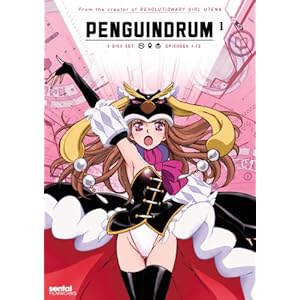
Penguindrum Anime Collection 1, Disk 3 (English)

March 3rd, 2013

The first volume of Penguindrum comes to a close in Disk 3, by introducing two major plot complications, several new visual symbols and a twist of fate. Or should I say…destiny?

We learn in a most roundabout way possible why Natsume Masako is after the diary. We see that Himari has a separate history of her own, a story about which she carries guilt, regret and unhappiness in great measure. And at last, we learn what really binds all the characters together…but not why. Not yet.

Visually, we’re noticing some new symbols, most especially Tokyo Tower, which now appears in many scenes. The storytelling to come is so powerful that merely seeing the Tower made me shiver (with what emotions, I can’t tell you – that would be spoiling it.)  The appearance of repeated, unexplained visual symbols laden with inexpressible meaning is the very essence of a Ikuhara Kunihiko production.

I’m watching the DVD of the series, as opposed to the Blu-ray, (and I’ve previously pointed out, I’ve got an ancient TV and that I’m not a great judge of video quality) but I still think the video is crisp.  I can imagine that on Blu-Ray, especially on a good screen, the video’s saturation of color and play of light and dark would be quite amazing.

I haven’t addressed the issue of translation. Sentai is generally adequate. They lack a translator with nuance, but for the bulk of the story, nuance is left out of the dialogue. The words Sanetoshi speaks are not where the nuance is, it’s they way he’s saying them and where he is and what he’s doing when he does. Luckily for us, since Sentai is generally adequate.

The thing I wanted very much to bring to your attention today is this – the song being blasted by the speakers that deafen Kanba is a Welsh folksong called Ar Hyd y Nos, also known by the English title, All Through The Night.  It’s a pretty famous hymn and lullaby and I wanted you to hear and enjoy it in a non-distorted version. Here is Aled Jones singing it in Welsh and English:

Which makes me wonder, why Ar Hyd y Nos? Doesn’t it strike you as odd that Ikuhara and his team would choose a Welsh folksong to blast at Kanba? But then, Ikuhara likes odd conjunctions of mismatched emotions. So, yeah. ^_^

Ratings:

Overall – 8

Once again, thanks so much to Okazu Superhero Eric P. for his generous sponsorship of today’s review!

And welcome to the new Okazu. Hope you like it! ^_^