Yuru Yuri Manga, Volume 1 (English)

September 25th, 2012

Yuru Yuri remains on the JManga best seller list, as it has since it premiered on the digital platform. Not surprisingly, I’m pleased to see it there, because we at ALC were able to be part of the team that brought it to you.  I was even allowed to contribute a short essay on the Yuri landscape in Japan to the feature story for the series. (And, I erm, just noticed that they called me the Yuri Master on the feature page. /snort/) As a result, I think I should disclaimer this review – I think we did a bang-up job on the thing and I have no intention of combing the book for mistakes. ^_^

That having been said, something popped up on Twitter yesterday that inspired me to do a quick review. I’ll get to that in a second.

The number one criticism of Yuru Yuri is, well, the lack of Yuri.

Basically, Kyouko sort of desires Chinatsu, who can’t stand her, Chinatsu loves, akogares and probably desires Yui, who probably knows but isn’t doing anything about it. Ayano has a made-up-in-her-head rivalry with Kyouko, because she hasn’t really figured out that she likes her, Sakurako and Himawari are a completely fictitious couple made up by the author to jerk the readers around. No one even notices Akari.

The only “real” Yuri in the series is in Chitose’s fantasies. Chitose is, of course, the stand-in for the readership. All the “Yuri” in the series is in our heads, because if you step back for a second, we are pairing up 13-year olds and how creepy does that make us? Massively creepy.

So for no reason at all, except because I find it amusing to do so, I’m going to ‘splain the real relationships in this series.

Here’s the picture that started this whole train of thought (Here’s a link to the original artist’s page on Pixiv. You’ll need to be logged in to see their page. Painting and links via Scott Green on Twitter)

This picture, “Yuri Meninas” is a mashup/parody of Velazsquez’s famous painting Las Meninas.
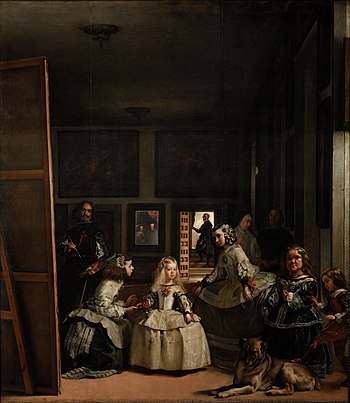
And I thought to myself, well, if this artist can see something in Yuru Yuri worth mashing up with Velasquez’s work, (often considered the best painting in the world), then clearly, I need to look at it again.

And so I have.

Yuru Yuri is, like Sasamekikoto, a discussion of Yuri tropes. Best friends, rivals in love, opposites attract, akogare out of control, etc. But where Sasamekikoto focused on tropes of plot common to Yuri stories, Yuru Yuri is focusing on character tropes common to moe stories…and making fun of the characters and the people who read so much into so little. In effect, Yuru Yuri can be seen as a commentary by the artist on the audience who works so hard to develop the characters which are, in reality, kept simple by design.

The main character of Yuru Yuri is not, as the story might imply Akari, nor is it Kyouko… the main character is Chitose. That is to say, the main character of the series is *you.* You are the one developing the series from 2-dimensional in every way, to anything at all that has some third dimension. Like Velasquez in Las Meninas, the reader must be involved with the narrative for it to make any sense at all.

So, because I as a reader (even though as I edit, I try hard to not engage with the story) am forced to form some opinion of it as I read, here is what *I* saw.

There is, in truth, only one couple here. Chitose and Ayano. To turn Ayano into the masochist she truly is, Chitose will, therefore, have to learn how to be a better sadist. She’s got a lot of work ahead of her. Sakurako and Himawari are a McGuffin. Himawari genuinely can’t stand Sakurako, and Sakurako is merely using Himawari. Chinatsu (who has been inexplicably described as “dark”) is a bore. Yui will come to realize this and then realize that she actually does like Kyouko…but only after Kyouko and Chinatsu become a couple.

So, that’s what this series looks like in *my* imagination. ^_^

No, not really.

In my imagination, this series doesn’t exist at all. ^_^

I am not, like Velazquez, reflected in the art. I am not represented by Chitose. I stand outside the story, outside the narrative and, instead of watching the subjects of the narrative, I watch the audience. I watch you as you paint the picture.

So, what I want to know is – what do you see when you look at Yuru Yuri? Where are you in the picture? Tell me in the comments!


Lesbian Novel: Bobby Blanchard, Lesbian Gym Teacher (English)

September 24th, 2012

Some years ago, I had the very real pleasure of reading The Big Book of Lesbian Horse Stories. The basic premise was a parody of lesbian novel tropes, each individually wrapped with a love affair and…a horse. (The horse was not part of the love affair, it was just somewhere in the story.) It was an awesome beach read.

So, not surprisingly, I was thrilled to find that one of the authors of that book, Monica Nolan, had also written a few standalone lesbian pulp-style novels.

If you’re a regular reader here, you already know that I like lesbian pulp novels. Everything from the classic Women’s Barracks by Tereska Torres, through Ann Bannon’s ground-breaking Beebo Brinker series, right through modern parodies like Mabel Maney’s Kiss the Girls and Make Them Spy. In fact, it’s safe to say that I prefer original lesbian pulp and lesbian pulp parodies far more than I do high culture efforts at modern lesbian literature. (With, perhaps, the exception of Madelyn Arnold’s Year of Full Moons, which was flat-out excellent.)

The difference between Monica Nolan’s parodies of lesbian pulp and Mabel Maney’s is a matter of degree; Maney grabs on to an idea and runs as fast and as far as she can with it, making silly noises and flailing her hands all the while, while Nolan approaches her stories with appreciation for the past, and creates something sweet, sincere and slightly goofy. Which brings me to Bobby Blanchard, Lesbian Gym Teacher.

Roberta, aka “Bobby”, Blanchard is a former semi-pro athlete who, after suffering a traumatic injury, takes a position as a gym teacher at an all-girl academy in the forested “north” of some state or other. Bobby has to deal with sexually inquisitive students, teachers, and her own desires. All this while figuring out what lies behind the headmistress’s increasingly erratic behavior and why, exactly, the new math teacher seems to have it in for her.

In the end, you’ll be glad to know, everyone lives happily ever after and, more importantly, the right girls get the right girls.(Girls, yes, you read that correctly. Everyone at Metamora Academy is gay. By which I mean…no, really, everyone. ^_^ Some are gayer than others, but they are all gay.)

Ratings:

Overall – 8

At the end of this book, I had come to a new appreciation of the girls’ school tropes of this genre, a renewed love of lesbian pulp and a desire to watch some field hockey.

You’ll also be pleased to know that Nolan, having beaten the girls’ school story into submission,  has also written an Office Lady-type adventure, Lois Lenz, Lesbian Secretary. I’ll be getting that one for sure. ^_^

P.S. – I’m at the bottom of my reading pile, so it’s mostly novels from here on in. I’m not ignoring you, I just don’t read Japanese that fast. ^_^


Yuri Network News – September 22, 2012

September 22nd, 2012

Random LGBTQ News

Fantagraphics is offering a 3-issue “subscription” for Volumes 4-6 of Wandering Son. This is very sensible for bot us and them.. It guarantees us the next three books and gives them a good idea of how big their market is for this series after the initial drop off.

Prism Comics is once again offering their Queen Press Grant to a comic creator. The application period ends on October 1, 2012.

I’ll be helping Prism out at New York Comic Con, which is right around the corner on October 11-14, 2012. Rica Takashima will be there with Geeks Out, at table 1974. Prism will be at table 1875. Also at NYCC will be the premier of the first episode of Rose of Versailles, followed by a talk with Susan Napier.

Autostraddle has the most lovely gallery of pictures of lesbians from the last 150 years. This just made me smile all afternoon. Take a look and you’ll smile too.

The Yuru Yuri festival in Akihabara was photoed and chronicled by Comic Natalie. In a touching tribute, Scott Green scrapes a bunch of random Yuru Yuri fanart from Pixiv over at Crunchyroll news.

***

Yuri Manga

Important reminder – Girl Friends: The Complete Collection 1 in English from Seven Seas is hitting the street on October 2.

The November issue of Comic Yuri Hime is up for pre-order, the cover story is still by namori and looking artistically manga page-like.

***

Yuri Anime

The trailer for the second season of the Jormungand anime is now streaming. Looks like a game is in the works, as well.

***

Other News

Not LGBTQ related, but very worthy of your time, Vertical will have manga artists Moyoco Anno at New York Comic Con creator of Sakuran, which Vertical just released. It’s…really good. Stop by the panel and show your support! There’ll be a number of anime/manga personalities at NYCC, so check ANN or Crunchyroll to plan your paneling!

A K-ON! GPS. Set it on Yui and tempt fate. ^_^

***

That’s a wrap for this week!

Become a Yuri Network Correspondent by sending me any Yuri-related news you find. Emails go to anilesbocon01 at hotmail dot com. Not to the comments here, please, or they might be forgotten or missed. There’s a reason for this madness. This way I know you are a real human, not Anonymous (which I do not encourage – stand by your words with your name!) and I can send you a YNN correspondent’s badge.

Thanks to all of you – you make this a great Yuri Network!


K-ON! Anime Season 2, Disk 3 (English)

September 21st, 2012

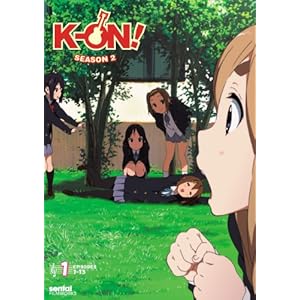
If you watch Episode 24 of K-ON!, Season 2 and aren’t just a teeny little sniffly when the Light Music Club sings “Touched by an Angel!” to Azusa, you are no longer a friend of mine.

Ratings:

Overall – 9

Superhero Eric P., who sponsored today’s review is definitely a friend! Thanks Eric, every moment I spend in the company of Houkago Tea Time reminds me of friends like you. ^_^


Puella Magi Madoka Magica Manga, Volume 1 (English)

September 20th, 2012

The trend in anime, right now, is to draw from Light Novels or Games. But there has always been a steady subset of entertainment properties created specifically to be “saturation series.” Some series graduate to the position of what I’m calling a “saturation” series – take Neon Genesis Evangelion. It was a popular anime, that lingered long after its initial popularity faded in the unlikely form of pachinko machines, until it went through a renaissance and burst back on to the scene with anime movies, manga, new games and related goods.

But of all the saturation series I have experienced in my time as a fan, Madoka is different. Released as anime, manga, light novels and games simultaneously, it exploded like a nova on the Japanese market, related goods everywhere, in every form possible. It was like all the Evangelion lessons of the years had been absorbed and BAM! Madoka radiated beams of media tie-in goods to every single consumer outlet in Japan.

That might have happened here in the west as well, but for three things – Yen and Aniplex didn’t coordinate even a little, so Yen’s printed matter couldn’t use the anime as a funnel for interest and there is, still, pretty much no organized consumer goods distribution in the US for anime-related goods. So, sure, at a con you could find eight thousand Kyuubey-related thingamabobbers, but there wasn’t the high water mark of saturation that those games, figurines, more figurines, even more figurines, extraordinary amounts of clothing, bags, random household goods of varying utility and other toys achieved in Japan.

So, Yen published the Puella Magi Madoka Magica manga and, like, no one noticed. Okay, yes, you can pull up a few reviews if you search for the title and “manga” and “review,” but compare those results to the  paeans of joy and screams of outrage about the anime….

Part of the problem is the above issue of release timing, lack of promotional tie-in, etc and partially, the manga just doesn’t have the impact the anime did. It’s the same story, of course, truncated from the time it takes to watch 12 episodes full of distracting visual imagery to the time it takes to read not quite 200 pages of a comic with somewhat less compelling visuals.

I almost never complain about the art in a manga. I can’t draw, so even the worst art is better than I can do. And really, the art here isn’t awful, it’s just inconsistent in a way that is obvious even to me, and frequently weirdly out of proportion – and not in a cool way. The art has all the hallmarks of a person who learned to draw manga by copying manga, but who never took any life drawing classes.

Other than that, the only true difference is the issue of pacing. I can’t watch a 22-minute episode faster than in 22 minutes. The pacing of the story is not for me to chose. I read insanely fast and as a result, the pacing of this manga was at full speed as I zammed through the volume. It wasn’t compelling enough for me to slow down. This is not to say this manga is, in any way, bad. I just never felt like I wanted to spend extra time with it.

Lastly, there is actually more Yuri in the manga series than there was in (at least my memory of) the anime. Madoka’s friend Hitomi keeps insisting that Madoka and Sayaka are in a relationship. Sayaka doesn’t help by playing the butch to Madoka’s femme – something I do remember from the beginning of the anime. Homura is…Homura, in this first book. Nothing indicative of what will or might come in the second volume. Mami is the perfect sempai, ripe for admiration, until she’s not. So, not like loads of Yuri, but more than I remember from the first half of the anime.

Ratings:

Art – 5
Story – 7
Characters – 6 They almost seem synopses of themselves
Yuri – 4
Service – 2

Overall – 6

It really wasn’t a bad manga, but when compared with the anime and the novels, it comes out on bottom. My very sincere thanks to Okazu hero Andreas L for his very kind sponsorship of today’s review!