The Study of Yuri, Part 2: Akogare ~ On the Edge of Desire

September 2nd, 2012

In Part 1 on the Study of Yuri, I introduced what I consider to be the origin of what will later be called “Yuri” in a novel entitled Yaneura no Nishojo. During the same period in which she found success with this novel, the author Yoshiya wrote a series of short stories that catapulted her into enduring popularity (if not critical acclaim) in the Japanese literary world. These stories, the Hana Monogatari (Flower Tales) are considered to be one of the masterpieces of a new genre – Japanese girls’ literature – in the early 20th century.

The Hana Monogatari are not Yuri, but as stories of girls coming of age in a newly westernized Japan, they include a few examples of same-sex platonic love. These are all of a type, in which a younger girl at a boarding school or “mission school” admires an older student with slightly more emotion than mere friendship. This emotion, what we might refer to as a “crush” in English, is called “akogare” in Japanese.

Since the 1920s saw an expansion of both adolescence and extended education for girls and boys, and literature and magazines for adolescents of both genders was expanding equally as rapidly.


Prolegomena to the Study of Yuri

September 2nd, 2012

(This article is not for reproduction. No portion of this article may be reproduced, in part or whole, without the express permission of the author. You are of course welcome to link to it, but if you want to quote chunks, please be so kind as to contact me first. Thanks.)

Introduction

Some time ago, I made an off-hand remark about 2011 being the beginning of the “Fourth Age” of Yuri in a post and immediately, some of you wanted to know what I meant by that. I spend a lot of time thinking about Yuri, obviously, and that got me thinking what, in fact, did I mean by that off-hand remark? Well, after pondering it for some time, I realize that it’s not as simple as saying any one date range equals “an era” of Yuri, but that there are definitely trends to be understood in the evolution of Yuri as a genre. Before we can understand what those trends are, or what they mean, we really need to be grounded in where they came from.

In my articles for Hooded Utilitarian, “40 Years of the Same Damn Story“ Part 1 and Part 2, I discuss some of the common tropes of Yuri, tracing them from their literary roots through to modern examples. Each one of these articles puts a pin in a moment in time, a single work of literature or art, that defined the tropes that grew from those works.

Yuri, the grandchild of Class ‘S’

To my mind, the moment when “Yuri” was born is the moment that Yoshiya Nobuko’s Yaneura no Nishojo was published. This story told a tale about a girl trying to understand the world she inhabited and her place in it. Akiko starts the story as a hesitant young lady, with dreams of grandeur, who finds herself slowly drawn into society precisely because she is isolated.  In the end of the book, no longer unsure, Akiko makes a decision to live her life the way she wants to – the kind of decision that was unheard of when the book was published. (This, despite the fact that the author of the book, Yoshiya herself, had made that same decision already and became successful because of her decision.) The social and political implications of this story are clear; women do not need to have their lives defined for them and two women are perfectly capable of making a life together without men – and of wanting that for themselves.

When we read Yuri now, we start from that perspective and it rarely occurs to us that there was ever a time in which that would be revolutionary thinking. We often find ourselves referring to the early 20th century “S” school of thought, without recognizing that it was not about lesbians in private schools (as the genre of literature it spawned might make one believe,) but a proto-Feminist movement brought about by newly imported ideas of wealth and leisure, and with them, freedom. Women who were part of the”S” movement ran into many of the same dynamics the American feminist movement of the 1970s encountered – some women felt that they simply wanted to have their contributions valued, others that only a  separatist society could ever be fair to women, while others wanted male privilege, or simply the right to have their own gender’s privilege. And, just as with the later American feminist movement, the inclusion of sexuality and gender in the mix caused a split between the straight women, who felt that political equality was more important that social liberalism and women who felt that there was no separation between the two. (See Voices from Japan, Eds. McLelland, Suganuma and Welker and Tales of the Lavender Menace by Karla Jay)

Now, nearly 100 years later, we look back at Akiko’s decision to leave Catholic school and live with Akitsu as a personal decision, one that any woman might make. It’s equally important to recognize that, at the time, it was a political decision. Even more importantly, a woman making a decision to step out of the traditional path assigned to a woman to make a life on her own, is effectively cutting herself off from her family and society. Every personal decision become political, as Carol Hanisch said, when the body politic states that that decision is not a viable alternative. (I have many times explained in conversation that, in Japan, taking a female lover and “being gay” are almost entirely unrelated things. To identify as gay, lesbian or any sexual minority in Japan is to take a political stance, much as the same was true for the members of the Mattachine Society or Daughters of Bilitis in the America of the 1950s. Saying “I am gay” in an apparently homogeneous society is to label one’s self as “other,” and “minority.” This is, in any society, a political act.)

As Hafl and I discussed in our review of Yaneura no Nishojo, this novel set up many of the tropes of what is now known the as Class S genre. These tropes will later be appropriated by male authors, but are arguably most effectively used by women who will write stories for girls and women later in the 20th century.

For those of us interested in Yuri, reading Yaneura no Nishojo gives a distinct impression of being witness to the birth of something great. And so, I start our chronology in 1920, with the publishing of this novel by Yoshiya Nobuko and I honor her as the grandmother of Yuri.


Yuri Network News – September 1, 2012

September 1st, 2012

Quick note, I’ll be on the road this week for some personal things, so do not expect much from me. OTOH, I plan on catching up on my reading and watching while I’m gone, so when I get back I should have some reviews for you.

Yuri Goods

GoodSmile has revealed a Nendoroid figurine of Akari from Yuru Yuri. ANN reports that the figurine will include a “Dango Bazooka” for those of you who have read through the second volume of the series. (And if you haven’t, you will be able to this fall. Then you will get the reference, too. ^_^)

And a Yuru Yuri Graphic T-shirt by Nijigen COSPA has been announced (in sizes too small to fit any of us, of course, but it’s a nice idea.)

***

Yuri Anime

Magical Girl Lyrical Nanoha The MOVIE Second A’s (魔法少女リリカルなのは The MOVIE 2nd A’s) is hitting theaters at the end of September in Japan. Sadly, I’ll miss it by a few weeks. And I’ll be too early to buy the Blu-Ray there, so Amazon JP gets my money…again.

The fourth Hidamari Sketch anime production process continues – key visuals have been revealed.

***

Yuri Manga

As I mentioned earlier this week, JManga has opened up a separate genre page for Yuri. Given the amount of Yuri that they will be putting out this autumn, it’s a good call. ^_^

Candy, (キャンディ) Volume 2 will be released in October. 

Hirari, the Yuri Anthology magazine, is putting out a special volume of Girls School Club Life. (ひらり、別冊「部活女子アンソロジー」) This special collection will feature work by Morinaga Milk among others.

Cool news for me and Bruce, at least, Senno Knife is doing a 3rd “lesbian” collection, this one called, I kid you not, Lesbian 3, Young Female Bloodsuckers (レズビアン3 吸血令嬢). You just cannot beat naming sense like that.

***

That’s a wrap for this week!

Become a Yuri Network Correspondent by sending me any Yuri-related news you find. Emails go to anilesbocon01 at hotmail dot com. Not to the comments here, please, or they might be forgotten or missed. There’s a reason for this madness. This way I know you are a real human, not Anonymous (which I do not encourage – stand by your words with your name!) and I can send you a YNN correspondent’s badge.

Thanks to all of you – you make this a great Yuri Network!


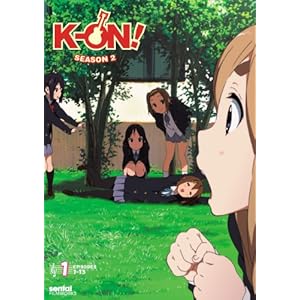
K-ON Anime, Season 2, Disk 2 (English)

August 31st, 2012

The second disk of the Season 2 of the  K-ON! anime, continues as it began, with wonderful moments of real life interspersed with absurd moments that only could happen in an anime…except when they actually happen in real life.

Houkago Tea Time enjoy their final high school school festival, play their final concert at school, pass their final final exams as high school students, take college exams and celebrate Valentine’s Day with their adoring underclassman, Asuza.

Time passes, as it does. I can barely remember my high school years, to be honest. Not all of what I can remember is good, but I find that my mind strays more to the moments that were good as I get older. Because K-ON! is about fondly recalling high school I will share a story with you from my high school years.

I’ve mentioned previously that I was in marching band and that I played clarinet. I was exceedingly mediocre, but when you’re playing that many hours every day…(band class, compulsory music lessons, marching band practice, football games, competition and individual practice) I was tolerable. My sempai in band was the woman who became my wife some years later.

One day we returned from an away football game to find that the band room entrance to the school was locked and that no one had the key. The band director went off to try and find someone to let us in and we stood there, bored, tired, ready to get out of our uniforms. To keep ourselves amused, we started to jam. One of our songs that year was a jazzed-up version of “My Favorite Things” – not a song that too many of us had any fondness for, but it did play well in the show. So we started to play that. The sun was getting low, it was getting dim out on the side of the school we were on, and we just…played.

For the first time it all meshed. The trumpets and the trombones got along, the soloist actually hit his notes, the drummers suddenly learned to count to 4. The woodwinds were in tune and on.

It was the best performance of that song we did all year.

If I never remember another thing about high school, I want to always remember that moment.

This disk of K-ON! made me remember that moment.

Ratings:

Art – 5
Story – 9
Characters – 9
Yuri – 1
Service – 4

Overall – 8

Thanks to Okazu Superhero Eric P. for sponsoring this review…and for bringing that memory to mind. ^_^


Yuri Manga: Aoi Hana, Volume 7 (青い花)

August 29th, 2012

There is a girl, she is in love with another girl. The other girl loves her back. They love each other. The end.

It’s that simple, right? The story ends with “Happily Ever After” and we move on to the next story, and never think about the characters after that moment.

This is the essence of “Story A” – the girl and the girl ride off into the sunset and nothing bad ever happens to them.

However.

Humans are not like that, Love is not like that. Friendship is not like that. Life is not like that.

If you have ever fallen in love with someone you know what I’m saying. ^_^; “Love hurts” isn’t a joke, it’s a reality.

In Aoi Hana, Volume 7, love hurts. Even as these girls we’ve come to care about move into their final year of high school, right on the edge of being adults, they are facing some issues they have to deal with. These issues are things that, one way or the other, will bring them that much closer to maturity. Sex is part of this, but it’s just part. Communication is a larger, much more intangible and difficult to grasp, part.

Kyouko needs to find her way with her fiance’, Kou. Their relationship is complicated by their betrothal, their actual feelings for one another and, most impenetrably, Kyouko’s mother.

Mogi’s relationship with Shinobu takes a shocking turn. Will they be split apart by their own lack of confidence or will they find their way?

At the very beginning of the volume, Haru mentions that her sister and teacher have “gotten married” – although it was not a legally binding ceremony, it was meaningful for them…and she lets us know how her parents coped (or didn’t.) Same-sex marriage in manga. I want to hug Shimura-sensei and Morishima-sensei and any other mangaka who surfaces this issue in a manga.

Most important for us, there’s Akira and Fumi. Fumi is in love with Akira, but she is convinced that Akira does not feel the same way about her. Akira can see Fumi is in love with her – and she does not want to stand in the way of Fumi’s happiness, but she has no idea at all what would make *herself* happy.

Fumi thought she got what she wanted, but Akira’s lack of honesty is subtle poison. Fumi’s not as happy as Akira thought she should be after having given herself entirely to her dearest friend. Although physically they’ve been as close as possible, emotionally, they are more distant than ever before.

Many fans have wanted this relationship since the beginning. This volume is very likely to make those fans profoundly unhappy. I have never numbered myself among those who wanted Fumi and Akira as a couple. This relationship is a perfect example of what happens when you get what you want, but not what you need. IMHO, the best of all possible results is that they end the relationship quickly, with no regrets and as few tears as possible, then patch together what remains of their friendship before that too dissolves. This was not the path that leads to a happy ending, they need to return to the fork in the road and choose another.

Against a backdrop of writing, creating and performing the Three Musketeers for the drama competition, this series eschews conventions of manga for realism. Thank heavens.

Ratings:

Story – 10
Characters – 10
Art – 10
Lesbian Life – 10
Service – 3

Overall – 10

There is a girl, she loves another girl. That girl is not sure she loves her back. The end?