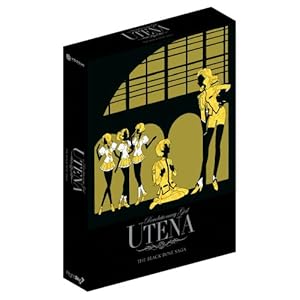
Revolutionary Girl Utena Anime Box Set – Volume 2, Disk 1 (English)

November 29th, 2011

The first episode of the first disk of Revolutionary Girl Utena, Volume 2, or what is commonly referred to as the Black Rose Arc, is that staple of long-running anime, the clip episode. Clip episodes became so common around the turn of the century, that in some infamous series, clip episodes were practically more common than actual story episodes.

In this case, the clip episode is welcome. Not only does it highlight each duel from the Student Council Arc, (which gives us a chance to relive the duels and their wonderful background music) but it provides an apparently objective perspective of each duel, allowing us to understand the motivation behind the duel, behind any discussion of the End of the World, a World Egg or Revolutionizing the World or other important-sounding nonsense.

The story of Nemuro Hall and the Mikage Seminar is set up, and we are quite suddenly dropped into a new, even more obscure arc than the last. Where the Student Council fights to possess Anthy, these new, derivative, duelists, seek to remove her completely from the game.

It’s not often I find myself incapable of half-watching an anime. Most of the time I watch something while simultaneously reading or writing. I wander off do a chore, come back and pick up the story wherever it’s taken me… it’s easy enough to do this if one doesn’t much care about the exposition. When Utena is on the screen, I do nothing else. There’s too much happening, too many symbols (both substantive and imaginary) and above all, there’s Anthy. This is the third or fourth I’ve watched this series and this time, I find myself watching Anthy intently. The joke is on me, because she rarely does anything. So every little nuance I perceive is me making it up in my head. ^_^

Of the many important things that happen on this disk, I consider most important the involvement of Kozue. It appears to us that her relationship with Miki and his with her are significantly dissimilar. Her Black Rose duel to me says that they are not, actually, that dissimilar at all. It’s simply that in those relationships, each holds a slightly different place in the other’s relatively similar world view. For Kozue, Miki holds the place of sibling, sempai and beloved, where for Miki, these are three separate positions. (I’ve always imagined that, post-series, it is Kozue who has the highest chance of becoming the next Rose Bride, despite it being a meaningless position by then.)

Also important is Nanami’s episode. These appear to always be the comedic relief episodes, but it’s important to remember that both Miki and Nanami are younger than Utena, and are working even harder to build a world that makes sense, with the fractured people around them. Miki appears to be the most innocent, but if we understand that innocence functions in part as a block to be carved, it’s instantly apparent that Nanami is the most innocent character in the series.

Two duels in to this arc and we still have no idea, really, what Mikage is after. However, if you’re adept at reading the signals here, you can see where at least two things are headed. Several key symbols have been introduced -the pointing fingers, the planetarium machine (which could spawn an essay all by itself) the pupa/moths (which return in the movie with a vengeance) and the elevators, both up and down, which Ikuhara uses again in Mawaru Penguindrum.

Two duels in and already the relationship between Utena and Anthy has radically altered. Anthy is something else to someone else and Utena begins to not note the obvious, in the most obvious manner. If Miki is clearly turning a blind eye to Kozue, how much more is Utena shuttering her eyes and ears?

The Black Rose Arc has always been my favorite. It is apparent to me that what Ikuhara does best is create tension. Scenes here are so fraught, so tightly wound, that we spend the episode watching wildly, waiting for the first blow. I described it recently as if, when we watch an Ikuhara production, we are standing in the middle of a ring of people with slingshots drawn, ready to shoot, not knowing where the first shot will come from, but knowing it will come. This tension makes us read into every comment, every scene, every background, whether there was something there to be read into or not. Every episode we’re standing on pins and needles, and Dios inhabiting Utena to win the duel fills us with the relief of predictability.

DVD extras are a pleasant addition for those who like production art, and the pamphlet this time is perhaps less distressing that the one that came with the first collection. Ikuhara’s episode commentary, and the discussion of the creation of Be-Papas and the anime and manga for Utena are equally full of pretension and insight. There is some discussion of the scene in which the sword is drawn from the Rose Bride’s chest and how the instructions were to make it look like a love scene, something that I think has stood the test of time. Of particular interest to me was the comment by one of the creators discussing the brief thought of redoing this anime, and realizing that it stood up so well and was so unique that there was no need. I agree completely. More than 10 years have passed since this series first aired and it still has the power to compel and enchant. Most series upon rewatching seem a little dated, maybe a little sentimental…not this one. I watch with the same creeping sense of…something… this time as I did the very first time. This series was one that I had on my personal top ten, but I presume, always, that nothing is as good as you remember it to be. This series is. Possibly even better.

Ratings:

Art – 9
Story – 10
Character – 9
Yuri – 3
Service – 3

Overall – 9

Stay tuned – we’re going to have a contest to win the second Box Set from Nozomi/RightStuf shortly! ^_^


Girly Comic, Volume 1 (English)

November 29th, 2011

girlyset-caseAfter revisiting Cute Wendy, I admit to questioning my faith in the entertainment value of Josh Lesnick’s Girly. ^_^ I mean, I liked it loads when it ran online and my original review of the first volume was positive enough to be included as a pull quote on the second volume. But times change and I change and things change…. I’m very glad to say that my opinion of Girly has not changed. I found myself putting other (probably more important) things aside to keep reading this first volume of the new collection, which encompasses both the original Book 1 and 2.

Otra and Winter are utterly un-normal, which makes them charming, and their adventures are utterly un-normal enough that one has to actually pay attention to what is going on in order to follow what is going on. In fact, reading Josh’s post-volume notes, we realize how much of the apparent randomness and haphazard happenstance is carefully plotted out in advance.

For Yuri fans, the real draw here is Otra and Winter. There’s no way to liken this to a normal romance, but the bits that need to be handled with relative normality…are. Otra tortures herself adorably over the unlikely attraction she’s feeling for Winter, while Winter, product of an alternative family as she is, is comfortable with her interest in the other woman.

The romance, such as it is, is lovely. This is particularly nice considering that it forms in the middle of an elephant infestation, cheap gags and other madness. I’m not the kind of person to laugh out loud at laugh-at-loud gags, but this book makes me laugh out loud.

The art is degrees better than Cute Wendy. You can actually follow what’s going on this time. ^_^;

Ratings:

Art – 7
Story – 8
Characters – 8
Yuri – 9
Service – 5

Overall – 8

This was the only webcomic that ever kept my attention for the span of a long run. It has elements I enjoy, not least of which was a great Yuri couple. Hence my desire for the figurines. And this collection. Which I enjoyed very much.


Now This is Only My Opinion, Big 10th Edition!

November 27th, 2011

From time to time, I open up a Q&A here on Okazu to address random questions about life, love and Yuri. It’s been a while since we did the last one, but this will be our 10th edition of this, so let’s all eat some cake as we reflect on the deep questions you are asking. ^_^

I am always interested in the questions I’m asked – especially when there is no one simple answer for the question. As always I’m giving it my best shot, and welcome other opinions and perspectives in the comments.

In any case, here we go for the 10th edition of Now This is Only My Opinion!

***

Q: How are minority characters treated in Yuri?

A: Not surprisingly, this is an incredibly complex question, because Yuri is unlikely to be different than manga as a whole in this regard.

Treatments of foreigners in manga and anime as a whole tend to be very stereotypical, although there will always be exceptions to the rule. What I’m seeing more and more in Yuri manga specifically, is the addition of the “American otaku girl” as a minority. But I have no doubt that’s not what you meant. I’m wracking my brain trying to come up with minority characters in Yuri. Anthy from Utena, of course, fares no worse than anyone in the series and, by my interpretation a damn sight better than most. Chinese characters are rarely treated well in manga in general, although I recall a Chinese/Japanese relationship one-shot from a Yuri anthology in which their linguistic (and presumably cultural) differences were superseded by their love. I can’t think of any stories with a Korean character, so if any of you do, please let me know. There have been a few Yuri stories here and there with a woman with dark skin, perhaps stereotypical African features, but I can’t think of any where that is a *thing*. And there are always stories where Japanese girl goes to some unnamed southern tropical island and falls in love with some unnamed dark-skinned beauty. In those cases, the women are merely a fantasy role, although in one case I can think of she at least is given a personality.

As I say, it’s a very hard question. There are some Yuri series which feed into typical stereotypes and others that don’t. What we can say is minority characters have yet to become a typical part of the Yuri manga landscape outside something like Battle Athletes, which played quite openly with stereotypes.

Because Japan is so much more homogeneous than the US, even Tokyo as compared with, say, New York, there’s less minority presence. This is reflected in every form of entertainment, so it’s not that surprising to see it in manga.

***

Q: I don’t read much Yuri, and in part it’s because of my impression that Yuri characters tend, overall, to be very stereotypically feminine. By contrast, BL is, as a genre, highly invested in gender nonconformity, and even general shoujo has a fair amount of genderbending. Do you agree that Yuri characters are more hyperfeminine, and if so, do you think it’s because of the influence of male readers/writers?

A: No, I absolutely don’t agree. I going to guess that you’re just familiar with one kind of anime or manga.

For one thing, our earliest role models in Yuri were the exact opposite – women who were portrayed as being specifically masculine or with masculine skills/roles in shoujo series. Prince Sapphire of Princess Knight, Haruka/Sailor Uranus from Sailor Moon, Arisugawa Juri and Tenjou Utena from Utena, even Satou Sei in Maria-sama ga Miteru, who is compared with a Takarazuka otokoyaku, an actress that takes on a male role.

I talk about the two main tropes of Yuri in my two essays on Hooded Utilitarian. I strongly suggest you read the second one, about the Girl Prince.

Yuri did not start to show up in seinen and shounen manga until most of the main tropes had already been established by shoujo manga (again, I discuss this in my essay about the tropes of Yuri on Hooded Utilitarian.) Once those tropes did become part of the seinen/shounen landscape, of course they wanted their lesbians drawn sexy. Because the audience was primarily male, they embraced a trope of the pervy lipstick lesbian, who does things to other girls that the audience wishes they had the balls to do. But this is a very, very late interpretation and is found in far, far fewer series than the much more common cool, slightly masculine lesbian character.

What you’re doing is seeing something in the series you’ve read and watched and generalizing it to the whole genre. But as you say, you haven’t read or watched much, so you just haven’t seen anything that contradicts your experience. ^_^ Watch Revolutionary Girl Utena.

***

Q: Why do you occasionally use the word ‘space’ so much; and in odd (but not incorrect) places?

A: What an interesting question! I guess I’d call it a verbal tic.

***

Q: While I was in one of my dictionaries yesterday, I happened by the page listing Japanese government bureaus. I returned there for a second look, because I was sure my glance had misread one of them. Sure enough, I was wrong, there is no “Cabinet Lesbian Bureau.” It is the much more prosaic and boring “Cabinet Legislation Bureau.” It did give me a laugh and make me wonder if my Freudian slip is showing.

So, my question for you: if Japan were to have a cabinet level “Lesbian Bureau,” what should it’s charter be and who would you wish its members were (real or fictional)?

A: I’ll be honest, I never have any thought that I wish a fictitious character was somehow real, so that limits me to a much smaller pool of candidates.

In fact, the only person I could unequivocally say should  be there is Osaka Assemblywoman and out lesbian politician, Otsuji Kanako. The charter would be to provide equal opportunities for lesbian representation in local, regional and national government.

***

Q:  What is the best way to spread Yuri-love (more precisely, love of reading Yuri works) to straight friends?

A: We’ve dealt with this question here before. You can’t and no one likes a friend who proselytizes. IF, and only if, you can think of a series that your friend would genuinely enjoy for other reasons, then introduce them to a series that fits those criteria. Otherwise you’re just being a pain. I mean really, would you want them to proselytize mecha to you when you don’t like mecha?

***

Q: Could you go through all the components of the Six Degrees of Yuri? I’ve read it somewhere before, but have been unable to find it again for precise quoting when telling people about it =D.

A: Six Degrees of Yuri is a riff on the Six Degrees of Kevin Bacon. In short, it’s the utter lack of coincidence that you’ll see the same voice actors and actresses over and over again in series with lesbian themes or characters.

***

Q: What is the best present for one lesbian to give to another?

A: Whatever would make the other one happiest.

***

Q:  What’s one interesting item you have on your Bucket List?

A: I only have two things left on my Bucket List, in fact. Of them, one is to see the Palace at Knossos, Crete.

***

Q:  Short of actually going to Japan, what do you think is the best way to learn Japanese both in terms of effectiveness and cost considerations?

A:  Another entirely complex question. The problem here is that people learn differently, and what will work for one person may simply not for another.

First, take a look at local colleges or adult school programs and see if they have a class you can take. Spend some time memorizing the hiragana and katakana syllabaries.

If there are no classes available, there are a lot of beginner’s exercises online you can work with.

Effectiveness is going to entirely depend on you and how you learn. Language tapes might work great for you, or they may not, so there’s no one way I can suggest that is sure to be a winner for you.

***

Q: Is Japan the only country in Asia where domestic authors of lesbian themed works are regularly published? Is there anything like Yuri manga and anime in South Korea, China, etc.?

A: Honestly, I have no idea. I’m putting this question up so hopefully my readers can answer it for us. I’d also like to know.

***


Q:  What are your ground rules for having a public blog and protecting your privacy?

A: The main ground rule is that when one decides to go online, one should not be delusional about the concept of “privacy.” There isn’t any privacy anymore, whether a person decides to be in the public eye or just has a Facebook page. (For instance, once a year there is a scare about zOMG, your name address phone # is available on XYZ site! But all that is public info and it is and always has been available, whether you like it or not.)

My biggest concerns are not privacy, as such, but safety. I do draw the line at tolerating threats of or implications of physical violence. When I receive those, I take measures.

And, while I let my readers into my thoughts and feelings, you do not have full access to all areas of my life, of course. ^_^

***

Q:  How would you start an anime/manga club specifically for adults, not just the typical high school and college age fans? How would you go about advertising it, what kind of venue should it be held at, should it be more of a discussion group vs marathon viewing, and what steps would you use to go about keeping the group going and growing?

A: That’s a great question and I have no definitive answer for you. Years ago, when there was a local video store with a fair selection of anime I toyed with the idea of creating fliers and advertising such a group there.

Now, it’d be that much harder, with digital distribution.

Here’s a suggestion – try your local library. Offer to show anime that anyone might like. My library shows up to PG-13 anime. You might get some kids, but there also might be adults who come. You could also go for stealth advertising and stuff fliers in adult-oriented manga that has anime (say Planetes) with contact info…but librarians usually notice that kind of thing. ^_^

As for going and growing…group dynamics will affect this, and the venue and the age/level of maturation of the members. Groups always grow, get settled, go through cramps, die. It’s nothing personal when people drop out, it just means you always have to be growing the group and time and place affect that.

***

Q:  Ok, just a question, since it has been a topic of conversations, albeit not so much a heated debate as an occasional statement by given sides, what is your opinion of “futanari” is it/are they in your eyes Yuri, Yaoi, Str8, or something else…?

A:  I’ve talked about this way back in 2004. I think of futanari as having two separate approaches to the topic; women with penises, and men with breasts. Women with penis series like Stainless Night are, IMHO, Yuri. A man with breasts series, like Chimera or Purple *might* have some Yuri, but are not in and of themselves Yuri. The audience in Japan is mostly straight adult males.

***

Q: What is your opinion of the trend of taking old myths or legends that had male characters as the central protagonists and creating stories around gender reversed versions of them?

A: Generally, I like reworking of myths. In fact, that is one of my primary hooks in having been captivated by anime and manga.  Gender reversal is rarely something I care about and, as I am very female-centric in my interests, I don’t know that I’d specifically watch or not watch a series that starred male characters in a typically female role. I’m otaku, not fujoshi, and prefer the girls to the guys.

I usually have no idea what I’d watch or not until I have an opportunity to do so. Yes, I have watched Ikkitousen, and Kohime Musou. If it were the other way around, say a BL version of Orihime and Hikoboshi, it would depend on other factors in combination with the story to determine whether I’d watch it. (Thinking about it though…that would be a pretty cool story idea and I probably *would* watch it! ^_^)

***

Thanks again to all of you who wrote in with questions! I see I’m going to have to get smarter to keep up with you all. ^_^


Yuri Network News – November 26, 2011

November 26th, 2011

Yuri Manga

Top news story this week, in case you missed it, is that Seven Seas announced that they have licensed GIRL FRIENDS by Morinaga Milk and will be releasing it in omnibus format. The first volume is slated for autumn 2012.

Shannon L. reminded us on the Yuricon & ALC group on Facebook  that Yen Press licensed the Puella Magi Madoka Magika graphic novels, the first one of which also should be coming out in spring 2012.

YNN Correspondent Tomo K. wrote in with the most wonderful news! Ame-iro Kouchakan Kandan (飴色紅茶館茶話) is getting a number of post-series one-shots Ame-iro Kouchakan Kandan~Golden and Silver Tips~. Terrific news for all of us who enjoy spending time in Fujieda Miyabi’s Amber Teahouse. (And maybe, just maybe, for those of us who would like to see more well-established, older couples in the pages of Comic Yuri Hime?)

***

Yuri Anime

Nozomi/Rightstuf is restarting showing Season 1 of Maria Watches Over Us on their Youtube channel. Catch 2 episodes a week for the next few weeks.

Also of interest to us on the Nozomi/Rightstuf website, is an interview with Director of Revolutionary Girl Utena, Kunihiko Ikuhara. Of specific note, Okazu reader and contributor Cryssoberyl asks the first question – and it’s about the romantic relationships involved! Cool for Cryssoberyl – and the answer is cool for us! ^_^

***

Other News

Deb Aoki on Twitter brought this to my attention: We Love Fine, a t-shirt company has a Saiilor Uranus/Sailor Neptune meets Nagel art t-shirt design. Looks pretty cool. If you buy it, let them know I sent you. ^_^

***

That’s a wrap for this week.

Become a Yuri Network Correspondent by sending me any Yuri-related news you find. Emails go to anilesbocon01 at hotmail dot com. Not to the comments here, please, or they might be forgotten or missed. There’s a reason for this madness. This way I know you are a real human, not Anonymous (which I do not encourage – stand by your words with your name!) and I can send you a YNN correspondent’s badge.

Thanks to all of you – you make this a great Yuri Network!


Great (Retro) Anime/Manga Gift Guide 2011 (English)

November 25th, 2011

I’m staring at my pile of to-watch and to-read anime and manga and I can’t but help notice that there are a lot of familiar titles among the mix. And, as it’s that time of year again, at which Americans decide what matching pen and pencil set to get their relatives, and otaku Americans decide what anime or manga they should buy to indoctrinate their younger family members, I had a thought.

This year, I’m specifically suggesting anime and manga that were awesome and wonderful a decade or more ago and are just as wonderful, now that they are available again. These will all make perfect family watching/reading to brainwash educate your young family members in the ways of anime and manga fandom. And, possibly create a new Okazu reader or two. ^_^

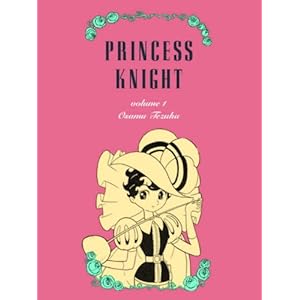
Princess Knight – This is as close to a kernel as we have in America for the concept of “shoujo manga.” And, not at all coincidentally, Sapphire is the inspiration for many of our favorite cross-dressing, sword-wielding heroines, Lady Oscar, Tenou Haruka and Tenjou Utena among them.

This manga makes a great starting point for discussion of gender roles, societal expectations, Disney as a role-model for manga and anime, and the history of manga. It also makes a terrific end point, after you’ve handed your youth of choice some of the other items on this list and they are intrigued as to where this kid of thing all started. History lessons disguised as entertainment…what will nefarious adults think of next?

Magic Knight Rayearth manga. This fetching all-in-one edition of CLAMP’s sword-and-sorcery classic manga is…really nice. Color pictures make the volume an attractive collector’s item, especially for those people who missed this the first time around. The story is, perhaps, “basic,” but as a result it makes a fantastic entree’ into role-playing, strong female characters, chicks with swords, teamwork/friendship-focused stories and other touchpoints that mean a lot to readers of Okazu. Let me be blunt, this would have been my favorite series ever at 8 years old.  Give this to the girl prince in your family, or the gamer kid and see what they make of it. I bet they love it. Then, when you’ve got them good and interested, invite them over for a marathon watching of….

Magic Knight Rayearth remastered Anime. Media Blasters did a really, really nice job.

Yes, the anime itself seems kind of kiddy-anime. That’s because it was. It was still pretty classic sword-and-sorcery stuff. Evolving armor, magic, weapons, a little light politics and romance, magical creatures, even giant robots. This is your chance to have heart-to-heart with your young relative about love and hate and violence and friendship and how many different ways humans make bad decisions.

And the remastered animation really looks good.

When you watch  Season 2, you can advance the discussions of politics a bit.

Also, I recommend start using the word “delusion” in discussion about the way we as adults, especially, talk about our world. Let them know that it’s not their imagination. ^_^

Or you can do none of that, and just enjoy the colorful animation in fine CLAMP style (personally, I always like their swirly bits,) and the D&D-ish world with Japanese influence.

About this time, you should introduce them to Code Name: Sailor V.

Bearing in mind that this may be the very girliest of all the girly things on this list, it’s still adorable and important.

Minako is not an “average girl” in the way that most magical girls are presented. She’s very athletic, she’s not too sharp and her life is centered around the kinds of things an actual 13-year old might care about – boys, pop idols, having fun with friends, playing games, reading about stuff that she’s not yet buying, but would one day like to.

As bizarre as that might seem, at 13 most girls actually do want to be more grown up, more active in their own lives, and they kind of have to wait a few years before they are allowed to be. Minako provides us a glimpse into a really typical teen girl id – fun, friends, fashion, yummy food, and an overwhelming, if somewhat limited, sense of justice. Sailor V is solid fun, with some weirdly non-moral of the story wrap-ups. The second volume of Sailor V gets a little deep and very superficial at the same time. Some of those chapters are perfect openings for discussion of body image, among other things.

Of course once your young family member has read this, hit them with the big guns….

Pretty Guardian Sailor Moon is not a classic by accident. This series combined elements of classic “girls” stories with elements of the most popular “boys” stories to a create a whole that resonates with readers even now. It’s not accidental that Sailor Moon was made into an anime, where Sailor V was not. The themes of friendship, teamwork, strength in numbers is one of the binding ideas of this series, just as it is in One Piece.

The supporting characters are exactly what makes this series so powerful. With such a large ensemble, each targeted to a personality archetype, there was someone for everyone to like in Sailor Moon. As the older characters are added in, it’s likely to be read by more family members than just the kid you’re giving it to.

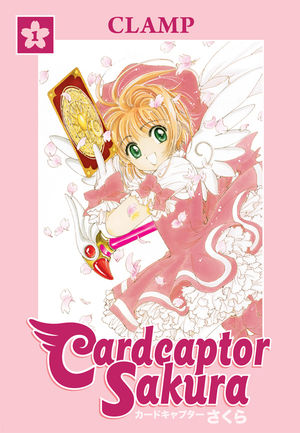
Now that your target kid is thoroughly hooked, hand them Volume 1of the Card Captor Sakura Omnibus. I originally gave these to my 14-year old niece, but she’s in a more Doctor Who phase right now. However, my 17-year old nephew ended up liking this series enough to keep reading.

I can’t say enough about this series. There’s so *much* here. Sakura is strong, in a complete girly, down-to-earth way. You can imagine having her over for lunch and really enjoying her company. (And Tomoyo’s, because of course she’d come, too.) There’s just enough sexual politics, elementary grade version, in this book to intrigue and bewilder anyone of any age. The art is some of CLAMP’s absolute best. I consider this series to be their peak work.  For those of you with kids in your life you think are even the slightest bit bent, this series is a must-read for them.

Volume 2  continues with even more great freaky magic, and more deeply intense relationships that you just don’t normally see, all within an adventure that’s perfectly child-friendly. I’m reminded over and over why this series was so damn popular when it came out. Because it’s *excellent* on every level.

Every new character that it introduces is delightful to know, even (and often especially) when they disturb you just ever so slightly. ^_^ This series also genuinely has the best magical creatures I’ve ever seen in any fantasy series.

(As an aside, my number one and two wishes for 2012 are that the Sailor Moon and Card Captor Sakura anime are relicensed and re-released by a company that cares about quality. Number three and four would to complete the body of literary precedents with the licensing of Rose of Versailles, anime and manga.)

Which brings us to the final suggestion I have for this year’s Gift Guide. In this case, it’s the manga that remains out of print, and the anime which has been re-issued.

Revolutionary Girl Utena could not have been without all the previous series. It took so many of the elements established in earlier series and combined them in unique, powerful ways.

Because of the non-linear story, the surreal art, and some of the themes, it makes a great benchmark to the inside of your family member’s brains.

This 10th anniversary edition looks good, has great extras, and has stood up well against the last decade of animation. The music is still a magical cookbook of awesome.

I must comment on  the tremendous overlap of voice actors in the anime for Utena, Sailor Moon, Card Captor Sakura. I consider these people masters of their craft for very very good reasons.

In any case, when you are considering your family members and you think you’ve got one that could become an Okazu reader in the future, stick these under their tree and see what happens. ^_^