Light Novel: Strawberry Panic, the Complete Novel Collection (English)

July 13th, 2011

Strawberry Panic, the Complete Novel Collection, tells the story of Aoi Nagisa, a cheerful, otherwise unexceptional girl who is swept up in high drama at an elite Girl’s Academy when the Academy star inexplicably falls in love with her.

Nagisa is a transfer student and so, as with so many series, a catalyst for change at the old, established St. Miator school. Without meaning to do so, Nagisa brings about chaotic change not only in Miator, but also in sister schools St. Spica and St. Lu Lim. The winds of change in Spica are also heralded by the appearance of a transfer student, Konohana Hikari whho, like Nagisa, finds herself swept up in the drama of a top star of the school. These two transfer students are foils for one another in this popular Yuri series.

Nagisa and Hikari’s adventures in love are, perhaps, the Yuri-est of all things. Here in the rarefied, “peach-scented” halls of Astraea, is a great deal of love between girls, but there is only one lesbian. There are protestations of desire, there are vows to be together forever, there’s petting and kissing and possibly even sex, but there is very little thought of the world outside these halls or how any of this could ever survive graduation. Here in this fantasy world, all the tropes and conventions of Yuri congregate to become the ultimate in parody literature.

In the end, Nagisa gets her Shizuma and Hikari and Amane make the most perfect couple that Astraea has ever seen as Etoile. God’s in his heaven, all’s right with this fantasy, peach-colored world of private girls’ schools and Yuri love. Fu~ fu~ fu~, the wind blows as the cherry blossoms swirl around our lovers.

And so, at last, we come to the end.

This journey began more than 7 and a half years ago, with the news that an anime was being made of a series of short stories about girls in “Yuri couplings.” I read those stories and found nothing but deep loathing for them in my heart. The art was moe, the situations were trite, and the characters lacked character.

The anime and I started off on a bad foot, but over time I grew to enjoy it. The manga and I have never been on speaking terms, but the Light Novels convinced me that there was something more here than just a parody. The Light Novels *were* more than just the kind of parody which the anime carried off – the novels were an incredibly intelligent parody written to be slightly dumb. And so, I began to find myself un-loathing the anime more and liking the novels. As my shackles of preconceptions fell, unbound by the sheer ridiculousness of the novels – and helped by Kaname’s global warming speech in the anime –  I found things to enjoy in the series. Including, but not limited to, the helicopters. Mostly though, it was the overblown, hyper-cute, yet, ridiculously over-formal moego language that appealed to me.

This time, as I read the novels I was able to just enjoy the overcomplicated saga of Nagisa and Hikari as they overcome absurd challenges so that the girls get their girls.

Ratings:

Overall – 9, which is pretty amazing when you think of how far it had to rise to get here.

One last time, I want to thank Seven Seas for making it possible for me to be part of the process.

This review was brought to you by Act 3, Scene 2 of Julius Caesar, by Shakespeare.
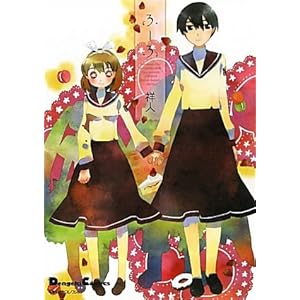


Yuri Manga: Fu-Fu Dengeki 4-koma Collection (ふーふ―電撃4コマコレクション)

July 12th, 2011

This is not the Fu-Fu you’ve been waiting for. This is not Minamoto Hisanori’s Fu-Fu. This is not a serious story about language and rights and perception wrapped in 6 layers of adorable-ness.

This Fu-Fu is the Fu-Fu that, in a series of 4-koma strips, flirts with saying something serious, but never quite does. This is Fu-Fu Dengeki 4-koma Collection (ふーふ―電撃4コマコレクション).

In this Fu-Fu, Furika and Fuyuta are the player names of two characters that met in an MMORPG. They became friends, and eventually were married in the game world. In that world, Furika is a cute bunny girl and Fuyuta is a handsome bird man. In real life, it turns out, they are both high school girls in the same grade at school.

The manga begins with some very affectionate displays of affection between them in public and their disbelieving classmates’ reactions. After an extended kiss, they’re asked, “Are you two lesbians?” Their response is, almost predictably, “No, of course not.” They then clarify that in the game, they are married, so this is obviously totally normal.

There is some space spent on classmate reactions. Predictably the boy representative is less concerned, although somewhat confused by the gap between their behavior and their words. A female classmate, Okada, is outright disgusted, which prompts the boy to say that it doesn’t bother him…he’s not sure how he’d react if it were two guys. Which then brings up a mis-timed reaction from a third classmate, male, about gay guys, implying that he himself might be gay…something that is quickly swept aside in denial.

And that’s about where it all stays in Fu-Fu.  Furika and Fuyuta are in love, married in the game, physically affectionate in person, but in no way are they lesbians.

This manga is a 4-koma, and the formula, while less obsessed with wacky humor than, say, Hyakko, or  Ichiroh!, is still meant to have a bwah~wah~wah~~~~ feel about it.

The second half of the book takes a slightly more serious turn, as Fuyuta (as we’ll continue calling her,) begins to get an inkling that her feelings for Furika are more than just in the game world. There are some awkward bits when she tries to push their relationship to deeper levels of intimacy, but fails, and even more when Furika won’t let her go when she starts to realize her feelings may indeed be “lesbian.” The book ends at a most uncomfortable moment, when Fuyuta lies to Furika about having a boyfriend, so this playing at being married must stop.

I’m not entirely sure what I feel about this book. It’s not serious enough to take seriously, it’s not silly enough to dismiss. Some real issues are touched upon, but not meaningfully, and the humor isn’t quite funny enough to carry the book.

Ratings:

Art – 6
Story – Starts at an amusing 7 and ends at a somewhat frustrating 7
Characters – I waffle on this, they are so inconsistent. Let’s call them 6
Yuri – Also inconsistent, 6
Service – 2

Overall – 6

It very much feels as if this started with an idea and suddenly had to develop a plot when it continued longer than planned. If a second volume is released, we may see a new direction entirely, as Fuyuta and Furika work through the gap between perception and reality. Of course, I hope they come to the gayest conclusion possible. ^_^


Rakuen Le Paradis (楽園 LeParadis) Manga Magazine, Volume 6

July 12th, 2011

As always, reading an issue of Rakuen Le Paradis is like a trip into the adult reading room when you’re usually stuck in the kid’s room at the library.

We’re at Volume 6 now, and there’s a rhythm to the stories. They focus on so many kinds of relationships – from consensual abuse to tentative first love, with every kind of experience in between. But they are rarely same-old, same-old.

For Yuri fans, Nishi UKO’s “Collectors” continues to be touching and amusing, as Shinobu, Takako and their friends hit up a hot springs resort for a weekend away, only to find their conflicting personalities and priorities split them up almost immediately.

Also from Nishi UKO comes a rather touching homage to the story of Galatea, “Mannequin.” This was a totally “awww….” story, told in style by an elegant artist.

Takemiya Jin’s “Omoi no Kakera” continues with a shocking confession by one of Mayu’s friends who is sick of hearing Mayu say that gays make her sick…because she’s gay herself.

As always, these Yuri stories are only a few examples of the quality artists and storytellers captured in the pages of this volume. If you’re not reading this magazine yet and are wondering if there’s more to manga than just the same three plots over and over, I once again recommend Rakuen Le Paradis.

Ratings:

Overall – 9

For grown-ups who want to read manga for grown-ups.


Yuri Manga: Kila Kila (キラキラ)

July 10th, 2011

Kila Kila (キラキラ) by Takemiya Jin, is a collection of one short serial, “Akogare no Itoshii Hito,” and a one-shot with the title name from Comic Yuri Hime.

The titular story is unrealistic and utterly adorable. Sayaka is obsessed with magazine idol Ria. She can just “sense” Ria’s aura she’s sure so, when one day a girl walks by and she senses Ria, she pursues the girl.

Sayaka’s 6th sense isn’t far off – the girl turns out to be Ria’s twin sister, Mari. Mari is not a model, but is an introverted, cynical girl with some understandable issues in regards to her famous sister.

Cynical as she is, Mari understands that Sayaka is befriending her to get closer to her sister and, as a result, when Ria learns of Sayaka’s existence, she expects to lose her new friend. What neither Mari, nor Sayaka expected was for Sayaka to find Mari’s own sparkle so alluring that she decides Mari is more important than Ria ever was.

The bulk of the book is taken up with a tale of a love triangle between sophisticated older sister Tsukiko, Nana who has a crush on her and her childhood friend Youko, Tsukiko’s blunt younger sister.

Youko and Nana argue over Tsukiko’s intentions and, even when Youko is proven correct about her playgirl older sister, she and Nana can’t repair the damage to their friendship, when Youko admits that she’s had feelings for Nana all along.

Years pass and Nana, with a new friend, Satomi, are out one day when she sees Youko….with what instantly appears to be a girlfriend. Nana is shocked, then appalled at her reaction of jealousy and suddenly, she realizes her feelings for Youko. She confronts Youko to learn if that is indeed her girfriend, and if Youko is happy. It is, Youko confirms, and she is. They part and Nana is left to realize that she might very well have thrown away something wonderful, but Satomi, in the most charmingly goofy way, picks up the pieces. The end comes with Nana realizing that she should not ignore Satomi’s feelings the way she ignored Youko’s  and they head off to live what we can hope will be happily ever after.

The final chapter revisits “Kila Kila” and allows Sayaka to reject Ria in front of Mari and to soundly kiss Mari so she knows these feelings are not one-sided.

As always, I enjoy Takemiya Jin’s work. I’m never going to try and convince you it’s beautiful and, if anything, I like it better when the characters are evil and scheming, rather than wide eyed and adorable. But still, it’s feel-good reading for me.

Ratings:

Art – 6
Story – 7
Characters – 8
Yuri – 9
Loser FanGirl –  6

Overall – 8

Takemiya-sensei’s work has a ring of verisimilitude when it comes to relationships between girls that series like A Channel or Yuru Yuri completely fail to capture. As a result, I can read something as utterly unrealistic as “Kila Kila” and still see the real-ness of the characters’ feelings where I watch a school girl life series like Yuri Yuri and see nothing at all I can relate to. ^_^


Yuri Network News – July 8, 2011

July 9th, 2011

Yuri Manga

Morinaga Milk’s Himitsu no Recipe (ひみつのレシピ) from Tsubomi has made it as far as a first collected volume. This fluffy little story about food vs love will hit the streets in August.

Also due in August is Nawoko’s drama, Private Lesson (プライベートレッスン) and Takemiya Jin’s Omoi no Kakera (想いの欠片).

Don’t forget Tsubomi 13 will be on sale, too.

From Ichijinsh, this month you can expect marriage black, Hatsukoi Tectonics (初恋テクトニクス) and Mizu-iro Ether (水色エーテル).

Otome Ranbu (乙女×乱舞) seems a pretty good bet for Yuri fans, as well. It’s a collection of shorts.

So does Concerto (コンチェルト) – just check the cover out.

***

Snatches of Yuri

Fans of the “Yuri Sekai,” i.e., that so-delicate fake look at the super-secret lives and loves of women, might enjoy Yuri-gokoro (こいごころ), which promises a glimpse behind the veil of secrecy for people who think that exists at all.

Here’s an interesting item – Naname no Ongaku (ななめの音楽), a manga based on a horror novel with, supposedly, some Yuri-ishness.

I keep seeing Banana no Nana (バナナのナナ) on the Yuri lists, but the cover put me off. If you’re buying it, let me know what you think o it!

In the anime world, a LOT of Japanese otaku like to imagine Yuri in the Id@lmaster universe, so I expect they will do the same with the upcoming Idolmaster (アイドルマスター) anime.

***

Other News

YNN Correspondent and Okazu Superhero Dan P. pointed out that Tenjou Utena makes The MarySue’s list of 10 Bad-Ass Gay Characters.

***

That’s a wrap for this week.

Become a Yuri Network Correspondent by sending me any Yuri-related news you find. Emails go to anilesbocon01 at hotmail dot com. Not to the comments here, please, or they might be forgotten or missed. There’s a reason for this madness. This way I know you are a real human, not Anonymous (which I do not encourage – stand by your words with your name!) and I can send you a YNN correspondent’s badge.

Thanks to all of you – you make this a great Yuri Network!