Novel: Wasurenagusa (わすれなぐさ) Guest Review by Hafl

May 25th, 2011

It’s Guest Review Wednesday, thank heavens. Today, returning Guest Reviewer Hafl is going to talk about another of Yoshiya Nobuko’s novels. As you may remember, I consider Yoshiya to be the Grandmother of Yuri and certainly one of the driving forces in the creation of Japanese popular literature for girls, what we think of as the shoujo genre. Any chance to talk about her work – which is relatively unknown in the west – is a good thing. Take it away, Hafl!

On the first glance, Yoshiya Nobuko’s Wasurenagusa (わすれなぐさ) is a tale of three schoolgirls, who become friends and learn to deal with their family situations. On second glance, it is entirely possible to read it as a story of a love triangle, and it does not even require that much effort on part of the reader.

The three main characters are Makiko, who is the ordinary girl, Kazue, who is the quiet and responsible girl, and Youko, who is the spoiled rich girl. Each of them also has family issues they must resolve before the book ends. Youko does not see the value of having a full family. Kazue is the eldest child in a fatherless household and is overly self-sacrificing. Makiko has a terminally ill mother and an authoritarian father, who wants her to completely sacrifice herself for family’s sake and wants her brother to become a scientist like him, despite the boy’s apparent distaste.

In the beginning, Makiko borrows school notes from Kazue, an act which is witnessed by Youko, who immediately starts suffering from jealousy and decides to get Makiko as her special friend. To that end, she employs such various methods as forcing Makiko to crossdress, gift swapping, summer camps, tailor-made dresses and distracting her with many different amusements. However, in the end, her spell over Makiko is broken and Makiko becomes friends with Kazue, who also helps Makiko’s father see that he cannot rule his children with an iron hand.

These are only the bare bones of the plot, which can be read in several different ways. It can be read as a simple tale of three girls becoming friends. It can be read as a veiled attack against Western decadence (It must be significant that Youko, always associated with Western clothing, wears kimono in the last scene of the book). And finally, it can be also read as a story of girl used to always getting her way, who decided to claim one girl for herself – that is the way I chose to read the book, since for me, it is the most fun way.

Wasurenagusa was written in the thirties, some ten years after Hana Monogatari and Yaneura no Nishojo and it shows. The prose style is much easier to read and there are mentions of things that would be simply unacceptable before, like Kazue ‘s father being a soldier who died in China. Even though the book is mostly told from the point of view of the main characters, there is an interruption from Makiko’s brother’s point of view and it shows that if one were to read the book “properly,” the main theme is not the relationship between the girls, but in relationships in family…and that the book’s more or less explicitly told stance on those relationships is that children must be allowed to find their own way in the world without their parents’ interference.

I tried to not spoil much of the plot, since Wasurenagusa is definitely worth reading. Personally, I would rate it to be about as difficult to read as the Maria-sama ga Miteru novels, so it is not as hard as Yaneura no Nishojo or Hana Monogatari. Or, perhaps, I have just became used to Yoshiya’s style, so I can read it more easily.

Story – 7, It is simple and without many surprise, but nicely told.
Characters – 7, Nothing special, but likable.
Yuri – Between 0 and 6, depending on how you decide to read the book.

Overall – 7, Not a must read, but still recommended.

However, this Wasurenagusa is not the only story titled Wasurenagusa that Yoshiya wrote. There is also an early story of the same name in Hana Monogatari, with the only difference being that the novel’s title is all in hiragana, while the story’s title uses kanji. Let’s take a short look at it:

Toyoko, a new girl at school, feels deeps admiration for an upperclassman, Mizushima-san, but she is unable to confess her feelings. In the end, she just leaves some forget-me-not flowers (wasurenagusa in Japanese) on Mizushima-san’s desk on her graduation day. While nobody dies of a flu epidemic out of nowhere or develops romantic tuberculosis, everybody is still sad. It is a pretty typical story in Hana Monogatari, where two girls separate without even having a proper chance to interact with each other.

Story – 6
Characters – 5
Yuri – About 3

Overall – 6

Thank you Hafl for your perspective – and for your prompt to remind me to read more of Yoshiya’s work.
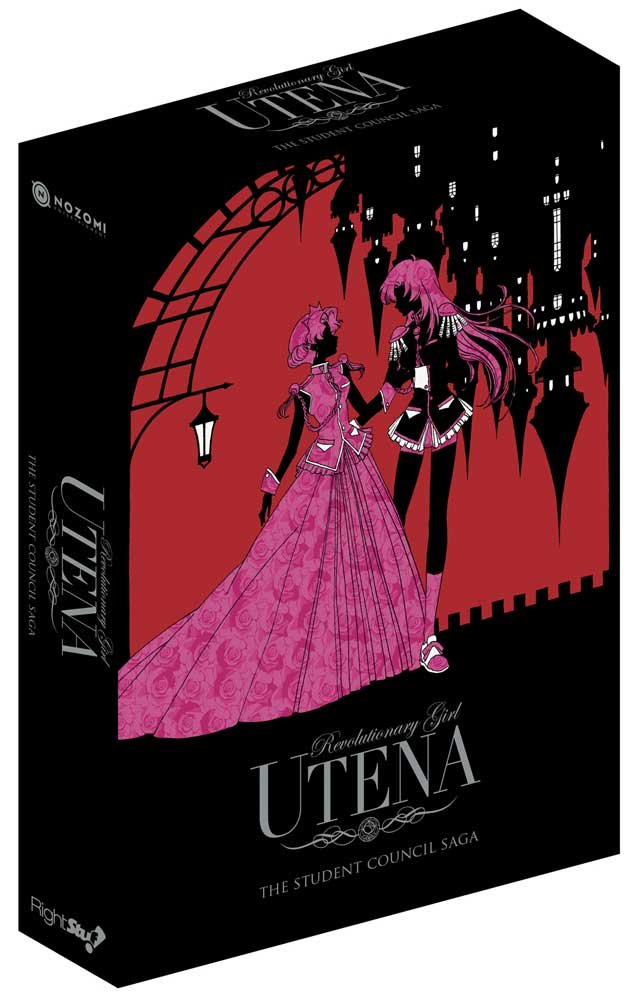



Revolutionary Girl Utena Anime Box Set Contest!

May 24th, 2011

Yuricon and Nozomi/RightStuf have teamed up to give you a chance to win a copy of the first remastered Revolutionary Girl Utena anime box set! Check out the rules (of which there is one, so don’t try too hard to find a way to not follow it, thanks) on Yuricon.com

Good luck!


Manga Censorship and Content Freedom on Otaku in Review Podcast

May 22nd, 2011

I’m just like any other fan. I like what I like and want other people to like it, too. I want anime and manga simulcast, subbed well and available on whatever platform I feel like using. I want to make my own choices about language, price, distribution and content.

Unfortunately, right now both the Tokyo government and the makers of hardware have begin to involve themselves in the above issues – and not in a way that facilitates freedom of choice or expression. No, the powers that be in government and in e-reader platforms have decided that the absolute most important thing they have to deal with is “protecting” people from things that they themselves don’t feel are appropriate. How’s that for ‘freedom’ folks? Apple says no to LGBT works on their shiny clean iPads, and Tokyo says no to marginal manga…are you really going to say “well, you know I think it’s okay to censor somethings I don’t like” and expect to be safe yourself?

I will stand up for the the rights of people I cannot stand to read manga I find repulsive because I stand up for the rights of everyone, everywhere to read whatever they damn well please.

This week on Otaku in Review,  I get up on this soapbox and have my say. I don’t agree with the episode title – I don’t believe I am going against the world. I stand with the world. And I’ll fight to the last to protect it.

I hope you’ll fight with me – don’t let Apple, Kindle, or anyone limit your freedom to chose content, don’t let Governor Ishihara limit your freedom to buy. Let’s stand up for the world, let’s stand up for freedom of the word.

Thanks to Scott and Michael for being such gracious hosts and giving me the chance to get my rant on. ^_^

Enjoy!


Yuri Network News – May 21, 2011

May 21st, 2011

Yuri Anime

The first Revolutionary Girl Utena box set is hitting the streets soon – get your preorders in on RightStuf to work towards some unnamed great extra when you pre-order all three sets. Here’s the Amazon link, if you prefer to go that way.

Also from Rightstuf, a new webpage, pre-order link and trailer for Sora no wo to, Sound of the Sky.

The Yuru Yuri anime will be premiering on July 4th. 

***

Yuri Manga

YNN Correspondent Komatsu-san says that the new issue of Comic Yuri Hime is pretty good. His favorites were the stories by Takahashi Mako, about older women, and Takemiya Jin’s story. I will chafe at the bit until my copy comes in….

Manga no Tsukurikata, Volume 5 is headed our way at the end of June.  (I was so very, very tempted to put this under the Snatches of Yuri category, let me tell you!)

***

Snatches of Yuri 

I have absolutely no idea what this is about, but Love Pheromone No. 5 (ラブフェロモンNo.5 ) is considered Yuri by the Japanese blogs and looks like it could be good or really horrible. It’s a Yuri / high school girl / phone manga.

***

Yuricon News 

Oh god, another interview with me. If you’re not absolutely done to death with that, or are willing to read my answers to a couple of slightly different questions about fandom and social media, drop by Fanboy.com. Don’t you just love the irony? ^_^

Our written archive of personal histories relating to Yuri is now online, with the first two sets of essays! Enjoy the Q&A with Morishima Akiko-sensei from the 2005 Yuricon in Tokyo program book, in English and Japanese, and an essay from Katherine Hanson, yesterday’s Guest Reviewer. These, and all the other essays will be on the  What Yuri Means to Me Project page on Yuricon.com. (Some files are PDFs.) You’re welcome to send us your own history with Yuri – this is an ongoing project and we’d love to hear what Yuri means to you, too!

***

Other Yuri News

You remember Tadeno Eriko, creator of WORKS, right? Well, she goes by the name Mizuki Monika now, and she’s part of Lesbian Erotica, a, duh, lesbian erotica circle. They’ve got a Youtube channel and some of their manga has been made into video-manga. Her high school Yuri story, Ai to Kai to ka is on the channel and it (and some of the others) are definitely worth a look! Some of their stuff is NSFW, so be warned.

***

Other News

So, in my Solution to the Scanlation Solution, I proposed a new idea for the manga industry – one run by and for creators and fans. I pretty much knew that it couldn’t be built by anyone who has to license work – it had to come from the folks who create manga and anime. When I heard of J-Comi, a Japanese creator site conceived of by Akamatsu Ken (Love Hina, Negima,) I was fairly certain that that was going to be the first site to embrace my vision. And so it has, with a program to absolve downloaders from guilt by legitimizing scanned manga. Now, J-Comi has a new translation feature. This is the future and the manga creators know it.

When I pointed out on Twitter that this was the first entry to my vision of the future manga industry, Nakiyoshi Tomino said that he would be the second. Online Mag Xenocross will be available in June, (with at least one Yuri-ish looking story,) all proceeds are going to a children’s welfare charity.

This is it – the first wave of our future guys. I can’t wait to see where it all goes. Isn’t it exciting?

***

That’s a wrap for this week.

Become a Yuri Network Correspondent by sending me any Yuri-related news you find. Emails go to anilesbocon01 at hotmail dot com. Not to the comments here, please, or they might be forgotten or missed. There’s a reason for this madness. This way I know you are a real human, not Anonymous (which I do not encourage – stand by your words with your name!) and I can send you a YNN correspondent’s badge.

Thanks to all of you – you make this a great Yuri Network!


Sakura no Sono (櫻の園) Manga – Guest Review by Katherine H.

May 20th, 2011

Today it is my very sincere pleasure to welcome back Guest Reviewer Katherine H. of Yuri no Boke. Katherine is an Okazu Superhero, a YNN Correspondent, a Yuricon supporter and a terrific lady. Thank you Katherine – the floor is all yours!

Yoshida Akimi, of Banana Fish fame, also made a short classic Yuri manga called Sakura no Sono, (櫻の園) which ran from 1985 to 1986 in Lala magazine and was adapted to film twice by the same director, Nakahara Shun, in 1990 and 2008. (The obi on the re-print being reviewed here advertises the 2008 movie.) While Sakura no Sono is noteworthy for when it came out, it isn’t especially groundbreaking or memorable in any other respect.

Sakura no Sono is the Japanese title for Anton Chekhov’s Вишневый сад (“The Cherry Orchard”). Sakura no Sono means “Garden of Cherry Blossoms”, which is apt given that SnS’s characters attend an all-girls’ school, Oka Academy, surrounded by cherry trees, and the idea of a girls’ school as a “garden of maidens” is well-established in Yuri. Additionally, sakura blossoms, which appear throughout this manga, represent ephemerality, as in the state of adolescence the characters are in.

SnS is divided into four chapters (followed by a bonus, unrelated story), each spotlighting a different student participating in the Oka Academy theater club’s annual production of “The Cherry Orchard” for the anniversary of their school’s founding.

The first chapter focuses on Nakano Atsuko, whose older sister is getting married soon. Natsuko’s boyfriend Shin-chan, who attends a nearby boys’ school, wants to have sex, but she isn’t ready yet. (To his credit, he’s good-natured and non-pushy about it, even after she slaps him after his initial overture.) One evening when Natsuko is alone with her sister, her sister talks about the guy she fell in love with in high school- and never stopped loving-, who she recently bumped into and caught up with. (Natsuko’s sister attended Oka Academy and the boy she liked attended Shin-chan’s school.) With her sister’s regrets haunting her, Natsuko decides to sleep with Shin-chan. Her two best friends tease her good-naturedly after she tells them about it, and life continues the same as always as they prepare for their school’s performance of “The Cherry Orchard.”

The second chapter follows Sugiyama Noriko, who is apathetic towards her classmates, her school, her parents, and her role in the school play. She enjoys going on dates with her boyfriend Shun-chan, but won’t kiss him because she’s afraid of going any farther. She and her friends get caught playing hooky and smoking, and after getting in trouble for it at home, she cries while thinking about when she got her first period, when the sakura were in bloom, of course. She invites Shun-chan to her house when her parents are out, and he warns her about how she shouldn’t go out at night because she might encounter guys, who only think about one thing. She doesn’t take his warning seriously until he jumps her. He backs off after she screams “No!”, but then yells at her that she’s a jerk who doesn’t think about other people’s feelings. At school, she finds out that people are spreading a rumor that she and her friends prostitute themselves, but she waves it off and decides to be more considerate of other people’s feelings by letting her boyfriend make out with her and becoming more like a “normal” girl. This was my least favorite chapter.

The third chapter stars the theater club’s president, Shimizu Yuuko. Her mature, put-together demeanor causes the other students to respect her, but prevents any of them from getting close to her. When she hears some girls gossiping about Noriko, she sticks up for her, and they become good friends. Noriko quickly pegs Yuuko as having a crush on Kurata Chiyoko, the reluctant prince of the theater club who draws the akogare of the other students and is playing a female role in this year’s performance of “The Cherry Orchard.” Yuuko and Noriko talk about the advantages of being in a girls’ school (that there aren’t any boys around to tease them for wearing bras or bringing pads to school), before Noriko kind of bizarrely points out that all of the cherry trees at Oka are male. It turns out that Yuuko partly has a crush on Chiyoko because she wants to be more boyish, like Chiyoko, but mostly because Chiyoko reminds her of her first love, an older guy named Akira. Before leaving school one afternoon with Noriko, Yuuko quickly writes a poem on Chiyoko’s desk, comparing her to sakura petals.

At the beginning of the fourth chapter, Chiyoko sees the poem and wonders who might have written it, not getting that it was meant for her. One day Yuuko gets in trouble for coming to school with a perm, and tells Chiyoko that she plans to quit the drama club. Just as Yuuko wants to be more boyish like Chiyoko, Chiyoko wants to be more girly like Yuuko, so she can get the attention of the guy she likes. Yuuko tells Chiyoko that she likes her (“Suki yo”, “Daisuki yo”), and even though Yuuko doesn’t return her feelings, she’s happy that someone cares that much about her when she’s so boyish. Yuuko’s just happy that she was able to tell Chiyoko how she felt. This was the high point of SnS- how Chiyoko responded to Yuuko’s feelings as nicely and non-homophobically as she could have, given that she didn’t return them. The theater club performs “The Cherry Orchard”, which Atsuko’s older sister has come to watch with her fiancé. She reminisces among the blooming cherry trees about how she performed “The Cherry Orchard” in the theater club when she was in high school.

Even though I really didn’t like how the situation with Shun-chan was resolved and having the “horny boyfriend x reluctant girlfriend” dynamic for two chapters in a row was overkill, this was mostly an okay manga. As a title from the 80’s, it doesn’t have the over-the-top melodrama and “Yay, we’re breaking new ground!” energy that the 70’s wave of Yuri has but, while it isn’t tragic (unlike Yuri from the 70’s), not much actually happens. (I would rather read a well-written story about two girls who are actually interested in each other and have chemistry, but have a tragic end – like Maya no Souretsu- than a bland one-sided crush that’s largely explained away as having nothing to do with being interested in women.) Sakura no Sono came out when Yuri was shifting towards happier endings in the 80’s, before unambiguous happily-ever-after endings emerged in the 90’s, a generalization that Yuuko’s story supports.

As a whole, SnS feels like a four-part after school special on “things teen girls need to deal with“, brushed over with a heavy coat of nostalgia for “days gone by.” For Atsuko’s sister, the one significant adult character, it’s the good old days of high school; for the teenaged characters, it’s their prepubescent years; nobody really seems to be looking forward to the future.

Sakura no Sono isn’t bad, just too tepid and wistfully nostalgic for my taste. It was worth reading to make the “early Yuri” catalogue in my head more complete, but the impression it leaves is as light and fleeting as the clouds of sakura petals fluttering across its pages.

Art – 7 (Good, but not especially eye-catching. I appreciate the “realistic” character designs, complete with hairstyles that girls were actually wore in the 80’s.)
Story – 6 (Aside from chapter 2, which is a 4.)
Character – 6 (5 for chapter 2.)
Yuri -3
Fanboy – 0 (It does take place at a girls’ school, but it doesn’t frame the experience in a manner that I can imagine appealing to Fanboys.)
Fangirl – Sadly, 0

Overall: 5

Erica here: Along with the translated and reasonably well-known Banana Fish, Yoshida is probably known best in Japan for her classic BL and GL collection, Lover’s Kiss  – click the link to read my 2006 review of that classic. 

Thank you again Katherine for the great review!