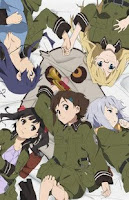
Yuri Anime: Rin: Daughters of Mnemosyne, Volume 1 (English)

February 4th, 2010

2010 continues to be a year of wonder for Yuri fans, as we now have an inordinate amount of good and bad Yuri and Yuri-ish anime to watch in English.

Inexplicably among them, Funimation picked up Rin: Daughters of Mnemosyne which has one of my top 2 most favorite opening themes ever right now. “Retsu no Matataki” from Air Master is the eternal winner, but “Alsatia” just cracks me up every time I listen to it.

Let’s get the most important thing out of the way first: Mnemosyne, greek goddess of memory, pronounced: \ni-ˈmä-sə-nē. Thank you, Merriam-Webster.

In Rin: Daughters of Mnemosyne we meet Rin, an investigator of things as small as missing cats and as large as international terrorism and her sidekick Mimi. Rin and Mimi can die, but they can’t stay dead and are, therefore, immortal.

The first episode covers their meeting with Maeno Kouki, a young man with no memory. Their adventure brings them into contact with a corrupt pharmaceutical company, enemies in advanced stages of psychosis and zombie-like test subjects. And a missing cat.

This leads into an episode about a missing stamp and a missing brother who is actually an angel and an episode about a military cover-up and a lethal disease.

Time passes quickly in this series. We jump years from episode to episode. Rin, Mimi and their dog Genta, don’t change, but Maeno ages and technology changes, which are cues for the passing of time that are far more powerful than the opening marquee telling us what year it is.

In every case, the story is deeply strange, full of intensely bloody violence and physical and emotional sadism the likes of which I have never seen before in anime. This is not a series for the light-hearted or light-stomached. It’s not graphically represented. It’s just…obvious.

I know it probably makes me a terrible person, but I love how Rin is tracked over the years by Laura, who single-mindedly kills her over and over and over. I also like how Rin’s deaths become progressively more extreme. You think they can’t beat blowing her up with a bomb but…you’re wrong. Of course, Laura isn’t the real enemy – the real enemy is Apos, voiced perfectly by Ishida Akira.

Apos is a source of much confusion and consternation for viewers….personally, I view almost all the plot complications as handwaves that must be accepted in what is not exactly the most logical or well-constructed plot ever written. Since the story is largely a vehicle for pandering of about 70 kinds, if you’re gonna stress about Apos, then you probably shouldn’t watch this series.

Personally, I loved hearing Noto Mamiko voice Rin. This is probably as close as fans will ever get to hearing her actual speaking voice in a role. And Kagamiya Rie probably broke a few brains as Mimi. She was awesome.

The DVD comes with an extra commentary for episode 2, in which the American director and voice actors are just about as infantile as you’d expect. The word “boobs” is bandied about frequently and references to lesbianism are almost all in the “girls gone wild” sense. Despite that, I laughed once or twice anyway. :-)

There is BDSM and violence and sexual violence, straight sex and lesbian sex and more violence in this series. It’s not for the kiddies and probably not for most normal people. I liked it. :-)

Ratings:

Art – this series is a good reminder that not everything looks better on a large screen – 6
Story – Oh, come *on!* It’s a 4, maybe 5, but if you’re watching it for the story, you have completely missed the point.
Characters – 9
Yuri – 8
Service – 23.8

Overall – 8

Yes, I know my ratings make no sense. Neither did this anime.

Many, many thanks to Okazu Superhero Eric P. for making today’s review possible!


Yuri Manga: Yuri Hime S Volume 11

February 3rd, 2010

Yuri Hime S, Volume 11 comes with a calendar for 2010, each month with an illustration by one of the artists from the magazine. Whether you think it’s great or mediocre will entirely depend on whether you like the artists in this magazine. The front illustration is hitting Dengeki Daioh levels of icky and then it heads right into that paean to passive-aggressiveness, “Flower Flower.” Nina sees Shuu through the eyes of the common people who adore her and at the end she’s still passive-aggressive


The second story of the collection was so surprising, so breathtakingly stellar, that the bulk of my review today will be centered around it. Minamoto Hisanari’s “Fu-Fu” is a story that I have already read three times and cannot stop boggling at how it managed to be included in this magazine and thanking the deities that it has.

Today is the first day that Su-chan and Kina are living together. They are already a couple, and clearly have taken the next step forward in their relationship. Kina asks if she can be Su-chan’s hanayome. That is, her bride. Su-chan wants to know why the word “lovers” (koibito) isn’t sufficient. Kina answers that their relationship is more than just lovers, now that they are living together, and she’d like a word that recognizes that fact. She suggests the traditional word for a married couple, fufu. This word is written 夫婦 in Japanese, the first character symbolizes the husband and the second, the wife. Kina likens it to sushi. Tuna is maguro, but there are specific words for the parts of the tuna that are special, toro, chuutoro and ohtoro. Likewise, when a person takes a special place in your life, there ought to be a word for it.

Before I deliver the punchline here, let’s stake a step back and look at the magazine once more.

This is Yuri Hime S which, since it’s inception, has targeted the male, moe Yuri audience. This is an audience that is not particularly LBGT friendly in any country, preferring to see Yuri as entertainment and titillation for them, and nothing to do with real, probably ugly lesbians who don’t really want them to watch, so screw off.

This story is quite sweetly making a case for what is arguably one of the two main issues involved in the question of same-sex marriage. One is, obviously, an issue of unequal rights and benefits. The other, more pernicious issue, is that of wording. The word “marriage” is powerful, precisely because it gives a name to a very specific joining of two people that is recognized by their community, potentially their deity, and their government at *all* levels. Likewise, the words “husband” and “wife” are equally powerful because they provide an instant way to establish the relationship between two people that combines their emotional and legal existence in one word.

Significant other, girlfriend/boyfriend, lover, just do not do that. They don’t and all of us who have to correct, reply, cajole, point out and casually mention what we call the other person in our lives who happens to be of the same sex, know that.

And here is this quiet little Yuri manga addressing what is a traditionally ultra-conservative group of people. (I was at a lecture at the Japan Society in which a Japanese art professor excoriated otaku for clinging to outmoded gender roles and national identity (I.e., focusing on fantasies of male/Japanese supremacy) to the exclusion of all else, but I sincerely doubt that the American otaku in the audience realized that he was talking to them, as well. Updated: I just read a chapter of Genshiken which made the same point, in which a male otaku insisted it wouldn’t be right for him to sit on a subway when there was a woman with him. She said, “how typical of an otaku.”)

I read this story open mouthed, agape, amazed and exultant. No, still not the “L” word, but I will gladly bypass that conversation to resolve this one. I will give up the word Lesbian, to be able to call the woman I love, “my wife.”

That is exactly what Kina and Su-chan do. While they can never be fufu, 夫婦 , they decide that they will be fufu, 婦婦. A word I whole-heartedly approve of.

This is meant to be a continuing series, so I now have a grain of hope that Su-chan and Kina will cutely and sweetly train the male Yuri fans of Japan to have a clue. In fact, between this and Poor Poor Lips I have more than a grain of hope. (Day 33, 2010 is *still* the best year ever!)

“Konohana Teikitan” has fox girls in kimonos doing things cutely for people who like that kind of thing.

“Osanajimi to Yobanaide” is a drippy looking story about a love polygon at school, by an artist who draws drippy looking stories about love polygons at school.

“Zettai Shoujo Astoria” combines EVERYTHING. For pity’s sake, even the title is a combo of everything ever. Rito comes to a new school, with a mysterious “unicorn horn”pendant around her neck and finds herself in love, then enmity, with her roommate and there’s school mysteries and stuff, and fighting, too. This series is a total ice cream sundae of a series and all it needs is a transformation scene to have one of each and some sprinkles on top.

I’ve stopped reading “Honey Crush.” Not because it offended or disgusted. I just got tired of it. It failed to hold my attention.

“Hatsujou Jijou” by the same artist who drew “Love Cubic” so I skipped in on principal.

Twice as much blood than ever before in “Shinigami Alice” which is desperately flailing for a plot. Dead people everywhere this time, including the protagonist. I guess that means something will actually happen now.

I can’t believe I’m saying this. I was so happy to see “Kaichou and Fukukaichou” in this volume. I guess I just wore down from the constant onslaught of carnival-head Yuri. Fine, fine, I like Hakamada Mera – are you *happy*?!?

In “Casseopeia Dolce” Anna gets lots of kisses and is surprised when her doll talks. I can’t imagine why…the one doll has been talking since the beginning of the series. Oh, and for some reason, not a single bath was taken this chapter. Takagi is falling down on the job.

“Yuru Yuri” follows that. Again, I have no particular reason to not read it except that it doesn’t interest me.

Yoshitomi Akihito’s “Futari to Futari” looks like every one of his last fifteen stories. I think he’s played out, overstretched, something. There hasn’t been a single story in any of his stories in three magazines for over a year.

More fox girls, more “Konohana Teiktan” followed by the resurrected, but no more interesting than it ever was “Nanami to Misuzu.”

Another skipped story and this time, I can’t even be bothered to translate the title it’s so unappealing. lol

“Ko-no-hana-link” finally hits the big day of the school festival and an old relationship drops by to cause a scene in front of Chieri. I find the title ironic, because it’s honestly quite difficult for me to remember who is who and what their relationships are from chapter to chapter. I expect a collected volume will help with that. I don’t blame the story – in fact, that single fact makes me believe that there’s an actual *story* in here, something more complex than “Story A.” One day I will read all of it in a row and find out what’s actually going on. :-)

I’m sorry, I’m just not as resilient as I used to be, so I skipped “Hime-chan ha yappari tereya-san” purely on account of the art.

Uso Kurata’s “Apocalypse” went somewhere I didn’t expect. When Matsuhara accidentally breaks Natsu’s game system, she asks Natsu and their friends to go on without her and lends Natsu her system. They do, and meet up with a guy wandering alone. He’s a nice guy, so they team up for that adventure. He sees Natsu’s marriage ring – that oh-so-rare item – and is kind of flipped out when he hears that she’s exchanged it with another woman. He writes it off as being just a game thing, and her friends don’t help by calling Matsuhara her “friend.” Although it’s just a game, Natsu wants to make sure she doesn’t leave Matsuhara behind, and asks Shibachi to lend her system this time, to let Matsuhara catch up. Clearly, Natsu has some reconciling her real feelings and their game relationship to do. I’m totally interested to see where this goes. Plus I really like Kurata’s art.

And finally, there’s a two-page short of drippy art that once again I skipped.

I’m sorry I skipped so much, but I’ve gotten to the point that I’m not wasting my time reading stuff that doesn’t interest me anymore. If you mostly disagree with me and my opinions, if you just read the stuff I skipped, you should probably be satisfied. ;-)

Ratings:

Overall – 7

Overall, the magazine was just as variable as ever, but the entire thing was made worth it by “Fufu.” That was such a significant, amazing story that I’d recommend the magazine just for it alone.


Gunjo Preorder (Japanese edition)

February 2nd, 2010

As I mentioned on Saturday, I will be placing a bulk order for the first volume of Gunjo, so should you be uncomfortable ordering from a Japanese website on your own, you can order through me.

Here’s what I’ve come up with on costs for the Gunjo order. These have been rounded off for convenience to my brain.

Book – $10
Shipping From Japan – $5
Domestic Shipping – $5 (Priority mail)
International Shipping (this includes Hawaii, Alaska, Canada and Mexico, I’m afraid) – $15 (Priority)
Handling – $5

So, Domestic US (48 contiguous states) – $25
International – $35

I’ve added in a “Handling” charge to cover Paypal fees and packaging materials, which, sadly, do cost something. That makes the International cost $35, which is edging very close to you getting it on your own. But I don’t want to say US only, because I know that Europe always gets left out of the equation.

For what it’s worth, I am *only* shipping priority, because trust me, the alternative means your book goes for a week or two long vacation to a warehouse somewhere where it will be lost, probably forever.

So, I’ve listed the links below. Domestic will be $25/book, International will be $35/book and I apologize, but it’s still cheaper than $50/book, which is roughly what it would be if you ordered by yourself through Amazon JP with nothing else in the order.

Orders must be placed through Paypal, no money orders, because I don’t want to lose my mind doing this. :-)

The book won’t ship until it’s released, so let’s say, Pre-orders will be open until February 20 and then I close them.

Domestic Order – https://www.paypal.com/cgi-bin/webscr?cmd=_s-xclick&hosted_button_id=QPE7LL64CHXT4

International – https://www.paypal.com/cgi-bin/webscr?cmd=_s-xclick&hosted_button_id=YGJJXZ8WTV5B6

I hope this makes life easier, not harder, for you all. :-)


Yuri, Yaoi Manga and More: Rakuen Le Paradis Magazine

January 31st, 2010

In an industry that primarily determines genre by target audience, the rarest of publications is one for “anyone who wants to read this publication.”

There are a few of these kinds of magazines. Kodansha’s Morning 2 can fall into that category, as can F Comics’ Manga Erotics F magazine. Not surprisingly, I really like both of these magazines. The stories are really meant for adult readers, but the content is varied, kind of odd and offbeat. In Morning 2 you have a sincere, cleanly drawn story about a young man who is a rising star as a magician, right next to some really strange, supernatural, violent, non-linear crazyness. Neither Gunjo nor Peepoo Choo were at all out of place in what is an overall experimental magazine. Erotics F runs stories of adult relationships or gang warfare right next to something like Aoi Hana.

To me, what these magazine say is that there is a different manga reading audience. A niche audience. This audience is composed of adults who admire manga for more than just the heroic fighting or the romance aspects, adults who are looking for good stories, drawn interestingly.

I count Rakuen Le Paradis as one more of these rare magazines. This one particularly seems to be for whoever wants to read it, rather than a particular demographic niche. And it is the very first magazine that I have ever seen that carries stories with straight, lesbian and gay pairings under one cover. I can’t say I liked everything in the magazine, but damn if I wasn’t impressed with it as a whole.

The first story is by Kowo Kazuma, the creator of Junsui Adolescence. It’s a straight romance that I quite liked, with a decent bit of character building in a short space. Following that is what was possibly my least favorite story, also straight, about a guy and woman who were a terrible match and not at all likable, separately or together, by Kiko Urino.

This was followed by a story of an established lesbian couple by Nishi UKO. They are established, but not without conflict. One can’t stop buying books and the other spends all her money on clothes. They can’t stop fighting about it, but it doesn’t stop them from loving each other. I loved this one, I admit it. Their befuddled friends were a great touch. :-)

Mika Hisaka’s story left me a tad cold, but it wasn’t bad. After sleeping with the guy, she leaves him her key. I’m not really sure what the moral was there. :-)

The life of a salaryman is charted by Takeda Chu in a story that combines trains and koto playing. This was charming, but difficult for me to follow.

“Overpass Junction” by Asumiko Nakamura is a rather unique look at Yuri. A girl sees a woman having a screaming match with her phone on the train platform, and finds herself drawn into the other woman’s life…and into love with the woman herself. This was a totally different approach to girl meets girl than I’ve ever seen and I liked it quite a bit.

Unita Yumi’s “Know me now” was a lovely little ditty about a boy and the girl next door. He’s in like but cluesless. Lucky for them, she’s not clueless at all. I like this artist and I really liked this story.

Then came “On,” by Rendou Kurosaki, which was probably the ugliest art in the magazine, but somehow it fit the story. The entire thing is basically a guy having sex with someone, who you think is female until the end, when he turns out to be a guy. I was glad to see BL in the book, but didn’t really like this story.

Takemiya Jin’s “Omoi no Kakera kata” had something I don’t think I’ve ever *seen* before. A girl who knows she’s gay and is totally cool with it, a priori. She likes going to this woman’s cafe, because she gets to read, thinks the owner is attractive and basically likes being around women who are probably gay. When she sees a group of loud woman making another of their group miserable, she walks over and pours a glass over the head of the loudest. Ultimately she meets with the woman she saved, who is having issues about maybe preferring women. Our heroine offers to sleep with her to see what happens. Years later we see our protagonist working at the cafe and the woman she slept with walking by pushing a baby carriage happily. I didn’t love the story so much, but I hope we see more of the protagonist. I loved how straightforward and no-nonsense she was.

“Otome Loop” is some high school wackiness by Suruga Kiryuu that totally missed me.

“…Gokko” was a story that honestly flipped me right out. Hikaru Ninomiya’s story appears to be a brother/sister incest story. But. I really should have read the title. That’s all I’m saying.

Nishi UKO has a second story, “Mio Post” about a woman who sees another woman on the train every day and wonders who she is and where she comes from or goes to. The end has the feeling of a “fateful meeting.”

Kaya Shigisawa’s “Anata sae Inakereba” was, IMHO, a lot of nothing. Very typical relationship drama. The art was nice, though.

Rendou Korosaki weighs in with another supremely ugly piece about a woman sexually harrassing a man. It looks totally consensual, but messy and blecch.

And finally another Kiko Urino “Nichiyoubi ni Jissatsu,” which starts with a guy getting ready to hang himself and his meeting with a young woman who had just killed herself in the afterlife. It was all right. The art was good, the ending a bit typical.

So, let’s see, finally tally was 6 out 15 stories I liked. Not bad for an anthology, really.

In general, it wasn’t that simple to know who this book was for, which I liked a lot. I’m a big fan of ambiguity in target audience. After all, why shouldn’t books be “for whoever might want to read it?”

Ratings:

Everything is variable, of course.

Art – 2-8
Stories 2-8

Overall – 7

My gut sense is that most of these artists have established followings individually, and the goal of the anthology was to utilize the collective buying power of these fans. I hope it worked! There is an ad in the back that mentions a second volume available in February. I will be very interested to see where this collection goes.


Yuri Network News – January 30, 2010

January 30th, 2010

This week was the last week of having 4 jobs; as of next week, I’ll be back to my usual 3 at a time. Thank you all for your patience with gaps in reviews. I’m *still* open to guest reviews, so if you have something you’d really like to review here, email me and we can talk!

Before we start, I have a Mystery to Solve. Someone sent me an absolutely *beautiful* doujinshi from Romania. There was no name, no note, no nothing. Can someone claim credit and let me know who to thank?

***

Yuri Manga

The pre-order for the first volume of Gunjo is up on Amazon JP. It’s got a February 25 release date.

Ordering from Amazon JP isn’t as hard as it appears, since all the buttons are the same size, color and shape on every Amazon, and the check-out can be displayed in English. However, I know that not everyone is comfortable with the idea of ordering from there. So, to make things easier, I’ll be coordinating a bulk order. I’ll let you know when it’s all set up, but here’s the plan: I’ll set up a link to take orders through Paypal. You’ll have to pay shipping from Japan, the cost of the book, the fees on Paypal and shipping to you. However, you’ll be paying a smaller shipping cost than if you placed the order on your own. You don’t *have* to order this way, I just want to make it easier for you if you want it. :-)

YNN correspondent Sean G. did some great investigative reporting this week, when he contacted Digital Manga Publishing and asked whether they had abandoned the Magical Girl Lyrical Nanoha StrikerS manga. Their response was ‘We still have it. Lyrical Nanoha Strikers will come out this year. Vol. 1 is in September.’ As Sean said, “there you go.”

Octave Voume 4 is up for preorder, and the latest Comic Yuri Hime magazine has already hit the shelves.

The big news is that Morinaga Milk will be doing a color illustration for Yuri Hime. This has excited some hope that she – and therefore Nana and Hitomi’s story – will be returning to the magazine. File that under conjecture and rumor. All it really means is that she’s doing a color illustration.

CANAAN Volume 1 is now available. So far, it pretty closely mirrors the anime, which is both good, and bad.

It’s the Year of Nanoha! The movie is out, with a Number #1 song for Mizuki Nana, and the first volume of Magical Girl Lyrical Nanoha ViVid has hit the stands. The story is excellent, the execution gives me nightmares.

For those of us who prefer the adult characters, the first volume of Magical Girl Lyrical Nanoha Force is also available.

***

Yuri Artist Interview

Speaking of Yuri manga artist Morinaga Milk (Girl Friends), she answers 10 questions on the Comic High website. These cover important issues like her unusual pen name and what items she keeps around when she’s writing, etc.

***

Other News

It’s my pleasure to announce the winner of “Get this thing out of my house! Contest” from last week – Satoshi Miwa. Miwa, can you DM me on Twitter or email me with your address and I’ll get this fine example of unrestrained crap out to you as fast as I can manage? :-)

It’s all the rage to give away manga these days among the manga bloggers – I may make this a regular feature!

***

That’s a wrap for this week.

Become a Yuri Network Correspondent by sending me any Yuri-related news you find. Emails go to anilesbocon01 at hotmail dot com. Not to the comments here, please, or they might be forgotten or missed. There’s a reason for this madness. This way I know you are a real human, not Anonymous (which I do not encourage – stand by your words with your name!) and I can send you a YNN correspondent’s badge.

Thanks to all of you – you make this a great Yuri Network!


