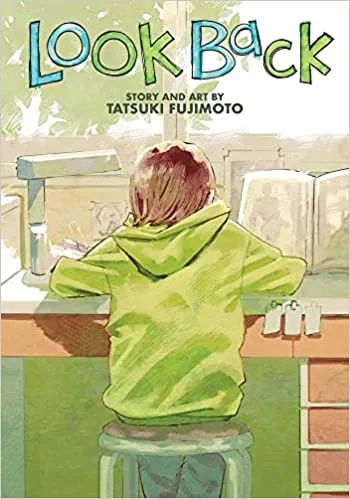
Look Back by Tatsuki Fujimoto

November 11th, 2022

Tatsuki Fujimoto is a well-known name in manga right now. Chainsaw Man is a popular Shonen Jump manga and the anime for the series was one of the most anticipated this year. And, honestly, I think the manga is pretty darn good, myself. I’ve been reading it on Shueisha’s official Manga Plus app for free, completely legitimately.

At the end of last year, the Mangasplaining crew took a look at this one-shot by Fujimoto-sensei and, as I had it on my to-read pile at the time, I bumped it up, and cried my way through it. Now Look Back by Tatsuki Fujimoto is out in print in English and I nabbed a copy at my local Kinokuniya when I saw it.

This is still a fantastic manga that you really ought to read. Read it slowly. Pay attention to the details. It’s a slim volume, and not terribly complicated in terms of concept. In fact, I’d call this a very typical “the second story a manga artist does after their series goes mega-hit and they need to write about creating manga” manga. But it is loaded to the gills with feels.

Fujino has always been told that she’s a great artist. But there is another girl in her school who is better. Look Back is a beautifully crafted tale about creating manga. It’s not a beautiful book, but is so stunningly rendered that it will hit you solidly in the gut time after time. As I mentioned in my review of the Japanese volume, there is a scene at the beginning where Fujino ugly cries that is so powerful, it will live with me for a very long time.

Content note: There is some violence at the end. It is pretty clear that this was, at least in part, written as a reaction to the Kyoto Anime tragedy. Yet another punch to the gut in a book full of them. 

I’m reviewing it, so you might expect there to be Yuri. There is not. But the relationship between Fujino and Kyomoto is lovely and heartbreaking. Just read it.

Ratings:

Art – 9 Outstanding
Story – 9
Characters – 9
Service – 0
Yuri – 0 The story is about a life-changing relationship between two girls

Overall – 9

I mean this with absolute sincerity – you really should read this volume. Just bring some hankies.

Watashi no Oshi ha Akuyaku Reijou -Revolution-, Volume 2 (私の推しは悪役令嬢。-Revolution-)

November 10th, 2022

As we all wait breathlessly for the formal announcement of an anime for I’m in Love With the Villainess, today I am looking at the Japanese print edition of Watashi no Oshi ha Akuyaku Reijou -Revolution-, Volume 2 (私の推しは悪役令嬢。-Revolution-). As a reminder, this series came out in print in English before it made it to print in Japan. So the edition you have read is the English translation of the webnovel which was put out digitally by GL Bunko. The series was licensed for print by Ichijinsha. Volume 1 of the JP print edition was reviewed here on Okazu last spring.

This will make the third time I have read this volume, having read it in the GL Bunko novel and English language editions. Because this is a new, deluxe version, with extra stories that have been written since the webnovel was initially licensed, there was quite a bit of new material tucked in between things with which we are already familiar.

There are several key elements to this content, even aside from the new content.  Lily becomes a major player on the board and we eventually learn several secrets regarding the Royal Family and their advisors. Rae explains her former life and tragic first love to her friends. Claire’s class consciousness is awakened when they visit Rae’s hometown. Manaria arrives and forces Rae and Claire’s relationship to change during the Scales of Love arc, which coincidentally completed in the December issue of Comic Yuri Hime as grandly as I had hoped. ^_^

So while the Yuri goes up significantly, with the addition of Manaria and her boyish charm, as well as the Love Scales, the LGBTQ rating stays high with open discussion of complicated queer lives, once again.

Ratings:

Art – 7 Still portraits of the people rather than the scenes.
Story – 9
Characters – 10
Yuri – 10
LGBTQ –10
Service – Rae’s obsession about Claire shifts more to her moods than her body, but there’s still some body commentary, Let’s still say 2

Overall – 9

The board is set now for what is to come. In Volume 3, what is to come will be…revolution.


Odoriba ni Skirt ga Naru, Volume 2 (踊り場にスカートが鳴る)

November 9th, 2022

In Volume 1, we met Kiki, a young woman who dreams of being the following partner in ballroom dance, but due to her height, is always assumed to be lead, and Michiru, a diminutive, but forceful young lady who wants to be Kiki’s lead.

In Odoriba ni Skirt ga Naru, Volume 2 (踊り場にスカートが鳴る) the two are still working out exactly what their partnership will look like. But in the meantime, they have their first test competition to get through – which does not go all that smoothly. Michiru passes out after they clear their test.

While they try to build something more stable between them at the dance club’s training camp, we turn our eyes towards Kiki’s former partner, Shion. She and Kiki are able to repair their fractured friendship and Kiki is finally able to step up and take Michiru’s hand fully as a dance partner. But she’s taken by surprise when Michiru asks if they couldn’t form a deeper relationship to make their partnership work. What if they pretend to be a couple…?

In a magnificent climax for the volume, the two open their hearts and begin to dance. They count the waltz steps and come together in a beautiful sequence.

This series is a surprisingly realistic look at the interior lives of young women. The drama is small and personal. No hysterics, no dramatics, but there is deep passion for ballroom dance (and what it means to be part of the Quadrille) and a wholly relatable struggle with being an adolescent girl.

Ratings:

Art – 9
Story – 8
Characters – 9
Yuri – Bumping it up to 2
Service – Nope

Overall – 9

This is, IMHO, a sleeper hit of the year. It won’t take over Times Square, but I have a warm place for it in my heart and really hope to see it in English!


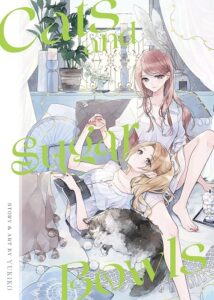
Cats and Sugar Bowls

November 8th, 2022

If you have picked up a Yuri Anthology in the past several years, you may well have encountered a story by Yukiko. This collection of several of Yukiko’s short stories from Seven Seas looks sweet, but right from the beginning, the claws are out. Cats and Sugar Bowls is a 18+ collection which includes BDSM and related fetishes. Content notes: A few of the stories are quite violent, others focus on other forms of domination and a few are rather sweet, depending on the anthology for which the story was written.

Overall, this collection is not my jam, but I would not hesitate to recommend it to someone who liked stories about dom/sub women. The art is surprisingly shoujo-like; characters tend towards cute rather than stylish. One of the strongest qualities of this volume is the characters themselves. The couples actually like one another and the partnerships seem to be based on mutual consent and attraction.

My favorite story is the final one, which was written for Cinnamon: Demihuman x Human Yuri anthology ( シナモン 人外×人間百合アンソロジー)  from Kadokawa, that pairs a priestess and a mountain god in a surprisingly gentle story.

Great job on the translation/adaptation, which manages to be sensitive and straightforward, without making anything here feel uncomfortable (there’s nothing worse than a translator whose discomfort is palpable in a translation of BDSM and yes, I have read some of those.) So thanka to Amber Tamosaitas and Asha Bardon. James Dashiell’s lettering is solid and supportive and, where it can be, is retouching, rather than just adding glosses to s/fx. It looks so much better that way. Beautiful cover design by H. Qi. And thank you to all the editors and proofreaders and technical folks that made this a smooth reading experience.

Ratings:

Art – 8
Stories – Not to *my* taste, but you may love them
Characters – 8 They know who they are
Service – Whether you consider adult exploration of domination or pain “fanservice” is up to you. But there is little salaciousness. Let’s split it down the middle at a 5
Yuri – 8

Overall  – 8

If you’re looking for something adult that isn’t all panty shots and lowest common denominator, why not give this volume a try.


Comics and the Origins of Manga: A Revisionist History

November 6th, 2022

Sometimes I com across a book that, while outside of my normal area of study, is so mind-blowing, I really just want people to know about it. Comics and the Origins of Manga: A Revisionist History, by Eike Exner is just such a book.

As a reader of Okazu, you’re probably familiar with orthodox manga history, tracing today’s modern sequential narrative art from Japan from early scrolls, through sketches of the Ukiyo-e period to (time jump) modern manga. In fact, I recently found a brand new history of manga which told that exact tale. Exner’s book stops the story and asks us to look – really look – at that time jump, and at one of the factors that shaped Japanese comicking into what we know today as manga.

The specific factor Exner focuses on is the shift from extradiagetic narrative, i.e., blocks of text – often literally-  outside the story that explain the story, to transdiagetic narrative tools like dialogue in speech balloons and sounds that both we and the characters in the story experience . Exner takes time to link together the influences from incredibly popular Western comics being translated in Japanese newspapers and magazines in the 1920s and 30s that jumpstarted the use of such tools in Japanese comics. He also discusses at length the word manga and again, covers the area that most modern manga histories gloss over, among which I include my own. ^_^

Exner is at great pains to carefully construct his argument. Again, like my own book, several of these chapters were presented or published elsewhere first, which means many of the most salient points are repeated, then built upon, until we can see how solid the scaffolding is to uphold the argument.

I found this book quite honestly fun to read; Exner’s voice is readable and friendly, with a sense of genuine conviction, rather than an argument that was made to be made. The illustrations not only helped seal the points, but I had great fun looking at the way Japanese lettering has morphed and shifted through the years. It was also quite eye-opening to see the evolution of what pop culture has considered “modern”… and, although Exner never says it, I dare say, “exotic.”

Ratings:

Overall – 9

If you have read all the conventional manga histories and are looking for something new and quite exciting in terms of manga history, I can highly recommend Comics and the Origins of Manga: A Revisionist History, from Rutgers University Press!