Galette, No. 15 ( ガレット)

September 2nd, 2020

Galette, No. 15 ( ガレット) continues the excellent work that we’ve seen all along, with names that are engraved now into a kind of Yuri Hall of Fame: Morishima Akiko, Morinaga Milk, Hakamada Meru, Inui Ayu, Morita Miyuki, Kitta Izumi and Momono Moto…

…and Akiyama Haru.

I know I sat up straight as can be when I saw that name on the masthead. It’s long enough ago now that maybe the Yuri-reading audience doesn’t remember Akiyama Haru’s adult-life series, Octave, but I sure do. A decade ago, before the current rise of Shakajin Yuri, Octave was a lovely, complicated story about complicated adult women in a complicated relationship, both professional and personal. It’s pretty exciting to see the name back and in Galette magazine, no less. It’s a good day for Yuri.

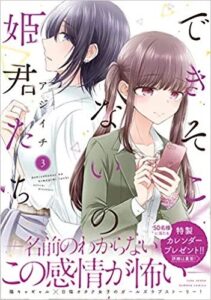
This volume is once again available in print, JP Kindle, digital on Bookwalker or digital, in Japanese on US Kindle. It has the usual lovely interior illustrations, and pen’s stylish cover art. The only thing missing from this issue is completely understandable, but somehow missed the more for that. This issue has no photography, a stark reminder that there is a pandemic out there.

Ratings:

Overall – 8

Overall, a good volume, and I’m glad to see that the hiccup that made Volume 14 a collector’s item is history. Manga artists are surprisingly resilient.

Next issue, we welcome back Amano Shuninta! You’ll excuse me, if I hope to see Takemiya Jin again soon, as well.


“What Makes A Story Yuri?” on Yuri Studio

August 31st, 2020

I am so very excited to present the newest Yuri Studio video today. One of the most common things I’m asked to do is explain when and how and why a series is considered Yuri, so today on Yuri Studio, please enjoy “What Makes a Story Yuri?”


It was a true team effort, with not only our amazing team here at Okazu – with many thanks to Louise, whose editing I rely on so heavily. This time we also have the special guest voices from Yuri Mother, LumRanmaYasha from Manga Mavericks and Sarah and Kit from TomoChoco Podcast! It was a a lot of work and a lot of fun.  This video has English-language subtitles and we’ll be adding Japanese in the future.

Please give it a like on Youtube, subscribe to YuriStudio, and if you’d like to have your questions answered in an upcoming video, become an Okazu Patron!


BL Metamorphosis, Volumes 1 and 2

August 30th, 2020

It’s Sunday, a day that we like to stretch out a little and look at things beyond the Yuri landscape on Okazu, from time to time. Today I wanted to take a look at a series that is wholesome, but isn’t really queer or even queer adjacent. Let’s call it queer tangential. BL Metamorphosis by Kaori Tsurutani, out from Seven Seas isn’t really about Boy’s Love so much as about fandom and the enjoyment of having connection with people through that fandom.

In BL Metamorphosis, Volume 1 we meet Urara, a high school girl who embraces her separateness and self-identifies as “strange” for her enjoyment of BL. She ends up introducing Ichinoi, an elderly neighborhood calligraphy teacher, into the world of BL. Almost reluctantly, Urara gains a comrade and a friend…

In BL Metamorphosis, Volume 2, Ichinoi embraces BL with a gusto that embarrasses Urara as much as it thrills her. Despite Urara’s desire to cling to being a weirdo, Ichinoi becomes a role model for Urara, as she simply refuses to be at all ashamed or secretive about her new hobby.  In this volume, there is a scene which is 100% on point for the two characters: At a comic market event, they are separated and half out of concern and half out of fear, Urara just stays put, while Ichinoi throws herself into the noise and confusion of the event happily, exploring different groups’ work without the shame Urara feels.

This, to me is a critical lesson. So many people seem to desperately cling to some wrongness they feel in themselves, and never think to just reinvent themselves at all, like Urara. And here’s Ichinoi happily opening up a new chapter in her life with no baggage at all. To some extent, we’re supposed to see this as a feature of Ichinoi’s age and maturity – she has nothing to lose by doing this, but…neither does Urara.

Almost reluctantly, Urara takes the advice of her new friend and picks up a pen to start work on her own BL story and it becomes clear to us that this was never a tale of Ichinoi’s metamorphosis at all, that Urara is the one that is stuck in her cocoon. It is Ichinoi who can fly already and Urara who has yet to grow wings. Hopefully, she’s about to start creating the Urara she wants to become.

It is very lovely to see a manga star an older woman as a lead, generally. This manga features what is being sold as an “unusual” friendship, because it spans generations, but I can attest to the fact that anime and manga fandom pretty much does away with the idea of chronological generations and instead has it’s own generations, as determined by which series was your first obsession. American anime fans are Ranma generation or Naruto generation or  My Hero Academia generation, Yuri fans can be Sailor Moon, or Utena or Strawberry Panic! or Bloom Into You, etc… generations. Ichinoi and Urara are years apart…but they are the same BL generation. ^_^

Tsurutani’s art has a  gentle quality to it.. As you know, I’m not a BL reader myself, but the art didn’t not feel at all to me to be BL-ish – which is a wholly ridiculous statement, I’m well aware. BL is of course not one style. But this feels more like an artist’s diary sketchbook, than a dramatic narrative. One expects random drawings of flower gardens and landscapes, if you know what I mean. It lacks tension, in a good way.

On a wholly personal note, setting the comic event in Sunshine City set all my “I miss Ikebukuro” bells and whistles off, so that was a joy. I remember that people mover and know exactly where those pillars are and that bench(!! That bench has seen some things) and …and…. ^_^ I can hear the noise of the comic market, as I presume, can the bulk of the Japanese audience.

This is another lovely bit of work by the team at Seven Seas. I want to especially bring your attention to the series logo, designed by Ki-oon. That is pretty fab work, vastly different from the Japanese logo, but is speaking differently to a different audience, as a different symbolic construct for a different title. The Japanese title is メタモルフォーゼの縁側, Metamorphose no Engawa, Margins of Metaphorphosis, which I think focuses on the liminal spaces of change, while the English title and logo are more about community and finding one’s self.) I give it top marks for translation and design.

Ratings:

Art – 9
Story – 8
Characters – 9, certainly Ichinose is.
Service – 0.5 The story itself has none, but it circles the discussion of BL service sometimes.

Overall – 9

BL Metamorphosis is a sweet story about finding friendship in BL fandom, but it’s also about pushing yourself out of the limitations you create for yourself. And for that, I think it’s absolutely worth reading.  What is life for, if we’re going to stay the person we were as a child all our lives?

Volume 3 in English is slated for a winter release, with a fourth volume in Japan released this past March. This June, creator Tsurutani-sensei said there is a little bit remaining of the series, as reported by Jennifer Sherman on ANN.

Thanks to Seven Seas for the review copies!


Yuri Network News – (百合ネットワークニュース) – August 29, 2020

August 29th, 2020

Yuri Light Novel

Seven Seas wants us to know that it’s almost time for the release of “reincarnated into an otome game” school comedy I’m in Love with the Villainess, by inori and hanagata.

They also wanted to remind us that Adachi and Shimamura, Volume 3 is on sale and will be hitting your mailbox in early 2021.

Via Yuri Mother, the upcoming Seven Seas release of Roll Over and Die: I Will Fight For an Ordinary Life With My Love and Cursed Sword!, will be delayed slightly.


Yuri Manga

Yen has nabbed the Adachi and Shimamura manga license, and Alex Mateo at ANN has the details.

Seven Seas hits this month’s licensing announcement with several Yuri titles. First up, School Zone, a school comedy by Ningiyau.

Seven Seas has also licensed Hero-san to Moto Onna Kanbu-san, Volume 1 (ヒーローさんと元女幹部さん) as Superwomen in Love! I sympathize with this title change as the other might play well in Japan, but yeah, The Hero and the former Middle Management Villainess would die on the shelves here. ^_^ I have reviewed both volumes here on Okazu. Volume 1 | Volume 2.

ANN’s Alex Mateo reports that A Witch’s Love at the End of the World, which has also been licensed by Yen Press will end this autumn with a third volume in Japan. I have not yet read this series, so you and I are on equal footing here. ^_^


Yuri Studio

We’re finishing up a new video for Yuri Studio that we’ll be launching this week. I decided to make this one way too complicated and our video editor Louise worked triple time to make it look good. ^_^ We’re hoping to get a few more Patrons before September to help us support this work and keep us on track for 2020. If you enjoy the weekly news report or the manga and anime reviews or our Yuri Studio videos, please support us on Patreon!

LGBTQ Manga

Via Megan on Twitter, we have news of Boys Run the Riot, a manga with a trans male lead, written by a trans man. I’m looking forward to reading that. Megan’s also offered up this interview with Gaku Keito and why he decided to come out. It’s in Japanese, but you have Google Translate.


Yuri Podcasts

Laethas and Mamma Luvs Manga talk about Viz Media’s How Do We Relationship on Yuricast, Episode 1.

I am doing a podcast, along with with Kit and Sarah from the Tomochoco Podcast today on Manga Maverick’s podcast about the Kase-san series!


Yuri Visual Novel

A spin-off of the Visual Novel Twofold, Yuri VN First Snow is free on Steam right now!


Other News

This is in no way Yuri, but the news that Sentai Filmworks has licensed Moribito: Guardian of the Spirit anime is very good. For many reasons, this anime is one of the very best I have ever watched and it stands as one of the few series I’ve seen that is significantly better as an anime than the original novel (the entire series of which I have reviewed here.) If you have not seen it, I can only make this the strongest recommendation I’ve ever made. It is really that good.

Via real-world journalist Jake Adelstein, comes this reminder that Takarazuka has recently done a production of Once Upon A Time in America.

The Yagate Kimi ni Naru / Bloom Into You encore stage production has been delayed due to the pandemic, but they are planning a live dramatic reading of a Sayaka story instead, according to the Yagate Kimi ni Naru Official Twitter account.

Let’s wrap up with this piece of news, via Mari Kurisato, Marvel celebrates Indigenous history with a landmark special, Marvel’s Voices: Indigenous Voices #1 that features native artists and writers taking on indigenous Marvel characters.


Become a YNN Correspondent by reporting any Yuri-related news with your name and an email I can reply to – thanks to all of you – you make this a great Yuri Network! Special thanks to Okazu Patrons for being an important part of the Okazu family. I couldn’t do it without you!



The Future is Always Obsolete: Ghost In the Shell Manga Franchise

August 28th, 2020

Some months ago, I took a great number of hours and watched all the visual media (except for the recent VR Noh-inspired play, which I desperately want to see…) from the Ghost in the Shell franchise. It was a learning experience and I very sincerely intended to do the same thing with the manga. 

I made my way through  Ghost in the Shell, Ghost in the Shell 1.5 Human Error Processor, Ghost in the Shell 2 Man-Machine Interface, Ghost in the Shell Standalone Complex and Ghost in the Shell Global Neural Network (but not yet Ghost in the Shell The Human Algorithm) and find…that I cannot do the same for the manga. These links lead to Global Bookwalker for the purposes of today’s musings – it can’t really be considered a review of any of these books, it’s more like an overview of all of them.

I was going to do a deep dive, as I said, but almost immediately, it was obviously impossible. Despite the pretension to profundity, there is very little depth to any of the manga, as both plot and protagonist are forced to do spins and turns so we can see the sexy parts, without the qualities of a person – or narrative – that might make those parts sexy.

Shirow’s manga is not truly a narrative…or, if there is narrative, it’s only by accident. Technological innovation to some extent has rendered his notes ridiculous, but even by 1997, “external memory” was not a complicated idea and his notes serve to distract, rather than reinforce. They explain in excruciating detail things not shown, irrelevant to the story, or merely random off-shoots of his thought processes.


Overall, Shirow’s manga is a technical manual of Shirow’s internal world-building told while flashing us with a constant ass-crotch-tits sequence. It’s like trying to learn the quadratic equation with someone waving a porn magazine in your face. You can’t concentrate on either properly. The audience for all this was, clearly, people who were enamored with Shirow’s world-building and had little to no chance for sex and were therefore satisfied by the constant disruption of “Network” world-building to enable multiple angle panty shots.


Tezuka sometimes popped little SD characters up of himself to make comments in his manga – it worked for him, not so much for Shirow who, we are frequently told is a great artist, who should not do manga. I posit that he is neither a great artist (although he is a competent draftsman) nor a good story teller, but is instead merely an “idea guy” so enamored of his ideas, that he can’t stop getting in the way of the story to tell you about them.

After the initial volume of Ghost in the Shell manga Kusanagi is, like the lesbian sex scene in that original manga, entirely performative. She never exists, except as our impressions of her existence. These impressions are reinforced by the strictly story-telling aspects of Gits 1.5 Human Error Processor, reinforced by our memories of those specific episodes from the animation. 


In GitS 2 Man-Machine Interface we can see that she is almost literally the only woman in the story, by virtue of being almost all the women in the story. In Standalone Complex, she is the sum of our memories of her, drawn by Kinutani Yu as a comic version of the television series. By the the time we reach Global Neural Network, we are seeing the memories of those impressions as their own stories…and, frankly, better for that than some of what passes for narrative in GitS 2.


The future in Ghost in the Shell is already obsolete. Cyborg body parts exist, and they get decked out with paint and stickers, our rainy neon-lit city streets are dystopian in multiple ways and also horrifically banal. We put on masks to block out a pandemic and facial recognition as we head out to get our fast food takeout and we’re bluetoothed into our podcasts, not wired through ports in our necks. Shirow’s network teeters precariously between being a religious philosophy and a technological phenomenon.  The only thing he got right is the proliferation of dangerously absurd conspiracy theories.


The takeaway from the Ghost in the Shell manga is that we’re not going to get flying cars or peaceful utopian societies, but maybe we might at least hope for cuter tanks.


No Ratings


If Kusanagi’s cyborg body weighs so much that she’d sink in water or crush a car by landing on it, how does she wear high heels?