Assorted Entanglements, Volume 7

June 30th, 2025

The cover of Assorted Entanglements volume 7. Shizuku and Saori lie in bed together in their school uniforms, both looking at their phones. Shizuku has her arm around Saori's shoulders and is looking over at her. You can see their matching gorilla phone charms hanging from their phone cases.

by Matt Marcus, Staff Writer

I ran into an ex once at the public batting cages in Arlington, VA. Well, she wasn’t really an ex, more like the other half of a pseudo-situationship. I spied her out of the corner of my eye as my then-girlfriend-now-wife and I looked for an open spot. If I were punching up this story, I would say we locked eyes through the wire fence. In a moment frozen in time, I’d be shot through with the pain of regret of decisions not made sooner, words left unsaid. My date would notice I had become quiet and distracted; I would shrug off any questions about it despite my soured mood, kicking off a downward spiral that ruins our date. But nothing so dramatic happened; we simply found an open cage, hit some dingers, and had a lovely rest of our evening.

In the previous volume of Assorted Entanglements, Shizuku was rattled by seeing a woman we haven’t seen before while walking Saori back to her house. Saori noticed, but couldn’t bring herself to ask. Turns out that the garishly-dressed woman is Shizuku’s ex.

A notable amount of Assorted Entanglements Volume 7 is dedicated to Shizuku’s past with this woman, Miki, and what Saori decides to do in response. This is the most seriously dramatic tone that Mikanuji-sensei has gone for in this series and I think that it pays off. We thankfully get no more detail about the abuse she suffered from her parents (and the violent reaction that landed her in juvvie), but her story with Miki, a hairstylist who took Shizuku in after she ran away from her foster parents, is tantamount to grooming. We don’t know much about how Shizuku extricated herself from that relationship or how she feels about it now (though she still wears her hair with the cornrows that is Miki’s personal style), but the effect of the encounter in the present makes her retread into her prickly Bad Girl shell.

Thankfully, what could prove to be a setback in “progress” turns into the opportunity for Saori to finally admit her honest feelings–that despite all her bluster and dismissal, she does indeed love Shizuku. Shizuku tacitly accepts this, and another ship sails. To be honest, I’m still iffy on the recurring theme that these so-called delinquents (read: abused young women) who have severe self-worth issues need to be whipped into shape by the normie girls/women who happen to love them. If I am being charitable, I’d highlight that the point being made is that they (Shizuku and Minami) are indeed worthy of the love they receive, which is good and true. I just wish they weren’t punished by their lovers for struggling with accepting affection.

Let’s not forget that this is still an ensemble story. Iori and Minami are up to their normal hijinks (this time they go to an onsen!). We get one short chapter of Sugimoto at her part-time job glowing about her aquarium date and not taking heed of her boss’ advice not to get her hopes up. Unfortunately, Heke-sensei and Shinohara-san finally succumbed to Mikanuji-sensei’s love of “slapstick” violence for one gag, but otherwise their chapters continue to be a sweet love story of a failgirl nerd and her blunt-but-secretly-tender lover/boss. It’s all solidly entertaining stuff.

If you have been waiting, nay, shouting at the pages for Shizuku and Saori to finally just get over themselves and have it out, then you will be pleased as punch here. With 3 out of 4 couples established, that leaves one last problematic pair to wrap up.

Art – 8
Story – 8
Characters – 8
Service – 1
Yuri – 8 / LGBTQ – 8

Overall – 8 Somehow made me “happy” for the worst couple here

The story of these mismatched women continues in Volume 8, coming our way in August.

Matt Marcus is a cohost of various projects on the Pitch Drop Podcast Network, as well as the writer for the blog Oh My God, They Were Bandmates analyzing How Do We Relationship in greater depth.


Young Ladies Don’t Play Fighting Games, Volume 5 & 6

June 27th, 2025

Volume 5 cover. Tamaki, a girl with light brown hair and yellow eyes stares at the viewer, tears in her eyes, looking stricken. It’s Luce with the ‘2’ of the 1-2 punch of reviews, so let’s get down to business on the series that can be best described by removing the ‘don’t’ in the title. Volumes five and six, memorise your combos and hit player select!

Well into the tournament by Young Ladies Don’t Play Fighting Games, Volume 5, Aya, Mio, Tamaki and Inui all have their battles to play, and hopefully win. Into the second pool battles, the opponents are more difficult. Mio is 1-1 against Cafe au Lait, a pro-gamer with a grudge match he wants a rematch on. Aya is in the same position with his previous opponent, Gekido, and struggling to keep her composure. Inui is trying to get the vitriolic kid Arisa to eat her words through the screen, while Tamaki battles her demons – or rather, her sister.

In Volume 6, Mio faces down Arisa in the loser’s bracket… . But, due to a viral tweet about her previous match, it’s been moved to the main stage! Who will win, between Mio fighting on instinct and Arisa with rage?

Do not smack yourself in the head with a game controller. Aya and Mio did break through a window escaping detention, so they clearly have anime sturdiness, however! Despite how metal it might look, it is not a proven strategy for… anything. Other than a trip to hospital with possible concussion. Also, never, ever tell people to ‘kill themselves’. Even in the heat of tournament. It makes sense for Arisa’s character and shows her immaturity, but even still. Just don’t. (The commenters are clearly shown to also disagree with her, so there is push back in canon). Sorry, had to get that out of my system. Onwards.

It’s somewhat odd to have the girls in a more anime style, and then most of the men in a more realistic style. That said, it’s nice to have ‘not perfect’ looking characters? Some characters that look closer to how Japanese people look? I just wish this could be extended to some of the women. Although the implications that those drawn in a more manga style are the prettier ones, so… I do like the art, it just stuck out more in these volumes, where we have a lot of different people commenting.

Volume 6 cover. Girl with bright green eyes and reddish brown long hair elaborately braided at at the top, Arisa glares at the viewer, tears in her eyes and looking frustrated.

Speaking of the art though, the rage faces in this area off the charts. Arisa is just a small ball of rage, all of the time. Her back story is probably pretty relatable to anyone who’s tried to connect with someone over something and had it gone badly. Gosh, she was just so desperate to impress Miyu, but it backfired. It’s really difficult as a kid when you’re good at something – most normal adults would be able to go ‘it’s impressive you’re so good at this’ and any jealousy is (should be) kept behind the eyes. For kids though, that’s a lot more difficult. In Miyu’s eyes though, I can see how she thought Arisa had flat out lied to her. I hope they get some resolution, actually.

The match between Mio and Arisa is just absorbing. Between the commentary of the crowd and online (I particularly like ‘nani the fuck?!’ as a comment) and their thoughts, it felt engaging in a way I haven’t felt with the other matches. Part of that is that we know a bit more about these two, and why they play fighting games, but it’s also panelled really well, flitting between them, the crowd, and the commentators without losing focus on the action. The visual of being underwater, not breathing, just living completely in the game works fantastically. I won’t spoil who won, but if you have enjoyed the series so far, volume 6 is the peak of the fighting game action.

Outside of this, Aya gets some of her gayest lines in these volumes. ‘I want to mean more to you than anything else’. If this series doesn’t have a moment where Aya kisses Mio in the heat of victory/defeat, I’ll be disappointed. That said, Aya has some thinking to do, when seeing Mio and Arisa’s match, and realising that she might not be Mio’s biggest rival, and being really upset by that. I want gamer girlfriends by the end of the series, dammit! Is that too much to ask?!

Ratings:

Story: 8
Characters: 8
Service: 0
Yuri: 9

Overall: 9


Volume 5 was good, but volume 6 was great. If you’ve enjoyed any of the series so far, highly recommended. In the imMortal Kombat words, Fatality!


Rainbows After Storms, Volume 3

June 26th, 2025

A tall girl with long blonde hair and a short girl with short dark hair that frames her face smile at one another. They wear matching white sailor-style school uniform blouse with blue collar.Exams, summer break, sleepovers, birthdays. High school life is both chaotic and relaxed for Chidori and Nanoha in Rainbows After Storms, Volume 3. 

This summer, they are both devoted to having fun and making memories, so their prioritize a group sleepover at Nanoha’s house with the requisite number of underwear discussions for a not-really-shoujo manga about girls. Despite the fantasies of those in charge of this manga fantasies, girls, who are mostly mortified that they have bodies at all, hardly ever discuss underwear. 

Chidori and Nanoha go on a date. They are impossibly adorable.

We are told, repeatedly that they are keeping their relationship secret, but in Volume 4 that faced is no longer really credible. In fact, I read this volume this time thinking that their friends are gently trolling them, because the lead-ins to Nanoha and Chidori stuffing their hands in their mouths, felt way too on the money to be accidental.

The art and story here are gentle, silly and just a little banal, presumably to create a soft nostalgic feel for the presumed readership. It makes for a very fast-reading volume, as nothing unusual or complicated is going on. This story is exactly what it appears to be, a high school love story between two nice girls. 

And then the final chapter shows up, throwing that whole last sentence out of the ring.

In an earlier volume Chidori has indicated that Nanoha is not her first love. And she looked clearly pained at the memory. In the final pages and older girl is seem arriving on a train, confidently, perhaps even arrogantly, wondering how her kouhai is doing…. and we know immediately that this woman is Chidori’s sempai. And…we already don’t like her. Something is about to happen.

What will the next volume bring? Well, Rainbows After Storms, Volume 4 is already out from Viz Media so don’t wait to find out. ^_^

Ratings:

Art – 6
Story – 6
Characters – 6
Yuri – 3
Service – 4 Underwear, bras, etc.

Overall – 6


A Tithe in Blood

June 25th, 2025

A woman with long silver hair wearing a yellow kimono, holds hands with a woman with long, dark-hair, wearing a blue jacket over a white blouse, as they lay head to head in opposite directions.by Ashley P, Guest Reviewer

As I desperately try to get more of my friends to try out visual novels I often emphasise the ‘novel’ part and not really mentioning or even reducing the ‘visual’ part. This is a bit of a disservice because some of the most affecting visual novels I have read have merged both fantastic prose to the rhythm of matched visual elements such as sprites and artwork to create an experience that matches the fun of any comic or puppet performance. I’m not talking about just having good art or sprites, but using those visual elements to create a feeling unique to the medium.
A Tithe in Blood is a recent new visual novel from Studio Élan and it is easily their most visually appealing game yet. Showing a levelof craft that I wish more games would strive for.

Asakawa Honoka is a Sapporo resident and university student who has tragically lost her family. Her despair and loneliness has led to an obsession with the blood magic writings of actual Renaissance poet Isabella di Morra. As long as she is willing to spill her own blood, Honoka can journey to seemingly Meiji era Sapporo and meet with the kind and graceful performer Yasue.

The withdrawn and depressed Honoka finds herself inexorably drawn to the sociable Yasue who performs whole kabuki plays on her own thanks to her incredible illusion magic. But to visit this alternate Sapporo, Honoka must pay a very literal blood tithe. This frequent bloodletting puts such a strain on her body that Honoka’s life continues to deteriorate even as she falls deeper in love with Yasue.

This enmeshment of both the healing power of connection after grief and the draw of control that self harm can bring is the core of the story and it is what gives Yasue and Honoka’s relationship so much bite. Honoka is so clearly happier when she is with Yasue but the only way to see her is for Honoka to hurt herself.

So often in stories about self harm the reader is not given a way to understand how this fundamentally bad idea can be so seductive. In A Tithe in Blood the whole yuri we are here for comes with a clear cost to our main character.

The high definition artwork and fantastic sprite direction that makes every interaction between Honoka and Yasue so wonderful is also used to show us Honoka’s scared arms. The perfect use of sprites and high definition artwork used to show Honoka and Yasue walking together in a cute scene is used to show the painful magical journey Honoka took to get there.

If that was the full story of this novel then I would have nothing but praise. The only issue is that the above is only about half the story of A Tithe in Blood. This is not bad in of itself. The other part is more of a magical underworld/detective story staring three other characters hired to observe Honoka. We get a beta couple in Tatiana and Kaoru, along with another narrator in Shino. I have no complaints about these characters, in fact, they are so charismatic I hope there is a sequel with more magical detective shenanigans with everyone. The downside is that the theming from this half that is more of an urban fantasy, does not match with Honoka’s story. If anything it reduces Honoka’s pain and it plays up misunderstandings between the two groups in ways that detract from the drama rather than intensify it.

Other than that though this is easily the most beautiful visual novel ever produced by Studio Élan who I hope continue to raise the bar into the sky.

Ratings:

Art – 9
Story – 6
Character – 8
Service – 1
Yuri – 9

Overall – 8

I truly hope we get a sequel or spiritual successor to A Tithe in Blood, so that the team can really show off what they are capable of.

Thank you very much to Studio Élan for the review copy!


Though I Am An Inept Villainess, A Tale Of Two Privileges

June 22nd, 2025

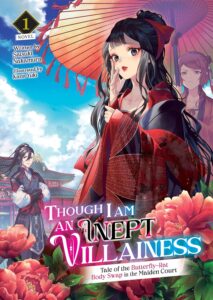
A girl in red and black "ancient Chinese"-styled robes, under a parasol looks at us, while another young woman stands behind her looking disapproving. Off to the left a handsome young man in a black uniform watches, his arms crossed. In the foreground are pink flowering plant,s the background is a Chinese style building.CW for this series and this post: Trauma, chronic illness, emotional and physical abuse.

A few months ago, on the recommendation of my dear friend, excellent reviewer and Sr. YNN Correspondent, Sean Gaffney, I picked up Volume 1 of Though I Am an Inept Villainess: Tale of the Butterfly-Rat Body Swap in the Maiden Court light novel series written by Satsuki Nakamura, with illustrations Kana Yuki, published by Seven Seas Airship as something to read on the plane to visit my mother.

Later, I found myself sitting in the bathroom on a plane, sobbing uncontrollably.

Since that moment, I have wanted to write about this series, but have not had the time. I expected to wait until Volume 9 landed in English (since the series tends towards two-volume long arcs, I was holding off reading Volume 8 until 9 came out), but I find myself today with an unexpected bit of leisure and want to get my thoughts down. Even now, so many months removed from that initial reaction, I find myself overflowing with hopefully not-entirely-inexpressable things I want to say about this series. These notes are not specific to any volume but are based upon my reading of Volumes 1-7 of the light novels.

In a fantasy Chinese-ish rear palace, i,e. harem prison, the consorts of the Emperor and their protégés vie for the Emperor’s and Crown Prince’s favor, blah blah blah. Kou Reirin is the unquestionable favorite to become the next Empress, but Reirin is chronically ill and weak to the point of being unable to do the activities that are required of her. As a result of being forced throughout her life to rely on others for so much, Reirin pushes herself constantly in everything. When she is well enough, she practices dance and martial arts, when she is not she sews and does calligraphy. Every moment she is able to sit up she hones skills and is always as kind as possible. Reirin is universally beloved for her dance, her embroidery, her writing and her generous nature.. 

Across the Inner Court is Shu Keigetsu, despised by everyone for her lowly upbringing, her lack of grace and talent, and her unpleasant personality. In a rage, Shu Keigestu uses magic to swap bodies with Reirin. Keigestsu quickly learns that, yes,  while being respected and loved is a privilege, so is having a healthy body. Reirin, having spent her lifetime captive in a body that was capable of little, suddenly finds herself unfettered. Exiled to a corner of the court as Keigetsu, Reirin find herself in a body that is strong and healthy. She sets out to make herself a life of almost complete freedom through hard work, study and a little luck. 

This swap sets in motion events that will radically change the Inner Palace in ways that no one could possibly expect. 

Sean suggested I would enjoy these books as they are centered on the relationship between two women who are not just intimately – emotionally and physically – intertwined, but who find that they need one another. And I did indeed find that. But I also found a story that touched some deeply felt emotions in my own life. 

I know I’ve talked about it from time to time here, but let me be plain – I am chronically ill and have been my entire life. Like Reirin, every day is a goddamn struggle, and I’m very lucky to have the level of ability I have, which often means I pass an able person. I’m not. I never will be fully able. Like Reirin, I practice martial arts, and I exercise to the best of my ability every day. I practice those things I can do in order to keep my mind as sharp and proficient as I can. (Some of you may remember my struggle with Long Covid which robbed me of cognition and memory. I have worked incredibly hard to be here today, although my memory will never be the same. Like Reirin, I am often forced to and often privileged to be able to, rely on others. I thank people profusely and try to pay it forward for those reasons. 

So, when Reirin was delighting in a body that, for the first time in her life, was able…it hit hard. I felt every single thing she felt deep in my gut. I knew exactly how I might feel if suddenly given a body that just…worked.

Conversely, as screechy as Keigetsu is, I understood her shock and consternation at suddenly being in a body that simply can’t. I know the feeling well. I’m often shocked at how much this body simply cannot.

Even after this emotional volcano, I kept reading the series, which is very well written. While I very much enjoy the current blockbuster novels of  Apothecary Diaries, Inept Villainess is superior in writing skill.

Fantasy Chinese-ish court dramas are  all the rage now, but for any woman watching, the setting is unsettling at best and could be triggering. Abuse and trauma are commonalities of both series, which make some of the arcs hard to read, but so far worth it in both cases. The complexities and politics of the Inner Palaces in Inept Villainess are interestingly complicated and often rather real-world horrible. I could not for a second imagine this series being interesting to a young person, even beyond the fact that before I let a teen read it, we would have to have a long conversation about women being treated as chattel.  

But I did say that there are two kinds of privilege in this series. One, obviously, is physical ability which is easy to understand. The other is so much harder to capture in a single concept. “Systemic bias” might be as close as I can come. Mental wellness is another way to look at it.

Keigetsu is treated as lesser because of social status, yes, but she is also groomed through emotional abuse to become a hateful figure, a person meant to cause pain and hardship in order to eventually serve as a scapegoat.  Her mentor is setting her up for failure from the beginning and Keigestu, although not an innocent, does not have the tools to understand what she is experiencing.  I felt that this was a clear reminder for us that behind every apparently screeching Karen is very likely a lonely and angry person who life is spiraling out of control for reasons they might not even be aware of.  Yes, Keigetsu is abrasive, but she was trained to be. Yes, she is demanding and capricious, selfish and angry…but she was not expected or assisted to not be these things, as they suited someone else’s narrative. And she was abused into becoming the person she is, through emotional manipulation and physical abuse.  So what she sees as Reirin’s “privilege” of being openly and nearly universally respected, is something Keigetsu was not allowed to imagine for herself. The result is a childish understanding of what Reirin’s life must be.

Who among us has not fallen victim to envy at the apparent golden child of school, or work or community? That person who seems to be consistently given permission to do or say anything, who is always forgiven, who always get favors. It’s hard to not be angry at that or want that for one’s self. Keigetsu’s desire to live that apparently easy life, unloved and unliked as she is, is wholly understandable. What might not be as understandable is Reirin’s refusal to be envious of healthy people and her unbridled rage when she can no longer hold that in. Even as I type, I rage with her. Wishing for health is an oubliette into which I cannot look.

While this is in no way a Yuri story, not even if you squint really hard, the bond between Reirin and Keigetsu is undeniable. By Volume 7 it is something that cannot really be described as “friendship” or love or really by any one word. They have literally inhabited each other’s bodies and lives. Reirin has gained brief respite of ability and health, and the ability to move ignored by the rest of the court. Keigetsu has gained access and the power to command. Thus far, Reirin has come out on top, but Keigetsu is beginning to learn to control her powers and her confidence is growing slowly but surely and healing is in her future.

One hopes that they will ascend to the throne together, hand in hand.

Ratings: 

Art – 7 I mean, it’s fine. The anime teaser art looks nicer, frankly. Light novel illustrations really are just so pointless. 
Story – 9 Very good and it’s getting better and better as it goes on 
Characters – 9 Same
Service – A bit here and there, and the boys are stripped down a bit, too
Intimacy – 10

Overall  – 9

Because of my own deep emotional connection to the series, I probably am going to skip the upcoming anime. I really don’t think I can sit through it. But if you do, let us know what you think on the Okazu Discord. I do however highly recommend the novels, with the caveat that if you, too, are chronically ill or disabled, maybe read the first novel somewhere where you can scream loudly or punch something or cry. Not a plane. ^_^;