Jormungand Manga, Volume 2 (English)

April 28th, 2010

In Volume 1 of Jormungand, we determined that this series is a fun, sometimes funny, light-hearted look at an occupation with is not at all funny and very definitely full of dark hearts, dealers of arms. In Volume 2, it’s more of the same.

There’s a certain amount of philosophical rambling I’m willing to put up with in stories of people with no ethical underpinnings. It’s interesting to watch authors struggle with the “why” someone would do something so awful and interesting to see that they often have to create a kind of cheerful nihilism to explain it, so that their characters remain likable while slaughtering people. It’s an interesting set of hoops that I have also occasionally jumped through – no less interesting when I have been jumping through them. How does one create damaged goods that are still charming? Well, first, you give them a philosophy that precludes selfishness. They must not just be in it for what they can get, or we won’t give a shit. Then you bond them into a team that not only takes care of one another – they must like and respect one another, so we are assured that they have some humanity left. Then – and this is the most important part – give each of them a moment of honest frailty and a sense of humor about it. Without the sense of humor about their frailty, they become a tragic figure. And the moment that happens, they must die.

Jormungand‘s cast has all these things. They are loyal, they don’t have noble ideals at all, but they are perfectly aware of what they do and why and what it really means – which is nothing at all. They don’t live in the center of their universe. They are a team that respects and likes one another and because Koko doesn’t take herself seriously, they are relived of having to take themselves seriously. Because Koko likes Jonah, they all rally around him as a surrogate family. Koko is the center of their universe and ours. They live or die by her command and we enjoy this story because she enjoys being in it. Without that, our interest would die.

I am pleased that Valmet has a delusion about being in love with Koko, because it allows me to review this manga here. I’m also pleased that she’s not shy about it, because it serves the plot that she is not. I am perfectly content that it is one-sided, because it is amusing without asking me to commit any emotional resources to it.

Like Dogs, Bullets and Carnage and Black Lagoon, the story will sometimes examine a piece of the damage that makes up the past of the one of characters, but is strongest when that’s thrown that aside for an equipment jargon- and obscenity-laced, physics-defying fight. That is why we read it. To have the  fights that we cannot – to be the hard-assed, highly-skilled killers that we can never be (and really don’t want to be, but it feels good to sometimes think about it.)

I like Jormungand and not at all despite myself. I grew up on a steady diet of action flicks and adventure books. This is the kind of stuff I choose to read when I am free from reading horrible ecchi Yuri romances that make me want to sob, because they fail on every level of storytelling. (What I would give for Komari to return to the dorm in Gokujou Drops with one of Koko’s guns and resolve the matter of the ongoing sexual harassment permanently.) This manga is a rollicking adventure story, where the bad guys are the good guys and there are no good guys and no one wins.

Ratings:

Art – 7
Story – 7
Characters – 8
Yuri – 3
Service – 3

Overall – 8

Whether you read it for the amusing attempt at philosophical discourse, the Yuri, the humor, the action or the exercise in trying to make killing people not so bad in your head for a little while, Jormungand is stupid. But it’s fun stupid and that’s all that matters.


Azumanga Daioh Manga Omnibus (English – ADV Edition)

April 26th, 2010

I swear to you that this is true. Last week I said to myself – y’know, I haven’t read Azumanga Daioh in forever, let’s crack open the old Japanese editions and re-read them. And that afternoon, the English-language Azumanga Daioh Omnibus was delivered.

Do you know, I have never read the English edition of Azumanga Daioh? Well, not entirely true – I scanned the first volume when it first came out, shuddered with distaste, and didn’t buy it. I understood why ADV made the choices it did. And in many ways, I agreed with those choices, as they made the manga more accessible to a wider audience outside the core fandom. By calling Yukari-sensei “Miss Yukari” and when the students called her Yukari-chan, “Yukari baby,” they would make it easier for a non-manga fan to follow the comic. I never disagreed with their choice. I just didn’t enjoy it for myself.

Once again, allow me to clarify – I do not believe that fans want “literal” translations. What we want is an authentic reading experience. This is a subtle, but critical difference.

A literal translation of an idiom won’t kill us (unless it’s a particularly bizarre or obscure idiom. For example,  try thinking of a cute way to translate “pig in a poke” to another language.) It doesn’t really matter if you write “staring off into the middle distance” or “staring off into the day after tomorrow.” Readers will get it, whichever way you chose.

However, Kaorin is a nickname,  and therefore doesn’t really need to be translated. It’s more authentic just to leave it. We have nicknames – we get it.

Why honorifics? Because Yukari-sensei, Yukari,  and Yukari-chan all mean completely different things. It’s perfectly respectable for her mother to call her Yukari-chan and perfectly not respectable (or respectful) at all for her students to do so. As ADV learned, when we all wrote to tell them so. And they listened, as we can see with the lovely translators’ notes, explaining the choices made (and the personal touch they provide) for later volumes.

Azumanga Daioh manga was the first real battlefield where this particular war was fought. The fans have mostly won this now, although there are still pockets of resistance among publishers. Ironically, one of the few instances left that *really* bugs me is in Yotsuba, by the exact same author. “Miss Stake” would only have been good localization if the character’s name was “Chigau.” “Shimau” is a form of the verb “shimasu” and as a result, the choice of translation is irrelevant and annoying. But not to the mythical people who read manga who know nothing about it, might potentially walk in off the street and grab Yotsuba off the shelf because it’s cute. They won’t, because they don’t exist and Yotsuba, which is wonderful and deservedly won all sorts of award nominations, is buried on the far right bottom corner of manga shelves because manga is shelved alphabetically by title, where no one who isn’t looking for it will ever find it.

Ahem.

I digress.

So, anyway, ADV caved and as a result, later volumes of the English adaptation were much less irksome. And, interestingly, as ADV was carving a tighter niche in translation/localization, the artist was doing the same thing with his art.

As a result, reading the omnibus volume of Azumanga Daioh, the manga, is like a little historical retrospective of both ADV’s learning curve and Azuma Kiyohiko’s.

I enjoyed it thoroughly.

Many times I find myself laughing out loud – at 4-koma comics? Is it possible? Yes – possible and probable in this series. I can say just about anything and it’ll make you smile – “Get out of the way, Oji-san!” or mention an iriomote cat named Maya or anything Osaka ever says or, heck, just hold out two evenly broken chopsticks and say, “hehhh.” And you’ll laugh.

Because where most 4-koma comics are amusing, Azumanga Daioh is *funny.*

The absolute best part of this volume is that I cannot *wait* to donate it to my local library. I hope that many people will take it out and enjoy Chiyo-chan in a penguin costume and The Red Raccoon Dogs in gakuran and the Morons.

Oh wait – that’s the second best thing about this volume, The number one best thing is that we have a new Okazu Hero to add to our list. Thanks Kevin R. for your support of Okazu and sponsorship of today’s review! Email me so I can send you your Okazu hero’s badge and my thanks to you personally.^_^

Ratings:

Art – starts 5 evolves to 7
Story – 8
Characters – 9
Yuri – 4
Service – 4

Overall – 9

The manga industry has come a really long way since Azumanga Daioh and so has Azuma’s work. But it’s still hard to top this series for belly laughs.


Yuri Network News – April 24, 2010

April 24th, 2010

While I enjoy the delights of Pittsburgh’s Comic Con, you can enjoy the delights of *not* being at Pittsburgh’s Comic-Con!

Yuri Manga

YNN Correspondent Erin S. wants us all to know that Comic Yuri Hime will be going bimonthly. (Insert obligatory “bi” jokes” here.) This is excellent news on all levels.

And YNN correspondent Sean G gleefully points out that Adam Arnold of Seven Seas wrote about plans for Hayate x Blade and why Strawberry Shake Sweet never got over here on the Shoujoai-Archive Forums.

I’d like to take this opportunity to once again address the issue of fan paranoia. Companies are NOT out to get you, screw you or otherwise do you in. Please, I beg you all, stop assuming the worst of every company. There is no company in the western manga industry that is doing anything other than doing their *very* best – with exceedingly limited resources – to bring you manga to read. Support them, stand by them, give them encouragement. Assuming the worst of them all the time is horribly disheartening to the people who are trying hard to do the best they can. Seven Seas has been honest, friendly, approachable and their quality has been top notch from beginning to end. They are also a business, so of course sometimes they will make decisions you don’t like, but I can guarantee that are doing their best to publish what they think you want to buy. Making them your enemy is weird and delusional. (Note to the extra frothy commenters that will follow this statement – seriously, it’s you. If you are getting THAT worked up about being denied something that is a comic book…it’s you.)

I completely forget to mention that a new series started in Ultra Jump that has some Yuri-service. It’s called “Sayonara Summer” and I think the service will be a regular feature, as the female protagonist professes to like girls. And she has some serious issues with baseball, as well. It looks interesting – if it becomes something worth watching, I’ll make sure to point it out.

Erin S. also want to make sure you know that Yotsuhara Furiko’s Sleeping Beauty is available for your reading pleasure.

The third volume of Watashi no Taisetsuna Tomodachi by Hakamada Mera is also out. One of the odd things about Mera’s work is that I always forget that she’s got all these series out there and then am surprised all over again when they pop pack into the news report. :-)

And I’m sure that someone is interested in knowing that the third volume of Creo the Crimson Crisis is available.

And I’m not sure if I told you that the Shoujo Yuri anthology will be getting a second volume or not. Well, it is. And this one will include stories by Kitao Taki and Mitou Kana, also known as Sakuraike, so at least two stories will definitely be good. :-) If there was anything that might tempt me to buy another volume – that was it.

***

Yuri Anime

Media Blasters is streaming dubbed episodes of Magic Knight Rayearth on Hulu. They already have Ikkitousen available on the video streaming service. Go Media Blasters! Work those properties, you sexy thangs.

I started to watch Seikon no Kwaser, but when I started tasting bile, I stopped. Guest Review fodder if ever there was.

Yuri has also reared it’s gothic head in the newest Precure property, Heartcatch PreCure. There’s definitely *something* between Dark Cure and Cure Moonlight. I like to pretend it’s a relationship. :-)

A new anime for this year, called Tamayura, has some serious potential, as well. It’s been on all the Yuri lists, has the staff that worked on Aria and Satou Junichi for a director. In a waterfront town, a girl who loves taking pictures, ends up taking a picture of a fairy-like girl and her life is changed. It sounds sweet, and the buzz is that the Yuri will be a major-ish part of the story.

***

Snatches of Yuri

In Literary – Mikaze High School Literary Club, the Belles Letters club of a school includes and encourages all genres – including BL and GL. The art kind of put me off, but I think I’m going to give this one a try.

YuyuShiki, Volume 2, is a 4-koma with skinship and possible actual Yuri interest. Volume 2 seems to up the level somewhat.

***

Other LGBT News

In what I think surely must win the “Whuh…?” Award this week, Archie Comics has introduced a gay character, Kevin. Just to add to the “Whuh…?” factor, he comes out first to Jughead. In my childhood, Jughead would have responded to a comment like, ‘I’m gay” with something high-larious like, “Well you sure seem happy to me!” but that’s an ancient Jughead. This one cleverly plans to use disinformation to shame Veronica. How 90210 of him.

***

That’s a wrap for this week.

Become a Yuri Network Correspondent by sending me any Yuri-related news you find. Emails go to anilesbocon01 at hotmail dot com. Not to the comments here, please, or they might be forgotten or missed. There’s a reason for this madness. This way I know you are a real human, not Anonymous (which I do not encourage – stand by your words with your name!) and I can send you a YNN correspondent’s badge.

Thanks to all of you – you make this a great Yuri Network!


Garo Exhibit at the Center for Book Arts

April 23rd, 2010

Garo was an experimental, independent manga magazine that ran from 1964-2002. The Center for Book Arts Exhibit covers the first decade of publication.

I attended the exhibit with manga artist Rica Takashima, who provided some interesting perspective on this influential magazine during it’s first decade of existence.

To understand where we are, it’s important to see where we’ve been. The Garo exhibit allows one to see and experience the turbulence of the 1960s and early 70s through the eyes of young Japanese artists. Intensely personally narratives, side-by-side with historical drama and tales of the eerie, provide a fascinating insight into a formative period of independent Japanese manga art.

Rica and I spoke about the magazine and about our lives as we walked around the space.

ELF: What are your impressions of Garo?

RT: I first encountered Garo when I was about 10 years old, in a book store. Manga artist Tsuge Yoshiharu was very popoular at the time, so I wanted to try it. It was very strange and weird – which was attractive to me. I tried to read it, but I couldn’t understand it. I decided to try again in a few years. When I was in middle school, I bought a few issues, but again, I really couldn’t understand it. I tried again in high school, but at that time June magazine was beginning to be published, and I ended up reading that instead. At that time, there was a New Wave in music and also in manga. Punk and New Wave music magazines were strongly linked with manga. Like Nagai Go’s work in Heavy Metal magazine, it shifted the focus of manga into new territory.”

Standing in front of a case that showed covers of the “Legend of Kamui,” we realized that, as groundbreaking as Garo was, we had no idea that it featured “Legend of Kamui” and some of Mizuki Shigeru’s “Kitaro” stories as well as the more well-known gekiga artists like Tatsumi Yoshihiro.

“Because I was so young when I tried to read Garo,” Rica said, as we observed many pages that showed violence against women, “I didn’t understand it, but it scared me.” Even though these manga stories were meant to be seen as non-pori – non-political – as adults we couldn’t fail to see the gender politics built into them.

We looked at stories that chronicled the Vietnam War protests in universities across Japan. “Something always blew the protests up into riots. At the time, I wondered why people couldn’t just calm down a little, but there were riots all the time in the news,” Rica said, pointing out an image that an American might think showed riot police, but in Japan represented the student forces, armed with a sword and wearing a helmet with a face shield. “To me the protests seemed so weird, since the college students were angry about different things, like Vietnam and the American presence in Okinanwa, but they would become the same thing.” We agreed that it’s human nature to conflate issues and anger at change becomes anger at many other things.

There were few women who contributed to Garo and only one regular contributor who was a woman. Both Rica and I noted that sex was a prominent theme – not surprising for a magazine created by young men. But the boy’s club atmosphere began to wear on us, as we realized that stories of female experience were mostly absent. Even in scenes where pro- and anti-Vietnam arguments were presented, the absence of women in the conversation was pretty noticeable. Curator Ryan Holmgren mentions “how, despite its commitment to political activism between 1964 and 1966, its continuing sympathies with the left until about 1970, and its experimentation with form and theme, Garo was highly regressive when it came to gender and sexuality issues, more and more so in the early 70s. “

As Rica and I walked the room for the second time, we talked about how Garo was chronicling what I think of as my “shadow childhood.” These events were all happening, I said as I pointed to a copy of Abandon the Old in Tokyo, while you and I were alive. Watergate, Vietnam….but we were very young, and so while it was always there, we weren’t old enough to understand. These are the stories of the shadows behind our youth. She agreed.
Surrounded by the past, we both are of a mind that that this is the best of all possible times to live – we still have access to the roots of manga, we can enjoy the present and we can look forward to a future of new stories that have yet to be told.

The Garo exhibit was small – but the conversation we had there was huge. If you are at all interested in manga, in independent art, in the way that past and present connect through books, printing and/or art, this exhibit comes highly recommended.


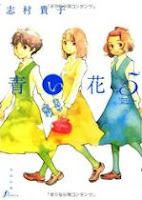
Yuri Manga: Aoi Hana, Volume 5

April 22nd, 2010

You know the 5 Stages of Death? Well, Coming Out also has certain stages. 1) First, you have to admit to yourself you are /fillintheblank/. 2) Then you admit it to someone close to you. Just one person, because your sure it’s going to turn them against you. 3) Then you admit it to someone else – sometimes a perfect stranger, because that’s safer than family or friends. 4) The biggest hurdle is vocalizing it to your family. If that stage is not horrible (and for many people it is,) you start becoming more comfortable with the whole thing, until the final stage 5) Acceptance. For that to happen you have to accept yourself. It’s a bonus if the people around you accept you too, but it’s most important that you accept yourself.

In Aoi Hana Volume 5, Fumi has made it past the third stage. And really, she’s not sure how she got there. But it’s okay, because she’s well on her way to accepting herself. And she’s also already incredibly strong, although she doesn’t yet realize it.

It’s once again time for the Drama Club to put on their play and emotions are running very high. Despite themselves, last year’s first-years are turning into rather mature second-years that are admired by the new students. Kyouko stuns people with her performance in Mishima Yukio’s Rokumeikan. (The link is to the collection of plays in which Rokumeikan is included.) Even Akira, who comes down with sudden nerves, finds herself caught up in the moment and shines on stage.


Haruka learns that Fumi, too, is a lover of women, and we follow a flashback when she learned of her sister and Hinako’s relationship. When Fumi meets Haruka’s sister, she is keenly aware – and a little jealous – of their comfort level with each other.

Even Mogi’s clandestine relationship with Akira’s brother is noted.

Everyone is growing up.

I only wish I had “met” Fumi when I was young. I could have used a media representation like her.

With vacation planned and old flames coming back into the story, Volume 6 promises to be full of fireworks – can’t wait!

Ratings:

Art – 8
Characters – 9
Story – 9
Yuri – 5
Service – 1

Overall – 9

Does *anyone* like Chizu? The more we see of her, the less I like her.